Summary

Health data is the most sought-after data in the world for cybercriminals. Financial, business and patient records are lucrative on the dark web which keeps bad actors coming back for more. One step to mitigate risk is to decrease the data footprint of legacy EHRs and servers by decommissioning the vulnerable systems/servers and retaining the data in a secure, active archive.

Join Fellow Healthcare IT Pros

Tips, Guides, News & More

Sign Me Up
Cybersecurity-blog-post

The story of healthcare being number-one for cyberattacks, unfortunately, continues. The three driving factors that create the perfect storm behind this unwanted title include less than adequate security protocols, vulnerable legacy applications/servers and the high value of the data.

Let’s look at this trifecta of cyber trouble.

Lackluster security protocols leave systems and data vulnerable

Wide-open data access – The average healthcare organization has 31,000 sensitive files (that include HIPAA-protected information, financial data and proprietary research) that are open to everyone in the organization. This equates to every employee having access to 1 in every 5 files and 1 in 4 files at smaller/mid-size organizations.

Not equipped with access monitoring – Many legacy EHR systems are not up to the task of monitoring user activity, data access and use. Many older systems were designed for easy data access as security wasn’t as big a factor when the systems were implemented.

Legacy systems and servers can’t keep criminals out or keep data safe

According to the HIMSS Cybersecurity Survey, legacy systems have known security vulnerabilities that can be relatively easy to exploit and are very difficult to rectify.

True story: More than 80% of healthcare organizations surveyed by HIMSS report they have legacy systems in place. There was a 32% increase in legacy operating systems in place from 2019-2020 based on Legacy Windows Servers (e.g., 2003, 2003R2 and 2008).

And, the footprint of legacy systems is growing.

Bottom line: Legacy systems no longer supported by the manufacturer are ripe for attack.

High-value health data is an attractive target

Healthcare is the most lucrative industry for criminals. The average security breach in healthcare is $9.42 million, the highest of any industry and more than double the global average. It’s not just patient health information (PHI) either, financial information is the most targeted type of data (51%), followed by employee data (48%) and then PHI (34%). Cybercriminals compromise bank accounts, divert wire transfers and even gain employee credentials to create whaling emails, which go after bigger targets within the organization.

Legacy systems that are running in read-only mode are vulnerable to technical breakdown, cyberattacks or even internal threats. Multiple silos of data stored in outdated systems can be compared to leaving doors and windows unlocked and open. Less open doors and windows to defend as cybercrime entry-points is a smart and necessary step in your organization’s long-range security plan.

Protecting business and health information requires a fully deployed data security strategy that includes decommissioning legacy systems and safely consolidating patient, employee and business records to a secure, HITRUST-certified active archive. There are numerous workflow, cost-savings and other business benefits to utilizing an archive, including four security-oriented benefits.

Four Security Benefits of Retaining Legacy Health and Business Records in an Active Archive:

  1. HITRUST Certification. Look for a trusted vendor with HITRUST CSF Certification. That means they meet an extensive set of security-focused controls that comply with the requirements of multiple regulations and standards. This certification demonstrates that the supplier adheres to exacting security measures to protect patient data, appropriately managing risk involving data protection, availability, confidentiality, processing integrity and privacy.
  2. Single Sign-On (SSO). SSO is a feature built into HealthData Archiver® that eliminates the need for manual log-in by clinicians seeking access to historical records. SSO seamlessly connects clinicians from the active EHR, in context, to the patient’s historical medical record. SSO for HealthData Archiver® is available for major EMR brands with Oauth/OpenID, Advanced Encryption Standard (AES), Security Assertion Markup Language (SAML 2.0) and other formats supported.
  3. Role-based Security/Audit Trails. Privacy and security for legacy data stored in an archive is as important as for active EHR records. This means rights and activities can be restricted and audited by user, role, group, and data domain/source. Role-based security and access controls are built-in. User audit logs are HIPAA-compliant and include the unique user ID, data subject ID, function performed, and date/time event was performed.  With Third-Party Auditing Integration, unusual user activity may be monitored to prevent internal threats.
  4. Break the Glass. Protecting the privacy and security of all medical records, both current and legacy—including those of high-profile patients—is important. HealthData Archiver® has numerous features built-in to manage, audit and protect legacy health records. Break the Glass provides:
    1. End-user access to privileged patient information only when necessary or in the event of an emergency, requiring that a reason to access the patient record be indicated.
    2. A Client Administrator option to add a Gatekeeper who is responsible for managing Care Team Member access for Highly Classified patients.
    3. Extra additional security measures, including explicit auditing of user authentication, authorization, and data-level access.

It’s time to step up the defensive moves to protect health data. Ransomware isn’t waiting.

A business will fall victim to ransomware every 11 seconds in 2021. That means, in the 5 minutes you took to read this blog, there likely were nearly 30 cybercrimes, with most focused on healthcare.

Our team is ranked number one as the top Data Archiving, Data Extraction and Migration company according to Black Book Rankings, a division of Black Book Market Research. This is the kind of number one ranking that we don’t mind receiving three years in a row (2019-2021). It underscores our commitment and keeps patient, employee and business records accessible, usable, interoperable, secure and compliant.

Ready to secure your legacy data?

Let’s connect.

Healthcare IT tips, guides, news & more delivered to your inbox

Learn More

Summary

There are not enough hours in one day to recognize all of the areas healthcare Chief Compliance Officers (CCOs) and their teams are focused on. Our team sends sincere appreciation on Compliance Officer Day (Sept. 26) for Chief Compliance Officers, Chief Ethics and Compliance Officers and all those who oversee the regulations, policies and procedures...

Join Fellow Healthcare IT Pros

Tips, Guides, News & More

Sign Me Up
Compliance-Officer-Day

There are not enough hours in one day to recognize all of the areas healthcare Chief Compliance Officers (CCOs) and their teams are focused on. Our team sends sincere appreciation on Compliance Officer Day (Sept. 26) for Chief Compliance Officers, Chief Ethics and Compliance Officers and all those who oversee the regulations, policies and procedures within their organizations.

From a health information standpoint, this includes a strong focus on ensuring the integrity, security, find-ability and interoperability of health information. Whether it’s for an audit, legal investigation or to share information with other health providers or consumers within the 21st Century Cures Act guidelines, the CCO’s contribution is vital to the overall health of the organization.

The Harmony Healthcare IT team supports healthcare compliance by migrating historical patient, employee and business records from disparate legacy systems into a secure and accessible active archive. Our active archive products, HealthData Archiver® and HealthData AR Manager®, ensure legal and compliance teams can retain required records for the duration of the retention period, mitigate legal and security risks and define a long-term data governance that maximizes technology to secure records in a HIPAA-compliant format.

Five Fast Facts about how HealthData Archiver® supports healthcare compliance efforts

  1. Search Ease– Legacy data is stored in a secure and searchable active archive.
  2. Record Retention Compliance – Supports plan to comply with compliance regulations at all levels; state, federal and by specialty.
  3. SecurityHITRUST Certified processes to secure legacy data and not leave it vulnerable in legacy, often unsupported servers.
  4. Audit Trails – Rights and activities can be restricted and audited by user, role, group and data domain/source. With third-party auditing integration, unusual activity may be monitored to prevent internal threats.
  5. Break the Glass – Protects the privacy and security of all medical records – including those of high-profile patients.

For more information about how HealthData Archiver® supports CCOs, check out this blog.

Also, don’t miss our new ebook, published by AHIMA: How to Manage Legacy Data in the Age of Information Blocking.

Ranked #1 for Data Archiving, Data Extraction and Migration for the third year in a row by Black Book Research, the Harmony Healthcare IT team has worked with hundreds of EMR/ERP software brands, archiving billions of records and storing petabytes of data. We migrate and archive records across the care continuum – for hospitals, health systems, pharmacies, clinics, labs, blood banks, home health care, long-term care, and more.

We move data where it is needed.

We support the efforts of CCOs who need a data management partner who literally checks all the boxes.

We’re ready to talk about how we can support your compliance program on #ComplianceOfficerDay and every day.

Let’s connect.

Healthcare IT tips, guides, news & more delivered to your inbox

Learn More

Summary

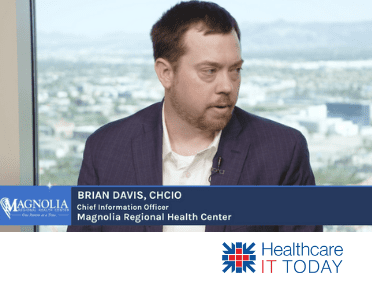
When Magnolia Regional Medical Center upgraded its EHR from MEDITECH Magic to the 6.1 platform, the big picture goal was laser focused: Achieve a Single Patient Record. A lofty goal? Maybe. Especially when you add in decades of legacy data in numerous disparate systems that needed a long-term plan. John Lynn, Founder & Chief Editor of Healthcare IT Today interviewed Magnolia CIO, Brian Davis, and Jim Hammer, SVP at Harmony Healthcare IT, about how their organizations worked together to deliver on that big picture goal.

Join Fellow Healthcare IT Pros

Tips, Guides, News & More

Sign Me Up
Magnolia-Migration-and-Partner-Selection

The beginning of the story at Magnolia Regional Medical Center may sound familiar. The 200-bed hospital in Mississippi needed to replace its EHR to better meet its needs. In this case, the MEDITECH Magic EHR gave way to the newer MEDITECH 6.1 platform. Two years of clinical data was migrated to the new system, which left more than 20 years of legacy clinical and financial data housed in silos across each facility that was still needed for HIM, legal and other record retention purposes.

Magnolia’s IT team needed a legacy data management strategy and plan, stat.

They also needed a data management partner that could deliver.

This is where the storyline picks up its pace.

In a brief with John Lynn, Founder & Chief Editor at Healthcare IT Today, Magnolia’s CIO, Brian Davis and Jim Hammer, SVP at Harmony Healthcare IT, share helpful data archiving project insights and outcomes.

One key take away: Compare apples to apples and archives to archives

Davis shares that one of the keys to the project’s success was choosing the right vendor partner with the right experience. In this case, the best-suited vendor with a robust solution to archive eight legacy applications, 26 legacy databases and more than 350,000 patient records.

To ensure it fully vetted its options for vendor partners, the Magnolia team developed a detailed 26-point matrix to evaluate several vendor partners archive solutions and services across seven categories:

  1. Usability
  2. Functionality
  3. Reporting
  4. Vendor Reputation/Support
  5. Implementation
  6. Cost
  7. Security

Harmony Healthcare IT outperformed the other two finalists.

Top vendor selection priorities where Harmony Healthcare IT scored especially high included:

  • Detailed Functionality – Harmony Healthcare IT demonstrated a superior ability to wind down A/R, fulfill release of information requests, and deliver on a record purging options per the record retention policy.
  • Single Sign-on – Harmony Healthcare IT offered a game-changer workflow, providing clinicians and the HIM team immediate access to historical records from within MEDITECH.
  • Deep Systems Experience – Harmony Healthcare IT proved to have a breadth of experience with multiple legacy software brands. This was important to Magnolia as its application portfolio included a collection of legacy EHRs with a mix of business, financial, HR, clinical and non-clinical records.
  • Solid value – Harmony Healthcare IT proposed low reoccurring costs and a fair total cost of ownership compared to competitors.

“Harmony far exceeded the other vendors across the board,” shared Davis, who added that the project implementation delivered on promises made during the sales process. “Harmony’s project management methodology is stellar in the industry. I don’t know if we could have asked for the project to go any smoother.”

This archiving project at Magnolia Regional Medical Center positions the organization well for fulfilling future release of information requests from patients and winding down accounts receivable. It will also provides Magnolia with a scalable solution should additional legacy data sources be added to the archive through merger and acquisition.

HIMSS21-Video-Callout

Are you looking ahead at your legacy data plans?

Let’s connect.

Healthcare IT tips, guides, news & more delivered to your inbox

Learn More

Summary

In a recent webinar, HealthSystemCIO’s, Anthony Guerra, sat down with a panel of experts to talk about the advantages of putting legacy data management to work for healthcare provider organizations. Discover how system decommissioning and data archiving can mitigate risk and offer monetary, security, and user workflow benefits.

Join Fellow Healthcare IT Pros

Tips, Guides, News & More

Sign Me Up
Webinar Recap: Dismantling Risk and Realizing ROI with Data Archiving

Today’s IT leaders and CISOs are inundated with an everchanging landscape of cyberattack headlines, interoperability challenges and tight IT budgets. While system decommissioning and data archiving projects may not be at the top of the priority list, they are strategic moves to consider to mitigate risk, save money and bolster security.

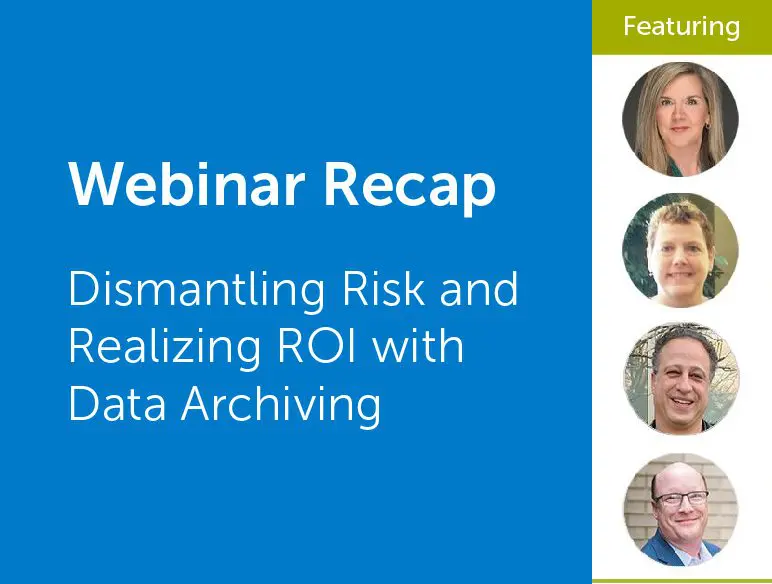
In a recent webinar, Editor-in-Chief of HealthSystemCIO, Anthony Guerra, sat down with a panel of experts to talk about the advantages of putting legacy data management to work for healthcare provider organizations. The panel featured Tressa Springmann, CIO & SVP of Performance Improvement at LifeBridge Health, Lisa Shubitowski, System Director, Interoperability at Hartford HealthCare, and Harmony Healthcare IT’s Jim Hammer, SVP.

The webinar featured a variety of topics, including how to:

  • Understand legacy data management and archiving as an option
  • Define your business needs
  • Identify how to get the most out of your vendor relationship

Understand Legacy Data Management and Archiving

Like an old box collecting dust in the attic, data that sits in a legacy system for too long is at risk of becoming inaccessible when you need it the most. As applications and servers age, they become more vulnerable to cyberattacks and downtime. As time passes and organizations grow, historical data becomes dispersed amongst more and more disjointed system silos—a true operational challenge for most hospital IT departments.

Harmony Healthcare IT works to help IT leaders clean out the attic so-to-speak. There are several reasons to have a legacy data plan in place:

  • Users want it. Inefficient Request for Information workflows cause organizations time and money. With a centralized active archive for legacy record storage, the day-to-day work of the HIM team improves.
  • Patients demand it. said they would consider changing their doctor or hospital provider after learning how their health record wasn’t available or shareable. A centralized active archive makes records readily available. This alone should prompt providers to act.
  • Hospitals benefit. Monetary, security and user workflow benefits are just a few ways that hospitals win following enterprise-wide data consolidation efforts.

Define Your Business Needs

The best way to start archiving is to step back and identify the business needs. Shubitowski explained that at Hartford Healthcare there were two catalyzing business needs: address the high degree of merger and acquisition activity and rationalize the application portfolio. At LifeBridge Health, Springmann had an organizational goal to retire legacy software that didn’t satisfy and improve workflow support for end-users.

The reasons why an organization needs an archive vary. But leaders that identify and justify the need for system decommissioning and data archiving upfront increase their chances of long-term success.

Harmony Healthcare IT’s team plays a vital role in what Hammer describes as the “playbook.” This is the strategy that is used to successfully archive data and give providers one-click access to legacy information—from out-of-production EHRs, revenue cycle, lab, blood bank. Accounting or materials management systems. Having worked with over 500 healthcare clients, Hammer can attest to Springmann’s point that keeping the patient’s care and satisfaction top of mind – no matter what sort of record type — is the most important part of the effort.

Identify How to Get the Most Out of Your Vendor Relationship

If you’re ready to streamline your data and improve your ROI, the panel recommended several action steps that drive success.

  • Secure engagement from leadership and have more than just IT staff on board. Talk to senior leaders, including CFOs, CISOs and CIOs, about why data archiving is a priority and the level of support needed from them. It’s no secret that healthcare systems are strained from a resource standpoint, so always be transparent on the frontend and share the hard and soft cost savings.
  • Anticipate any challenges that could occur. Effective legacy data management doesn’t happen overnight. A governance team can help make decisions about how and what data to store. Keep your team informed about what you’re doing and the benefits from doing so.
  • Automate and accelerate as much as you can. Hammer said the biggest factor that improves the vendor relationship is for organizational leaders to respond to requests in a timely manner. He also advised that organization leaders shouldn’t shy away from asking questions and providing feedback, as his team is always striving to improve by pivoting on projects instream if necessary.

Want to learn more about how data archiving might be the next step for your organization? Watch the webinar here.

Healthcare IT tips, guides, news & more delivered to your inbox

Learn More

Summary

We surveyed women across the country to get a better understanding on how they view motherhood and starting a family.

Join Fellow Healthcare IT Pros

Tips, Guides, News & More

Sign Me Up
Mother Baby

Earlier this year, data from the United States Census Bureau revealed that the American population grew at the slowest rate since the 1930s during the last decade. Researchers from the Brookings Institute also estimate that the U.S. might see as many as 300,000 fewer births this year alone due to the Covid-19 pandemic.

As a healthcare data management firm that has migrated and archived millions of U.S. patient records, we were curious to find out what’s behind America’s birth rate decline and why women are opting to delay or forgo motherhood. We recently surveyed women without children between the ages of 18-51 to ask them about their feelings on starting a family.

Family Planning

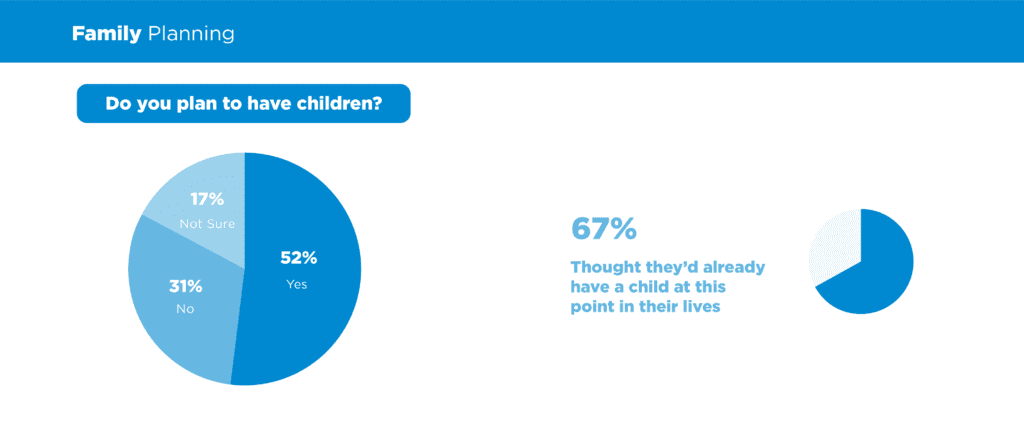
According to respondents, 52% say they plan to have children while 17% say they’re “unsure” about starting a family, and nearly one-third (31%) have no plans at all to have a child. These numbers vary considerably among women who are in a relationship compared to single women. Among women who are either married or in a relationship, 59% say they plan to have a child. Among women who are single, 42% say they will not have a child and 24% say they “aren’t sure.”

Family Planning

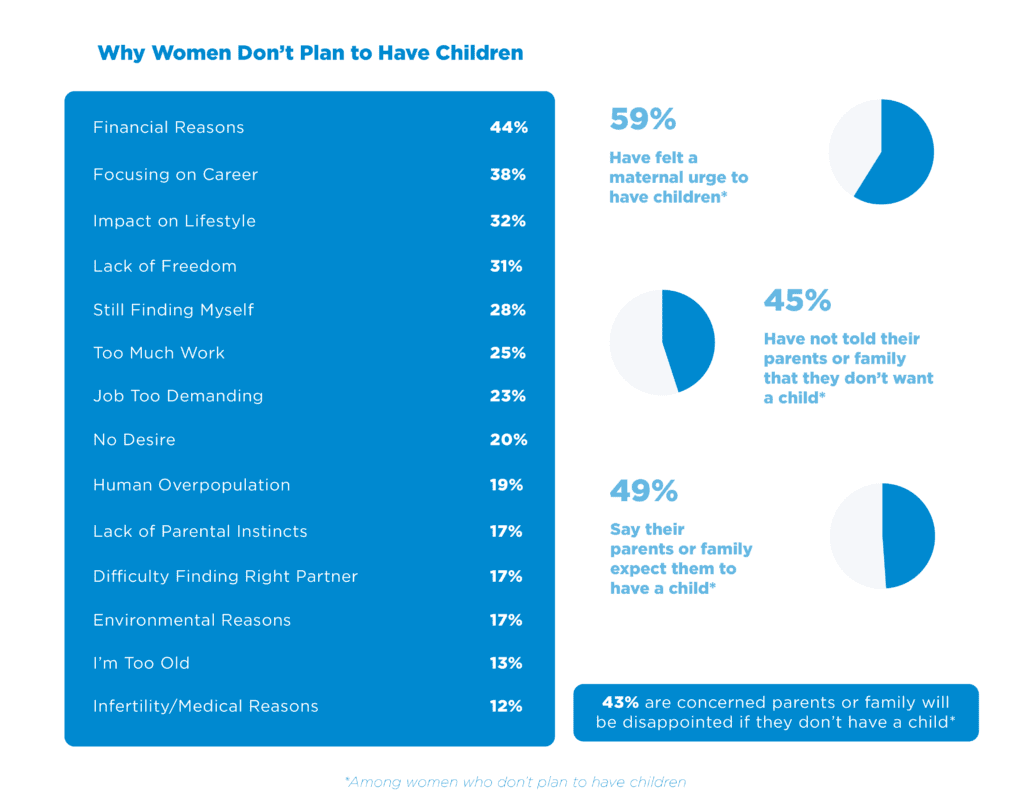
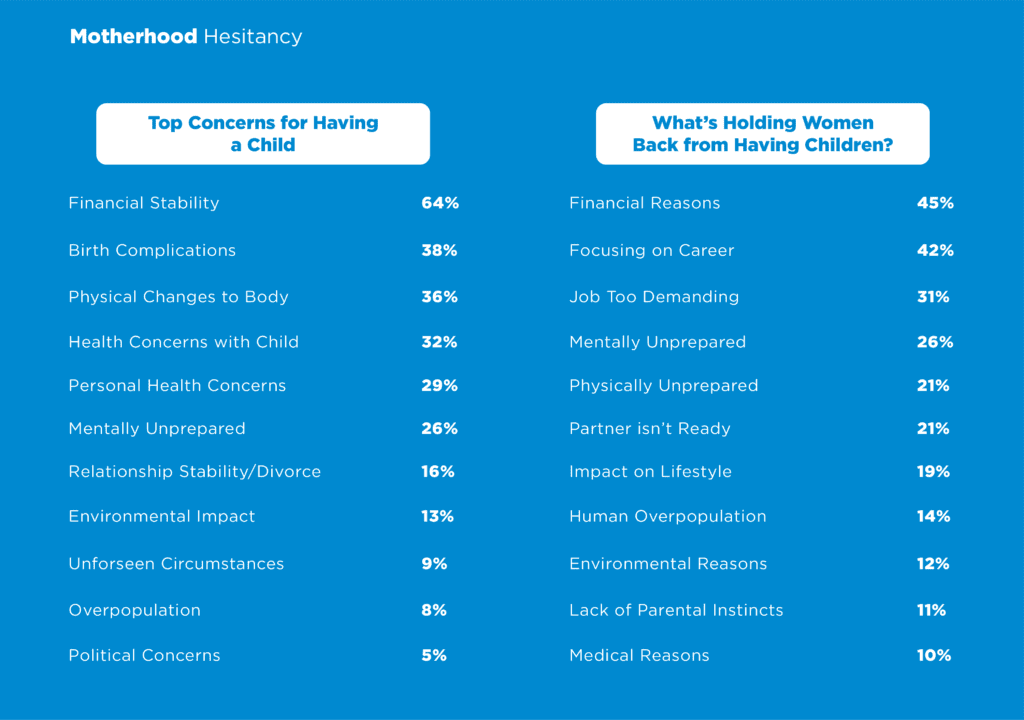
There are many reasons why women don’t plan to have children, but finances and careers are at the top, according to respondents. Impact on lifestyle and a lack of freedom were also among the main reasons why women say they don’t want to have children.

Birth Rate Decline Reasons

However, even though 48% of women say they either don’t want children or aren’t sure about having children, 59% of those respondents still say they have felt maternal urges to have children. Nearly half (49%) say their parents or family expect them to have a child, but 45% haven’t told their family that they have no plans to have one.

Financial Reasons

Financial Reasons

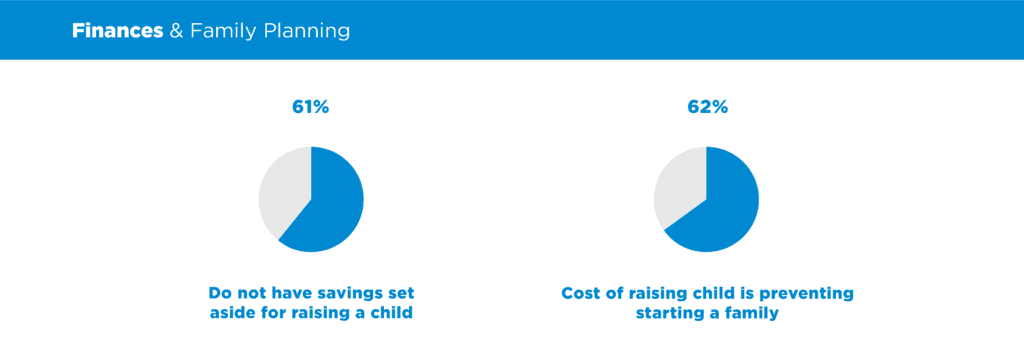
Among women who don’t plan to have children or aren’t sure about motherhood, 44% say financial reasons are the biggest barrier to starting a family. This sentiment is true among all women surveyed as 62% say the cost of raising a child is preventing starting a family. According to the United States Department of Agriculture, the estimated cost to raise a child in the U.S. is $233,610, which does not factor in the cost of college education.

Motherhood Hesitantcy

Finances are also top of mind among women who do plan to have children. According to respondents, financial stability is the main concern women have when it comes to motherhood. Finances were also the top reason cited for why women who want children are hesitant to have one.

Pandemic: Baby Boom or Baby Bust?

Pandemic Birth Rate

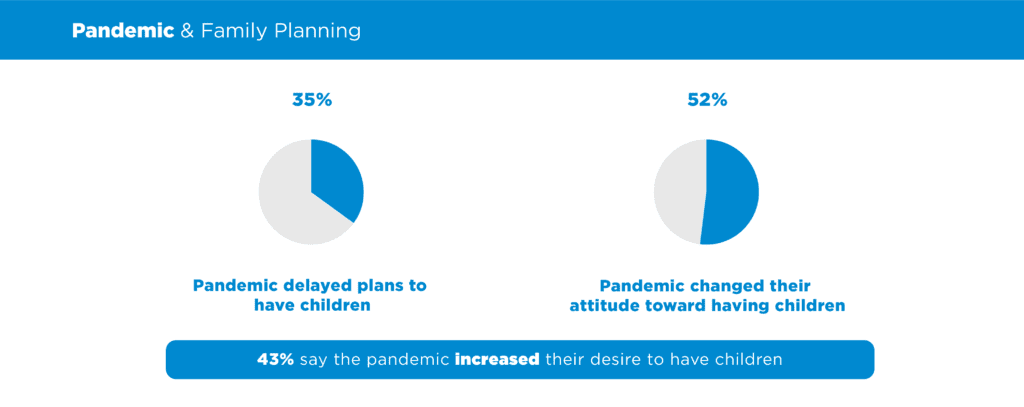
According to respondents, more than half (52%) say the pandemic changed their attitude toward having children and more than one-third (35%) say the pandemic delayed their plans to have children. It’s interesting to note that 43% of respondents have felt an increased desire to have children throughout the pandemic.

Parenting Pressure

Parenting Pressure

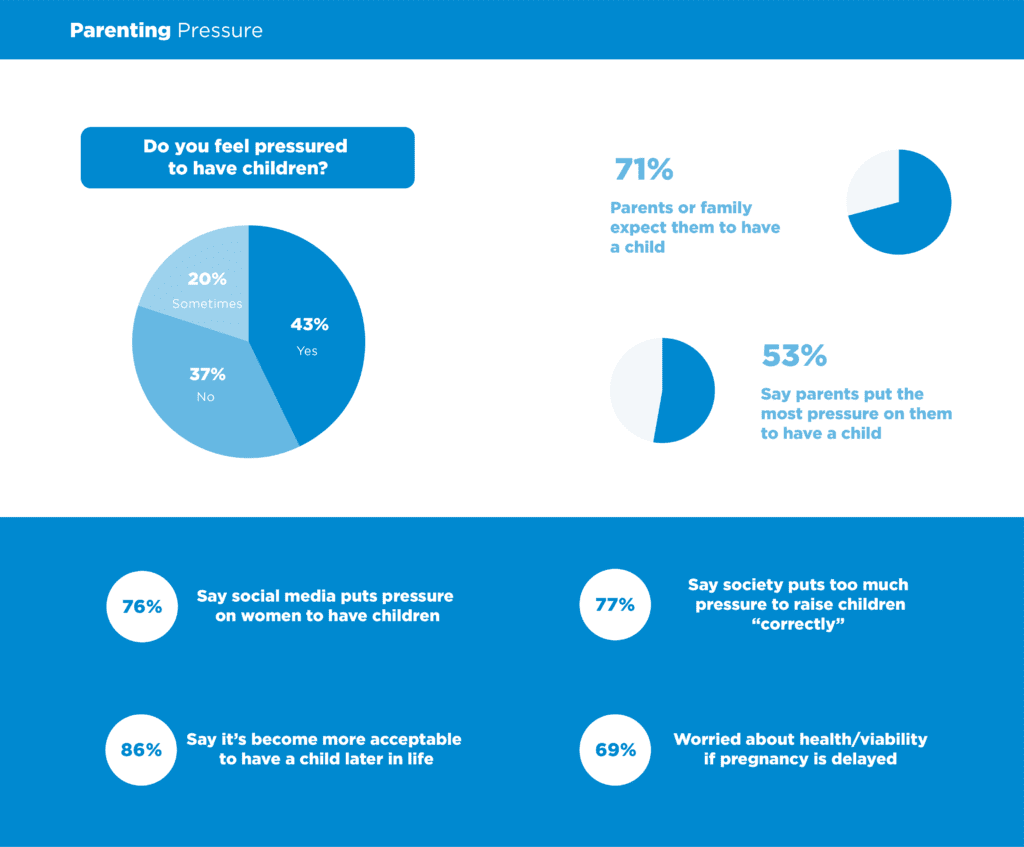
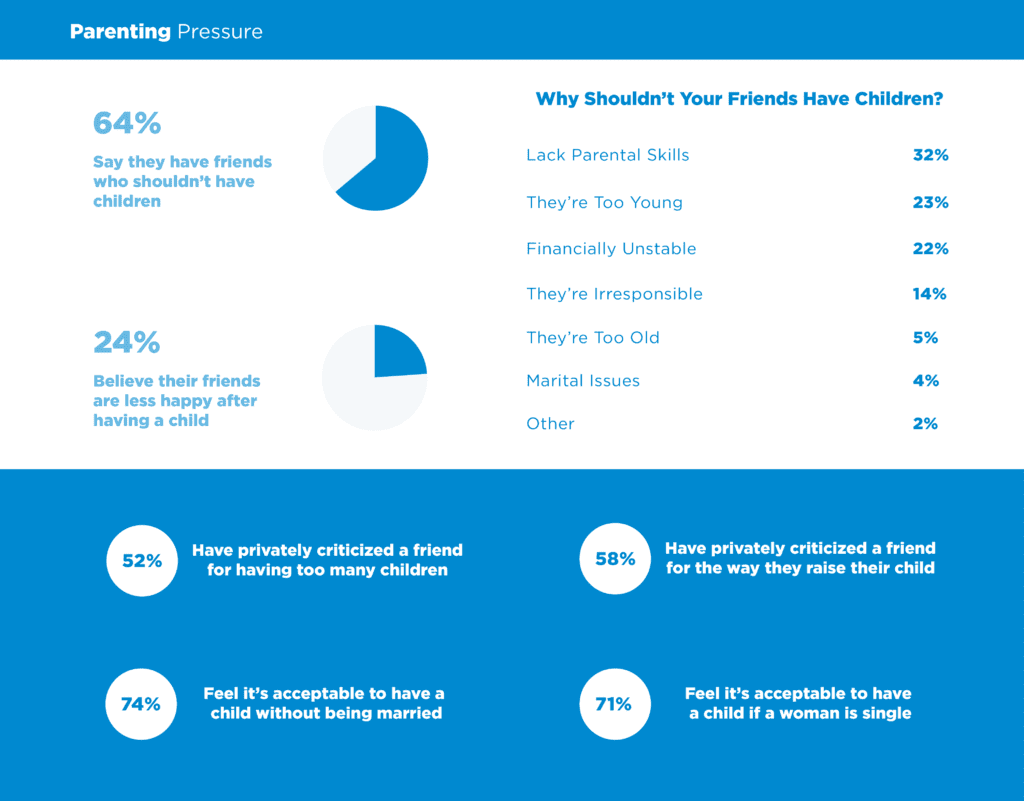
Women who were surveyed say that pressure to have a child exists in multiple layers. Everything from social media to parents and family are putting pressure on women to start a family. Overall, 71% say their parents or family members “expect” them to have a child and 76% say social media puts pressure on women to have children.

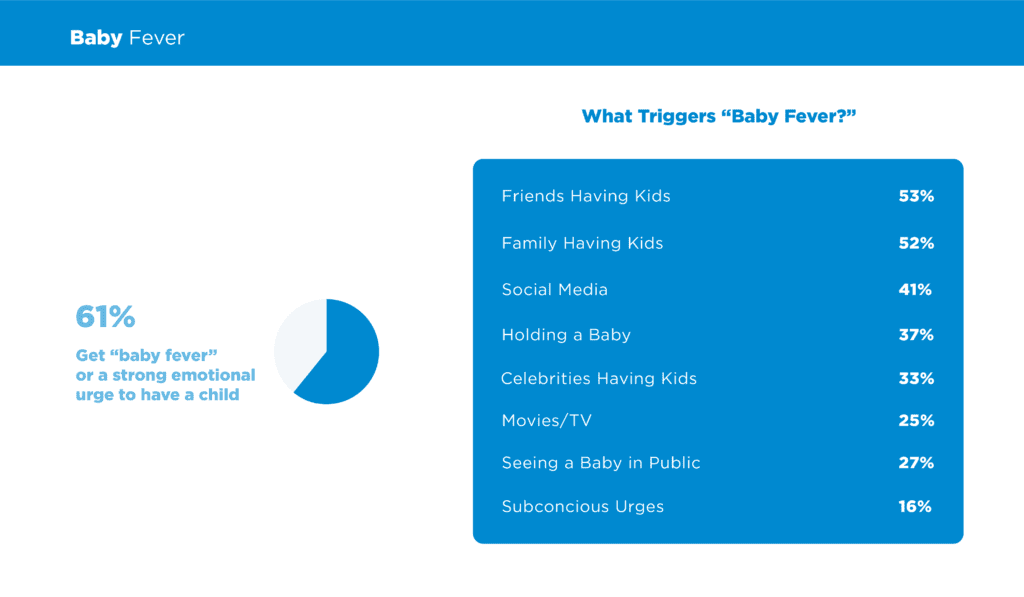
Along with parents and social media, women also say that seeing their friends have kids triggers “baby fever” or a strong emotional urge to have a child.

Baby Fever

There’s also a flipside for women who see their friends having children. According to respondents, 64% say they know a friend or friends who shouldn’t have children either due to a lack of parental skills, their age or irresponsibility.

Parenting Pressure

The number of children women’s friends are having also seems to be an issue. More than half (52%) admit to privately criticizing a friend for having too many children. However, changes in society have led women to feel that it is more acceptable to have a child without being married, according to respondents.

Motherhood and Mental Health

Motherhood and Mental Health

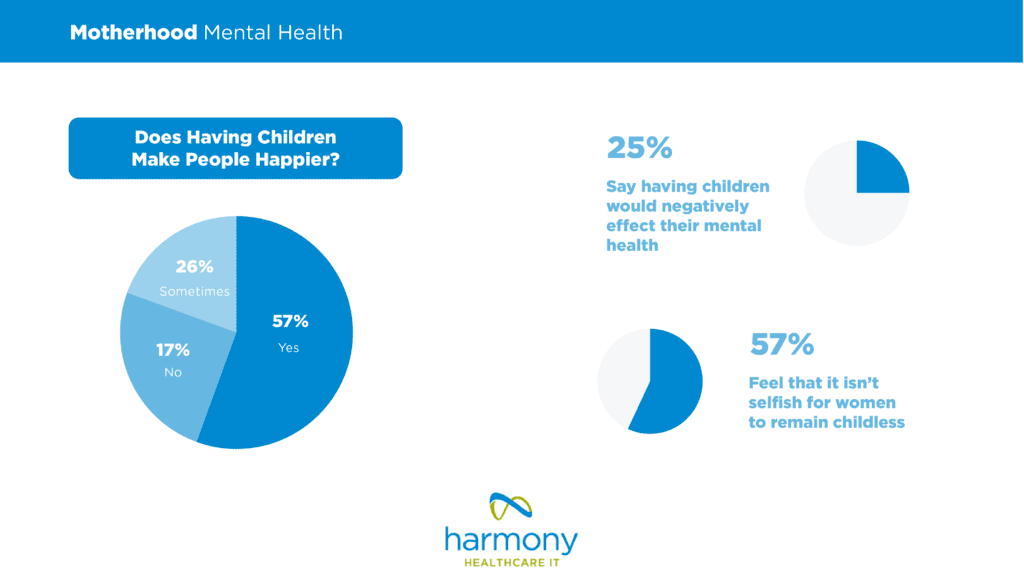
Along with physical health, mental health also plays a strong role in the decision to have a child. According to respondents, more than half (57%) say that having a child makes people happy.

As the world continues to evolve to the changes brought on by the Covid-19 pandemic, it will be interesting to see how attitudes and data behind America’s declining birth rate evolve as well.

Methodology

From May 28 to July 6, 2021, we surveyed 1,000 women without children between the ages of  18 and 51 on the topic of motherhood and family planning. The median age was 32. Income: Under $20K: 13%; $20-40K: 23%; $40-60K: 29%; $60-80K: 21%; $80-100K: 10%; Over $100K: 4%.

Employment status: Employed full-time: 82%; part-time: 11%; unemployed due to COVID-19: 2%; unemployed not due to COVID-19: 4%; other: 1%.

For media inquiries, contact media@digitalthirdcoast.net.

Healthcare IT tips, guides, news & more delivered to your inbox

Learn More

Summary

Thinking of archiving your legacy patient data? Read the summary below or listen to the full podcast with Harmony Healthcare IT’s own Jim Hammer, SVP, as he discusses the six phases of the data lifecycle and how each step can ensure your records are properly stored for years to come.

Join Fellow Healthcare IT Pros

Tips, Guides, News & More

Sign Me Up

Whether you are an individual practitioner, part of a large integrated delivery network (IDN), or someplace in between, the healthcare data lifecycle likely is on your radar. There is a lot to think about these days as compliance regulations continue to advance, data volumes continue to multiply, real-time patient access to their records is a priority and mergers and acquisitions require system replacements.

Behind every scenario is a need for a secure plan for legacy data.

Recently, Jim Hammer, SVP at Harmony Healthcare IT, participated in an interview about legacy data management best practices and 21st century Cures Act compliance, hosted by Jim Tate of The Tate Chronicles, broadcast through Healthcare NOW Radio. To listen to the podcast, click here.

Tate-Chronicles-Six-Phases

In this episode, Jim Hammer shares the six phases of the data lifecycle, and importantly, how each step is essential to ensure effective health data management of clinical, financial, human resource and other business records that need to be saved minimally for 7-10 years and sometimes indefinitely, depending on the type of record.

Hammer describes how the Harmony Healthcare IT team works with small ambulatory to large health systems to support the solutions needed across the entire data lifecycle that includes:

  1. Consultation
  2. Extraction
  3. Migration
  4. Retention
  5. Integration
  6. Destruction

As the 21st Century Cures Act deadlines add another layer of compliance regulations to data management, there are action steps to take, if you haven’t already, to make sure your organization is ready and able to support the interoperability of medical information between providers, payers and patients.

As a full-service data management partner, Harmony Healthcare IT makes legacy patient, employee and business records accessible, usable, secure and compliant. Since 2006, our team of experts has extracted, converted, migrated and retained records from over 500 different clinical, financial and administrative software brands.

We have earned industry recognition for data archiving, extraction and migration as well as being named to the Best Places to Work in Indiana and to the Best Places to Work in Healthcare.

We hope you find listening to the podcast helpful.

When you are ready to talk, let’s connect.

Healthcare IT tips, guides, news & more delivered to your inbox

Learn More

Summary

Join Bridget Group, JD, Corporate Counsel for Harmony Healthcare IT, for a brief look at the legal risks and major considerations for a solid legacy data management plan. Group shares her insights in a recent interview on the Compliance Perspectives podcast.

Join Fellow Healthcare IT Pros

Tips, Guides, News & More

Sign Me Up

Healthcare legacy data may not be accessed daily; however, there are many considerations providers need to manage to ensure they meet federal, state and condition-specific retention requirements.

Bridget Group, JD, Corporate Counsel for Harmony Healthcare IT, recently discussed the key legal factors for legacy data management in a podcast with Adam Turteltaub, Vice President of Strategic Initiatives and International Programs for the Society of Compliance and Ethics (SCCE) & Health Care Compliance Association (HCCA).

Group noted the major risks for legacy health data management include:

  • Security vulnerabilities as legacy systems can be weak links and ripe for cyber attacks
  • Compliance challenges in meeting HIPAA and 21st Century Cures Act rules
  • Keeping unstable system hardware up and running
  • Increased technical support and maintenance costs

A few of Group’s recommendations for a solid legacy data management plan include:

  1. Create a system inventory of all data – capture critical details like the system name, vendor, version #, database size, server location, operating system, etc.
  2. Review the purpose of each system
  3. Log the access requirements for each system
  4. Consider the maintenance cost schedule
  5. Create or review the Governance Board’s role and processes which should include:
    • Update and maintain policies for retention, access, HIPAA and Cures Act
    • Ensure a robust and ongoing training schedule is implemented within the entire organization
  6. Evaluate legacy data against the organization’s policies and determine which data should be migrated to an archive solution or a storage warehouse based on a checklist of factors (security, accessibility, anticipated future needs, HIM requirements, legal considerations, etc.)
  7. If the data has met its complete requirements for compliance, determine purging or destruction schedule.

For more information on creating or updating your organization’s legacy data management plan, contact the team at Harmony Healthcare IT.

Note: The information shared in this podcast is not intended to serve as a replacement for legal advice and does not create an attorney-client relationship. Should you require legal counsel, please seek guidance from your organization’s legal team.

Healthcare IT tips, guides, news & more delivered to your inbox

Learn More

Summary

College students have unique health needs. Let’s take a quick look at the state of healthcare for this group of young adults. There are about 20 million college students in the U.S. eligible to use campus health centers. While more than 90% of those recently surveyed reported to the American College Health Association (ACHA) that...

Join Fellow Healthcare IT Pros

Tips, Guides, News & More

Sign Me Up
Student-health-backpack

College students have unique health needs.

Let’s take a quick look at the state of healthcare for this group of young adults.

There are about 20 million college students in the U.S. eligible to use campus health centers. While more than 90% of those recently surveyed reported to the American College Health Association (ACHA) that their health is good, very good or excellent, there is a notable increase in students seeking mental health care.

In the ACHA survey, 14,000 on-campus students responded:

  • 49% feel lonely
  • 32% have experienced a high level of stress within the last 12-months
  • 42% sleep less than 7 hours on weeknights, and only 11% report getting enough sleep so they feel rested
  • 71% report more than three problems in the past year with academics, career, family, health of someone close to them, bullying, finances, peers and other life events
  • 34% report an acute diagnosis within the past year that negatively impacted their academic performance (e.g., flu, mumps, pneumonia, bronchitis, concussion, urinary tract infection, mono, GI issues, etc.)

Another study found that during the pandemic, depression symptoms tripled among American adults, including college students. (Note: 27.8% of all American adults report depression symptoms, compared to 8.5% prior to the pandemic.)

This is consistent with a recent study by the Centers for Disease Control and Prevention (CDC) that reports the pandemic elevated the already growing mental health concerns for college-age students, including:

  • 3 in 4 report facing at least one adverse mental health symptom such as anxiety or depression
  • 1 in 4 seriously considered suicide within the 30-days prior to completing the survey

The campus health centers that serve this population need to be nimble and nurturing to address the young adults who seek care, while also equipped to meet the advancing regulatory requirements for their electronic medical records. 

Campus health centers – like other medical providers – are held to federal and state laws for protecting health information and retaining medical records. In fact, some institutions must store student records 10+ years after the last semester of attendance, making it necessary for universities to have a secure, long-term data management strategy. This includes student medical record archiving. It is vital to maintain secure and detailed records for a comprehensive medical record that provides a complete history of health.

Student health centers need to be prepared with lifecycle data management solutions to comply with new Cures Act regulations.

Student health centers may also be “hitting the books” to determine if and how they need to comply with the 21st Century Cures Act, specifically the Information Blocking rule. In short, the rule prohibits practitioners from engaging in information blocking of electronic health information (EHI). While ePHI excludes education records and treatment records, there may be some records that would be included, such as: records of a student who are patients of a hospital affiliated with the university. While the rule went into effect on April 5, 2021, the ONC will hold off on enforcement and penalties while organizations work through the process of implementing policies and procedures to comply with the Cures Act.

Beyond regulations, patients are demanding online access to their medical record. In a recent survey of 2,517 healthcare consumers, 67% said they will consider changing their doctor or hospital providers in the coming year after learning how their health record was not sharable, available or was blocked in the past year.

HealthData Archiver® is a record storage solution that delivers a single point of access to historical patient information. This HIPAA-compliant solution also allows for secure, user-restricted access to documented behavioral health information.

In addition to other risk and cost savings benefits, HealthData Archiver® offers both interoperability and data analytics capabilities for colleges tracking population health information as a part of the College Health Surveillance Network (CHSN), a national database of over 1 million enrolled students from student health centers at universities across the country.

Harmony Healthcare IT, the makers of HealthData Archiver®, is equipped to provide campus health centers with technical and business guidance that will allow them to develop and execute a secure legacy data management strategy. That’s why we offer campus health centers data management services like extraction, migration, retention and student medical record archiving.

Are you seeking data archiving solutions or a legacy system replacement strategy for your student health center? We’re experienced in decommissioning major EHR brands often used in campus health centers.

Need to make sure you are equipped to manage the requirements of the 21st Century Cures Act and that your data retention and population health requirements can be met long after the student has left campus?

Let’s talk.

Note: This blog is updated from a previously published article from Dec. 2, 2019.

Ready to connect?

Contact us today to learn more about our healthcare data management solutions.

Healthcare IT tips, guides, news & more delivered to your inbox

Learn More

Summary

EHR vendors are not created equally, and neither are active archive vendors. When it comes to legacy data management and integration in healthcare, it is important to find the right and proven partner that can get the job done correctly.

Join Fellow Healthcare IT Pros

Tips, Guides, News & More

Sign Me Up
Green-shoes-facing-two-paths

We are seeing an uptick in inbound sales calls about disappointment in archiving vendor choices that hospital CIOs have made. Data extraction, migration and archival from legacy systems isn’t always straight-forward. Some legacy data archiving projects require advanced data management skills and deep industry, legacy system, and database experience. While there are many archiving vendors out there, not all are equipped to handle the complexities of the legacy data landscape in healthcare.

Sometimes the calls come in after the project has failed.

An IT Director reached out on our website for help. When we asked via email whether his organization had a current archive solution in place or was launching a search for one, the response was: “It’s complicated, we should discuss it on the phone.”

It turns out that the CIO had decided to go with a competing vendor based on price. But, as the projects unfolded with barriers including encrypted files and antiquated database types, the vendor was unable to advance the project to completion.

It is better when the call comes before a project is sourced.

Another recent inquiry: We are looking at migrating from one EHR to another. We met with another company, but we weren’t convinced they could handle the task. Is this something you can do?

When it comes to moving data, clinical experience matters.

What is becoming common is that health delivery organizations are struggling to find the “right” vendor partner, and some are contracting with a data migration or archiving company only later to learn that they made a sourcing decision that wasn’t a good match for their project(s). In short, some of the archive vendors on the market cannot get the job done for the myriad of legacy systems in the provider’s inventory.

Data can be complex, but finding an archive partner who can get the job done efficiently and effectively doesn’t have to be complicated.

Archiving requires a nimble and experienced partner who understands clinical, financial and business data. Whether the system is Cerner Millennium® that was deployed across 15 hospitals, a Soarian billing system that requires accounts receivable wind down for millions in AR, or a simple Kronos time and attendance system – the vendor must have experience with any legacy system in the application portfolio.

A recent case study outlines the stress and hassle when a complex data format halted an archive project. With decades of experience, and specializing in complex projects for large enterprises, the data experts at Harmony Healthcare IT dug into the issue with an electronic dental record’s odontogram files and delivered a customized solution and a seamless integration. Read the story that led to the client’s advice to other health IT leaders: There is complexity any time one is extracting or migrating data to and from EHRs… Make sure any archiving vendor has the right experience to handle the data.

Harmony Healthcare IT has been around the block with data management – more than once.

If it relates to the movement, storage or integration of data from within the technical infrastructure of your health system or medical practice, we’ll tackle it. We specialize in healthcare data management. Since 2006, our team of experts has extracted, converted, migrated and retained records from over 500 different clinical, financial and administrative software brands.

We have earned industry recognition for data archiving, extraction and migration as well as being named to the Best Places to Work in Indiana and to the Best Places to Work in Healthcare.

We take pride in those awards and also in the feedback from clients like the IT Director from a 25-bed critical access hospital in Wisconsin who shares in a case study:IT-Director-Quote

Looking to get it right the first time?

Let’s connect.

Healthcare IT tips, guides, news & more delivered to your inbox

Learn More

Summary

Healthcare employs more people in the United States than any other industry. Like patient information, employee records must meet strict retention requirements, and often human resource management (HRM) and enterprise resource planning (ERP) systems are replaced before that timeframe is met. When a system storing critical person information is displaced, active archiving comes to the rescue, securely storing records for the largest employer in our nation – the healthcare industry.

Join Fellow Healthcare IT Pros

Tips, Guides, News & More

Sign Me Up
Employee-record-retention

As an industry, Healthcare must retain employee records for the more than 22 million of its healthcare workers at over 784,000 healthcare businesses in the United States. And, human resource (HR) record retention guidelines in healthcare go deep and wide.

Healthcare delivery organizations are required to manage and retain several types of records for varying timeframes (sometimes 30+ years), including:

  • Personnel Records
  • Records for Employment Tests and Employment Opportunities
  • Online Application Records
  • Apprentice Programs
  • Payroll Records
  • Income Tax Withholding
  • Time Cards and Schedules
  • Wage Differential
  • General Ledger/Accounting
  • General Business Records
  • Minor Employees
  • Federal Contractors
  • EEO-1 Reports
  • Agreements, Contracts, Benefits
  • Family and Medical Leave Records
  • Affirmative Action Plans
  • OSHA Records
  • Drug Testing Records

Plus, the HR team must stay abreast of new issues and the employee recordkeeping that is required. A few recent examples:

  • COVID-19 vaccine records – While health systems are grappling with the legal issues of requiring employees to obtain a COVID-19 vaccine, employees’ vaccine records are being tracked at more than one third of U.S. businesses.
  • New Rules for COBRAThe American Rescue Plan Act (ARPA) signed into law in March 2021, mandates that employers provide 100 percent of COBRA premium subsidies to eligible employees. Recordkeeping compliance for this additional program requires auditing workforce records to determine eligibility, coordinating the program and also retaining the business records of all COBRA subsidies and attestations obtained from AEIs.

HRM and ERP systems play a large role in managing the business side of healthcare. When it comes time to replace these systems for various reasons, there are many decisions to be made about where, how and for what duration the employee and business data they contained will be retained.

While HIPAA is a driving factor for employee data retention at healthcare facilities, there are a few other federal employee data retention requirements that apply to all organizations:

  • The Equal Employment Opportunity Commission (EEOC) Regulations require employers to retain personnel or employment records for one year.
  • The Fair Labor Standards Act (FLSA) states that employers must keep payroll records for a minimum of three years and any records that might be needed to explain wage discrepancies for employees of the opposite sex for a minimum of two years.

Other federal laws regarding the retention of employee records and HR information often depend on the number of employees at an organization. Those record retention requirements might range anywhere from one to 30 years. The Society of Human Resource Management has a good consolidation of guidelines from those requirements.

According the United States Department of Labor, The Occupational Safety and Health Administration (OSHA) requires “the retention of occupational medical records for 30 years after termination of a worker for the purpose of providing access to the records for employees and their representatives after a worker has left employment. Both employee medical and exposure records must be retained.”

How to Store Employee and other HR Records Long-term

When your employee record retention policy requires data storage for the long haul (i.e., up to 30 years or beyond) and, especially if the systems that store your employee data have been replaced by a newer system, you may need to seek an archive vendor and solution.  When it comes to decommissioning legacy human resources software that stores employee and HR data, a legacy data management strategy is an important consideration. Whether you are retiring one, four or 14 legacy systems at once, a legacy data management strategy from an expert archiving vendor helps guide decisions around system retirement prioritization.  It also provides a common data retention methodology and framework.

There are numerous benefits to employing an active archive solution like HealthData Archiver® in your record retention strategy. The primary benefits of HealthData Archiver® for the HR team includes data accessibility and security for numerous types of employee and other HR data like time and attendance or payroll. A few notable features include audit logs, role-based security, reporting and record purging.

Harmony Healthcare IT also handles the migration of legacy employee records to the go-forward HRM system.

For more information about managing legacy employee data at healthcare delivery organizations, contact us.

Note: This blog is an update from a previous blog published on Nov. 15, 2017.

Healthcare IT tips, guides, news & more delivered to your inbox

Learn More