Summary

Whether its guidance from HIPAA in the United States or PIPEDA in Canada, healthcare providers have specific regulatory requirements to ensure the safety and security of the data within their care. A detailed Disaster Recovery Plan is a must-have to be prepared for the possible technology-based, natural, or physical threats that can literally strike at any time. Let’s look at best practices for planning ahead and how legacy data management comes into play.

Join Fellow Healthcare IT Pros

Tips, Guides, News & More

Sign Me Up
disaster recovery plan

Hurricanes, hardware failure, wildfires and cybercrimes all have the potential to create havoc on a health system’s electronic medical record (EMR) and valuable data.

Healthcare providers in the United States and Canada abide by very specific regulatory guidelines to ensure that no matter what happens, the data remains safe, secure, and usable.

In the U.S., HIPAA’s security rule states that healthcare groups of all sizes must have a data plan for backup, disaster recovery and an emergency mode of operations. While the response to this rule will vary based on the size and scope of the organization, each entity must abide by the regulation that patient care and EHR security is never put at risk.

For Canadian-based healthcare providers, there are even more stringent requirements for data management and they vary by province. Canada’s federal law, the Personal Information and Electronic Documents Act (PIPEDA), is comparable in many ways to HIPAA in the U.S.; however, there are broader expectations and some pockets of differences as each province has the right to have its own rules and regulations, as long as they are similar to PIPEDA.

The most common disasters to prepare for include:

  • Technology-Based Disasters – Ransomware, data breaches, ISP outages, phishing incidents and loss of data through corruption, failure or viruses
  • Natural Disasters – Fire, physical loss of a data center, flooding, storms, pandemics or other health emergencies
  • Physical Disasters – Infrastructure failure such as loss of power or water, a facility problem, break-ins or heating/cooling issues that could make the workplace unstable

For all cases above, it is a best practice to plan ahead to be most prepared when technology-based, natural or physical disasters occur.

The focus from providers on fortifying electronic health record (EHR) and enterprise resource planning (ERP) systems to ward off cybersecurity crimes has advanced disaster recovery and data security strategies overall. The implementation of smart data protection steps help protect ePHI in the event of natural disasters and man-made threats.

There are many resources and vendors that can help providers create and maintain a solid disaster recovery plan. One resource, Healthcare IT News, has a four-part video series developed in conjunction with Sungard.

  1. Identify a Disaster Recovery Team – Provide training on how to prepare for a variety of situations and determine communication guidelines of how the team will communicate to other members of the organization when disaster strikes.
  2. Create a Disaster Recovery Plan – Led by the team, create a written plan that will be reviewed and updated regularly with technology and contact information.
  3. Perform Data Backup – Run regular backups of all current data either to the cloud or offsite.
  4. Test the Plan – Practice drills to confirm that data back ups are working as planned.

Legacy EHR systems can be vulnerable when disaster strikes

Legacy EHR systems create security risks for healthcare delivery organizations of any size. Think about each legacy EHR as a silo of information that will have to weather a storm on its own. Some organizations have 30-50+ legacy EHR systems with varying degrees of security and stability still intact.

Does your IT leadership have a plan to consolidate legacy patient, employee, or business data silos to ensure secure record retention for the next 7, 10 or even 25+ years? Once consolidated, will the data be readily accessible and enabled for interoperability?  Requests for historical patient records are fielded routinely from patients, payers, employers and lawyers.  Keeping the data siloed in outdated applications not only makes your healthcare organization vulnerable from a security standpoint; it also makes it far more difficult and costly to maintain, access and share information.

HealthData Archiver® offers the flexibility necessary and ensures critical patient, employee and business records are available when, where, and how needed. This improves workflows to provide accurate data for patient care and release of information. There are numerous features to HealthData Archiver® that support the instant accessibility of records for a healthcare organization.

Our team is well versed in securely migrating legacy data into a consolidated, searchable active archive that meets HIPAA requirements and helps reduce legacy data management costs and vulnerabilities.

Cold storage for inactive data

Does your organization have data that will rarely need to be accessed but still requires preservation for compliance or disaster recovery? Cold storage can be a cost-effective solution. With dedicated, secure cloud storage and no user interface (UI), HealthData Locker is intended for occasional access by a technical resource via file copy or ODBC connection.

Whatever your legacy data needs, we secure historical records and help your team be better prepared for future storms.

Connect with us. We’re ready to help.

Editor’s Note: This blog has been updated from the original post on May 29, 2018.

Healthcare IT tips, guides, news & more delivered to your inbox

Learn More

Summary

There is an unprecedented increase in the number of older adults in the U.S. and Canada. Senior living communities that are prepared with a long-term care EMR system that can provide complete information about residents internally and share that information with other organizations (hospitals, hospices, pharmacies, labs, etc.) will be best prepared to care for the aging population.

Join Fellow Healthcare IT Pros

Tips, Guides, News & More

Sign Me Up
assisted-living-helpful-nurse

In the U.S. and Canada, 25 percent of the population will be over 65 by 2050. While people are living longer, it doesn’t mean they are living healthier. A National Institute of Aging (NIA) report says there are many public health challenges that need attention to support the aging population.

As 50 percent of assisted living residents have three or more chronic conditions, it seems logical that those senior living centers with an electronic medical record (EMR) system are likely more efficient caring for patients than those facilities still managing care with paper.  Additionally, considering how Assisted Living Centers and other Long-Term Care entities (nursing homes, continuing care retirement communities and home care) in the United States and Canada typically interact and collaborate with multiple members of the healthcare ecosystem –such as payers, affordable care organizations (ACOs), hospitals, hospices, pharmacies, and labs — it makes sense that hospitals may prefer to send patients to long-term care communities that can interface with the hospital care and discharge systems.

In fact, having a robust electronic medical record (EMR) system that can provide complete information about residents, including allergies, conditions, medications, needs and preferences is being promoted as a benefit in some long-term care communities.

Suddenly, a long-term care EMR is a marketing asset.

One reason long-term and senior care facilities may have been slower to adopt an EMR for providing long term care is that they weren’t included in the financial incentives. But that has changed. Medicaid providers such as long-term care facilities in the U.S. now are eligible for federal and state funds that support long-term care EMR adoption and use.

Creating a data management plan is important for every type of healthcare provider, and long-term care centers based in the United States, Canada and abroad need to have an actionable strategy that addresses the variety of data coming in, what needs to be retained and for how long, as well as how to best share information across the healthcare landscape.

As your technology needs change and there are now legacy systems that still contain records that must be retained and accessed, it may make sense to review some lifecycle data management solutions, such as an EMR for long-term care.

Many U.S. and Canadian-based healthcare companies are upgrading to newer systems and still have legacy systems that house data that must be retained. Rather than keeping old and costly EHR or ERP systems running just to meet record retention requirements, the long-term care provider can securely and centrally store multiple data sources with HealthData Archiver®.  This easy-to-use storage solution is helpful for organizations that are upgrading or adding a new EMR go-forward system, in merger and acquisition mode with a need to consolidate systems – or those looking to reduce technical risk and IT labor burden.

We help healthcare providers of all sizes throughout the United States and Canada. Our team decommissions out-of-production software by extracting, migrating and archiving historical patient, employee and business records into an accessible, usable, secure and compliant active archive. We have worked with more than 500 unique clinical, financial and administrative software brands with award-winning results.

Long-term care centers benefit from the ability to access all available data regardless from where it may have originated. Connecting senior living care providers is the future of what is needed to support this important demographic. And, the benefits of having true interoperability, care coordination and insightful data analytics allows seamless delivery of an outstanding patient (and clinician) experience.

Harmony Healthcare IT has been consistently ranked as the #1 data extraction, migration, and archival healthcare IT company according to Black Book Market Research for three years (2019-2021) as well as ranked #1 in the 2020 Best in KLAS Software & Services Report as a Category Leader in Data Archiving.

We help U.S. and Canadian-based healthcare providers reach a better-connected health information system. Isn’t it time to organize your health data and offer clinicians a single-sign-on to maintain ongoing access to the complete patient record?

You have a lot to do and there’s no room for errors. We can help.

Our mission is to preserve vital information to improve lives.

Connect with our team.

Note: This blog has been updated from an original post on Nov. 6, 2018.

Healthcare IT tips, guides, news & more delivered to your inbox

Learn More

Summary

Sitting in front of a computer all day has put a cramp in our style and a kink in our necks, but what are the most common tech-related ailments in every state? We analyzed Google search volume to find out.

Join Fellow Healthcare IT Pros

Tips, Guides, News & More

Sign Me Up
Tech Ailments by state

For many remote workers, working from home meant ditching suits for sweatpants and long commutes for later alarms. As of September, 45 percent of Americans are still taking advantage of their remote setup, according to a recent Gallup poll.

But that doesn’t mean employees are more comfortable on their couches. Increased screen time and makeshift office furniture has strained our eyes and stiffened our joints over the last 18 months.

Tech Ailments by State

At Harmony Healthcare IT, our consultants are here to help health systems, hospitals and physicians navigate a dynamic industry. To find out how employees are getting through these unprecedented times, we analyzed Google search volume to determine the most common tech-related ailments, aches and pains Americans have been suffering due to our tech-obsessed lifestyles.

Tech Ailments by State

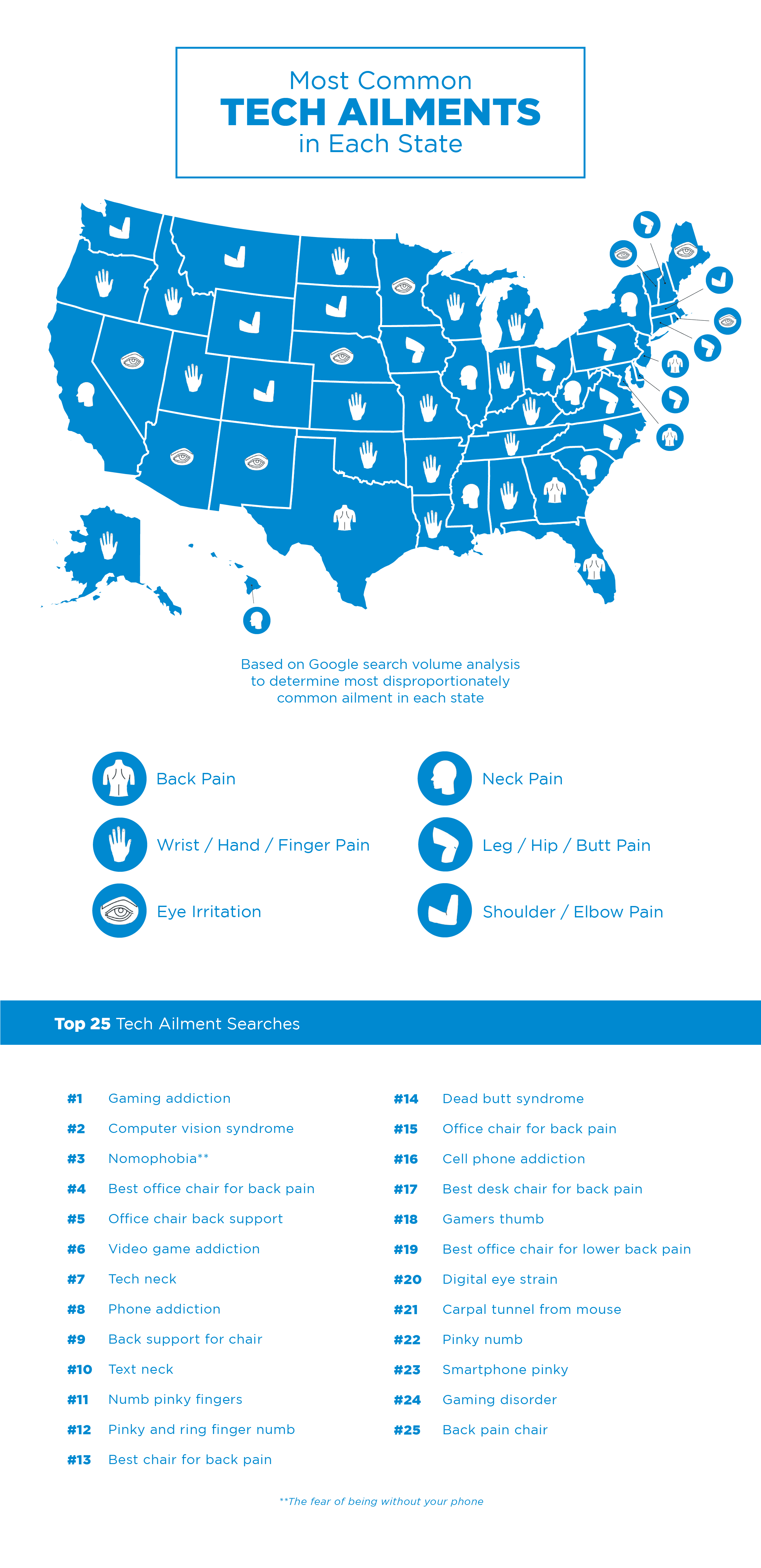
The results are a real pain in the neck or rather, the hands. Wrist, hand and finger pain dominated as the most common tech ailment across the country, with 32 percent of states searching for a remedy online. Both lower joint pain and eye irritation claimed 16 percent, while neck pain bothered 14 percent of Americans.

So, what technology caused so much pain? According to our research, it’s not work-related technology that’s afflicting us the most. Gaming addiction landed the top spot among tech ailment searches, followed by computer vision syndrome. And video games aren’t Americans’ only addiction. The third most popular search is “nomophobia” or the fear of being without your phone.

Tech Ailments and COVID-19

Tech Ailments Covid-19

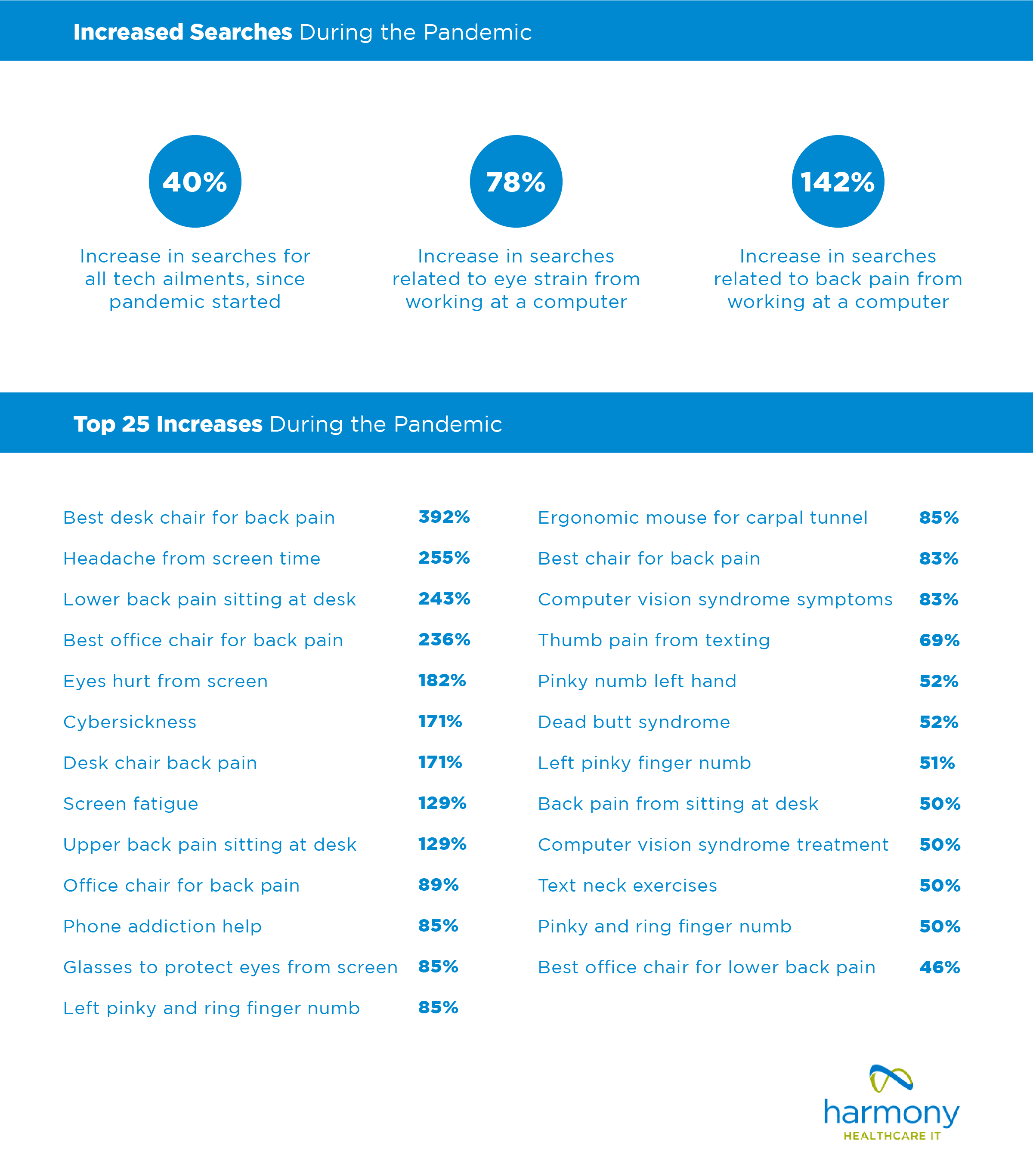
It’s clear that the pandemic took its toll on Americans’ eyes, backs and joints. Since October of 2019, searches related to back pain from working at a computer increased by an astounding 142 percent. And between Zoom work calls, Zoom happy hours and Zoom conferences, Americans were glued to their screens more than ever. Perhaps that’s why we found a 78 percent increase in searches related to eye strain from working at a computer. All those stresses combined might explain the 40 percent increase in searches for all tech ailments since the start of COVID-19.

If your order for a new chair for your home office was delayed, you weren’t the only one trying to fix your posture. Searches for the best desk chair for back pain have skyrocketed by 392 percent and searches for the best office chair for back pain went up by 236 percent since October 2019. All that increased time on phones and computers didn’t come without a cost either: searches for headaches related to screen time increased by 255 percent over the same period.

Some Americans may have also unfortunately discovered a new term over the last year: cybersickness. Searches for cybersickness, a cluster of symptoms that includes dizziness, eye fatigue and disorientation caused by staring at screens for prolonged periods of time, grew by 171 percent during the pandemic.

As dependency on technology in both work and personal life continues to increase, it will be interesting to see what steps Americans take in order to prevent tech-related aches, pains and ailments.

Methodology

We analyzed Google search volume queries related to technology aches and pains in every state to determine the most disproportionately popular terms. Our analysis also included increases in tech-related ailment queries since October 2019.

For media inquiries, contact media@digitalthirdcoast.net.

Healthcare IT tips, guides, news & more delivered to your inbox

Learn More

Summary

While the 21st Century Cures Act has focused on requirements for providers to share clinical information, other records are included in the longer-range guidelines. Revenue cycle records that support increased transparency into the cost and outcomes of a patient’s care join the Cures Act requirements in late 2022. What does this mean for an organization’s data management strategy?

Join Fellow Healthcare IT Pros

Tips, Guides, News & More

Sign Me Up
rev Cycle records need a strategy

The health information included in the scope of the  21st Century Cures Act soon will expand to include a broader range of data, all aimed at helping patients gain easier and virtually unrestricted access to their complete record set. While current attention is focused on clinical data, other administrative/revenue cycle records are included in the longer-range Cures Act requirements.

From a revenue cycle perspective, the Cures Act seeks to ensure transparency into the cost and outcomes of a patient’s care and to provide competitive options in getting medical care. Revenue cycle records that contribute to the capture, management and collection of patient service revenue can include:

  • Registration – Informs the patient record demographic set up and scheduling.
  • Insurance Coverage – Indicates payer plan billing information with insurance versus patient financial responsibility.
  • Point of Service Collections – Shows co-pay and deductible information so patients know what their portion of the bill will be in advance of service.

Being prepared with a well-rounded active and legacy data Cures Act strategy is vital for the IT, HIM, and Revenue Cycle departments.

First, there are deadlines to plan ahead for:

One major deadline was Jan. 1, 2022, when Medicare Advantage plans, Medicaid and CHIP managed care plans, and QHPs became required to share patient data with other payers. Payers must respond to requests from a patient to share their data, up to five years after their coverage ends.

Then, on October 6, 2022, the definition of EHI expands beyond the USCDI to all ePHI that is in the designated record set under HIPAA. This includes some financial information. There are options for providers in how they deliver patient access to records if the information is retrievable.

Next up, the current date for Conditions of Certification for EHI export rollout is May 1, 2023.

New ways of doing business may require revenue cycle employee training.

To assist patients, revenue cycle staff may need training on how to navigate the patient portal or other tools/processes to access requested records. While revenue cycle staff members may not be answering clinical questions, they may need to know how to work with HIM to respond to record requests – or vice versa.

Legacy data may need to be a part of the Cures Act strategy.

The time span required to retain the majority of healthcare data is seven to 10 years — but it is often even longer. As records dating that far back may not be stored in the current electronic health record or revenue cycle software, there may be a need to consider an active archive to meet those requirements if one is not already in place. Records from various legacy systems can be consolidated and secured in a HIPAA-compliant active archive. An intuitive user interface enables workflows for clinical and financial information management so teams can easily access and release historical records.

To learn more, listen to this podcast “Six Phases of Data Life Cycle Solutions: Put Health Data Archives to Work for You.”  And, check out this eBook: How to Manage Legacy Data in the Age of Information Blocking to recognize how successful legacy data management will benefit patients and inform your team about staying compliant with information blocking mandates.

Ebook-Info-Blocking

There’s a lot of data to track and be prepared to potentially share within the guidelines of the 21st Century Cures Act.

Most healthcare delivery organizations have legacy systems that store data in a read-only format.  Many of those legacy systems are outdated, yet, they contain critical data.  That means that these legacy systems may be ripe for a better long-term data storage plan – and one that takes release of historical clinical and financial information into account for compliance with the Cures Act. The Harmony Healthcare IT team works with healthcare delivery organizations of all sizes to make sure data is available, reportable, researchable, and interoperable.

Our full-service legacy data management solutions: HealthData Archiver®, HealthData AR Manager®, and HealthData Locker are ready to help your team meet its best practices  goals for complete lifecycle data management. We’re proud to announce Black Book Rankings, a division of Black Book Market Research ranked Harmony Healthcare IT as the top Data Archiving, Data Extraction and Migration company for the third year running (2019-2021).

Are you looking for a strong data management partner to help your team with a long-term strategy?

Let’s connect.

Healthcare IT tips, guides, news & more delivered to your inbox

Learn More

Summary

Telehealth in Canada is fueling investments in technology solutions that best support virtual healthcare delivery. As EHRs are replaced, record retention requirements vary greatly throughout the ten provinces and three territories (e.g., five years from the last date of entry in Quebec to 16 years from the last date of entry in British Columbia). As new solutions are on-boarded, legacy records need a secure, accessible, and compliant long-term home. That’s where the active archive, HealthData Archiver®, fits in.

Join Fellow Healthcare IT Pros

Tips, Guides, News & More

Sign Me Up
Canada-M-and-A

COVID-19 sparked an increase in the need for telehealth, with virtual care providers adapting and pivoting to meet the increased demand for services and accommodating the Canadian government’s funding and payment models. Before the pandemic, four percent of Canadians utilized telehealth services and since March 2020 that figure has increased to 47 percent. Even as the pandemic starts to slow down, telehealth services remain a popular option for many Canadians. In a recent survey, 8 out of 10 Canadians reported they would like to see online booking/scheduling, health services in local pharmacies and telehealth services continue. As such, there is a need to modernize healthcare delivery and a continued demand for high-tech solutions — especially those that support virtual care visits.

COVID-19 highlighted the need for increased investment in telehealth, which is predicted to grow in Canada at an 18.2 percent compound annual growth rate (CAGR) from 2022-2030 and will reach $18.532 billion in 2030. This growth is fueled by several factors including lack of access to healthcare in Canada which causes extremely long wait times partly due to a chronic shortage of physicians and compounded by the country’s geography.

Interestingly, 22 percent of Canadians do not have a primary care provider or nurse practitioner to support their overall healthcare needs. This can lead to problems that are not caught in a timely manner and increase reliance on walk-in clinics and emergency rooms. Virtual care for this population can be a game-changer with increased access to medical services.

Health Spending Growing for Technology Solutions

In its 2023-2024 Plan, Health Canada states a Core Responsibility is to: Work toward a modern, connected, world-class health system – Improve how health data is collected and used to better inform the care that patients receive. This, in conjunction with improved digital health systems, will allow Canadians to access their own health information in a timely manner.

The Canadian government announced it will spend nearly $200 billion, in addition to existing commitments, in the next ten years on healthcare in Canada. The government is supporting numerous technology-based efforts and had previously designated $13.4 million to a few Toronto-based telehealth companies and an “innovation hub” in the industry.

Connecting the Health System for a Healthier Canada

There are many initiatives underway to improve the connectedness of the healthcare system within Canada. One is a collaboration between Canada Health Infoway (Infoway) and numerous stakeholders including the government, health care providers, clinicians, and patients has its sights set on end-to-end healthcare data interoperability for all audiences. The primary goals of the collaborative effort include better accessibility for Canadians to access and share health data, a modernized health system built on connected care and improved data flow and better data to inform system-level planning. Currently, fragmented systems and lack of interoperability are a significant issue with only 34 percent of physicians able to exchange patient’s clinical summaries.

EHR System Replacement is a Natural Part of Health Information Evolution

About 93 percent of family doctors are using EMRs, but systems are not connected and few can share patient summaries or laboratory and diagnostic test results. This may result in EHR system replacements to better meet the healthcare provider’s evolving needs. Currently the top EHR vendors in Canada — in order — are MEDITECH, Epic, and Oracle Cerner. Epic is making strides in terms of market share growth and in customer satisfaction.

As EHR systems are upgraded and replaced, often there is a need to retain access to the health and business records for many years following a system replacement. As such, a record retention strategy and active archive plan is needed.

There are differences in retention requirements among Canada’s 10 provinces and 3 territories. In general, medical record retention in Canada is 10 years from the date of last entry or 10 years from when the patient reaches the age of majority or until the physician ceases to practice if some conditions are met. Overall, experts recommend retaining medical records in Canada for a minimum of 15 years.

The data management experts at Harmony Healthcare IT deliver data where it is needed.

Harmony Healthcare IT works with healthcare teams in Canada to map out and perform extractionmigration, conversion and long-term data storage strategies based on retention guidelines and the organization’s needs. It’s important that health data is available and actionable in either the go-forward EHR or the active archive. The Harmony Healthcare IT team can customize features to meet specific Canadian deployment needs, should that be that the archive support both French and English languages or other unique storage or data center and security features.

Upgrading an EHR should include a legacy data strategy that offers clinicians a single sign-on to maintain ongoing access to the complete patient record in Canada.

Harmony Healthcare IT is ready to help.

Let’s connect.

This blog has been updated from a previous version published Nov 11 2021

Healthcare IT tips, guides, news & more delivered to your inbox

Learn More

Summary

The SAFER Guides, introduced in 2014, help healthcare organizations address EHR safety using self-assessment tools. However, the Centers for Medicare & Medicare Services (CMS) has issued a final rule requiring hospitals to complete annual SAFER assessments for fiscal year 2022. Healthcare organizations should consider a 10th SAFER Guide, addressing legacy data best practices. The guide should include checklists, tools, and scenarios to ensure accessible, usable, secure, and compliant data. Archives need a seat at the table when addressing the overall safety of health information technology.

Join Fellow Healthcare IT Pros

Tips, Guides, News & More

Sign Me Up
SAFER-Guidelines-Blog

The SAFER Guides, introduced by the Office of the National Coordinator of Health Information IT (ONC) in 2014, enable healthcare organizations to address EHR safety with self-assessment tools for their health information technology, including:

  • High Priority Practices
  • Organizational Responsibilities
  • Patient Identification
  • CPOE with Decision Support
  • Test Results Review and Follow-up
  • Clinician Communication
  • Contingency Planning
  • System Interfaces
  • System Configuration

While adoption in using the Guides varies, there is increased attention on the Guides because in Aug. 2021, the Centers for Medicare & Medicare Services (CMS) issued a final rule that requires hospitals to attest to having completed an annual SAFER assessment of all nine guides for fiscal year 2022, per the Protect Patient Health Information objective.

Proponents of this rule suggest that this is good news for patient safety and health IT as problem areas can be discovered and remedied.

We suggest that healthcare organizations consider a 10th SAFER Guide: Legacy Data Best Practices

While the SAFER Guides address EHRs that store critical patient data, they do not address archives that also store patient data, plus financial and business records.

Like the current nine guides, the Legacy Data guide could include checklists and tools to support the rationale, risk assessment, best practices, worksheets, scenarios and follow-up activities to ensure that historical clinical, business and financial data is accessible, usable, secure and compliant.

For example, there is a recommended best practice in the current Guide for System Configuration (2.2) that states:

There is a role-based access system in place to ensure that all applications, features, functions, and patient data are accessible only to users with the appropriate level of authorization.

The accompanying worksheet discusses the rationale for having role-based access to ensure users only see, enter or modify data when necessary to perform their jobs. Further, it describes how organizations are expected to configure and maintain correct associations between the roles and the functions of the EHR and maintain correct assignments of user roles.

We agree with this guideline, but argue that it extends to ALL data, including legacy data in an active archive. Our HealthData Archiver®® active archive is configured with role-based security and access tracking that restricts and audits user activities by individual user, role, group and/or data source. It also includes Break the Glass capabilities.

The ONC suggests in its High Priority Practices Guide, that the potential benefits of EHRs may not be fully maximized unless the people responsible for their implementation, maintenance and use are prepared for and manage the new challenges and risks they create. They call it the “sociotechnical” focus needed to address the safety challenges and risks introduced by EHRs.

Archives need a seat at the table when looking at the overall safety of health information technology.

There are features and functions within the EHRs that should extend to archives when confirming that best practices are being followed. And, there are unique technical and security-related considerations for historical clinical, financial and operational data that need to be managed specifically in the archive.

After all, health data may spend more time in an archive than it spends in an active EHR.  

Want to learn more about legacy data and active archives?  We recommend the following resources:

  1. eBook: How to Manage Legacy Data in the Age of Information Blocking – Recognize how successful legacy data management will benefit patients and inform your team about staying compliant with information blocking mandates.
  2. Legacy Inventory Template – A helpful tool to guide the collection of all information needed about the organization’s legacy systems. This inventory is vital to support the data extraction, migration and retention process.
  3. 10 Privacy and Security Questions to Ask your Archive Vendor – to ensure you are asking the right questions to ensure your vendor partner will protect you and your data.

Considering that many organizations have 30-40 or more legacy systems that need a safe, secure and compliant long-term home for the data within their care. There are a lot of outdated systems – all of which contain critical data — that are ripe for a better long-term plan. The Harmony Healthcare IT team works with healthcare delivery organizations of all sizes to make sure data is available, reportable, researchable and interoperable. With an active archive solution you should expect to:

  • Lower costs
  • Reduce risk
  • Fortify cybersecurity defenses by decommissioning out-of-production applications
  • Make legacy data more accessible to users and patients

Our full-service legacy data management solutions: HealthData Archiver®, HealthData AR Manager®, and HealthData Locker are ready to help your team meet its best practices  goals for complete lifecycle data management. We’re proud to announce Black Book Rankings, a division of Black Book Market Research ranked Harmony Healthcare IT as the top Data Archiving, Data Extraction and Migration company.

We can help.

Let’s connect.

Healthcare IT tips, guides, news & more delivered to your inbox

Learn More

Summary

A rural health system in Mississippi is successfully implementing health IT solutions that would normally be found in larger metro areas. A state-of-the-art EHR, active archive – HealthData Archiver®, and an enterprise-wide imaging platform using AI tools is just the beginning. Learn how health IT supports #healthequity in an American Healthcare Leader interview with Kory Hudson, Director of Information Systems and Health Information Management at Singing River Health System.

Join Fellow Healthcare IT Pros

Tips, Guides, News & More

Sign Me Up
Rural-field-for-Health-Equity-Week

For the 15 percent of people nationwide who rely on rural healthcare, efforts to improve access, options and services can’t come soon enough.

Health IT solutions can play a major role in improving rural healthcare.

Kory Hudson, Director of Information Systems and Health Information Management, at Singing River Health System in the Mississippi Gulf Coast is leading the way in implementing health IT solutions that support the kind of high-quality care and experiences patients would expect in a major market.

Hudson and his team implemented the Epic electronic health record (EHR) which reduced paper records by 90% and saved $2 million. The organization also instituted Harmony Healthcare IT’s HealthData Archiver®® to consolidate and store patient and business records within an active archive that maintains secure access and allowed the decommissioning of many legacy systems.

Stepping up the IT offering behind the scenes directly supports front-line clinicians and helps ensure patients receive the best care possible.

“It’s our responsibility to provide the best technology and the best service with no interruptions,” Hudson shared in a recent interview with American Health Leader.

Hudson has many tech-based initiatives underway that use data, analytics and technology to improve outcomes and the patient experience.

Read the full article from American Healthcare Leader.

Healthcare IT tips, guides, news & more delivered to your inbox

Learn More

Summary

Harmony Healthcare IT, a leading innovator in enterprise active archiving, celebrates 15 years of creating award-winning health IT solutions like its flagship HealthData Archiver®. The company moved to its new headquarters in South Bend, Indiana, and is hiring technical and business development specialists. Harmony Healthcare IT is the only company in the greater South Bend area named to the 2021 “Best Places to Work in Indiana” list. The company is hiring for technical and business development roles, including remote positions.

Join Fellow Healthcare IT Pros

Tips, Guides, News & More

Sign Me Up
Ribbon Cutting at Harmony Healthcare IT

Oct 22, 2021. South Bend, IN – The volume of health data grows faster than any other industry and must be accessible, secure and usable for decades or longer. Harmony Healthcare IT, a leading innovator for enterprise active archiving, celebrates 15 years of creating award-winning health IT solutions, like its flagship HealthData Archiver®.  The company hosted a Ribbon Cutting and Open House at its new headquarters at 3454 Douglas Road in South Bend. Guests included South Bend Mayor and members of the South Bend Regional Chamber.

Harmony Healthcare IT is the only company in the greater South Bend area named to the 2021 “Best Places to Work in Indiana” list by the Indiana Chamber of Commerce and Best Companies Group. The company moved to its new building to accommodate its growing team that has expanded thirty percent over the past two years. The company currently is hiring technical and business development specialists.

“Our team represents the best of the best in healthcare technology strategists and developers who share core values to serve humbly, exceed expectations and never stop improving,” said Tom Liddell, CEO of Harmony Healthcare IT. “We’ve built some of the most comprehensive and respected integrated data management solutions in the industry, along with creating a really amazing company culture. These two things are interdependent and truly drive success and growth for everyone.”

“We are excited for Harmony Healthcare IT’s continued commitment to South Bend,” said Mayor James Mueller. “Growth of local businesses like Harmony is vital for our economy and our community’s success.”

“The new Harmony Healthcare IT office is not only beautiful but progressive at the same time. We are thrilled the global company made the decision to invest in the South Bend Region,” said Jeff Rea, President and CEO of the South Bend Regional Chamber.

Medical records that first existed in paper files and were stored in cabinet drawers, now exist mostly in electronic formats. Depending on the medical specialty or record type, some records might need to be kept for 25 years or more, and need to be secure and accessible to meet state, federal and even condition specific retention requirements. As the electronic health record (EHR) systems get replaced, often the medical records need to be retained, and this is where Harmony Healthcare IT’s integrated data management solutions come to life.

Harmony Healthcare IT is hiring for several technical and business development roles. There are opportunities to work at the headquarters in South Bend, IN as well as remote positions. For more information, visit the company’s career page.


Healthcare IT tips, guides, news & more delivered to your inbox

Learn More

Summary

Occupational Therapy (OT) is in growth mode due to the aging population and the success of OT treatments that support lower hospital readmission rates for patients with major health issues. During COVID-19, OT services were included in the approved telehealth services, and now, a new rule seeks to make permanent changes to allow home health visits for OT treatment. Regardless of where the treatment takes place, the medical record retention and archiving requirements remain the same and must be complete.

Join Fellow Healthcare IT Pros

Tips, Guides, News & More

Sign Me Up
bigstock-Physiotherapist-makes-occupati-271360144

The $27.3 billion U.S. Occupational Therapy (OT) market continues to grow steadily, with approximately 230,000 occupational therapy practitioners, assistants and students within more than 40,000 clinical and home care settings nationwide. The need for occupational therapists is expected to grow 17 percent through 2030, which is faster than the average of all occupations.

When COVID-19 caused an emergency shift to new ways of conducting medical appointments, OT joined a list of approved medical visits that became acceptable for telehealth practices. A new rule that expands the Home Health Value-Based Purchasing Model (HHVBP) would permanently change the home health conditions that were implemented during the COVID-19 Public Health Emergency (PHE). However, regardless of whether the therapy visit takes place online, at home, or onsite — medical record retention and archiving requirements for occupational therapy remain the same and must be complete.

Record retention requirements for occupational therapy visits vary by state, but generally are five years, with the exception of pediatric records that must be retained until 7 years after the age of majority (usually 18, but varies state by state). Some states and individual facilities may have more stringent standards for medical record retention. The HIPAA privacy regulations require that all medical records, signed consent forms, authorization forms, and other HIPAA-related documentation be retained for a period of 6 years. The Centers for Medicare & Medicaid Services (CMS) requires patient records for Medicare beneficiaries to be retained for a period of five years (see 42CFR482.24 (b)). However, Medicaid requirements also vary by state.

As occupational therapists support patients with individualized goals and evaluations to improve the person’s ability to perform daily activities, their documented occupational therapy electronic health record (EHR) is an essential piece of the overall health portfolio for the patient.

It follows, then, that as occupational medicine-specific EHRs such as WebPT, Therapy Rehab Plus, ClinicSource Therapy Practice Management, AC’s Clinic Controller and other HIS specialty-specific systems are upgraded or replaced, maintaining access to the therapy health and accounts receivable  information remains a retention requirement and best practice. That’s where it makes sense to include an active archive in an occupational therapy ER and data management plan.

Rated #1 by Black Book for Data Extraction, Migration and Archival for three years running (2019-2021), Harmony Healthcare IT is committed to quality, providing occupational therapy facilities with secure, compliant access to historical patient and billing records.

Is your occupational therapy facility replacing an older occ therapy EHR?  Do you need options for what to do with the legacy patient and billing records? Let’s connect.

This blog was updated from the original blog posted on June 18, 2020.

Ready to connect?

Contact us today to learn more about our healthcare data management solutions.

Healthcare IT tips, guides, news & more delivered to your inbox

Learn More

Summary

Harmony Healthcare IT, a leader in health data lifecycle solutions, is pleased to release HealthData Talks, a podcast that shares tips and trends for managing legacy data in healthcare settings. Available on Spotify, Amazon Music, Castos, iHeartradio, and Apple Podcasts, each episode of HealthData Talks lasts about 10 minutes. “The podcast allows us to feature...

Join Fellow Healthcare IT Pros

Tips, Guides, News & More

Sign Me Up

Harmony Healthcare IT, a leader in health data lifecycle solutions, is pleased to release HealthData Talks, a podcast that shares tips and trends for managing legacy data in healthcare settings. Available on Spotify, Amazon Music, Castos, iHeartradio, and Apple Podcasts, each episode of HealthData Talks lasts about 10 minutes.

“The podcast allows us to feature experts in short, information-packed episodes,” says Shannon Larkin, HealthData Talks host and VP of Marketing & Business Development at Harmony Healthcare IT.  “We hope the topics covered will elevate and simplify the conversation on legacy health data so those tasked with managing it can reduce risk and cost in healthcare by consolidating and protecting historical records.”

The podcast is aimed at healthcare professionals in information technology (IT), security, health information management (HIM), legal and compliance, revenue cycle, clinical care, human resources, and other roles interacting with patient, employee, or business records. Initial episodes cover topics such as:

To pitch new content, provide feedback, or become a guest on the podcast, email HealthData Talks producers at marketing@harmonyhit.com.

Healthcare IT tips, guides, news & more delivered to your inbox

Learn More