Summary

With more than 50% of U.S. adults reporting negative behavioral health symptoms related to the pandemic, healthcare IT is stepping up with tools and systems to provide robust telemental health services.

Join Fellow Healthcare IT Pros

Tips, Guides, News & More

Sign Me Up
Half full and half empty glass. Life philosophy of optimist and pessimist

More than half of U.S. adults have reported that worry and stress related to COVID-19 has negatively impacted their health. Interestingly, the front runners of the many initiatives aimed at supporting mental health care efforts have one thing in common: they are all technology based.

Virtual care is here to stay

While the pandemic forced the healthcare industry to shift in many ways, there are some positives in the advancements of telehealth delivery, especially for telemental health services (online therapy sessions).

According to the 2021 Large Employers’ Health Care Strategy and Plan Design Survey, 91% plan to offer telemental health services in 2021, with an anticipated growth to 96% by 2023. Plus, 88% plan to offer access to mental health apps, videos, and articles. And, while about half already provide manager training to identify mental/behavioral health issues, about 18% plan to add this in 2021.

EHRs enhance mental health-related offerings

  • Recently, the Epic App Orchard marketplace listed its first mental health platform. This integration allows clinicians to view patient engagement data and clinical measure scores through the application.
  • Cerner has updated its behavioral health EHR workflows to help streamline COVID-19 identification and screening. This includes new dashboards to give leaders broad and updated views of key information around hospital capacities and other critical metrics.
  • Cerner also is offering a free video platform to rural hospitals that use its CommunityWorks EMR through 2021.

Legacy data management important in protecting and serving-up the complete patient record

Important to healthcare technology success is access to the complete patient record. This longitudinal view is especially important with historical mental health records that can provide critical information to support overall patient care and help deliver better outcomes.

HealthData Archiver® is a secure record-storage solution that seamlessly integrates legacy records into a searchable and easy-to-use format so that important records are at your fingertips anytime you need them. With Single Sign-On capability to the active EMR, clinicians have access to the complete patient record at the point of care, whether that be bedside, in an office, or through a telehealth visit.

Medical record retention laws vary state to state and by condition, spanning 20-30+ years in some cases. Providers of all sizes, and in all locations, need to have a technology game plan that makes medical records — both active and historical — accessible.

Is your behavioral/mental health organization considering implementing a new behavioral health EMR to better manage the increase in mental health visits due to the pandemic?  Whether you’re implementing or replacing behavioral health EHRs such as Anasazi, CareLogicEHR, Netsmart, myAvatar, Credible, Accumedic, DrChrono, InSync Healthcare Solutions, Mindlinc, NextGen, SimplePractice, ThereapyNotes or Valant — you need legacy health data access.

As an award-winning health data management firm ranked #1 in the 2020 Best in KLAS Software & Services Report as a Category Leader in Data Archiving, we can help.

Ready to connect?

Contact us today to learn more about our healthcare data management solutions.

Healthcare IT tips, guides, news & more delivered to your inbox

Learn More

Summary

With physicians spending an average of five minutes for chart review per patient visit, it is important to make the all the data readily accessible. A consolidated archive of historical patient records with single sign-on access from the go-forward EHR can significantly enhance workflows and reduce time. This improves the experience of both the physician and the patient. With HealthData Archiver® from Harmony Healthcare IT, this single sign-on feature is available for most major EMR brands, such as Epic, Cerner, Allscripts and Athena.

Join Fellow Healthcare IT Pros

Tips, Guides, News & More

Sign Me Up
Close-up Of Male Doctor's Hand Using Computer for EHR

On average, physicians spend 16 minutes and 14 seconds using the EHR for each patient they see. About five of those minutes are for chart review while the rest of the time is for documentation and ordering. Those five minutes need to provide the physician with the complete medical record and information needed to best serve the patient.

Single Sign-On from the go-forward EHR to an active archive such as HealthData Archiver® provides clinicians with instant accessibility to the historical patient record. From their EHR, clinicians seamlessly connect, in patient-context, to the legacy medical record. This game-changing feature is available for most major EMR brands, including Epic, Cerner, Allscripts and Athena. It also supports numerous formats including: Oauth/OpenID, Advanced Encryption Standard (AES), Security Assertion Markup Language (SAML 2.0) and others.

As clinicians rely on the EHR at the point of care, the complete medical record should be available to efficiently tell the whole patient story. This includes the most recent problems, allergies, medications, immunizations, procedures, and results, as well as legacy notes about relevant past encounters.  With a seamless connection between the go-forward EHR and active archive, gone are the days of searching through multiple systems to access information.

While there isn’t a one-size-fits-all answer for legacy data availability, HealthData Archiver® offers the flexibility necessary and ensures critical health data is available when, where and how it is needed. This improves work flows, provides accurate data for patient care and supports efficient search.

HDA SSO Brochure

SSO Video Demo

As EHR systems age or are replaced with a new go-forward platform, there are decisions that need to be made about how much data should be migrated to the go-forward EHR and how to securely store the remaining legacy data in an active EHR archive.

The data management experts at Harmony Healthcare IT deliver data no matter where it is needed.

We work with healthcare teams to map out and perform extraction, migration, conversion and long-term data management strategies based on retention guidelines and the organization’s needs. It’s important that your health data is available and actionable in either the go-forward EHR or the active archive.

Single Sign-On is just one feature that Harmony Healthcare IT EHR archiving clients appreciate. In the 2020 KLAS Research Performance Report, clients reported:

“The HealthData Archiver® software is integrated and easy to use. Patient records are easy to find. Other high points are that auditing and release of information capabilities work well.”

“Harmony Healthcare IT is absolutely part of our long-term archiving strategy. The product has been very easy to use. I think the benefits of it have been that we don’t have to keep aging equipment and systems around; the product has allowed us to retire and sunset additional software systems. From our standpoint, that helps with security and maintenance, and we don’t have to have FTEs maintain those old systems.”

Strong, useful product features also support the fact that 100% of clients surveyed by KLAS report that Harmony Healthcare IT is part of their organization’s long term plans. Ranked #1 in the category of data archiving by KLAS Research and with experience with more than 500 different EMR systems, Harmony Healthcare IT team members stand ready to roll up their sleeves and help healthcare IT teams work through their health data management projects.

Ready to organize your health data and offer clinicians a single sign-on to maintain ongoing access to complete patient records?

Let’s connect.

Healthcare IT tips, guides, news & more delivered to your inbox

Learn More

Summary

With years of medical data storage experience, Harmony Healthcare IT, the makers of Health Data Archiver, has created a sample RFP template that healthcare IT teams can utilize as a starting point to help ensure they choose the right health data storage solution.

Join Fellow Healthcare IT Pros

Tips, Guides, News & More

Sign Me Up

Download RFP Template for EMR Storage

Have old systems to decommission? Looking for an EMR storage solution? We can help.

We know the costs of running a legacy health software application.  Those costs, as well as IT labor burden and technical risk, only continue to add up over the long haul. Choosing a reliable and experienced vendor for your EMR storage is a critical first step in meeting state medical record retention requirements, as well as, HIPAA regulations.

Many healthcare organizations, especially those with an extensive inventory of legacy systems in their IT portfolio, release a request for information (RFI) or request for proposal (RFP) as a means of systematically gathering information about data extraction, migration, and retention vendors. It’s a great way to compare apples to apples when it’s decision-making time for EMR storage.

Are you trying to formulate a software retirement plan? Are you charged with gathering proposals from numerous vendors? Do your archiving needs extend beyond patient data into human resource/payroll, general ledger, or accounting data? Again, we can help.

10 Security Questions

With years of medical data storage experience, Harmony Healthcare IT, the maker of HealthData Archiver®, has created a sample RFP template that healthcare IT teams can utilize as a starting point to help ensure the right EMR data storage solution is chosen.

Ask the right questions. Get the right answers.

Download the Legacy System RFP Template so you can move forward, simply.

Healthcare IT tips, guides, news & more delivered to your inbox

Learn More

Summary

EHR leaders Cerner and Epic offer cost-effective programs that allow smaller healthcare facilities to link into a larger local hospital’s EHR network to enhance interoperability with the nearby health system as well as to provide a lower cost EHR implementation. A more complete continuity of care, which can include access to legacy records, supports improved outcomes for the 20 percent of Americans who live in rural areas and often have more long-term chronic conditions then their urban counterparts.

Join Fellow Healthcare IT Pros

Tips, Guides, News & More

Sign Me Up
Rural Healthcare

Healthcare accessibility for the 57 million Americans who live in rural communities is the main driver behind National Rural Health Day. The National Organization of State Offices of Rural Health has set aside the third Thursday of November since 2011 to focus on collaboration, education, communication and innovation to improve health in small towns around the country.

In terms of health IT innovation, EHR adoption and interoperability have made steady gains in the last several years, but rural health providers still face challenges in sharing records. Thankfully, EHR market leaders Cerner and Epic each have addressed this critical need by adding platforms within their systems to assist rural hospitals and clinics.

  • Cerner’s CommunityWorks provides an integrated digital record of a patient’s health history that includes clinical and financial data across the continuum of care. This ability to share information across facilities takes advantage of Cerner’s expertise in IT and process improvement to help shift rural healthcare to more proactive health management.
  • Epic’s Community Connect allows hospitals to connect to a larger local hospital to access the Epic EHR network. This enhances interoperability and provides a uniform electronic health record among provider facilities. The benefits include a better coordination of patient care, avoidance of duplicate testing/procedures and more opportunities to measure quality and manage costs.

These EHR market leaders offer a means for rural healthcare providers to provide local care with state-of-the-art technology. This is important considering that 60 percent of Americans live with at least one chronic disease that can benefit from treatment over a long period of time. And, rural areas tend to trend higher than the national average for seven main chronic diseases, including: high cholesterol, high blood pressure, asthma, diabetes, heart disease, arthritis, depression and chronic obstructive pulmonary disease (COPD).

Further, medical record retention laws vary state to state and by condition, spanning 20-30+ years in some cases. Providers of all sizes, and in all locations, need to have a technology game plan that makes medical records — both active and historical — accessible.

As a pioneer in patient, employee, and business record archiving, Harmony Healthcare IT has worked with more than 500 clinical, financial and administrative software brands in the areas of data consultation, extraction, migration, and retention. HealthData Archiver®® consolidates health information silos with as part of a storage platform that provides secure and easy access to legacy records. With Single Sign-On, clinicians are able to access health data and the complete historical patient record in-context from within the active instances of Epic Community Connect or Cerner CommunityWorks – as well as Allscripts and other leading EHR brands.

As technology continues to enable healthcare to advance across even the most remote of rural areas, we are encouraged by the opportunity to deliver legacy records wherever they are needed. And, telehealth continues to play an essential role in healthcare delivery — especially until Americans are ready to opt for a yet-available COVID vaccine — we support that the documentation requirements for a telemedicine visit are the same as a face-to-face encounter. The information about the visit, history, review of systems and consultative notes must be documented and retained.

Is your team charged with keeping the flow of health data moving across its entire lifecycle? Do you need legacy health data availability from your remote clinics as well as onsite at a healthcare center? Are you concerned about how to meet the 21st Century Cures Act requirements?

As an award-winning health data management firm ranked #1 in the 2020 Best in KLAS Software & Services Report as a Category Leader in Data Archiving, we can help.

#PowerofRural

Healthcare IT tips, guides, news & more delivered to your inbox

Learn More

Summary

Cyberattacks on healthcare are not letting up. The latest warning from several federal agencies says the newest threat could be the “most significant” the country has ever seen. Healthcare providers continue to grapple with protecting their PHI, attempting to secure the vulnerable “doors and windows” on the network that lead to legacy systems containing medical records.

Join Fellow Healthcare IT Pros

Tips, Guides, News & More

Sign Me Up
CyberSecurity

Ransomware in healthcare is spiking again. The FBI, Dept. of Homeland Security and Dept. of Health and Human Services issued a warning in October of a credible and imminent cybercrime threat that could reach up to 400 hospitals according to industry analysts. While cyber criminals have been steadily launching rebranded ransomware strains of the Ryuk virus, healthcare continues to be a go-to target again and again.

The Associated Press reports that a total of 59 U.S. healthcare providers have been impacted by ransomware in 2020, disrupting patient care at more than 500 facilities.

The latest cyber threat is being called the “most significant” the country has ever seen.

Recently, Universal Health Services (UHS) with its 250 facilities was targeted in September with a massive ransomware attack that shut down its IT networks completely and took the better part of three weeks to be restored. News reports aren’t clear how much the hackers demanded in ransom, or if the health system paid the demand.

While some feel the federal warning itself could help avert the worst results as hospitals step up precautions or expand efforts to knock down the systems cybercriminals use to launch the attacks, there is an important steps to take to keep PHI — especially in legacy systems — protected.

Decommission Aging, Out-of-Production Applications

Multiple silos of data stored in outdated systems offer some of the easiest entry points for hackers. Legacy systems that are running in read-only mode are vulnerable to technical breakdown, cyberattack or even internal threats. Less open doors and windows to defend as cyber crime entry-points is a smart and necessary step in your organization’s long-range security plan.

Our team of extraction and migration experts help healthcare delivery organizations decommission legacy systems, and safely consolidate patient, employee and business records.  Since 2006, our team of experts has extracted, converted, migrated and retained records from over 500 different clinical, financial and administrative software brands. That information is secured on our cloud-based platform, HealthData Archiver®, which is live in production on Epic’s App Orchard.

Security Benefits of Working with Harmony Healthcare IT and Retaining Records in HealthData Archiver®:

  1. HITRUST Certification. Harmony Healthcare IT has earned HITRUST CSF Certification. That means we meet an extensive set of security-focused controls that comply with the requirements of multiple regulations and standards. Our certification demonstrates that we adhere to exacting security measures to protect patient data, appropriately managing risk involving data protection, availability, confidentiality, processing integrity and privacy.
  2. Single Sign-On (SSO). SSO is a feature we built into HealthData Archiver® that eliminates the need for manual login by clinicians seeking access to historical records. SSO seamlessly connects clinicians from the active EHR, in context, to the patient’s historical medical record. SSO for HealthData Archiver® is available for major EMR brands with Oauth/OpenID, Advanced Encryption Standard (AES), Security Assertion Markup Language (SAML 2.0) and other formats supported.
  3. Role-based Security/Audit Trails. Privacy and security for legacy data stored in an archive is as important as for active EHR records. Within HealthData Archiver®, rights and activities can be restricted and audited by user, role, group, and data domain/source. Role-based security and access controls are built in. User audit logs are HIPAA-compliant and include the unique user ID, data subject ID, function performed, and date/time event was performed.  With Third-Party Auditing Integration, unusual user activity may be monitored to prevent internal threats.
  4. Break the Glass. Protecting the privacy and security of all medical records, both current and legacy—including those of high-profile patients—is important. HealthData Archiver® has numerous features built-in to manage, audit and protect legacy health records. Break the Glass provides:
    • End user access to privileged patient information only when necessary or in the event of an emergency, requiring that a reason to access the patient record be indicated.
    • A Client Administrator option to add a Gatekeeper who is responsible for managing Care Team Member access for Highly Classified patients.
    • Extra additional security measures, including explicit auditing of user authentication, authorization, and data level access.

If your provider organization needs help protecting legacy records in this hostile, hacker-centric environment, Harmony Healthcare IT, a leading and award-winning health data management firm, is ready to lend a hand.

We’ve also developed several resources that provide further information about securing legacy healthcare data and deflecting cyberattacks:

Cyber Security White Paper

10 Security Questions

Protecting Healthcare During Pandemic

Bottom line: Active Archiving is the one big defensive move your healthcare organization can take immediately to protect its EHR, ERP, and HR systems to keep cyber criminals locked out.

Let’s connect.

Healthcare IT tips, guides, news & more delivered to your inbox

Learn More

Summary

Data is in a race. And, it’s gaining momentum. By 2025, global estimates suggest 463 exabytes of data will be created each day. While it is difficult to picture the overall volume of data in the world, one visual is that with 44 zettabytes of data in the current digital universe, this represents 40 times...

Join Fellow Healthcare IT Pros

Tips, Guides, News & More

Sign Me Up
Server Room Data Storage

Data is in a race. And, it’s gaining momentum.

By 2025, global estimates suggest 463 exabytes of data will be created each day. While it is difficult to picture the overall volume of data in the world, one visual is that with 44 zettabytes of data in the current digital universe, this represents 40 times more bytes than stars in the observable universe.

Then, consider that the overall volume of all electronic data realistically doubles every two years. And, that healthcare data outperforms this estimate and is expected to be the highest data growth business sector with a compound annual growth rate (CAGR) of 36 percent through 2025.

One thing is clear. The volume of health information continues to skyrocket.

Big Data is a Big Job
Experts realize the potential for big data to improve patient outcomes and population health, while at the same time warning that without proper governance models, interoperability standards and developer platforms, the flood of medical information being collected and stored could become unmanageable.

Archives Offer Solutions – Know Your Options
It is a smart and economical choice to engage an archive, or two, to support the long-term data management strategy for your healthcare organization. However, not all archives serve the same goals, so it is important to understand the key features of the distinct models.

Note: One important point to remember is that backups are NOT archives. Having a backup copy of your data is a necessary security measure, but without searchability, backups are very different than an archive.

Active Archive – An active archive gives you access to your data, all the time. There is a process to determine which data is stored in an active archive and healthcare organizations are assured of secure long-term (to indefinite) access to legacy EHR data. An active archive is a combined solution of open systems applications, disk, and tape hardware that gives users an effortless means to store and manage data. Using this intelligent data management framework, cost reduction per Terabyte can be up to 75%. (Source: www.activearchive.com) Our HealthData Archiver® (HDA) is an example of an active archive with its easy-to-use interface that allows healthcare professionals to query, search, view, addend and even purge specific EHR or ERP data. It also alleviates the costs and hassles of maintaining out-of-date platforms and vulnerable legacy software systems.

Deep Archive – or Deep Storage, is suited to cases in which a raw form of data is retained, but, does not require frequent or immediate access when needed. For example, a vendor like Harmony Healthcare IT may store the raw data and, with lead time, provide access to it for a client as needed, under contract. Or a provider may retain the data in deep storage themselves. In healthcare, deep archives might account for about 25% of legacy data – or more, as desired, as alternative storage. The data could be needed and accessed at some point to satisfy an eDiscovery need or some other unknown purpose, but it is not needed on a regular or immediate basis.  (Source: www.activearchive.com)

More Changes on the Horizon — Are our current EHRs up to the challenge?
Managing current and legacy data is a juggling exercise that takes a truly integrated team effort and robust EHR systems. It’s estimated that the 1,000 EHR vendors ten years ago has dwindled to about 400 who are racing to improve their products to deliver expanded functionality to continue to compete. In a Harris Poll survey of 521 physicians for a Stanford Medicine research project, seven out of ten physicians (67%) think solving interoperability deficiencies should be the top priority for EHRs in the next decade.  In that same survey, six out of ten physicians (59%) think EHRs need a complete overhaul. With those thoughts in mind, we see a lot of system replacements and market consolidation continuing in the future.

As production EHR systems and technologies continue to evolve, archives will continue to play a critical role in shoring up disparate legacy records from systems that become sidelined for one reason or another.

Our team is versed and experienced in archives. We can help you navigate your legacy data management strategy to be the most efficient and cost-effective process for your organization.

Are you ready to talk about archives? We can go deep (and/or active). Contact us today.

Note: Content has been updated from a blog that originally posted Jun. 6, 2018.

Healthcare IT tips, guides, news & more delivered to your inbox

Learn More

Summary

Hear perspectives on best practices for healthcare data management from a recent webinar we presented with healthsystemCIO. The panelists share tips spanning seven key areas that support system decommissioning and eliminating bloat in the IT portfolio.

Join Fellow Healthcare IT Pros

Tips, Guides, News & More

Sign Me Up
Webinar Recap

Cost containment is the driver for healthcare providers of all sizes. With the pandemic impacting hospital revenues, and organizations taking a hard look at their application portfolios, there are opportunities to reduce cost and risk by following a data consolidation strategy and legacy system wind down.

Our team recently hosted a webinar facilitated by Anthony Guerra, Editor-in-Chief at healthsystemcio.com. The discussion covered seven key areas to consider for lifecycle data management. We appreciate the time and thoughtful perspectives shared by the three panelists who joined our very own Jim Hammer, VP of Operations and Product Development. Panelists included:

Webinar Panelists
webinar Panelists

    1. The driving question is: Is it possible to reduce IT spending by reducing the application portfolio?
      “Definitely…The ultimate strategy is to try and offload the data onto a single archiving solution so that you no longer have to pay for support, because you obviously are obligated to save the data and retain it for a number of years… It is a huge cost saver. It is great that there are solutions out there to aggregate all the data into a single archive,” shared Hudson.”Our record retention policy for most clinical data has a 20-year life. Luckily on our side, our leadership committee is committed to this initiative and I think that makes a big difference. They understand the upfront cost, but they can see the long-term benefits from doing this work,” added Branigan.

      “Sometimes you have to spend money to save money. You need to look at the return on investment,” added Duryee.

      Looking at the cost for maintaining legacy systems and applications, there are three areas to obtain savings with an archive vs keeping the legacy system up and running in read-only mode:

      • Hard costs – Maintenance costs, renewals, infrastructure costs for servers
      • Soft costs – Staffing and ensuring support is onsite to support legacy applications
      • Risk costs – Security, compliance and risk aversion if data is not available due to a technical breakdown or compromised by a security breach
    1. Over time, providers may find their application portfolios are bloated. How can this be stopped?
      “We are entering into new partnerships with other health systems and practices, so that is the main cause of how our application portfolios get out of whack. We find ourselves with several applications that are doing the same thing, so when we do an integration of a new practice or a new hospital, we have teams that will go through what applications we are bringing on board and whether it’s a duplicate from our standard,” said Branigan.”We have had some niche systems, but really back to the ROI, we have one central committee that approves or disapproves standalone systems. That is important to do that centrally,” added Duryee.

      “You need an overall organizational strategic plan, so that each department isn’t on their own path and you end up with all these disparate systems,” added Hudson.

    2. What are some techniques for application portfolio management?
      “Usually what happens is we will work with our clients to build an inventory list and the things that are obvious maintenance costs like renewal dates of those applications for maintenance contracts… certain contracts have annual renewal contracts that can be negotiated down to quarterly or monthly renewals so when systems come offline those costs can be minimized,” shared Hammer. “Risk may elevate a certain application to the top of the decommission list. We have had some really unstable environments and downtime scares people… And, with acquisitions we will help with the playbook to help develop an archive plan based on past policies, procedures, compliance and governance. Our inventory tool can be helpful too.”
  1. What types of buy-in from stakeholders is needed as you go through the archiving process? What is the CIO’s role and IT’s role?“A lot of organizations put governance in place for a system implementation… but legacy data doesn’t get the attention it needs and becomes a supporting project. It is an important point upfront with your governance committees to decide on the legacy data,” shared Duryee.”IT’s role now has reached a pinnacle where they need to lead. With all the regulations and compliance, it is often my job to find solutions for other folks and to think ahead of what our operational leaders are wanting to do and put solutions in front of them,” added Hudson.

    “We have a record retention steering committee that meets monthly. It is made up of Legal, Compliance, HIM, IT, etc. We review these projects and determine whether or not it is in the best interest of the long-term strategic plan to archive this data,” said Branigan.

  2. How do you ensure sunset applications and data transfer still ensures data quality and security?
    “This is easier for smaller applications and more difficult for full EMRs, but ensuring data quality is so crucial. We go through a very, very stringent validation process for every application we archive. We keep the source application around and when the archive is at the stage where we can test it and validate it, we have a full team on our end that goes in, brings out 10-20 patients and looks at every single piece of data in that patient record, compares it to the data that was archived to ensured everything was copied over,” shared Branigan.”Time required to validate the data needs to be added in… You really need to look at legacy vendors. What is their longevity going to be and their willingness or ability to negotiate? We had a situation with a one-year contract with a legacy vendor and then wanted to go month-to-month. The premium to do that was cost prohibitive, so it accelerated our plan to archive,” added Duryee.”We do an automated level of testing, for record row counts, then we do a heavy set of similar verification of side by side comparisons. So much so that we built a communication protocol into our application for submission of validation items that are found during that phase. This can shrink timelines from two to six weeks on average. We also invested in HITRUTST certification which includes more than 400 control measures that we have to meet to make sure we are good stewards of the data,” added Hammer.
  3. How do you encourage users to agree with sunsetting an application to avoid the “hanger-on” effect that we can’t shut it down for X reason?
    “The steering committee has to have a list of what they are charged with, they have to hold firm and really look at ROI and not just personal preference,” shared Duryee. “And, have demos and allow end users to bring in sample records, instead of a heavy-handed approach.””Give a demo and share the goals. (Explain) we want this data to be moved over and this is what it is going to look like. Once you do that, they quickly get on board and it’s not as painful of a process because the way our active data looks is very similar to the original application,” added Branigan.
  4. Is there a strong value proposition in moving the archive to the cloud?
    “About 80-90 percent of our customers choose the hosted option. The price points have come down and there are benefits from a maintenance perspective as well in the cloud. If you upgrade one item it upgrades all using the remotely hosted environment vs.  CAB (change advisory board) processes and individual customer-related downtime for upgrades,” shared Hammer.

Watch Webinar

Looking for a healthcare data management firm with deep experience migrating and archiving patient, employee and business records? Our team of experts has extracted, converted, migrated and retained data from over 500 clinical, financial and administrative software brands.

That information is secured on our cloud-based storage platform, HealthData Archiver®, which is live in production on Epic’s App Orchard. Harmony Healthcare IT has been ranked #1 in the 2020 Best in KLAS Software & Services Report as a Category Leader in Data Archiving, and as the top data extraction and migration healthcare IT company according to Black Book Market Research in 2019 and 2020. We were also selected by Modern Healthcare as one of the 2019 Best Places to Work in Healthcare.

Let’s connect.

Healthcare IT tips, guides, news & more delivered to your inbox

Learn More

Summary

Survey: How Many Americans Will Get a COVID-19 Vaccination? From working to socializing, COVID-19 has altered the way we live our lives. Words like “social distancing” and “quarantine” have become commonplace since the pandemic broke out and we have learned how to adapt to living under a “new normal” until a COVID-19 vaccine is developed....

Join Fellow Healthcare IT Pros

Tips, Guides, News & More

Sign Me Up
Covid-19 Vaccination

Survey: How Many Americans Will Get a COVID-19 Vaccination?

From working to socializing, COVID-19 has altered the way we live our lives. Words like “social distancing” and “quarantine” have become commonplace since the pandemic broke out and we have learned how to adapt to living under a “new normal” until a COVID-19 vaccine is developed.

As a health data management firm, Harmony Healthcare IT was curious to learn how many Americans would agree to receiving a COVID-19 vaccination if an effective one was produced.  We surveyed 2,000 Americans to get a better understanding of the public’s views on a potential vaccine, who should be vaccinated first and when they expect a return to normalcy. Considering the impact of flu season during the pandemic, we also asked respondents whether they intend to or have already gotten a flu shot.  For context, we analyzed 10 years of flu shot coverage data by state.

COVID-19 Vaccine

Covid Vaccine

Pharmaceutical and biotechnology companies like Pfizer, Moderna and AstraZeneca have shown promising results for vaccine candidates, but even if a vaccine is developed, a larger hurdle will be to get buy-in from the public to receive it.

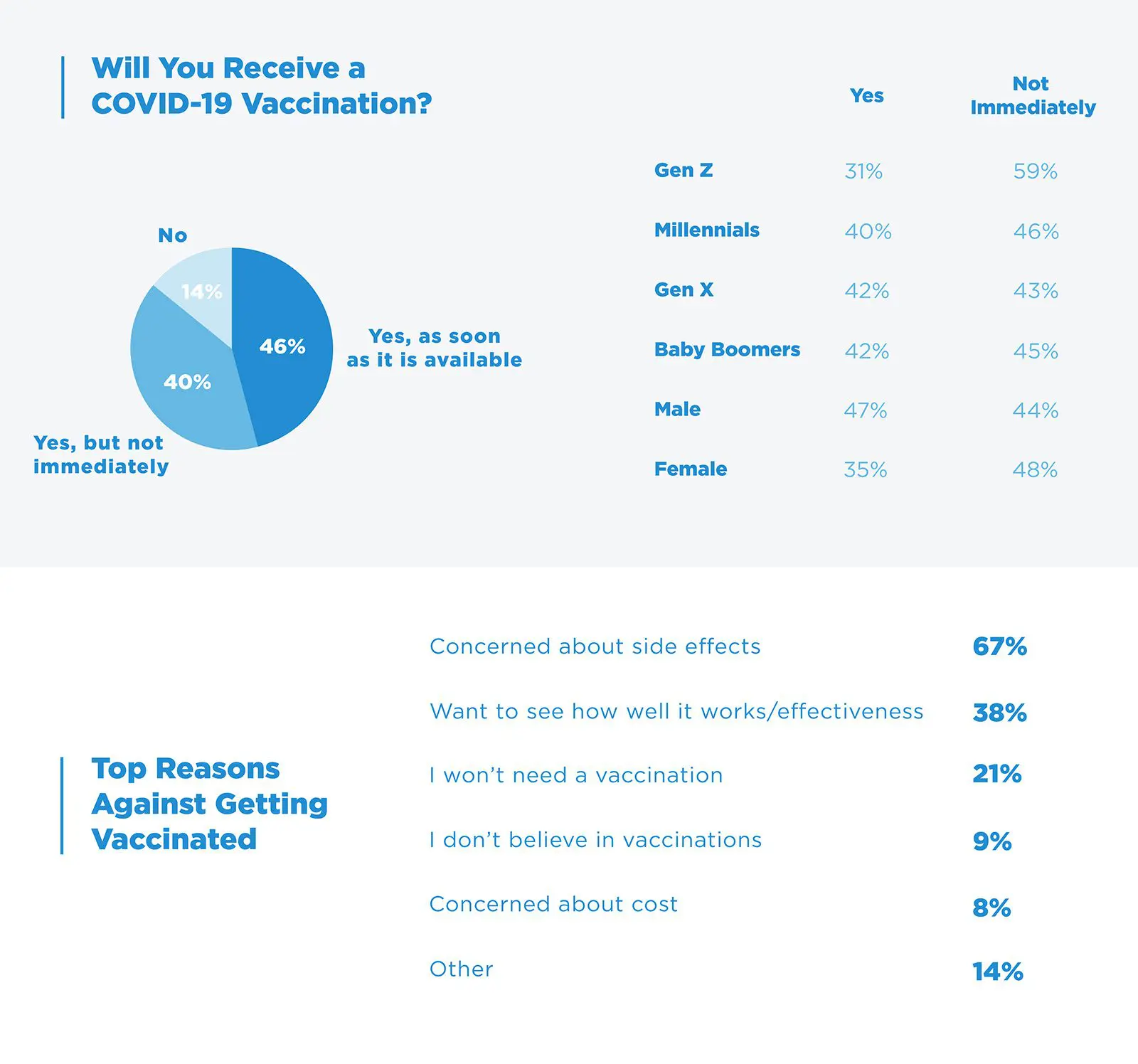
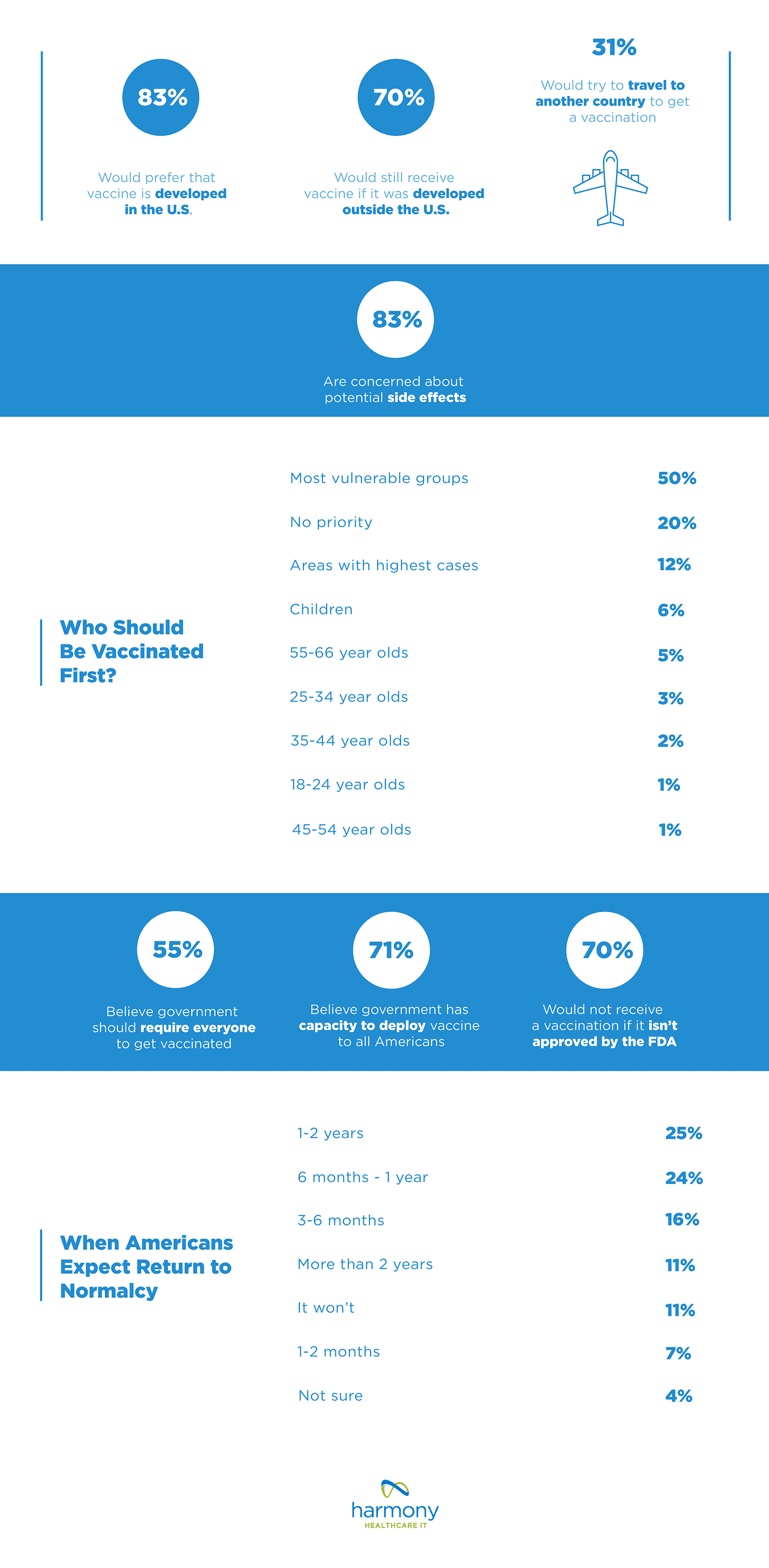
According to survey respondents, 46% say they would receive a COVID-19 vaccination “as soon as it is available.” Others say they would like to receive a vaccination (40%) but prefer to see how effective and safe it is before receiving it. The remaining 14% say they will not receive a vaccine under any circumstances. Concerns about potential side effects were the main reason why respondents said they wouldn’t be vaccinated.

In terms of generational differences, Gen X and baby boomers were the most likely to say they would receive a vaccination as soon as they could while Gen Z were the least likely. Males were also more likely than females to say they would be vaccinated as soon as they could.

When Will a COVID-19 Vaccine be Produced?

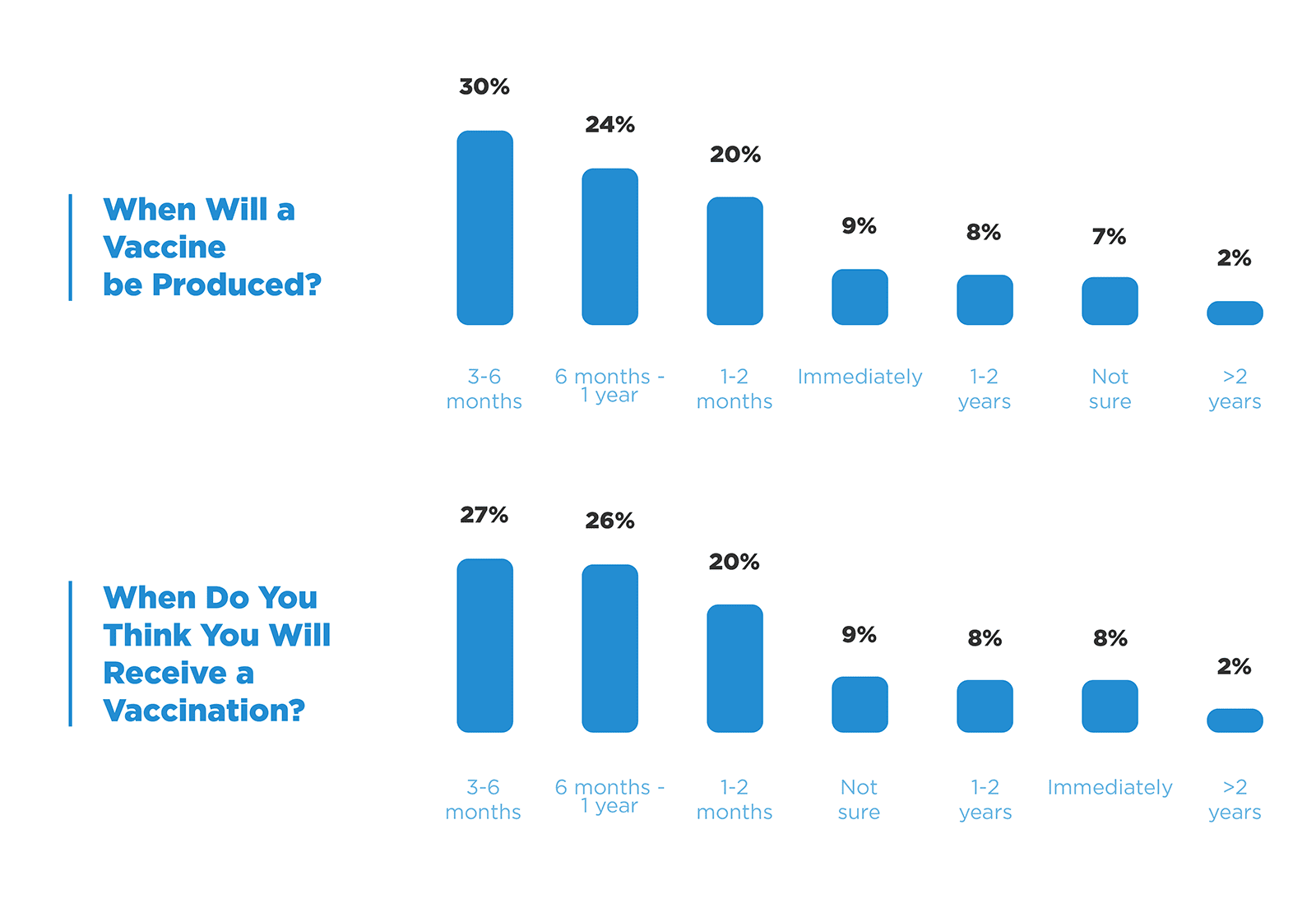
While there are no guarantees, many Americans feel that it’s a matter of time before a vaccine is developed. A majority (54%) feel that a vaccine will be produced within one year. However, producing a vaccine and deploying a vaccine are two different obstacles and it will most likely take time before everyone receives it.

According to respondents, 27% believe they will be able to be vaccinated within 3-6 months of a vaccine being developed and 26% believe it will take 6 months to one year.

Covid Vaccine Produced

Who Should be Vaccinated First?

Most respondents (50%) agree that the most vulnerable and susceptible populations should be the first to receive a vaccination. According to Centers for Disease Control and Prevention (CDC), adults of any age with underlying medical conditions such as cancer, COPD (chronic obstructive pulmonary disease), heart disease and severe obesity, among other conditions, are at increased risk of developing severe illness from COVID-19.

Vaccination

Most respondents (55%) also agree that the federal government should require or mandate all Americans to receive a vaccination and 71% believe that the government has the capacity to deploy a vaccine to everyone.

Return to Normalcy

From concerts and movies, to family reunions and weddings, it’s fair to say that Americans are eager to get back to pre-pandemic life. But a return to normalcy hinges on an effective vaccine that can be deployed to the public. Once Americans are vaccinated, a quarter of respondents feel that it will still take between 1-to-2 years before a return to normalcy while 24% believe it will happen sooner (6 months to a year).

COVID-19 and Flu Season

Infectious disease experts have raised concerns over increased COVID-19 infections and the flu season, which could overwhelm hospitals if Americans do not take precautions.

One of the most effective ways to take precautions this flu season is to receive a flu shot, according to health experts. Harmony Healthcare IT analyzed CDC flu vaccination coverage in every state to see where Americans are receiving a flu shot.

Which States are Getting Flu Shots?

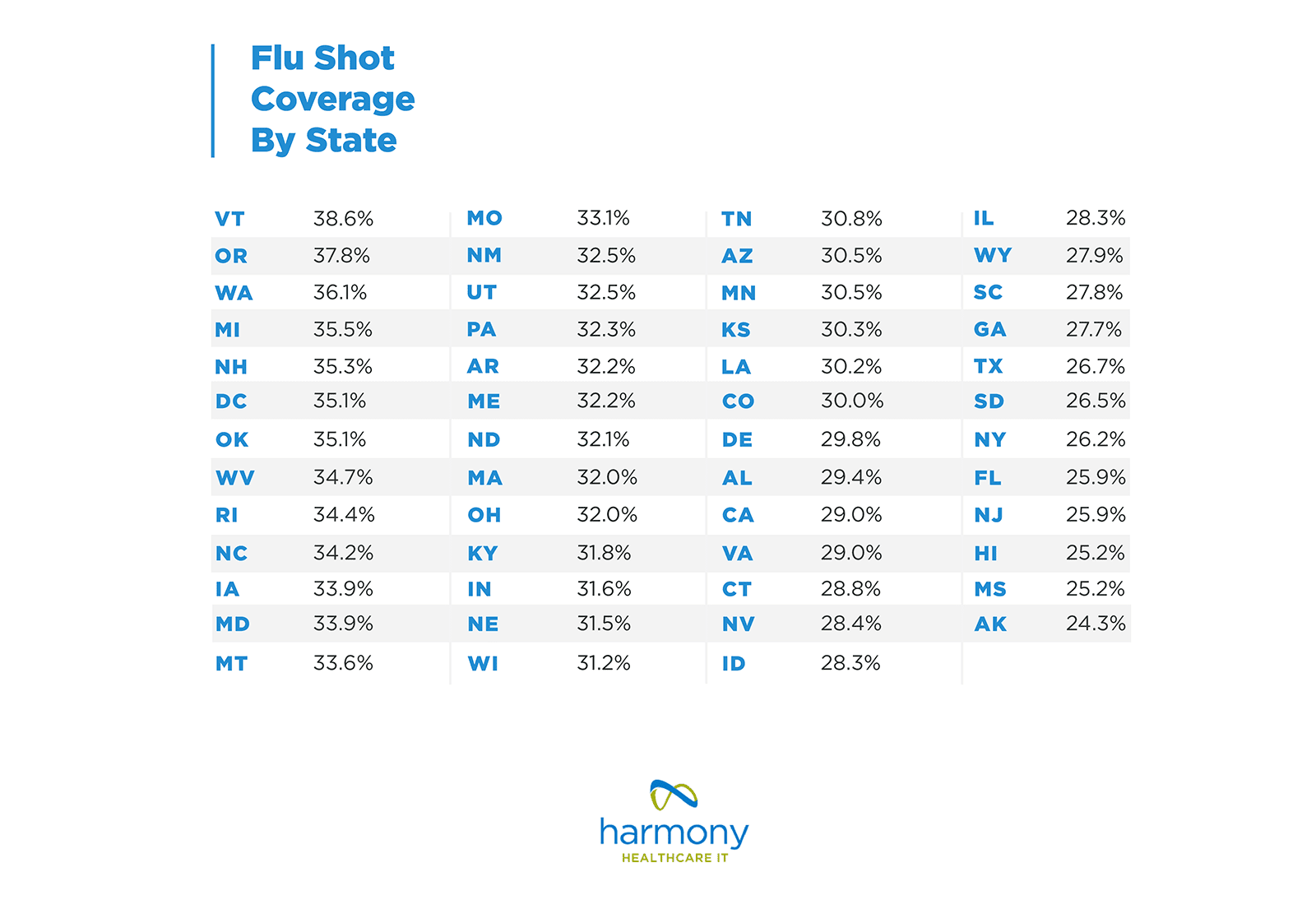
According to the CDC, a flu shot is recommended for adults 18-64 who are at increased risk for pneumococcal disease and all adults over 65. The map above shows the most recent data for flu shot coverage for these populations. Vermont, Oregon, Washington, Michigan and New Hampshire are the top five states with the highest flu shot coverage percentages. Meanwhile, Florida, New Jersey, Hawaii, Mississippi and Alaska are the bottom five states with the lowest flu shot coverage percentages.

Flu Shot

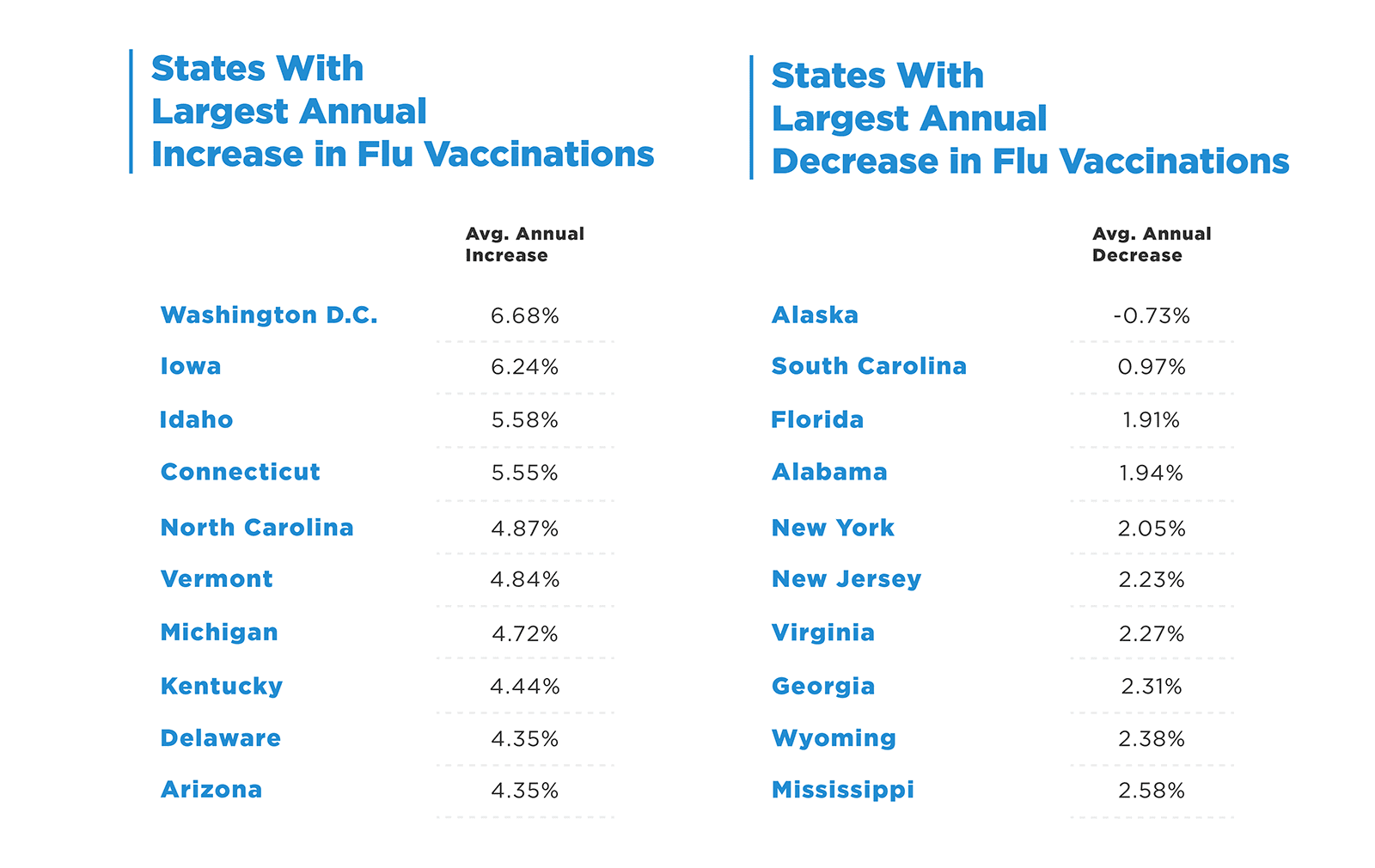
Harmony Healthcare IT also analyzed flu shot coverage data by state from 2008 to 2018, which allowed us to determine the average annual increase and decrease in each state. Washington D.C., Iowa, Idaho, Connecticut and North Carolina are the top five states with the largest annual increase in flu vaccinations. Alaska, South Carolina, Florida, Alabama and New York are the bottom five states with the largest decrease in flu vaccinations.

Flu Shot Coverage

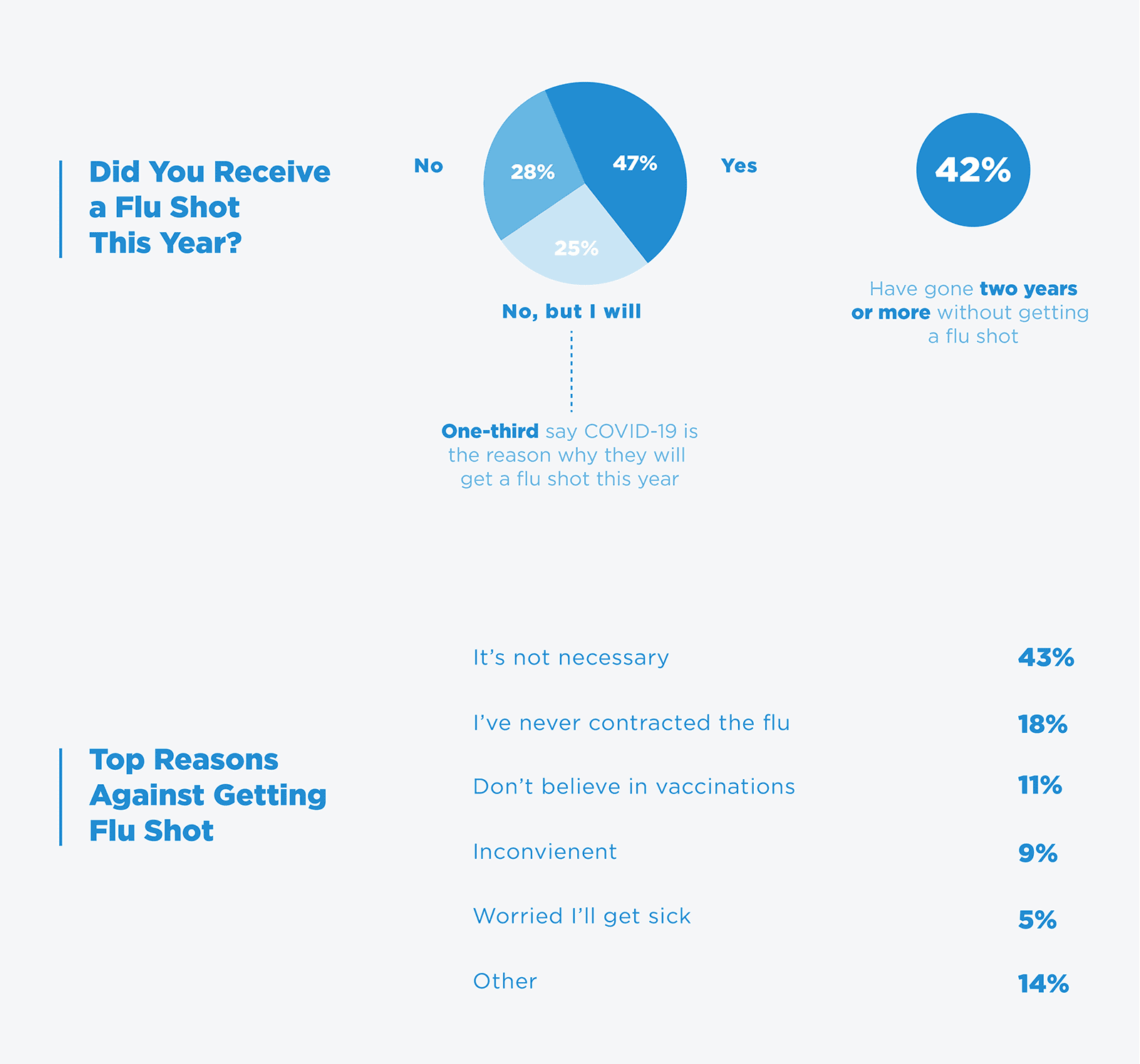
According to respondents, 47% have already received a flu shot this year and a quarter intend to receive one. A total of 42% say they have gone two years or more without receiving a flu shot.

Flu Shot Vaccine

It’s difficult to estimate when the public can expect a return to normalcy, but it’s clear many Americans are hopeful that an effective vaccine will be developed. In the meantime, Americans can take precautions, follow CDC guidelines and get their annual flu shot in order to keep themselves, their family and their neighbors safe.

Methodology

From November 1 to November 5, 2020, we surveyed 2,006 Americans on the topic of a potential COVID-19 vaccine. Of those respondents, 55% were female and 45% were male and the median age was 38. Income: Under $20K: 15%; $20-40K: 22%; $40-60K: 25%; $60-80K: 21%; $80-100K: 9%; Over $100K: 8%.

Employment status: Full-time: 67%; part-time: 14%; seeking opportunities: 5%; unemployed due to COVID-19: 3%; unemployed not due to COVID-19: 6%; furloughed: 1%; retired: 4%.

Source: Pneumococcal vaccination coverage data via Centers for Disease Prevention and Control.

For media inquiries, contact media@digitalthirdcoast.net.

Healthcare IT tips, guides, news & more delivered to your inbox

Learn More

Summary

There are many benefits of switching to cloud-based patient data archiving. The question is whether cloud is a good fit for your healthcare organization. Some hospitals and medical practices use their own onsite servers and equipment for data storage. Others contract with a trusted partner to provide off-site hosting in a secure environment. It is...

Join Fellow Healthcare IT Pros

Tips, Guides, News & More

Sign Me Up
On Premises Data Archiving or Cloud Archiving

There are many benefits of switching to cloud-based patient data archiving. The question is whether cloud is a good fit for your healthcare organization.

Some hospitals and medical practices use their own onsite servers and equipment for data storage. Others contract with a trusted partner to provide off-site hosting in a secure environment. It is important to weigh the options and determine which archive deployment solution best meets your needs.

Here are 5 questions to answer when evaluating off-site hosted vs. on-premises EMR archiving:

  1. Do we currently have the technology infrastructure required for an on-premises data archive? If you elect an on-premises archive deployment, you must provide the equipment, redundant power, cooling, threat protection, vulnerability scanning and physically-secured location for data storage in your facility. If you already own high-availability, high-compute, load-balancing server equipment and have the technical expertise on staff to support it, then an on-premises archive deployment may be the best choice for you. Based on the type and amount of data you’ll be archiving, check with your health data system consulting partner to determine the recommended equipment sizing and performance needed for scalable and optimized on-premises archive hosting.
  2. What is our current internet bandwidth and network stability? Access to remotely hosted archives requires appropriate internet bandwidth and processing speeds for users to easily access records in a timely manner. It is also important to consider, monitor and manage the number of users who will access and query the archive at any one time. For smaller provider practices utilizing a lower bandwidth DSL connection for daily business needs, there may be slowness accessing archived data depending on the total number of simultaneous users. A cloud-hosted archive may prove to be the best solution in that scenario so that response times when searching for archived patient data are quick. Larger facilities with high-availability network topology may be suited to handle the demands of on-premises hosting. If you are considering an archive solution and have bandwidth concerns, look for providers that render the data on their cloud which will limit the bandwidth usage to only presenting the completed inquiry.
  3. Does my IT staff have the expertise and time to set up and maintain the archive? If you use a remote hosting service for archive deployment, then your staff is not responsible for setting up servers, troubleshooting performance issues, performing application maintenance, or managing and responding to threat detection. For on-premises hosting, your IT staff must ensure that the technical infrastructure is maintained and monitored for the archive, that all users have access, that hi-speed network connectivity is available and that computing power is scaled to support demand as user counts and archive projects increase over time. It is also essential that your facility has a failover backup and recovery strategy in place in case a restore is ever required. If considering a hosting service, ask questions regarding their redundancy, security, and backup procedures. Medical practices and facilities with experienced IT staff may find that an on-premises archive solution makes the most sense while health organizations with leaner staffing may find that a hosted archive is their best option for secure and scalable archive deployment and management.
  4. How secure are other software solutions at our organization that are hosted or on-premises? It is common to follow your facility’s current position regarding hosting vs on-premises software solutions. If you are already using hosting services for other software and data platforms that manage PHI, then a hosting service may naturally be the right fit for your health data archive. If your organization is not using cloud-hosted solutions, find out why. With industry-standard privacy and security frameworks such as HIPAA and HITRUST available as a part of the hosting package to protect PHI, remote hosting with the right partner often offers more security than a local environment. Find out whether your local environment offers next generation firewalls, antivirus protection with advanced threat analysis, whitelisting, intrusion management detection, micro segmentation, and industry-standard encryption of data at rest and in transit.
  5. What is the Total Cost of Ownership (TCO) for both options? Cost is an important consideration and should be weighed carefully. With on-premises hosting, facilities will likely have more upfront costs in regard to equipment and technology while those using a remote hosting service will ultimately take on higher – yet predictable – recurring service fees. In some situations, the cost breakdown is roughly equal regardless of the path chosen while in others there is a significant difference. Compare all costs associated with both options over the length of your required record retention requirements to determine if one route makes more financial sense than the other. Be sure to consider labor costs for patch management and downtime for application upgrades as a part of the cost calculations.

Ready to talk hosting?
Our team at Harmony Healthcare IT, ranked #1 in the category of data archiving by KLAS Research, helps healthcare providers consolidate data stores by decommissioning legacy EMR, HR and other administrative systems and securely retain patient, employee and business records across the healthcare enterprise. HealthData Archiver®, our long-term data storage solution, delivers a single point of access to maintain retention and compliance in a secure and searchable format.

Let’s connect.

Note: Content has been updated from a blog that originally posted Jan. 15, 2015.

Healthcare IT tips, guides, news & more delivered to your inbox

Learn More

Summary

Hear three perspectives on best practices for healthcare data management from a recent webinar we presented with healthsystemCIO. The panelists share tips to reduce expenses, navigate sunsetting applications, maintain security and achieve hard and soft cost-savings through archiving.

Join Fellow Healthcare IT Pros

Tips, Guides, News & More

Sign Me Up
Finding Cost Savings with Legacy Data Management

Reducing ongoing costs and taking a cost containment approach with future projects is high on every hospital IT department’s to-do list. A recent webinar, Finding Cost Savings with Legacy Data Management, hosted by Anthony Guerra, Editor-in-Chief of healthsystemCIO, offered numerous cost savings insights as well as guidance on governance, security and planning for the year ahead.

The webinar panelists included:

Webinar Panelists

The panelists answered questions and shared their lessons learned related to legacy healthcare data management with five focus areas of specific insights around reducing costs. To listen to the complete webinar, click here. A brief synopsis is below:

  1. How have the financial impacts of canceling elective procedures due to COVID-19 impacted the IT budget? And, how are you aligning your archival strategy to guide your organization forward?

“The impact was quite severe…Seems like we’ve weathered the storm, but it was quite impactful. We’re heading into a tough budget season… governance is critical on the big projects and for the dozens to hundreds of smaller requests coming through,” shared Lundal. “End users aren’t pressing for archiving, so it’s a stewardship thing for the organization and a sound business practice for managing technology. The best time to press that is when you get your budget approved to get it locked in.”

  1. Strategies for IT to reduce expenses – Is it necessary to reduce the application portfolio?

By reducing the application portfolio, you have the opportunity to reduce the operational burden of maintaining availability of systems, access, and backups and redundancy for preservation of data,” said Page-Santacruz. “All of these things have a cost to them and they’re part of what helps build a compelling ROI for application rationalization.”

“The rationalization and prioritization process is key to support expense reduction. We find larger health systems are centralized and very organized and have all of that in their inventory portfolio, but a good majority don’t have this due to mergers and acquisitions. We provide some best practices to go about gathering the inventory, negotiating with source vendors and sometimes do the extraction work ourselves to minimize the cost for our clients,” shared Hammer.

  1. What are cost-effective techniques to work with applications that sunset?

“Customers’ past point of reference was thinking they need to migrate all of their data – so over the years we’ve developed best practices around what should be migrated and what should be archived,” shared Hammer. “An archive can provide the same level of comfort and ease of the previous systems, with Single Sign-On from a core application… and there is a cost savings there.”

  1. What are hard and soft cost savings achieved with archiving legacy systems?

“There are maintenance costs, storage costs and soft costs like time it takes having all of those applications in your portfolio,” shared Lundal. “There are costs of expertise too. Like if Bob is the only guy who knows XYZ system, what are you going to do if Bob leaves?”

“The most important soft cost you could quantify is the value of the clinician’s time they spend searching for information about a patient when you don’t have all your data in one place,” said Page-Santacruz. “[With an archive], the clinician doesn’t have to leave the EHR they’re working in to access the historical data, so it’s really huge how valuable that time saver is for clinicians.”

  1. What are the security considerations that must be taken into account when sunsetting applications? What are some hidden dangers or risk costs that can’t be overlooked?

“Many of these old applications sit on servers that are 2003, 2008…we just took care of a server from a 2000 application the other day. You don’t want these servers in your organization,” said Page Santacruz.

“Archiving is definitely a security play,” said Lundal. “Getting your access right, so those who need access have it, but that is tracked with an access management process. There’s a lot of involvement upfront from security and then access management becomes the game…it’s important to have an external party come in and continually audit and test you in making sure that the archive is part of that program.”

Access the Webinar

Looking for a healthcare data management firm with deep experience migrating and archiving patient, employee and business records? Our team of experts has extracted, converted, migrated and retained data from over 500 clinical, financial and administrative software brands.

That information is secured on our cloud-based storage platform, HealthData Archiver®, which is live in production on Epic’s App Orchard. Harmony Healthcare IT has been ranked #1 in the 2020 Best in KLAS Software & Services Report as a Category Leader in Data Archiving, and as the top data extraction and migration healthcare IT company according to Black Book Market Research in 2019 and 2020. We were also selected by Modern Healthcare as one of the 2019 Best Places to Work in Healthcare.

Let’s connect.

Note: To read a summary article about the webinar by healthsystemCIO, click here. You can listen to the full webinar here.

Healthcare IT tips, guides, news & more delivered to your inbox

Learn More