Summary

After 13 years, HIMSS has expanded its fall focus from U.S. health IT to a worldwide recognition week aimed at celebrating the power of information and technology to improve access to healthcare for all. As a health data solutions innovator, our team directly supports the four pillars that are needed to advance healthcare on a global scale.

Join Fellow Healthcare IT Pros

Tips, Guides, News & More

Sign Me Up
World health day, Globe with a stethoscope wrapped around it. Save the wold/ Green Earth day concept.Save the wold, Global healthcare, Green Earth day concept, Ecology concept, save world, Health

For 2020, HIMSS shifted its annual U.S. National Health IT Week to a broader event, Global Health Equity Week. For the first time since its inception in 2006, the week of Oct. 19th now will highlight the role of digital health as a bridge to worldwide patient wellness by focusing on four topics:

  • Telehealth
  • Public health data modernization
  • Patient identification and safety
  • Maternal health

Our role as a health data solution innovator continues with even more critical importance as we pioneer and deliver data management solutions that strengthens healthcare delivery, but more importantly, improves lives. As we consider the four pillars for Global Health Equity Week, we recognize the value that immediate access to vital health information offers on a global scale.

Let’s look at how our health data management services support each of the Health Equity topics:

Telehealth – With the recent uptick in telemedicine utilization, access to medical records is important for treatment. Also, the documentation requirements for a telemedicine service are the same as a face-to-face visit. As the trend in telemedicine is expected to continue, there will be EHR upgrades and replacements that require solutions for legacy health data. An active archive like HealthData Archiver® with its Single Sign On capabilities supports efficient and immediate access to legacy health records at the point of care. Further, information flow with telemedicine records is held to the same standard as traditional medical records. This is important to note as compliance to the 21st Century Cures Act Rules on interoperability and patient access to their health records will be enforced beginning in 2021.

Public health data modernization – Data modernization is what we do at Harmony Healthcare IT. Simply defined, data modernization is the movement of data from legacy mainframe databases to modern databases.  We help providers of all sizes inventory legacy systems, migrate historical data from siloed systems to a vendor neutral active archive, and then decommission the legacy system. This streamlines the IT portfolio, increases security and provides cost savings. This work also supports interoperability and public health initiatives that involve analytics gained from being able to seamlessly share information.

Patient identification and safety – Experts state that most, if not all, wrong-patient errors are preventable. As migrators of legacy data, we take this part of what we do very seriously, ensuring that patient information is 100% accurate. There has been talk for decades of creating a National Patient ID, which could support patient matching in the future, but until then, there are many processes taking place within different health systems and with EHR and archiving vendors. We remain committed to our integrated data validation process that is a standard feature built into our HealthData Archiver® to give our clients and team real-time communication options within the user interface to easily document and report questions or concerns during validation testing.

Maternal health – The health of women during pregnancy, childbirth and the postnatal period is a key global focus. While it is true that less developed countries have bigger issues, the United States lags behind other developed nations in preventing pregnancy-related deaths. One of the keys to improving these stats is the importance of team-based care, that includes maternal fetal medicine physicians, nurses, obstetricians/gynecologists, cardiologists, midwives and nurse practitioners. Technology-based solutions are needed to provide access to the complete health narrative—such as electronically archived fetal monitoring strips—to help guide treatment decisions and deliver on the quadruple aim in healthcare.

Our team remains committed to delivering technology breakthroughs that lift up healthcare options for all. We fully support Global Health Equity Week and will continue our work in breaking barriers to deliver health information wherever it is needed.

Ranked #1 in the 2020 Best in KLAS Report for Data Archiving, the Harmony Healthcare IT team has worked with hundreds of EMR/ERP software brands, archiving billions of records and storing petabytes of data. We migrate and archive records across the care continuum—for hospitals, health systems, pharmacies, clinics, labs, blood banks, home health care, long-term care, and more.


Healthcare IT tips, guides, news & more delivered to your inbox

Learn More

Summary

EHR data has helped assess COVID-19 and other infectious disease outbreaks such as Hepatitis B, Lyme disease, Tuberculosis, Measles, Chickenpox, Zika virus, Ebola virus, HIV infections and even the common cold. It informs immediate medical treatments for infectious disease patients by capturing source data such as symptoms and lab results, and it provides big-picture trends...

Join Fellow Healthcare IT Pros

Tips, Guides, News & More

Sign Me Up
a doctor man wearing blue surgical gloves holding a world globe wrapped in plastic, depicting the plastic contamination or the protection against the epidemic infectious diseases or the air pollution

EHR data has helped assess COVID-19 and other infectious disease outbreaks such as Hepatitis B, Lyme disease, Tuberculosis, Measles, Chickenpox, Zika virus, Ebola virus, HIV infections and even the common cold. It informs immediate medical treatments for infectious disease patients by capturing source data such as symptoms and lab results, and it provides big-picture trends to support broader population health initiatives.

EHRs in 73% of all emergency departments contribute real-time data to the National Syndromic Surveillance Program (NSSP). The NSSP draws from more than 5,000 facilities, covering 47 states and Wash D.C. The CDC defines collection of signs and symptoms that are of interest (e.g., fever and cough). Data on patients with these symptoms documented are abstracted from EHRs via the CDC’s BioSense Platform, with more than four million electronic messages received daily. This data is intended to support syndromic surveillance to monitor public health and help respond to emergencies.

Long-term, improved disease reporting and longitudinal collection of disease data will provide valuable insights into trends and risks. Importantly, data-informed records will improve health outcomes. The health of our nation riding on information that can be culled from both general and infectious disease electronic medical records, such as outcomes from:

  • Immunotherapies
  • Antibiotic dosing
  • Lab orders
  • Drug Interactions
  • Infectious Disease Assessment Plans

Some healthcare providers rely on EHRs with specific templates and functionality designed for managing infectious disease. This includes many of the expected leading EHR brands as well a WRS Health’s Infectious Disease EHR, Praxis EMR and CureMD. As infectious disease EHR software ages or gets replaced, it is critical to safeguard legacy data not only to meet record retention guidelines for release of information but also to support population health research. This is where an EHR active archive for infectious disease medical records, such as HealthData Archiver®, becomes a valuable part of your overall health data management plan to support the quadruple aim of healthcare.

Medical record retention laws vary state to state and by condition, but may span 20-30+ years in some cases. Providers of all sizes need to have a game plan that doesn’t disregard historical data.

Now, more than ever, health data matters. Harmony Healthcare IT collaborates with health providers of all sizes to develop a plan for extracting and delivering legacy data wherever it is needed. This may entail migrating or converting the most recent years of data into a new go-forward EHR. It also entails securely retaining all of the historical data within an active archive before decommissioning the old system. Historical information is then accessible within the go-forward EHR through a Single Sign On feature to ensure clinical accessibility at time of treatment.

There isn’t a one-size-fits-all plan for what each organization needs to meet its unique needs.

We get that.

We’ve worked with more than 500 EHR systems and with some of the most complex projects in the industry. Our ranking as #1 in the 2020 Best in KLAS Software & Services Report as well as our top rankings in 2019 and 2020 as the top EHR Data Extraction and Migration provider according to Black Book Rankings, a division of Black Book Market Research are third-party validations we continue to strive to re-earn every day.

Are you working on a plan to safeguard the infectious disease and other records within your care?

Do you have an EHR system replacement in your future?

Let’s talk about legacy records.

Ready to connect?

Contact us today to learn more about our healthcare data management solutions.

Healthcare IT tips, guides, news & more delivered to your inbox

Learn More

Summary

Information security is a growing concern as the tactics used by cybercriminals become more sophisticated, particularly in light of the COVID pandemic and recent healthcare breaches. Healthcare providers or their Business Associates that don’t utilize healthcare data cybersecurity best practices are at a high risk for data breach. As an organization that focuses on moving...

Join Fellow Healthcare IT Pros

Tips, Guides, News & More

Sign Me Up
Cybersecurity Doctor

Information security is a growing concern as the tactics used by cybercriminals become more sophisticated, particularly in light of the COVID pandemic and recent healthcare breaches. Healthcare providers or their Business Associates that don’t utilize healthcare data cybersecurity best practices are at a high risk for data breach. As an organization that focuses on moving and preserving legacy patient, employee, and business records, Harmony Healthcare IT makes information security a priority.

For that reason, Jim Hammer, VP of Operations and Product Development at Harmony Healthcare IT, was invited to join a recent eWeek online discussion with a panel of IT security experts. Timely topics were discussed, including information security, best practices to defend against ransomware attacks that currently plague the healthcare industry, and new information security technologies being adopted. Below are three key takeaways from the discussion.

1. Healthcare organizations are increasingly targeted by cybercriminals.

Patient information is valuable — and is, at times, stored in outdated systems. “Legacy systems are often less protected, which is why they are targeted by cybercriminals,” said Harmony Healthcare IT’s Jim Hammer.

In addition, many healthcare organizations are not up to date when it comes to protecting their valuable patient healthcare data. “Despite the increasing number of cybersecurity breaches, healthcare has been behind other sectors in taking security measures. Four to 7% of a health system’s IT budget is in cybersecurity, compared to about 15% for other sectors such as the financial industry,” said Lisa Rivera, a partner at Bass, Berry and Sims.

2. Proper data storage is key to data protection and surviving a ransomware attack.

With ransomware being one of the top cybersecurity threats to healthcare and other industries, developing safe practices for data storage and archiving is crucial to your organization for defending against ransomware attacks and having the ability to recover quickly. Proper data protection and encrypted backup versions are the main defense against ransomware attacks. Proper healthcare data backup practices also ensure networks can be brought back online in the shortest amount of time.

“The 3-2-1 data backup approach is the ideal process. This means three sets of backup copies on two different types of media and one encrypted and stored offsite or in the cloud to maintain security compliance,” said Eric Bassier, Head of Product and Tech Marketing at Quantumcorp.

3. Sophisticated threat analysis and threat management systems are a costly (but necessary) investment.

To deal with ever-increasing amounts of threat data and counter measures, “many enterprises and large healthcare networks are taking the approach of investing in and installing sophisticated threat monitoring and automated threat management systems. [To support their IT teams], they are also partnering with outside Security Operations Centers (SOC) to monitor and analyze threat data. These outside SOC as a service teams augment our security posture to fine-tune systems and flag high-level threats,” said Hammer.

Molly Presley, EVP Product Marketing & Communication at Qumulo, added, “More applications and more complexity is tough [on IT teams] when also grappling with additional business protection requirements. Integrated data monitoring and protection tools make lives much easier.” 

Keep your information safe

The eWEEKchat panelists concluded that developing the right governance for healthcare data access and storage, deploying technology to manage threat data and automate security tasks, and partnering with cybersecurity experts are all strategies being employed across enterprise organizations to keep their information safe.

To learn more about health data security, download our latest cybersecurity whitepaper. If you are interested in how Harmony Healthcare IT can support your information security efforts, especially when it comes to data sitting in legacy applications, let’s connect.

Healthcare IT tips, guides, news & more delivered to your inbox

Learn More

Summary

Healthcare is #1 in cloud adoption, compared to all other industries, with 35% of healthcare organizations housing more than 50% of their data or infrastructure in the cloud. With health data volumes continuing to skyrocket, and 30 percent of the world’s stored data being health-related, it is clear that providers of all sizes need a...

Join Fellow Healthcare IT Pros

Tips, Guides, News & More

Sign Me Up
Server

Healthcare is #1 in cloud adoption, compared to all other industries, with 35% of healthcare organizations housing more than 50% of their data or infrastructure in the cloud. With health data volumes continuing to skyrocket, and 30 percent of the world’s stored data being health-related, it is clear that providers of all sizes need a long-term plan for health data management. Beyond the sheer volume of healthcare data, there also are thousands of data fields collected for each patient and there is a disparate nature of the records that can include patient demographics, lab results, medications, radiology, treatment, documents, financial and insurance information.

As providers focus more on interoperability and care coordination, cloud-based hosting contributes to secure and efficient communication among patients, physicians, hospitals and payers. And, for the IT team, there are a wide variety of benefits.

Five benefits of switching from on-premise archiving to the cloud:

  • Cost Savings – Costs for on-premise data hosting and storage are decreased through the scalable computing power offered through cloud. If more compute is needed as the number of users or data under management increases, cloud hosting can readily scale to meet the demand.  Likewise, platform management and maintenance is taken care of by the hosting provider, minimizing the healthcare organization’s IT labor, as well as software and hardware upgrade expense burden. After migrating, facility costs  are also reduced based on less power usage and space requirements to maintain equipment.  The expense of certain hardware upgrades or replacements essentially goes away.
  • Increased Security – As the #1 most breached industry, healthcare battles cybersecurity and data breach concerns daily while continuing to be up against a shortage of privacy and security professionals. Cloud solutions may offer higher levels of security than what is often available at the facility level (e.g., if the hosting framework is HITRUST CSF® certified in a SOC-2, Tier III data center across multiple locations).  Further, a hosted archive solution typically comes with a centralized team  dedicated to 24/7,365 internal and external threat protection, penetration testing and system monitoring services tailored to the preservation and interoperability of ePHI. The IT team maintaining an on-premise archive (and other applications) is often pulled in many directions and not entirely up-to-date on industry-specific vulnerabilities, intrusion detection or managing a common security framework with 450+ physical and process security controls.
  • Reduced Downtime– With a cloud-based archive hosted solution, high-availability servers are load balanced with redundancy and disaster recovery data back ups performed offsite with failover for power, cooling and storage controllers to a second substation. The right hosting partner will greatly reduce the likelihood for downtime and need for disaster recovery by ensuring structural integrity of its data center locations to withstand severe weather and even natural disasters .  They will also offer a multi-tier approach to upgrade and patch management from the operating system to the application.  Additionally, node redundancy will likely allow for zero outage upgrades.
  • Improved Connectivity and Accessibility – Users are connected to the archive application with anytime/anywhere access via a high-availability fabric network topology which also speeds data transmission and handling. The benefit of quickly accessing archived records 24/7 is helpful in these times of increased telemedicine offerings and remote operations. At some level, cloud hosted solutions also support the ease of care collaboration among practitioners with Industry standard encryption at rest and in transit.
  • Faster Deployment – Cloud-based services can be deployed more rapidly than the weeks or months it might take for a healthcare organization to initially plan, procure, build and implement an internal IT infrastructure. When it comes to additional data migration from a source system to the hosted archive (i.e., in the case of merger and acquisition), data transfer and image copy is quicker on a cloud network than it would be with an on-premise environment demanding data/image copy onto or off of secure hard drives. This speed and security supports a better relationship between the healthcare organization and Business Associate.

Ready to talk hosting?

Our team at Harmony Healthcare IT, ranked #1 in the category of data archiving by KLAS Research, helps healthcare providers consolidate data stores by decommissioning legacy EMR, HR and other administrative systems and securely retain patient, employee and business records across the healthcare enterprise. HealthData Archiver®, a long-term data storage solution, delivers a single point of access to maintain retention and compliance in a secure and searchable format.

Let’s connect.

Healthcare IT tips, guides, news & more delivered to your inbox

Learn More

Summary

Harmony Healthcare IT, a top innovator in legacy data management, ranks #1 in the 2020 KLAS Software & Services Report with its HealthData Archiver® platform, praised for user-friendly features.

Join Fellow Healthcare IT Pros

Tips, Guides, News & More

Sign Me Up
#1 Rating in KLAS

Earning all A’s for all customer experience measurements, 100% of customers surveyed report the innovative legacy data management company is part of their long-term plans.

Harmony Healthcare IT, a first-to-market innovator in legacy data, management recently ranked #1 in the 2020 Best in KLAS Software & Services Report as the Category Leader in Data Archiving, is further recognized as a stand out for successful experience archiving a wide variety of complex clinical and financial software systems for enterprise-wide inpatient organizations as well as smaller acute providers. The company received all A’s in the six customer experience pillars of culture, loyalty, operations, product, relationship and value. These expanded findings are included in the recently released KLAS Performance Report.

In the report, Harmony Healthcare IT’s long-term record storage platform, HealthData Archiver®, is described by customers as integrated and easy to use, making it simple to find patient records. Customers also mention that auditing and release of information capabilities work well.  Also of note, 100% of customers surveyed said they would include Harmony Healthcare IT in their long term plans.

One IT Director/customer explains: “Harmony Healthcare IT is absolutely part of our long-term archiving strategy. The product has been very easy to use. I think the benefits of it have been that we don’t have to keep aging equipment and systems around; the product has allowed us to retire and sunset additional software systems. From our standpoint, that helps with security and maintenance, and we don’t have to have FTEs maintain those old systems.”

“We take tremendous pride in this positive client feedback,” said Tom Liddell, CEO at Harmony Healthcare IT. “With its broad and deep technical experience, our team continues to break through barriers that other data management firms cannot for some of the largest health systems in the nation.  We welcome the opportunity to decommission the more complex inventories of clinical and financial systems, ultimately delivering legacy data wherever it is needed to strengthen care delivery.”

Looking for a trusted company with experts in data extraction, migration, and retention? We’re ready to talk.

Healthcare IT tips, guides, news & more delivered to your inbox

Learn More

Summary

Has EHR system replacement put your medical practice at risk? If your clinic has recently replaced its practice management or electronic health record (EHR) system, it could be at risk.  The risk lies in the strategy you deploy for managing the storage of protected health information (PHI).  Legacy PHI includes those patient records “left behind”...

Join Fellow Healthcare IT Pros

Tips, Guides, News & More

Sign Me Up
Legacy EHR At Risk

Has EHR system replacement put your medical practice at risk?

If your clinic has recently replaced its practice management or electronic health record (EHR) system, it could be at risk.  The risk lies in the strategy you deploy for managing the storage of protected health information (PHI).  Legacy PHI includes those patient records “left behind” in the replaced system(s) — all of the data that didn’t convert or migrate into the new, go-forward system.  While demographics and other key clinical data points like problems, allergies, medication, immunizations and procedures are often converted to a new system, complexity and cost often prohibit line item financial detail or other clinical data elements from migrating.  That leaves legacy PHI at-risk in a “retired” system, often sitting on an aging and vulnerable server.

Cybersecurity Risks Increase with Legacy EHR Systems

Besides the technical risks associated with trying to maintain outdated systems, there are cybersecurity risks that cannot be overlooked. Black Book Market Research found 93% of U.S. Healthcare organizations surveyed were breached in the past handful of years. And, more than half of those breached organizations were breached again (and even again).

While providers of all sizes are at risk, cybercriminals often find smaller healthcare practices to be ripe targets. In fact, more than four out of five physicians have been a victim of some type of cyberattack, with one in three physicians reporting their practice experienced a cyberattack-related business shutdown. The hackers leverage technical vulnerabilities, infiltrate the network and virtually shut down the operation until a ransom is paid or restorative measures can get the practice up and running again.

In a HIMSS cybersecurity survey: 69% of healthcare organizations reported they had at least some legacy systems in place. 83% of those still operate with Legacy Windows Servers (e.g., 2003, 2008, 2012, 2016 and XP).

Learn more about how to safeguard your legacy health data with our resource: Active Archiving: A Smart Security Move to Protect Legacy Medical & Business Records.

What constitutes PHI and how long must it be stored?  

The United States Department of Health & Human Services defines PHI as “any individually identifiable health information about health status, provision of health care, or payment for health care that can be linked to a specific individual in any form or media.”  When it comes to replacing a practice management system, outpatient clinics often don’t consider it necessary to retain financial history.  But, according to the definition of PHI above, a patient financial history is considered a part of the legal medical record and should be saved along with other historical clinical data elements for the duration that the state in which you practice medicine requires.  That is often a minimum of seven years.

Where should historical PHI be stored to comply with medical record retention mandates?

To avoid risk and to be compliant with federal, state and agency record retention mandates, legacy systems should be decommissioned and the PHI they contain should be securely archived.  Affordable yet secure solutions exist for practices of any size to extract data from a replaced practice management or EHR and migrate it into an electronic archive.  This transition of PHI from a full production system into an archive allows the practice to

  • reduce software maintenance payments to the legacy vendor
  • remove aging server(s) from its network and deflect cyber-crimes or data breach
  • consolidate historical patient records and make them accessible over time as employees come and go
  • comply with medical record retention mandates

Why active archive versus run legacy systems in read-only mode?

As healthcare data volumes continue to surge and the push for secure and inter-operable data continues, it makes sense for your practice to eliminate the risk and hassle of keeping legacy systems up and running in read-only format.  Servers age.  Software must be patched to meet security requirements and be protected from hackers.  Staff members who know how to navigate the old system may leave the practice for a new job.  For these and other reasons, legacy practice management and EHR systems pose technical risk for the practice, not to mention cost and labor burden.  Should release of information be required to fulfill a request from a patient, lawyer, employer, payer or auditor; the historical medical record must be accessible and easy to share in a HIPAA-compliant format.  Secure, compliant, long-term PHI storage in an electronic health data archive solution is not only the right solution for your practice – it’s the right solution for your patients.  Preserve their clinical care story and financial history by employing a legacy data management strategy.

Get started Now

Contact the legacy data management specialists at Harmony Healthcare IT to learn more about medical record retention tools like HealthData Archiver®.

Editor’s note: This blog is updated from the original content published in 2018.

Healthcare IT tips, guides, news & more delivered to your inbox

Learn More

Summary

Harmony Healthcare IT (HHIT) has fielded reports that Ceridian’s Latitude HR, payroll and benefits solution that launched in 2008, has been sunset. Healthcare providers replacing Ceridian Latitude HRIS have contacted HHIT to discuss data management options ranging from extraction to migration to retention of their human capital management records. Historical employment records must be maintained...

Join Fellow Healthcare IT Pros

Tips, Guides, News & More

Sign Me Up
Sunset over the sea horizon nature landscape. Red clouds and sea landscape. Sea nature in sunset. Nature landscape. Sunset landscape background. Sunset over the sea landscape. Red sunset background. Landscape. Nature.

Harmony Healthcare IT (HHIT) has fielded reports that Ceridian’s Latitude HR, payroll and benefits solution that launched in 2008, has been sunset. Healthcare providers replacing Ceridian Latitude HRIS have contacted HHIT to discuss data management options ranging from extraction to migration to retention of their human capital management records.

Historical employment records must be maintained for several years based on state and federal laws. While guidelines for human resources-related records range from a one to three year retention period, certain record types require longer time periods. W2’s, for example, must be kept for at least four years. OSHA requirements insist that records of job related illnesses and injuries be kept for five years. In addition, records related to medical exams along with toxic substances and blood-borne pathogen exposure must be retained for thirty years after termination of employment.

Bottom line: Electronic employee records, like patient records, require secure data archiving through a legacy data management strategy.

HRIS data migration to a HIPAA-compliant, long-term storage solution like HealthData Archiver® is often a preferred solution over a system-wide migration to the new HR system as it can be less costly and complex. Because HealthData Archiver® is an open, relational database, it is easier to map data to it versus transforming data from the format of the source HR, like Ceridian Latitude, into the format of the destination software.

Our team at Harmony Healthcare IT, ranked #1 in the category of data archiving by KLAS Research, helps healthcare providers consolidate data stores by decommissioning legacy EHR, HR and other administrative systems.  We securely archive and retain data from the patient, employee and business records across the healthcare enterprise. HealthData Archiver®, a long-term data storage solution, delivers a single point of access to maintain compliance in a secure and searchable format.

Faced with a system replacement for Ceridian Latitude or any other HR, payroll or benefits system??

Connect with our team to walk through an efficient plan for keeping legacy employee data accessible and secure within an active archive.

Healthcare IT tips, guides, news & more delivered to your inbox

Learn More

Summary

The amount of patient health data is increasing exponentially. This increase is causing healthcare organizations to review legacy medical record data storage strategies. An active archive provides both secure storage and access to records while reducing maintenance costs for legacy systems.

Join Fellow Healthcare IT Pros

Tips, Guides, News & More

Sign Me Up
Visual Depiction of Medical Data Storage in the Cloud

By 2025, global estimates suggest 463 exabytes of data will be created each day. While it is difficult to picture the overall volume of data in the world, one visual is that with 44 zettabytes of data in the current digital universe, this represents 40 times more bytes than stars in the observable universe. While some of that new data doesn’t need to be stored long term, experts predict that about 7.5 ZB (zettabytes = 1021 bytes) of data will need a long-term home in 2025, up from about 1.1 ZB in 2019.  This is a 581% increase.

In healthcare, current estimates suggest a single patient generates close to 80 megabytes each year in imaging and electronic medical record (EMR) data. Bottom line: The amount of patient health data is increasing exponentially, which means the amount of legacy EHR data is skyrocketing as well.

Plus, with additional data demands such as tracking major health outbreaks, staying abreast of the latest information on treatments and vaccines, tracking patient diagnoses and treatments across multiple providers and supporting the growth in telemedicine, the role of health data has never been more critical.

As healthcare IT expectations continue to evolve with expectations of secure patient data storage within a care community, it is smart to put a strong active archive solution in place that provides similar one-stop access to historical patient records.

Learn more about our #1 Best in KLAS Data Archiving Solutions

Health Data Volumes Increase Faster Than Any Other Industry

The overall volume of all electronic data doubles every two years. However, healthcare data outperforms this estimate and is expected to be the highest data growth business sector with a compound annual growth rate (CAGR) of 36 percent through 2025.

Healthcare organizations are faced with managing this tremendous amount of patient data along with an increased demand for real-time access to complete patient records. In conjunction, they must streamline their application portfolios to decommission legacy applications and keep protected health data stored and accessible for compliance, research and reporting. A legacy EHR active archive is an intelligent decision as part of an overall health data management strategy for saving on legacy system maintenance cost, labor burden and technical risk.

Making Archived Patient Data Available to Health Information Exchanges (HIEs)

Many healthcare organizations have implemented, or are in the process of working with private or public HIE solutions that enable numerous healthcare organizations to securely store and share medical data for their patients. The federal government has incentivized participation in HIEs, offering states grants to form them and medical providers extra money if they sign on. A patient data archive can also be made available to the HIE and further benefit patient care.

The Difference Between Data Backup, Archiving and Active Archiving

Having a solid legacy medical data storage and retrieval plan is a smart step forward in managing historical patient and operational data well into the future. It is important to understand the specific differences between data backup, archive and an active archive:

  • Backup – creates a copy of data and restores it in case of data loss or corruption.
  • Archiving – frees up expensive capacity by moving less frequently used data to more cost-effective storage locations
  • Active Archiving – uses highly scalable archive systems with intelligent software. The software uses rich metadata, indexes, directories, tags and more to enable high-performance search and information retrieval.

An active archive such as HealthData Archiver® is a long-term medical data storage strategy that reduces or eliminates legacy system management costs. Secure, compliant, long-term PHI storage in an electronic health data archive solution helps manage the legacy application portfolio, minimizing the volume of legacy EMR, ERP, GL, Accounting or HR/Payroll applications, saving on maintenance contracts, mitigating technical risk, and reducing labor burden. With an active archive, outdated legacy systems can be decommissioned and ROI can be expected within 12-18 months.

Connect with our team for more info on how an active archive could be a cost-effective, secure solution for your historical records.

Editor’s Note: This blog has been updated from an earlier post on August 3, 2018.

Healthcare IT tips, guides, news & more delivered to your inbox

Learn More

Summary

Telehealth has experienced tremendous growth due to the COVID-19 pandemic. Medical providers have expanded access to care for patients by offering virtual appointments and other online services, which has allowed patients to speak with their doctor from the comfort of their homes during COVID-19. As a health data management firm interested in telehealth’s potential in...

Join Fellow Healthcare IT Pros

Tips, Guides, News & More

Sign Me Up
Telehealth Covid-19

Telehealth has experienced tremendous growth due to the COVID-19 pandemic. Medical providers have expanded access to care for patients by offering virtual appointments and other online services, which has allowed patients to speak with their doctor from the comfort of their homes during COVID-19.

As a health data management firm interested in telehealth’s potential in becoming more common, Harmony Healthcare IT surveyed Americans about their experiences with telehealth and if they plan to continue to use virtual medical services after the pandemic.

Telehealth and COVID-19

Telehealth Covid-19

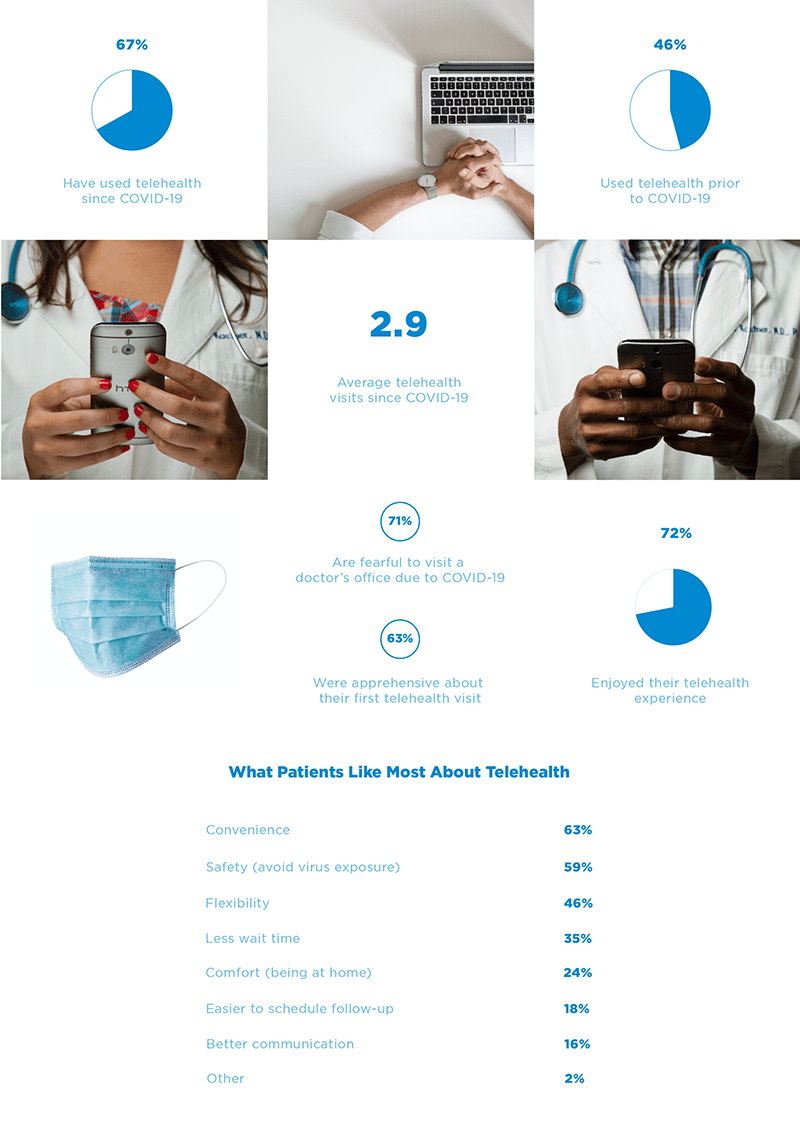
Telehealth has helped medical providers continue to see their patients virtually, either through video conferencing tools such as Zoom or Skype. Not only does telehealth provide convenience for patients, but it also helps them limit their risk of exposure to COVID-19, which is a priority considering that 71% of respondents are fearful to visit a doctor’s office or hospital due to the pandemic.

Overall, 67% of survey respondents said they have used telehealth in some form since the pandemic and 46% said they had used telehealth prior to COVID-19. Even though 63% were apprehensive about their first telehealth appointment, 72% ultimately enjoyed their experience.

Convenience, safety and flexibility were the top three factors of telehealth that patients liked the most.

Telehealth Wait Times

Telehealth Wait Times

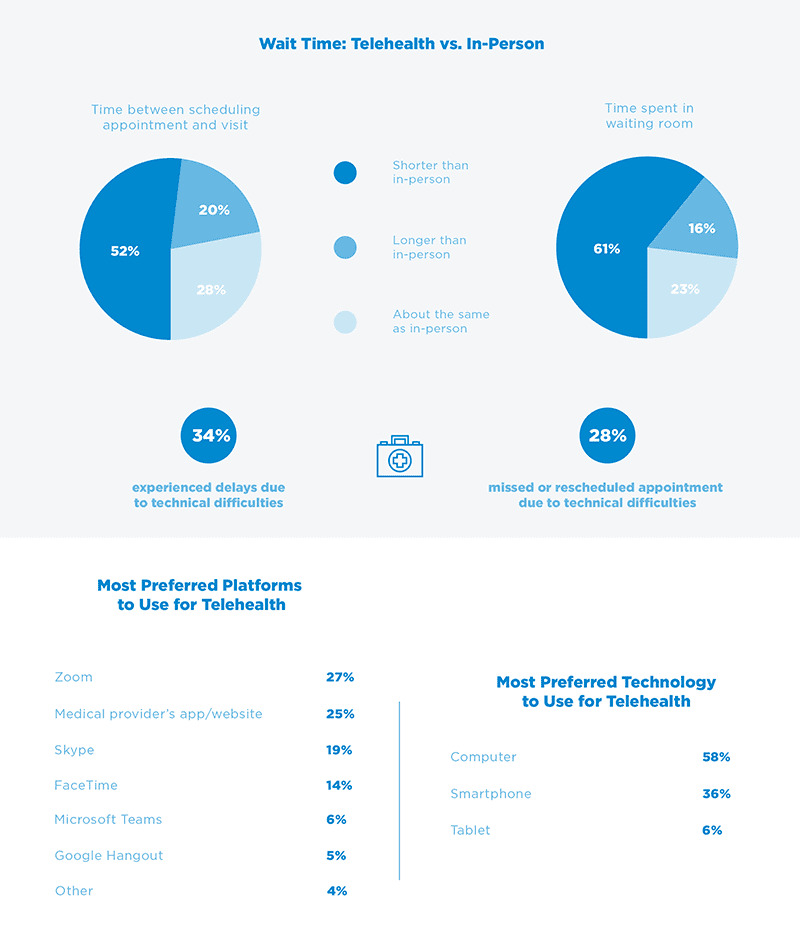
Along with convenience, respondents also said they experienced shorter wait times with telehealth compared to in-person visits. More than half of respondents said the time between scheduling an appointment and visiting their medical provider was shorter than in-person. According to respondents, 61% said the time spent in the virtual waiting room was also shorter than an in-person visit.

However, one-third said they experienced delays during their telehealth visit due to technical difficulties and 28% said those delays caused them to miss or reschedule their appointment.

How Patients are Using Telehealth

Telehealth Providers

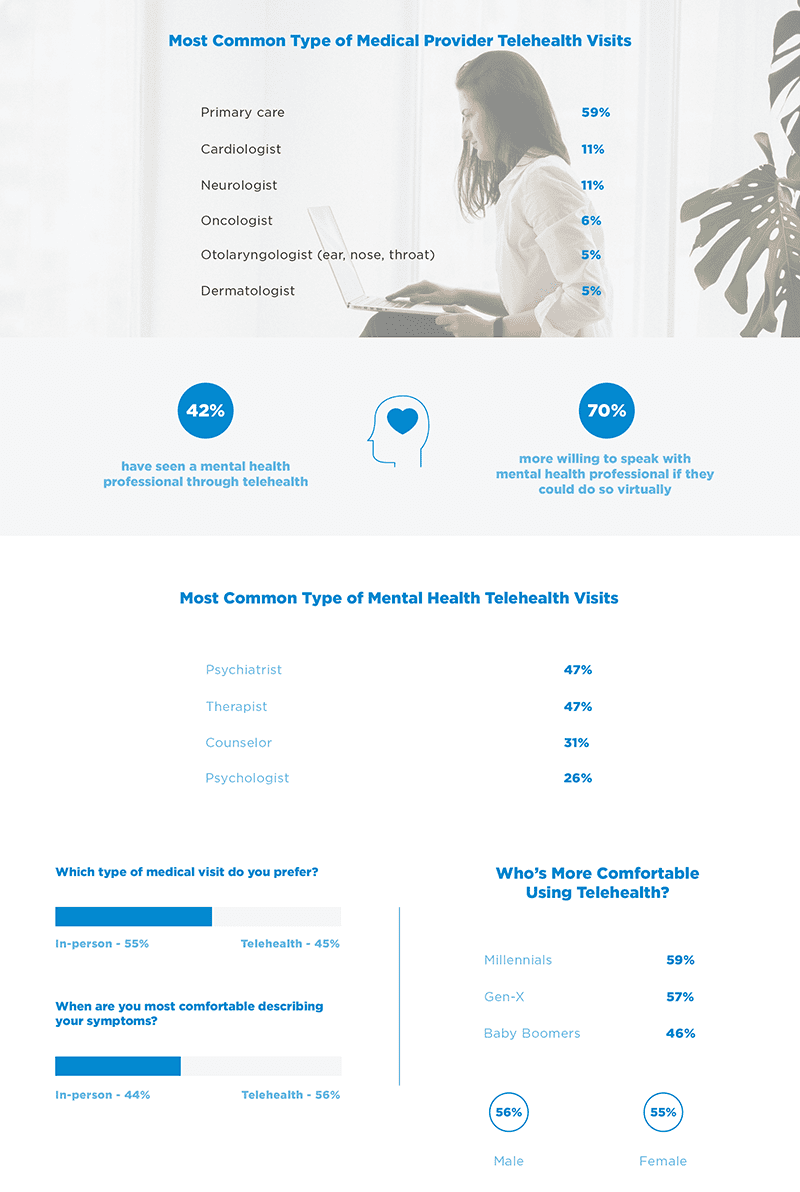
Whether it’s their primary care physician or dermatologist, patients can be connected to their medical provider from almost anywhere with the simple touch of a button. While respondents reported using telehealth to see a wide variety of medical providers, virtual appointments with primary care physicians were the most common (59%), followed by cardiologists (11%), neurologists (11%) and oncologists (6%).

Along with using telehealth to check their physical health, 42% of respondents said they’ve also used the technology to speak with a mental health professional. Interestingly, 70% said they would be more willing to speak with a mental health professional if they could do so virtually.

Telehealth vs. In-Person Visits

Telehealth In-Person

Even though most respondents enjoyed their telehealth experience, many are still split on the type of visit they prefer. Overall, 55% said they would still prefer an in-person visit. Among age groups, millennials said they felt the most comfortable using telehealth (59%) while baby boomers were the least comfortable (46%).

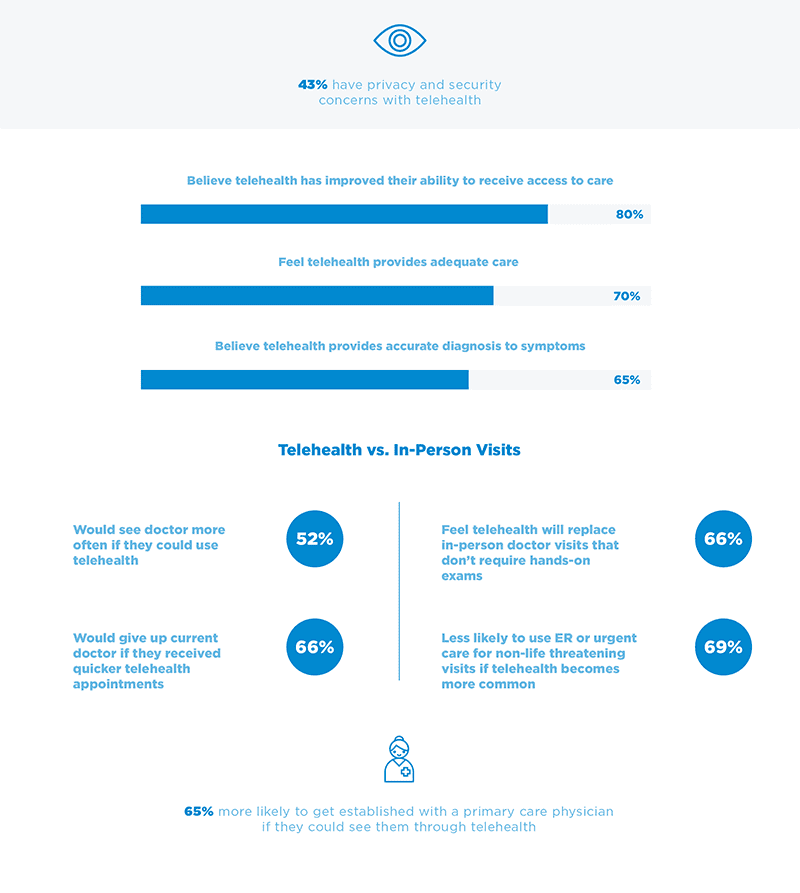
In terms of providing an extra level of comfort for patients, medical providers may want to consider ramping up telehealth security measures. According to respondents, 43% have concerns over privacy and security when using telehealth.

Despite these concerns, 70% feel telehealth provides adequate care and 66% feel that telehealth will eventually replace in-person doctor visits that don’t require hands-on exams or labs. It’s also interesting to note that 66% would be willing to give up their current doctor if it meant they could receive a quicker telehealth appointment.

Future of Telehealth

Telehealth Future

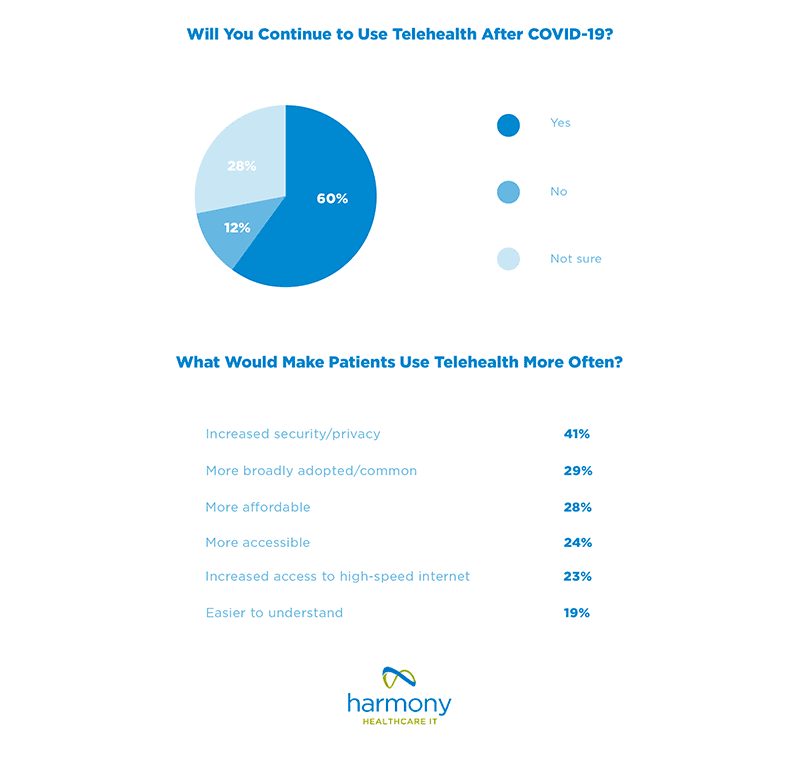
What does the future hold for telehealth after the COVID-19 pandemic? There are certainly a number of improvements that patients would like to see such as increased security and privacy as well as making the service more affordable and more broadly adopted. However, these requested improvements aren’t turning patients away from using the technology. According to respondents, 60% said they plan to use telehealth after the COVID-19 pandemic.

As telehealth continues to evolve, both patients and medical providers will be taking the journey together. COVID-19 has provided an opportunity for patients to give valuable feedback on their experiences with telehealth, which will help pave the way for the technology post-pandemic and beyond.

Methodology

From July 8 to July 10, 2020, we surveyed 2,042 Americans on the topic of telehealth. Of those respondents, 51% were female and 49% were male and the median age was 36. 57% had employer-based health insurance, 23% had Medicare and 10% had Medicaid.

For media inquiries, contact media@digitalthirdcoast.net.

Healthcare IT tips, guides, news & more delivered to your inbox

Learn More

Summary

A recent request for information tells a familiar story of EMR market consolidation: Our legacy Behavioral Health EMR, PsychConsult by Askesis sunset on April 1st of 2020. We have until April 1 of 2021 to find a way to extract our legacy EMR data out of that system in a format that our providers can...

Join Fellow Healthcare IT Pros

Tips, Guides, News & More

Sign Me Up
1980s Retro Futuristic Background. Retro Sunset With Laser Grid.

A recent request for information tells a familiar story of EMR market consolidation:

Our legacy Behavioral Health EMR, PsychConsult by Askesis sunset on April 1st of 2020. We have until April 1 of 2021 to find a way to extract our legacy EMR data out of that system in a format that our providers can easily access.

Healthcare providers that switch from PsychConsult by Askesis may choose to migrate all or some of their legacy EMR data into a newly-selected behavioral health system.  But, system-wide data conversions can be costly and complex. That makes archiving a nice alternative.

As you strategize around your legacy EMR data management plan and how to most efficiently handle the decommissioning of Askesis PsychConsult or other EMRs that end production, keep in mind that legacy data will also need to be addressed. Leaving an old system up and running as read-only – which is not always an option when systems are sunsetted — is a security risk that leaves your PHI vulnerable and open to data breaches. The best practice for safely and securely managing your legacy data is with an active archive.

When you look at the real cost of maintaining multiple legacy systems, including licensing, maintenance and support as well as the associated internal IT labor burden, the ongoing management of outdated systems becomes difficult to justify. Plus, the risk exists that the old systems may become obsolete and non-supported. Keeping the organization’s long-term vision in mind, there is business value and strategic benefits to adopting an EMR archive to keep legacy data intact in a searchable, manageable and HIPAA-compliant format.

Our team at Harmony Healthcare IT, ranked #1 in the category of data archiving by KLAS Research, helps healthcare providers consolidate data stores by decommissioning legacy EMR, HR and other administrative systems and securely retain patient, employee and business records across the healthcare enterprise. HealthData Archiver®, our long-term data storage solution, delivers a single point of access to maintain retention and compliance in a secure and searchable format.

We’ve worked with more than 500 different EMR systems. If it’s software in a healthcare setting, chances are we’re familiar with it or can quickly become familiar.

Faced with a sunsetting PsychConsult by Askesis EMR?

Connect with our team to walk through an efficient plan for keeping the legacy data management accessible within an active archive.

Healthcare IT tips, guides, news & more delivered to your inbox

Learn More