Summary

When it comes to archiving medical records, every data element must be retained with 100% accuracy. That’s why the extraction, migration and retention of protected health information includes data validation — the process of checking its consistency, accuracy, completeness and quality. Validation is a critical step for achieving success in any migration or archiving project....

Join Fellow Healthcare IT Pros

Tips, Guides, News & More

Sign Me Up
Data Validation

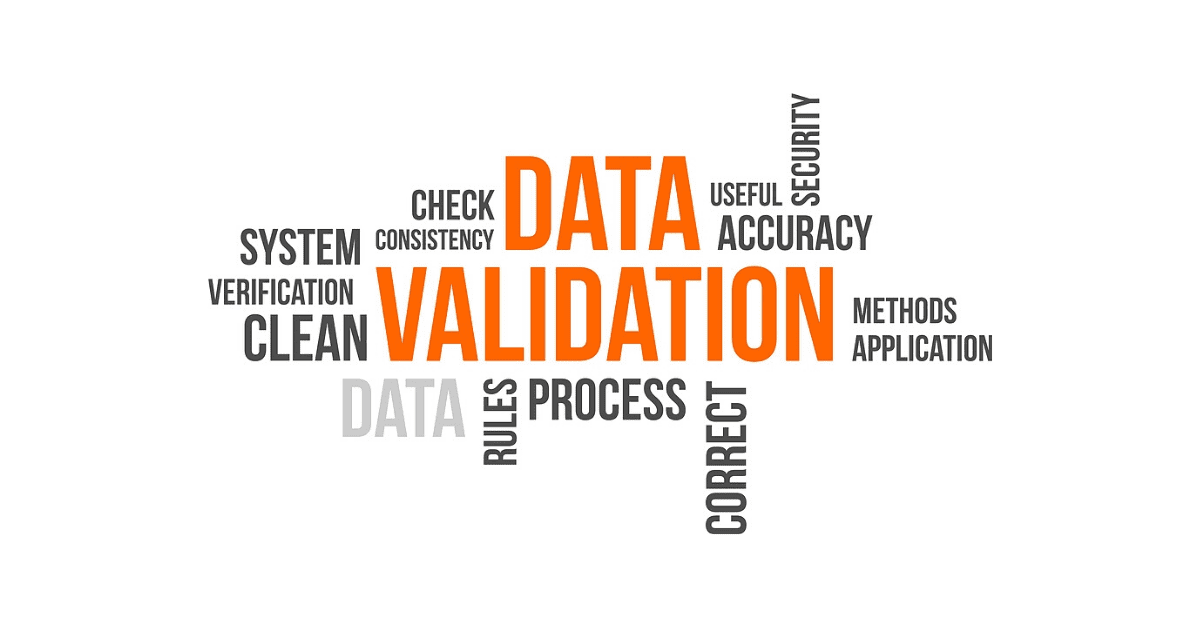
When it comes to archiving medical records, every data element must be retained with 100% accuracy. That’s why the extraction, migration and retention of protected health information includes data validation — the process of checking its consistency, accuracy, completeness and quality.

Validation is a critical step for achieving success in any migration or archiving project. It both ensures the integrity of information as it moves from its source to its destination and verifies that data displays and functions as expected. Because of its impact on quality, validation is performed first by the vendor and then by the client before the project advances.

To accelerate project cycle times, ensure that data is migrated with accuracy, and confirm that archiving software functions as anticipated, Harmony Healthcare IT has integrated the validation process to occur right within its long-term record storage platform, HealthData Archiver®, as a standard feature.  A simple communication tool within the user interfaces allows a user to quickly and easily document and report questions or concerns in one of three categories during validation testing:

Data Validation

  • Bookmark-by-bookmark
  • Field-by-field
  • Documents and Images
  • Chart Order

Feature Validation

  • Record search
  • Filter and sort
  • Download and print
  • Exporting

Issue Management

  • Identify and document issues
  • Resolve issues to 100% satisfaction

The benefit of HealthData Archiver®’s integrated validation feature is that the manual spreadsheets and emails often associated with the validation reporting process between client and vendor are eliminated.  That saves both parties time and reduces potential errors.

Ranked number one in the 2020 Best in KLAS Software & Services Report as a Category Leader in Data Archiving, Harmony Healthcare IT, the maker of HealthData Archiver®, has extracted or migrated patient, employee or business records from over 500 EHR and ERP brand names. That includes the major leading EHR brands you would expect like Allscripts, Cerner, CCPSI/Evident, eClinicalworks, GE, Greenway, Healthland, McKesson, Medhost, MEDITECH, NextGen and Practice Partner. It also includes the “rest” of the EMR brands with less market share as well as what most would consider the one-off or even home-grown EMRs with lower install rates. If it’s software in a healthcare setting, chances are we’re familiar with it or can quickly become familiar. We build in automated data validation into every project to ensure the right data is in play for the complete lifecycle of the record.

For more information, our case studies provide real-world examples of how our HealthData Archiver® platform provides secure, accurate and accessible storage of records by archiving data from retired legacy systems.

Ready to connect about your legacy data management strategy?

We’re here.

Healthcare IT tips, guides, news & more delivered to your inbox

Learn More

Summary

M&A activity for healthcare providers prior to the COVID-19 pandemic was on pace with prior years with 29 announced transactions (compared to 30 in Q1-2018 and 27 in Q1-2019). While the pandemic shifted most organizations’ resources inward, there now is some movement again. Analysts predict that M&A for Q2 will be fewer than in years...

Join Fellow Healthcare IT Pros

Tips, Guides, News & More

Sign Me Up
Chessboard With Wooden Blocks Showing Mergers And Acquisitions Concept

M&A activity for healthcare providers prior to the COVID-19 pandemic was on pace with prior years with 29 announced transactions (compared to 30 in Q1-2018 and 27 in Q1-2019). While the pandemic shifted most organizations’ resources inward, there now is some movement again. Analysts predict that M&A for Q2 will be fewer than in years past, but accelerate for the second half of the year — especially for larger organizations that have had room to remain focused on longer-term strategic initiatives.

Smaller, community-based clinics — especially those in areas that were hard hit by the pandemic — likely will have an increased motivation to consolidate in order to gather additional operational resources. Further, experts predict a short-term uptick in strategic M&A deal making and interest from private equity to buy struggling physician offices.

As participants of all industry segments seek to scale services and gain leverage from a purchasing standpoint, the challenge of integrating two (or more) Healthcare delivery organizations can present unique information technology and data management challenges. During Hospital acquisition, how to manage EMR & ERP systems must be considered.

One of the key predictors in the success of a merger or acquisition is if the two organizations can obtain a “systemness” approach. This means they truly merge and are able to realize the cost/benefit efficiencies of having a meaningful exchange of information through interoperability and data-driven decision-making with business intelligence and analytics. Bottom line, it means evaluating the technologies and processes of both organizations and adopting the best go-forward solutions for the combined entity.

Another success factor to consider is “doing more with less.”

This concept can have a negative connotation when you think of budget cuts and workloads; however, there is an upside when it comes to IT. The positive outcome of the “less is more” idea is favorable when evaluating the end gain of system consolidation — if and when there is a well-planned strategy for managing all of the data within the organization’s care. Less systems to manage, less risks with outdated servers, less technical burden, less maintenance costs, and less cybersecurity risks lead the list of positive points to consider when consolidating  systems through M&A.

In terms of EHRs, often a large healthcare enterprise may have 30-40 clinical, financial and administrative data silos in varying stages of use, but all with a meter ticking with costs and risks rolling along. Other healthcare scenarios include system replacement of the existing EHR to a system that is a better fit for the organization moving forward.

Our team at Harmony Healthcare IT, ranked #1 in the category of data archiving by KLAS Research, helps healthcare providers consolidate data stores by decommissioning legacy EHR, ERP, HR and other administrative systems and securely retaining patient, employee and business records across the healthcare enterprise. HealthData Archiver®, our long-term data storage solution, delivers a single point of access to maintain retention and compliance in a secure and searchable format.

Secure, compliant, long-term record storage in an electronic health data archive solution helps manage the legacy application portfolio.  The solution minimizes the volume of legacy EMR, ERP, GL, Accounting or HR/Payroll applications, allowing the organization to save on maintenance contracts, mitigate technical risk, and reduce labor burden.

With an active archive, outdated legacy systems can be decommissioned and ROI can be expected within 12-18 months. Hence, the doing more with less payoff.

Decommissioned legacy systems equals less burden, less technical risk and a consolidated portfolio of integrated records that remain active and available through a secure, cloud-based active archive.

Is your organization involved in a merger or acquisition? Are there EHR or ERP system replacement activities planned in the near future?

Let’s talk.

Healthcare IT tips, guides, news & more delivered to your inbox

Learn More

Summary

Health Data Archiver is a cloud-based storage platform designed to enhance the integrity, privacy, and security of medical records. It offers features such as consolidated historical records, organized data search, streamed release of information output, a purge rules engine, automatic or manual purge, proof of purge, and purge delay and un-purge. The platform also supports multiple record requests and allows for flexible scheduling and exceptions. Harmony Healthcare IT has developed this platform to support HIM professionals in managing and releasing protected health information.

Join Fellow Healthcare IT Pros

Tips, Guides, News & More

Sign Me Up
We've Got This

Tasked with ensuring the integrity, privacy and security of medical records, Health Information Management (HIM) professionals are always on the lookout for the best way to store, access, and release protected health information.  With that in mind – and in response to the #HIMstrong COVID-19 movement launched by @BradJustusHarmony Healthcare IT has pulled together a list of features and workflows that HealthData Archiver®, a cloud-based storage platform, has to offer HIM teams:

  • Consolidated Historical Records. Tired of logging in to multiple systems to fulfill a single release of information request? A one-time legacy data extraction out of disparate, out-of-production software silos allows those records to be migrated into a single, scalable archive for quick and easy access to information moving forward. With Consolidated Clinical View, a single patient’s encounter information can even be optionally aggregated and viewed across multiple data sources on one screen.
  • Organized Data Search, Display, Sort & Filter. Need to put your hands on the right information right away?  Archived records can be instantly accessed using multi-data point search. This allows for the location of records by patient ID, name, social security number or data source. Data is displayed in categories called bookmarks that may be grouped, expanded or collapsed according to user preferences for easy referencing.  Data filtering allows for sorting by data column and an ability to view results in ascending/descending, alpha, or numeric order.  Additional search features exist within and across record content.
  • Streamlined Release of Information (ROI) Output. Frustrated by the time or effort it takes to generate a copy of a medical record?  From HealthData Archiver®, individual patient records can get printed on demand according to flexible print filters and/or pre-defined print templates.  Templates can default to common record request types such as patient, attorney, payer or employer to ensure that compliant record sets are generated consistently and efficiently.  Multiple record requests can even be generated in batch and/or by date range—a great feature for rapid compliance to bulk records requests (I.e., an audit).
  • Purge Rules Engine. Need archive technology that marries up to your record retention and destruction policy? Designed to accept a multitude of if-then scenarios based on record retention policy, HealthData Archiver® is flexible in how it creates, manages and allows for exceptions with purge rules. Criterion for record destruction might include date of last service, date of discharge, date of birth, document or data type (i.e., behavioral health), etc.  Exceptions may include legal hold, RAC audit, clinical research or other similar situations which might prevent a medical record from being destroyed.
  • Automatic or Manual Purge. Purging can be configured as an automatic or manual process.  If automatic, the system will follow the purge rules created, identify the records which meet destruction criteria, and then queue the records for purge at a scheduled time.  This automatic process happens without user intervention.  Manual purging allows the user to dictate when the process will take place and which rules it will follow at that time.
  • Proof of Purge. Certificates of destruction are provided to show that a record was available at one point in HealthData Archiver®.  The certificate includes the reason as well as the date and time of the purge event (i.e., the record reached the ten year retention period on 12/31/16 at 10:00amET).
  • Purge Delay and Un-Purging. Upon processing of a purge routine, a soft purge occurs.  This means that the records are no longer visible in the archive, however, they are available to be un-purged for a user-defined period of time (i.e., the purge delay).  Once the purge delay time has expired, the record is hard purged.  A hard purge means that the records have been deleted from the archive per National Institute of Standards and Technology (NIST) guidelines.
  • Detailed User Auditing. Want to ensure as much privacy and security for your historical data as you do for active EHR records?  Rights and activities in the archive can be restricted and audited by user, role, group, and data domain/source with built-in, role-based security and access controls. This includes a Break the Glass feature for increased “classified” patient record security. User audit logs are HIPAA-compliant and include the unique user ID, data subject ID, function performed, and date/time event was performed.  With Third-Party Auditing Integration, unusual user activity may be monitored to prevent internal threats.
  • Optimized Clinical Access to Legacy Data. Looking for a better way for caregivers to access archived records? Rather than fielding requests for information from physicians at time of care, give them direct access right from the go-forward EHR.  HealthData Archiver® eliminates the need for manual physician login with single sign-on function right from the go-forward EHR (I.e., HealthData Archiver® is live on the Epic App Orchard and other major EHR marketplaces).  This feature offers complete, in-context access to historical patient records from the active EHR for quick, easy reference at time of treatment.
  • Error Correction/Addenda. Need to ensure late additions, errors or updates to a health record are accurately documented in the archive? HealthData Archiver® includes strike thru, notes and addenda features. These features show how data was displayed in the source system (pre-archive) and, subsequently, when it was changed or corrected (post-archive). This could be helpful if a result was erroneously recorded in the source system, or if a document that should be part of the original legal record never got scanned pre-archive. 
  • Accounts Receivable (A/R) Management. Looking for a solution that allows staff to continue collection efforts on A/R data from a decommissioned billing system? HealthData Archiver® offers A/R management capabilities ranging from simple transaction posting to more comprehensive functionality that includes posting payments/adjustments/memos/refunds, refiling 837 claims, receiving 835 remittance advice, producing statements, managing collector and agency workflows and more.
  • Simplified Information Sharing. Want to share all or part of a patient record? Data can easily export in a wide variety of secure, industry-standard formats for hassle-free sharing and interoperability.
  • Standardized & Customized Reporting. Need canned or custom output from your archived records?  HealthData Archiver® offers a variety of standard reports as well as the ability to attach any ODBC tool to run custom reports. Workflow integration within HealthData Archiver® even supports the need for batch printing/exporting of records for audits.

These and other HealthData Archiver® features help HIM professionals  comply with medical retention policies and increase productivity to remain #HIMstrong. As the #1 ranked Category Leader in Data Archiving in the 2020 Best in KLAS Software & Services Report, Harmony Healthcare IT, the maker of HealthData Archiver®, supports HIM professionals as they manage medical information that is vital to providing quality patient care.

Want to see, first-hand, how HealthData Archiver® can reduce data silos and streamline release of information workflows? Contact us to schedule a demonstration.

Healthcare IT tips, guides, news & more delivered to your inbox

Learn More

Summary

Telehealth technology has played an essential role in maintaining patient and provider safety during the COVID-19 public health emergency. Less stringent regulations and Federal Communications Commission stimulus money has allowed some physician offices to transition to 100% virtual offices while currently, 76 percent of U.S. hospitals connect with patients and consulting practitioners using video and...

Join Fellow Healthcare IT Pros

Tips, Guides, News & More

Sign Me Up
Doctor on phone with Senior

Telehealth technology has played an essential role in maintaining patient and provider safety during the COVID-19 public health emergency. Less stringent regulations and Federal Communications Commission stimulus money has allowed some physician offices to transition to 100% virtual offices while currently, 76 percent of U.S. hospitals connect with patients and consulting practitioners using video and other technology. This is a significant contrast from the 2.4% of people from large employer health plans who had utilized at least one telehealth service in 2018.

To assist with the increase in telehealth practices, the HHS Office for Civil Rights (OCR) now allows providers to utilize non-public facing applications like Apple FaceTime, Facebook Messenger video chat, Google Hangouts video, or Skype. More established and secure virtual care platforms are offered from specialty providers like AmWell, MDLIVE, TelaDoc Health/InTouch Health and a variety of others.  While there are many more options to connect patients with care providers, the OCR still requires good faith in the use of telehealth methods.

One key requirement for telemedicine that remains the same as it is for traditional in-person visits is the requirement for medical record documentation. Documentation requirements for a telemedicine service are the same as for a face-to-face encounter. The information about the visit, the history, review of systems, consultative notes, or any information used to make a medical decision about the patient must be documented along with a note that the service was provided through telemedicine.

A recent update from AHIMA notes that as regulations remain fluid around these new virtual care settings, telemedicine systems documentation will be even more important than ever and will help post-crisis to ensure accurate billing, coding, and syndromic reporting can occur.

To that end, all telemedical records are considered equal to the patient’s primary health record and retained according to all applicable laws. Further, security and back-ups should be maintained according to best practices in case of a system failure.

At a minimum, AHIMA recommends each telemedicine record contain:

  • Patient name
  • Identification number
  • Date of service
  • Referring physician
  • Consulting physician
  • Provider organization
  • Type of evaluation performed
  • Informed consent, if appropriate (in many telemedicine programs, the referring physician/organization retains the original and a copy is sent to the consulting physician/organization.)
  • Evaluation results (In many telemedicine programs, the consulting physician/organization retains the original and a copy is sent to the referring physician/organization)
    Diagnosis/impression
  • Recommendations for further treatment

It is important to review the appropriate state laws and regulations for any specific requirements. For example, telemedical records media may be hard copy, video or audiotape, monitor strip, or electronic files. Some states specify acceptable media for health records. For more information about state telehealth laws, see the Center for Connected Health Policy’s State Telehealth Laws – Spring 2020 publication.

Telemed

Information flow with telemedicine records is held at the same standard as traditional medical records.

Release of information and sharing telemedicine documentation and records with other providers follows the same requirements as an in-person medical record. As such, maintenance of telemedicine records should ensure that the organization can quickly assemble all components of a patient’s record, regardless of their location in the organization. In the absence of policies specifically addressing disclosure of telemedical information, disclosure should be allowed upon receipt of written authorization from the patient or legal representative or in accordance with court order, subpoena, or statute. Informed consent for telemedical encounters should include the names of both the referring physician and the consulting physician, and it should inform the patient that his/her health information will be electronically transmitted.

Many providers have integrated a telemedicine-specific application to assist with the bi-directional workflow needed to keep the EHR up to date, so the physician need only interact with a single platform. This integration increases efficiency and supports facilitating faster diagnosing, lowering prescribing errors, and as a result, improving patient outcomes.

As telemedicine continues to keep patient care moving forward during these unusual times and beyond, there will be EHR system upgrades and replacements that require planning and implementation of solutions for legacy health data. Much like the smooth integration of telemedicine applications that offer workflow benefits to the EMR, an active archive provides Single Sign-On from hospital-wide EMRs like Cerner® or Epic® to support efficient and immediate access to legacy health records at the point of care.

Migrating and storing legacy health data into an active archive, like HealthData Archiver®, makes all legacy health data accessible to physicians at the point of care (wherever that may be), as well as for eDiscovery purposes for the legal team, the HIM team that needs to fulfill a release of information request, and revenue cycle teams who need to perform legacy A/R Management.

Is your team charged with keeping the flow of health data moving across its entire lifecycle? Do you need legacy data availability from your remote offices as well as onsite at a healthcare center? Our team has award-winning experience in extracting, migrating and archiving data and images from over 500 EMR systems. Ranked #1 in the 2020 Best in KLAS Software & Services Report as a Category Leader in Data Archiving, we can help.

Ready to connect?

Contact us today to learn more about our healthcare data management solutions.

Healthcare IT tips, guides, news & more delivered to your inbox

Learn More

Summary

Healthcare organizations should create a Data Governance team to manage legacy systems, prioritize decommissioning, and ensure data integrity.

Join Fellow Healthcare IT Pros

Tips, Guides, News & More

Sign Me Up
Legacy EHR

Implementing a new EHR system? If so, is there a plan for the legacy data? Sometimes, providers let legacy systems continue to run alongside the new EHR based on either a lack of confidence in the migration or lack of a data governance plan, says Joe Ponder, senior partner at InfoCycle, in a recent blog entitled Legacy System & Data Management.

Joe Ponder, Senior Partner at InfoCycle

Leaving legacy systems up and running isn’t a best practice for lifecycle data management and may be a recipe for disaster. With healthcare ranked as the number one most cyber attacked industry, the most vulnerable entry points for bad actors are weak links in the network, which start with legacy systems. And, operational failure or poor performance from outdated systems adds more risk to the IT portfolio the longer the legacy systems are kept in read-only mode.

Considering the total cost of ownership of maintaining a legacy system – hardware, software, liability, licensing, back-ups, access management, security, operations, and training costs —  expenses can really add up while also posing substantial risk to the organization. Plus, there are missed opportunity costs when the IT team spends time repairing and/or troubleshooting issues with legacy systems versus working on current projects.

To take the reins on data management across the organization, create and engage a Data Governance team. Typically, the group includes representatives from Health Information Management (HIM), Finance (Patient Financial Services and General Ledger/HR), Clinical, Operations, Legal, Audit & Compliance, and IS. This group will:

  • Establish a health data archiving strategy
  • Define archive vendor requirements
  • Provide input and approval around the prioritization of the legacy application decommissioning schedule
  • Ensure record retention policies and standards are followed
  • Oversee data archiving project resourcing
  • Monitor regulation awareness and compliance

Once the Data Governance team and plan is solid and stakeholders are aligned, the follow-through with a lifecycle data management strategy can begin. This involves creating an inventory of legacy systems to archive and sourcing RFPs for which EHR and HR/Payroll systems to archive. The inventory will serve as an evolving tool to ensure the organization’s enterprise-wide data management needs are met and managed.

While this task can be completely managed in-house, some organizations choose to engage a third party to help facilitate and implement the legacy data management program. This is a role that our Harmony Healthcare IT team regularly plays; see our case studies for examples.

Ranked as the 2020 top EHR Data Archiving Company, including Data Extraction and Migration, by Black Book Rankings – Harmony Healthcare IT prides itself on working with IT stakeholders to formulate a strategy that lowers maintenance costs, makes release of information more efficient, and provides easy accessibility to records for consolidated clinical viewing and regulatory compliance.

Our team has extracted or migrated patient, employee or business records from over 500 EHR and ERP brand names. Chances are, we’ve worked with the system(s) within your IT portfolio. This depth and breadth of experience provides clients with the peace of mind that data integrity will remain intact and that the active archive will include everything necessary to preserve the PHI, HR, A/R and operational records needed to meet your organization’s record retention plans.

Ready to talk? We’re here.

Healthcare IT tips, guides, news & more delivered to your inbox

Learn More

Summary

Healthcare industry prioritizes cost reduction, operational efficiency in medical records management, with health data expected to grow 36% by 2025.

Join Fellow Healthcare IT Pros

Tips, Guides, News & More

Sign Me Up
Chalkboard Low Cost High Value

Cutting cost and increasing operational efficiency is a focus right now in the healthcare industry, and – when it comes to medical records management and retention — these pressures run up against skyrocketing data volumes.

While the overall volume of electronic data doubles every two years,  health data outperforms this estimate and is expected to be the highest data growth business sector with a compound annual growth rate (CAGR) of 36 percent through 2025. It is estimated that a single patient generates close to 80 megabytes of data each year in imaging and electronic medical record (EMR) data. From x-rays to prescriptions to mental health records and more, health data adds up.

The first question is whether all that data is needed for the long haul.

“We find that, on average, 30-40% of unstructured storage is noise and can be confidently removed,” said Joe Ponder of InfoCycle, an information lifecycle expert, in a recent blog series, Opportunities for Cost Reduction and Operational Improvement. “This noise is often categorized by the industry as ’ROT’ or Redundant, Obsolete and Trivial data. In addition, the average cost of adding additional (unnecessary) storage to some of these solutions can range from $3,000 – $5,000/TB.”

Beyond the storage and management costs of over saving data, there can be legal expenses that make keeping too much data a costly and cumbersome decision. eDiscovery costs can range from $5,000 – $30,000 per gigabyte with discoverable vs evidence ranking about 1000 pages discovered to one page entered as evidence.

There is a better way.

While many healthcare organizations have kept all their records without worrying too much about ever needing to access the information again, there are best practices and technology solutions to support providers in lifecycle data management.

Here are four health data considerations to cut costs and drive operational efficiency:

  1. Conduct a Data Audit – Involve legal, compliance and IT teams to develop a roadmap for record retention guidelines that takes into account HIPAA, federal and state retention requirements.
  2. Maintain a Record Retention Schedule – Create and consistently update a retention schedule that includes an audit of the types of records that need to be stored and for the length of time required by the regulations and laws for each type of record. The plan must be executable so it becomes a standard practice. Involve legal, compliance, IT and other key stakeholders in your organization to ensure that the plan meets the enterprise-wide requirements for what needs to be retained and for how long.
  3. Plan ahead – Create a solid plan for the future that includes an active archive with robust search, sort and filter functionality for historical data. It will be less costly over the long term and less overwhelming should the data be needed for eDiscovery or an audit. Some healthcare organizations have developed stand-alone methods for data management; others rely on vendor developed systems and/or retention models and architecture developed by industry organizations such as the International Council of Archives (ICA).
  4. Develop a plan to eliminate Redundant, Obsolete, Trivial data (ROT). This “eTrash” as it is commonly known can take up valuable storage space and create discovery headaches down the road. eTrash refers to unstructured content with no business purpose that may not require preservation it for regulatory or compliance purposes.

In many cases, by including an active archive in a data management strategy, there is an ROI within 12-18 months. Plus, there are important benefits in terms of increased security and decreased risks of system failures from outdated equipment and software.

Ranked as the 2020 top EHR Data Archiving Company, including Data Extraction and Migration, by Black Book Rankings – Harmony Healthcare IT prides itself on working with all IT stakeholders to formulate a strategy that lowers maintenance costs, makes release of information more efficient, and provides easy accessibility to records for consolidated clinical viewing and regulatory compliance.

Is your organization focused on cost savings and operational efficiencies with the ever-growing data store within your care?

Let’s connect.

Note: To follow Joe Ponder’s blog series, Opportunities for Cost Reduction and Operational Improvement, visit: https://www.infocycle.com/blog

Healthcare IT tips, guides, news & more delivered to your inbox

Learn More

Summary

Location and health data that gets captured, stored, and analyzed through contact tracing apps may be a key factor in supporting the nationwide effort to return to daily activities following the COVID-19 pandemic. However, this sort of new data gathering comes with privacy, security, compliance, and legal questions. Contact tracing involves tracking the location patterns...

Join Fellow Healthcare IT Pros

Tips, Guides, News & More

Sign Me Up
Covid-19 Contact Tracing

Location and health data that gets captured, stored, and analyzed through contact tracing apps may be a key factor in supporting the nationwide effort to return to daily activities following the COVID-19 pandemic. However, this sort of new data gathering comes with privacy, security, compliance, and legal questions.

Contact tracing involves tracking the location patterns of humans so that – as infected individuals are identified – those they may have come in contact with could be identified, alerted, and quarantined. Supported by the Center for Disease Control (CDC) and the World Health Organization (WHO), contact tracing is a crucial part of a three-pronged plan to fight COVID-19 until a vaccine is developed: test, trace, isolate. A highly human-powered effort today, a scholar estimates that the United States will need at least 100,000 workers in contact tracing to keep COVID-19 at a manageable level – more than three times the amount of trained contact tracers today.

Technology to support this human investigative work may involve widespread adoption of contact tracing apps leveraging GPS or Bluetooth to track location data – similar to the Find My app and service provided by Apple Inc. that enables users to track the locations of devices and AirPods. In this use case, however, humans would be tracked and alerted when they come in close proximity to infected individuals. Although location tracking technology already exists, there are privacy, security, and HIPAA compliance considerations to work through depending on how personal health data may be married up with location data. There are also concerns about whether enough people would voluntarily download and utilize contact tracing apps and sensors to make data aggregation statistically relevant for public health officials at community and national levels.

One example of aggregated data was presented by a location and analytics firm which analyzed human interactions within the United States using available anonymous cellular data. They researched and analyzed three factors to come up with a Social Distancing Scoreboard: average distance traveled, visitation to non-essential venues, and decrease in probable human encounters. Overall, the nationwide combined social distancing score came out to be a C-. Researchers from this project stress that the data did not single out any individual person, device, or household and that the company adhered to industry guidelines to ensure individual privacy was not breached and that the report was done pro bono for the greater good.

Moving contact tracing apps forward to support an organized effort to implement the test-trace-isolate methodology poses data management questions, including:

  • Privacy – What contact tracing information is tracked and how is it shared? Would apps be mandated or optional? What about those who don’t want to or cannot participate?
  • Security – What platforms would be used to securely store contact tracing data? Are there cybersecurity risks? How would data protocols support the increased security needed?
  • Data Retention Regulations – How long would contact tracing data need to be stored? Who are the stakeholders responsible for record storage? What is the governing body?
  • Data ownership – Who would own contact tracing data? How would the chain of custody (i.e., viewing and acting on the data) for these records be managed?
  • Legal Considerations – What types of legal issues could arise from this increased tracking of location and health data related to contact tracing? Could workplaces be held accountable if employees claim they were exposed to the virus at their workplace? What other kinds of privacy issues could have legal ramifications?

Many other countries are diving into contact tracing with varying approaches utilizing technology and human efforts. In Europe, the European Commission issued its Guidance to ensure full data protection standards of apps fighting the pandemic. There are many points, and most focus on the opt-in voluntary nature for the app and that there should be no negative consequences for individuals who choose not to use an app. The Commission recommends storing the least personal amount of data, meaning the exact time/place of the contact doesn’t seem necessary and that the app should be automatically deactivated once the pandemic is declared under control.

As scientists, politicians, public health officials, and the general public tune in daily to review the numbers associated with COVID-19, it is even more evident that health data is something that unites people worldwide. With answers to some of these questions, the storage of location and health data from apps supporting the human effort associated with contact tracing may be a key factor in limiting the spread of COVID-19 and Opening Up America Again.

Healthcare IT tips, guides, news & more delivered to your inbox

Learn More

Summary

Award-winning data management firm Harmony Healthcare IT, consistently a first-to-market innovator, has been named to the annual CIO Review listing of 50 Most Promising Healthcare Solution Providers. CIO Review profiles health tech companies offering leading solutions to the healthcare industry. Offering a “compelling and comprehensive approach for healthcare organizations to preserve vital information,”, as stated...

Join Fellow Healthcare IT Pros

Tips, Guides, News & More

Sign Me Up
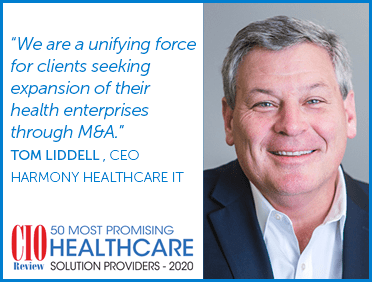
Tom Liddell CIO Review testimony

Award-winning data management firm Harmony Healthcare IT, consistently a first-to-market innovator, has been named to the annual CIO Review listing of 50 Most Promising Healthcare Solution Providers. CIO Review profiles health tech companies offering leading solutions to the healthcare industry.

Offering a “compelling and comprehensive approach for healthcare organizations to preserve vital information,”, as stated by CEO Tom Liddell, Harmony Healthcare IT distinguishes itself with the ability to harmonize legacy data silos and make information secure, compliant, and accessible.

Ranked as the 2020 top EHR Data Archiving Company, including Data Extraction and Migration, by Black Book Rankings – Harmony Healthcare IT prides itself on working with IT stakeholders to formulate a strategy that lowers maintenance costs, makes release of information more efficient, and provides easy accessibility to records for consolidated clinical viewing and regulatory compliance.

Learn more about why Harmony Healthcare IT is considered one of the 50 Most Promising Solution Providers of 2020 by reading the full article.

Ready to talk about the risk tied to your organization’s use of multiple legacy systems? We’re ready to listen, and help.

Healthcare IT tips, guides, news & more delivered to your inbox

Learn More

Summary

As providers focus on the frontline of COVID-19, hackers are on the attack even more. In an industry that was already targeted and re-targeted for cyber crimes, there have been 108 healthcare data breach incidents affecting 500 or more records reported so far in 2020, versus 510 reported for all of 2019. Researchers tracked almost...

Join Fellow Healthcare IT Pros

Tips, Guides, News & More

Sign Me Up
Hacker in a Pandemic

As providers focus on the frontline of COVID-19, hackers are on the attack even more. In an industry that was already targeted and re-targeted for cyber crimes, there have been 108 healthcare data breach incidents affecting 500 or more records reported so far in 2020, versus 510 reported for all of 2019.

Researchers tracked almost 10,000 attempted phishing email cyber attacks linked to the coronavirus crisis since the beginning of March. This compares to about 1,800 in February, a 455% increase in just one month, and there’s no sign of the attacks slowing down. These malicious emails use the trending coronavirus topic to lure individuals into clicking on dangerous links and downloading attachments that typically include computer viruses.

With these increased attacks come new exploitations – fraudulent emails are now impersonating widely recognized and trusted domain names from the World Health Organization (WHO) and the US Centers for Disease Control and Prevention (CDC). The fake emails play to readers’ emotional responses about COVID-19, requesting passwords and even asking for bitcoin donations to fund a fake vaccine. Hackers also prey on the public’s increased need for information and are sending more emails that impersonate CEOs appearing to give a company-wide update that includes fake links. This is the opening hackers are looking for to gain access to healthcare networks and, ultimately, valuable PHI.

These new attacks pile on top of the already overly cyber-attacked healthcare industry. A recent report found a staggering 90% of healthcare organizations experienced an email-borne threat in the past year. While 3 out of 4 providers are now engaged in a cyber-resilience program, only half of respondents have a high level of confidence with their current security deployment. More concerning is that this survey was conducted prior to the coronavirus adding a massive uptick in cyber attacks.

An Active Archive Helps Protect Legacy Data from Cyber Attack
Only 17% of healthcare organizations believe their current data protection solutions will meet their future data protection needs and requirements. This leaves a lot of room to further secure patient, employee, and business records – especially legacy records that may be stored in outdated, vulnerable servers.

Legacy systems, by the sheer nature of their age and diminished capacities, are more prone to vulnerabilities including cyber attack. In a HIMSS cybersecurity survey of healthcare providers:

  • 69% indicated that they had at least some legacy operating systems in place at their healthcare organizations
  • 83% of those still operate with Legacy Windows Servers (e.g., 2003, 2008, 2012, 2016 and XP)
  • 14% of respondents said over 10% of their systems qualify as a legacy operating system

One immediate step healthcare providers of any size can take to bolster security is to evaluate their legacy data management strategy and implement an archiving solution. An active archive is a data management platform that provides a single point of access to historical patient, employee, or business data for healthcare enterprises. This web-based solution, with its release of information workflows, Single Sign-On integrated clinical views, revenue cycle features, and eDiscovery capabilities provides a significant return on investment for healthcare delivery organizations decommissioning legacy systems. The solution consolidates data stores, reduces out-of-production system maintenance costs, mitigates technical risk, complies with record retention mandates, and offers both interoperability and data analytics capabilities.

Most importantly, an archive and decommissioning plan can eliminate the number of doors and windows you need to protect within a healthcare IT landscape. Less entry points equals better security odds, which is paramount in a time when the industry continues to come under fire.

When considering decommissioning legacy systems and determining how to handle legacy data management to shore up the risk factor to your PHI, there are a few things you’ll want to ask any future archiving partner to ensure cybersecurity is a high priority in the project.

Bottom line: Active Archiving is the one big defensive move your healthcare organization can take immediately to protect its EHR, ERP, and HR systems to keep cyber criminals locked out.

If your provider organization needs help protecting legacy records in this hostile, hacker-centric environment, Harmony Healthcare IT, a leading and award-winning health data management firm, is ready to lend a hand.

Healthcare IT tips, guides, news & more delivered to your inbox

Learn More

Summary

Healthcare is on the mind of Americans now more than ever. Millions of Americans receive healthcare insurance through an employer-based plan, Medicare, Medicaid or other type of program, but more than 27 million Americans remain uninsured. As a health data management firm interested in where those who are uninsured live, we analyzed health insurance data...

Join Fellow Healthcare IT Pros

Tips, Guides, News & More

Sign Me Up
Uninsured Americans

Healthcare is on the mind of Americans now more than ever. Millions of Americans receive healthcare insurance through an employer-based plan, Medicare, Medicaid or other type of program, but more than 27 million Americans remain uninsured. As a health data management firm interested in where those who are uninsured live, we analyzed health insurance data from every state as well as the 100 most populous metro areas in the country.

Uninsured Americans by State

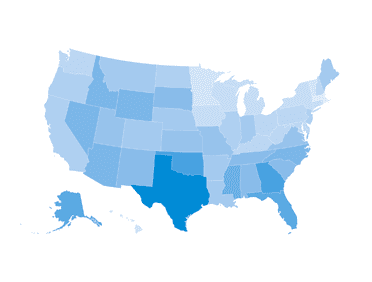
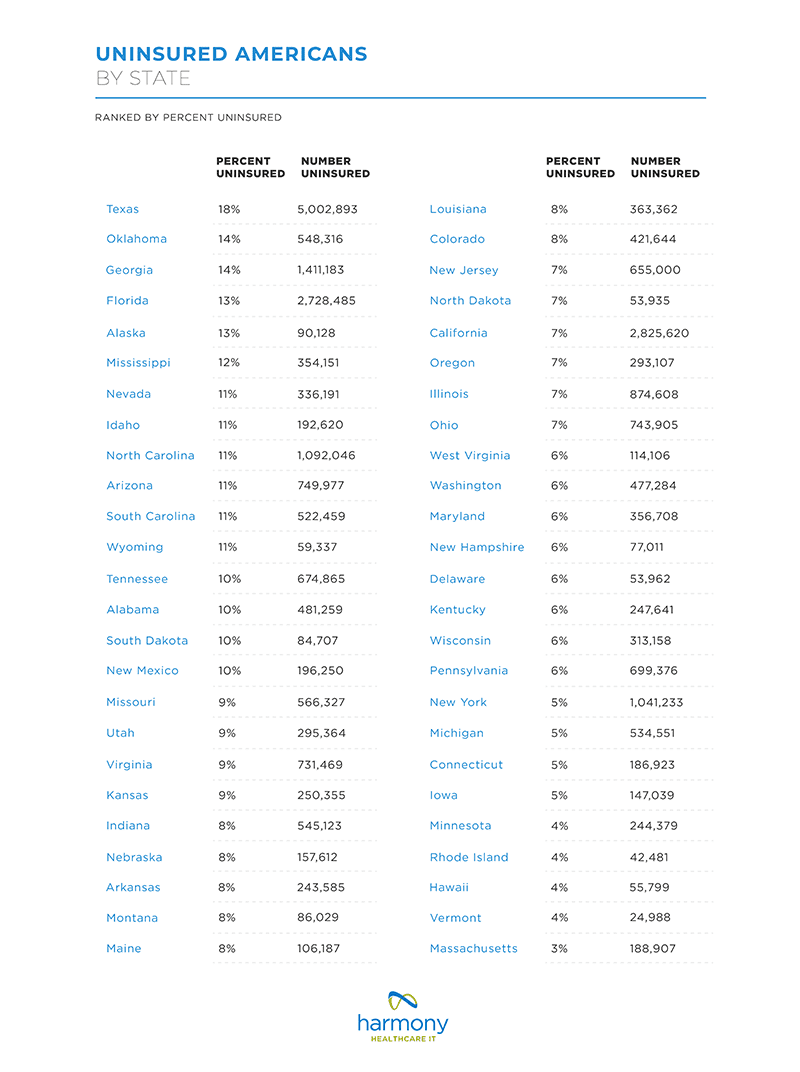
Among the top 17 states with the highest percent of uninsured residents (10% or more), 11 are in the South or Southwest. However, it’s Texas that is home to the highest percent of uninsured residents in the nation. More than 5 million Texans, or 18% of the population, are uninsured. Meanwhile, neighboring Oklahoma ranks right below Texas at No. 2 with more than half a million uninsured, or 14% of the population. Georgia ranks No. 3 with 1.4 million uninsured residents, or 14% of the population.

In terms of states with the most insured residents, Massachusetts ranks No. 1 with only 3% of its population uninsured, followed by Vermont (4%) and Hawaii (4%).

Uninsured Americans by City

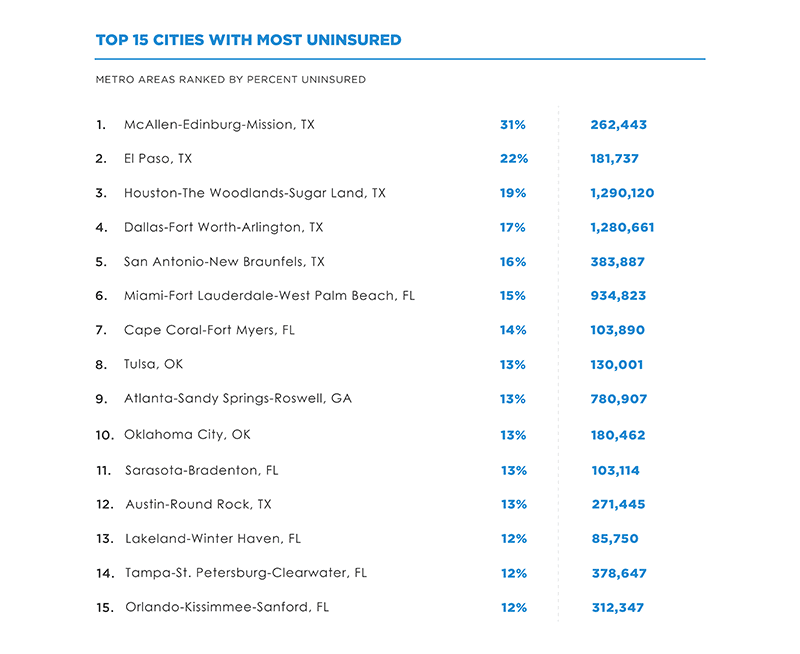
Considering that Texas has the highest percent of uninsured residents, it may not come as a surprise that it is also home to the metro area with the highest percent of uninsured in the country. More than 260,000 out of 858,000 residents in the McAllen-Edinburg-Mission metro area are uninsured, which equates to 31% of the population. In fact, the top 5 metro areas with the most uninsured residents are in Texas. Behind the McAllen metro area, El Paso ranks No. 2 with 22% uninsured, Houston No. 3 (19%), Dallas-Fort Worth No. 4 (17%) and San Antonio No. 5 (16%).

With only 3% of Massachusetts residents uninsured, the state is also home to the top three metro areas with the least uninsured residents. The Boston-Cambridge-Newton metro area ranks No.1 with 3% uninsured followed by Springfield and Worcester, each with 3% uninsured as well.

Uninsured Millennials by State

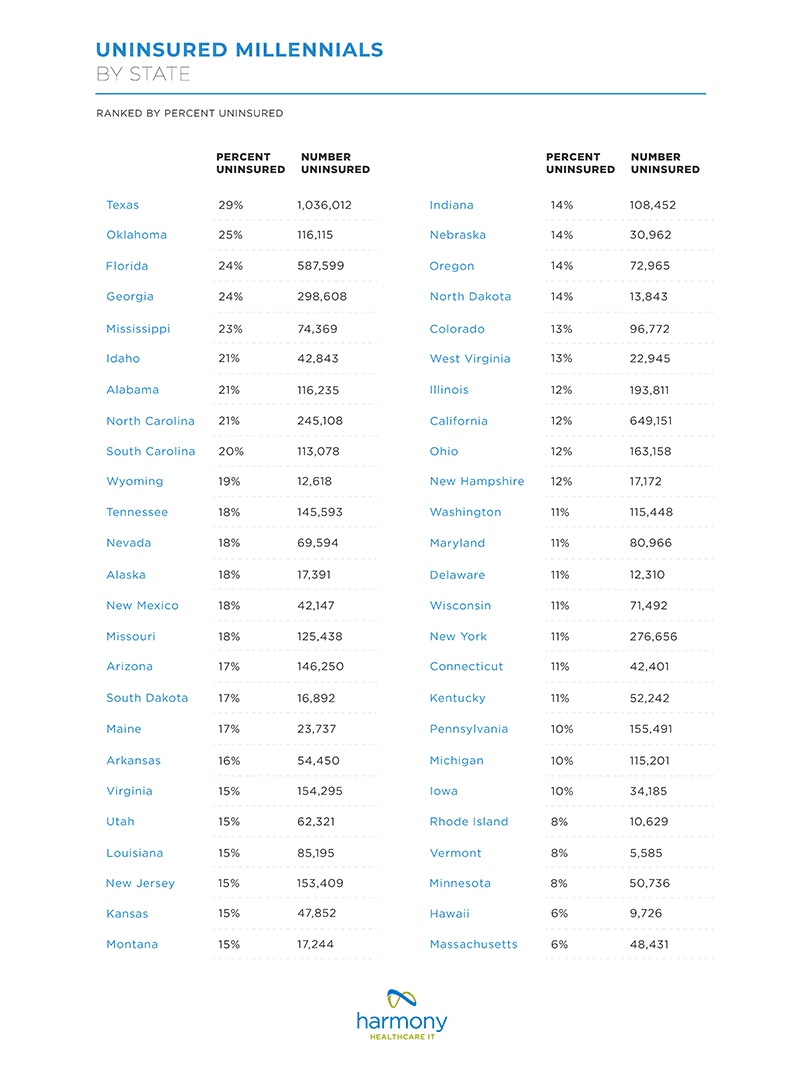
Among Americans without health insurance, millennials are the demographic with the highest percent of uninsured. Nationwide, more than 6 million millennials between the age of 26 and 34 do not have health insurance. Texas is home to the highest percent of uninsured millennials with 29%, or more than 1 million.

In neighboring Oklahoma, a quarter of the state’s millennials are uninsured. Florida ranks No. 3 (24%), Georgia No. 4 (24%) and Mississippi No. 5 (23%). Overall, the average percent of uninsured millennials in every state is 15% and only 5 states have less than 10% of uninsured millennials.

Uninsured Millennials by City

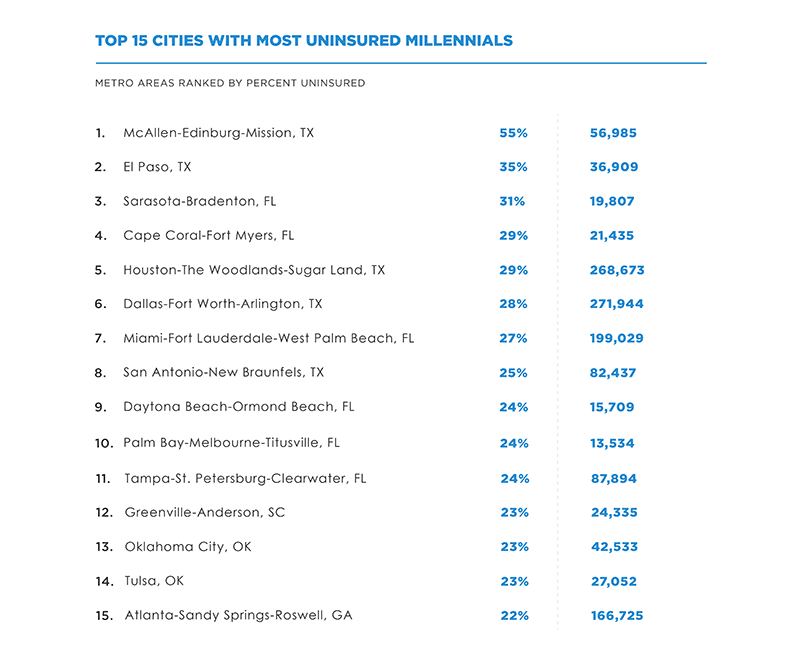
Perhaps one of the most startling statistics when it comes to uninsured millennials is the percent of uninsured millennials in the McAllen-Edinburg-Mission, Texas metro area. Overall, 55% of millennials are uninsured in that region. El Paso ranks No. 2 with 35%, Sarasota-Bradenton, Florida ranks No. 3 (31%), Cape Coral-Fort Myers No. 4 (29%) and Houston No. 5 (29%).

Gaining insight into which states and cities have high percentages of uninsured residents can give us a better understanding of exactly where Americans are struggling to get healthcare coverage, or simply choosing not to have it at all.

Methodology

We analyzed the United States Census Bureau 2018 American Community Survey to determine the percent of uninsured Americans in every state. We also analyzed data from the 100 most populous metro areas within the United States. For millennials, we analyzed data for those between the age of 26 and 34 within those same states and metro areas.

For media inquiries, contact media@digitalthirdcoast.net.

Healthcare IT tips, guides, news & more delivered to your inbox

Learn More