Summary

While cancer is among the leading causes of death worldwide with nearly two million adults diagnosed each year in the U.S., the number of survivors continues to rise and is expected to reach 20.3 million by the year 2026. Negative health effects brought on by chemotherapy, radiation, surgery, or other therapies can manifest right away...

Join Fellow Healthcare IT Pros

Tips, Guides, News & More

Sign Me Up
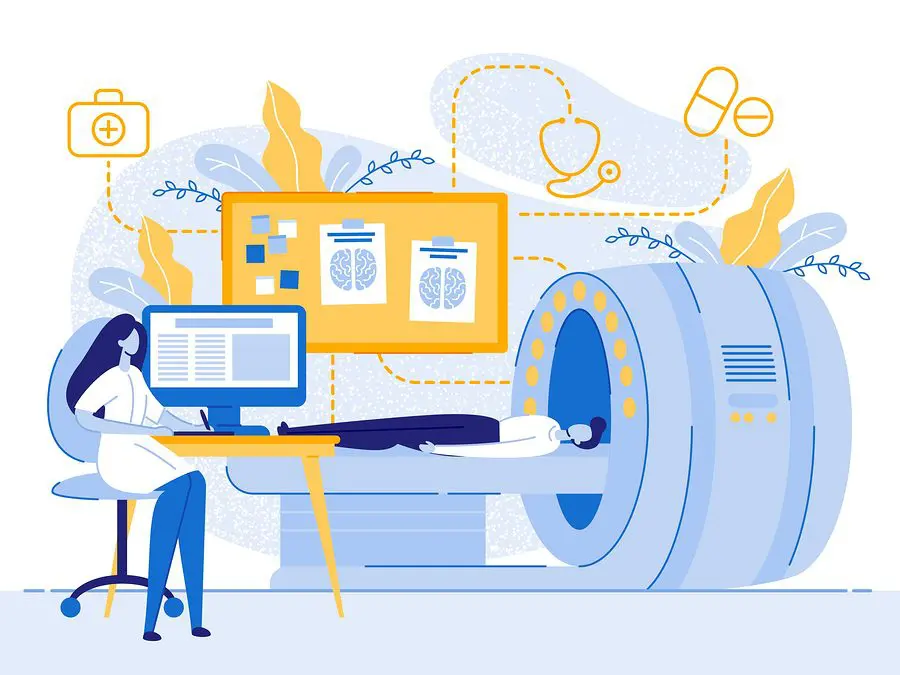
MRI Illustration

While cancer is among the leading causes of death worldwide with nearly two million adults diagnosed each year in the U.S., the number of survivors continues to rise and is expected to reach 20.3 million by the year 2026.

Negative health effects brought on by chemotherapy, radiation, surgery, or other therapies can manifest right away or years after treatment. In fact, two thirds of adult survivors of childhood cancer are at risk of developing a chronic condition as a result of cancer treatment. For this reason, it is essential to actively archive radiation oncology medical records when one EMR gets replaced with another. Secure, long-term access to these radiation oncology medical records ensures quality patient care, effective cancer research, and compliance with record retention requirements.

To manage radiation oncology records, some physicians rely on specialty-specific information systems such as ARIA®, Centricity‘ RIS-IC, MOSAIQ®, or OncoEMR®. Other providers utilize more general EMRs in their practice like NextGen®, Prime Suite, Allscripts, eClinicalWorks, or Amazing Charts. Any of these systems might interface with a hospital-wide EMR like Epic® or Cerner®, exchanging demographics, appointments, clinical data, and billing information in and outside of the healthcare enterprise. This interoperability enables access to records and continuity of care in support of better outcomes for the patient. For example, if a patient receiving radiation for brain cancer shows up in the emergency room in the middle of the night, the ER doctor could review the most recent radiology/oncology therapies or treatments.

When one of these radiation oncology EMR systems get replaced, it’s important that the consultations, care plans, treatment summaries, and lab/radiology/pathology/operative reports are preserved in an archive versus left siloed in an aging legacy system. Migrating and storing the information into an active archive, like HealthData Archiver®, makes the data accessible to cancer researchers as well as allows for compliance with strict oncology medical record retention requirements (i.e., the Food and Drug Administration requires records pertaining to cancer patients be maintained for 30+ years).

Other archive users benefit as well. Through Single Sign-On from hospital-wide EMRs like Cerner® or Epic®, archived records can be made available, in-context, to treating physicians so that better-informed care decisions can be made at time of treatment. Legal teams can benefit from quick eDiscovery by using search, sort, and filter functions that span consolidated charts. Using built-in workflows, HIM staff can access the active archive to fulfill release of information requests and revenue cycle teams can perform legacy A/R Management.

Is your radiation oncology department/practice looking to archive data or images from a legacy system like ARIA®, Centricity RIS-IC, MOSAIQ®, OncoEMR® or any other electronic medical record systems? Our team has award-winning experience in extracting, migrating, and archiving data and images from legacy radiology and oncology systems. Ranked #1 in the 2020 Best in KLAS Software & Services Report as a Category Leader in Data Archiving, we can help.

Ready to connect?

Contact us today to learn more about our healthcare data management solutions.

Healthcare IT tips, guides, news & more delivered to your inbox

Learn More

Summary

Medical labs are in the spotlight during the COVID-19 pandemic. We all need information about the virus – who has it, where it came from and, importantly, how to treat it. Laboratory professionals and pathologists are tasked with developing rapid testing methods, deploying tests nationwide, and marshalling test results in the all-hands-on-deck approach to flattening...

Join Fellow Healthcare IT Pros

Tips, Guides, News & More

Sign Me Up
Doctors Hand Taking a Blood Sample

Medical labs are in the spotlight during the COVID-19 pandemic. We all need information about the virus – who has it, where it came from and, importantly, how to treat it. Laboratory professionals and pathologists are tasked with developing rapid testing methods, deploying tests nationwide, and marshalling test results in the all-hands-on-deck approach to flattening the curve and caring for the nation. In general, experts suggest that medical labs contribute in three important ways during wide-spread viral outbreaks:

  1. Etiological diagnosis – conducting studies to determine one or more factors that come together to cause the illness.
  2. Patient monitoring – clinical and sometimes remote monitoring of health variables.
  3. Epidemiologic surveillance – the systematic collection, analysis and dissemination of health data for the planning, implementation, and evaluation of public health programs.

In general, outside of pandemics, lab results collected by clinicians nationwide and stored across the health ecosystem contain important health data for patients, their relatives, and for public health officials. Currently, medical lab record retention requirements range from 2-5 years for most records, but there are variables for specific medical labs, such as bone marrow specimens that must be retained for 10 years. eDiscovery requirements often extend longer than medical record retention requirement as well. It’s plausible that medical lab records from COVID-19 will also have an extended retention policy as pandemic research continues.

The medical data in lab results and reports contains information that can help shape future healthcare directions. Laboratory information systems (LIS) such as Sunquest, HCLL, Wellsky, and Mediware carry that responsibility. As these and other lab systems get replaced, evaluating how much and what sort of legacy lab data will migrate to the go-forward system is a critical step. And, for the data left behind, it will be necessary to determine a legacy data management strategy. An active archive provides a secure, searchable, long-term option for historical lab and blood bank records.

Ranked #1 in the 2020 Best in KLAS Software & Services Report as a Category Leader in Data Archiving, and awarded the 2020 top EHR Data Archiving Company, including Data Extraction and Migration, according to Black Book Rankings, a division of Black Book, Harmony Healthcare IT can help your team with a Medical Lab record retention guide to successfully plan a long-term strategy for your laboratory records and systems. As interoperability, eDiscovery, and public health initiatives continue to stretch the long-term needs of lab results and reports, your strategy to effectively manage this key information may need a refresh.

Ready to talk laboratory system legacy data management?

Connect with us.

Healthcare IT tips, guides, news & more delivered to your inbox

Learn More

Summary

RockWood Group consulted for integrated delivery network, saving $17 million, preserving data integrity.

Join Fellow Healthcare IT Pros

Tips, Guides, News & More

Sign Me Up
Case Study The RockWood Group

The RockWood Group (RWG), a health information technologies consulting firm, consulted for an integrated delivery network (IDN) made up of nine hospitals, 1,200 beds and 700 physicians. One IT project for that IDN was to manage the decommissioning of 40 legacy medical, revenue cycle, HR/payroll and ancillary systems, securely archiving the data.

The IDN’s IT department was close to selecting a data archiving solution at the time, but Helen Thompson, CEO of RWG, advised them to give their end-users a chance to review the archiving system before making a final decision. She also encouraged the IT department to bring in Harmony Healthcare IT for a demonstration of its long-term storage platform, HealthData Archiver®.

When Harmony Healthcare IT visited the client site, “the end users evaluated HealthData Archiver® and reviewed how it would manage workflows once data was put in,” said Helen. “Nearly 100 percent of them agreed that HealthData Archiver® was the tool they wanted.”

The IT team also recognized the diverse data management experience and systematic project methodology Harmony Healthcare IT offered to manage its vast inventory of systems.

Helen Thompson, CEO

“The Harmony team is professional and committed. Most importantly, they deliver on time. Their knowledge of the multitude of EHRs out there is incredible. Working with Harmony has helped to mitigate
cybersecurity risks, save my client money, and reduce their labor burden. From an operational perspective, HealthData Archiver® has improved the release of information and clinical workflows.”
– Helen Thompson, CEO, The RockWood Group

Solution

HealthData Archiver® provides consolidated legacy records for end users, making them easier to access and more secure.

“Historical data that a physician used to have to wait days to see is now embedded in the electronic health record they’re using and can be accessed through Single Sign-On with a click of a button,” said Helen. “HealthData Archiver® really changes the availability of historical information in the workflow of our clinical users.”

In addition to its product being the best option for end-users, Helen found that the ability for Harmony Healthcare IT to deliver met and exceeded expectations.

“Harmony is an expert in its field,” said Helen. “Their team understands the goals and timelines. They were able to accelerate some timelines for us to match up with budgetary goals. We found them very easy to work with.”

Saved Money

The IDN saved a projected $17 million over three years with the data archiving project.

Minimized Data Integrity Issues

Data integrity was preserved as a result of validation testing and training.

Delivered Projects On Time and On Budget

Expanded the Use of the Archive

Access this Case Study in .pdf format

Healthcare IT tips, guides, news & more delivered to your inbox

Learn More

Summary

BC Solutions, a firm specializing in laboratory consulting and compliance, had a long-standing relationship with their data extraction, migration and archiving vendor. However, as the volume of large-scale laboratory information system (LIS) decommissioning projects increased, BC Solutions sought an alternative resource to handle the growing project load. FDA requirements for the collection of blood, blood...

Join Fellow Healthcare IT Pros

Tips, Guides, News & More

Sign Me Up
case Study BC Solutions

BC Solutions, a firm specializing in laboratory consulting and compliance, had a long-standing relationship with their data extraction, migration and archiving vendor. However, as the volume of large-scale laboratory information system (LIS) decommissioning projects increased, BC Solutions sought an alternative resource to handle the growing project load.

FDA requirements for the collection of blood, blood products, and record-keeping are extremely detailed. Therefore, it was essential to BC Solutions’ success in the laboratory market for their next partnership to be with a capable and proven archiving vendor.

BC Solutions conducted careful research and evaluated each new archiving vendor’s customer reviews, prices, and turnaround times. They sought a partner who would not only execute effectively on projects, but also communicate efficiently and professionally with both BC Solutions and their customers.

Diane Janowiak, National Sales Director

“Because we’re dealing with blood products—blood banks and transfusions—it is all about patient safety, and you can’t put a price on that. Harmony’s attention to patient safety and the quality of their work is really what sets them apart.”
– Diane Janowiak, National Sales Director, BC SOLUTIONS

Solution

Ultimately, BC Solutions selected Harmony Healthcare IT as their vendor of choice for the data extraction, migration and archival of their customers’ historical LIS data.

“Harmony’s reputation in the industry and the quality of their work is what made them stand out,” said Diane Janowiak, National Sales Director at BC Solutions. “Not only are they able to efficiently help with data migration, but their HealthData Archiver® platform is robust, and we feel good about the security that comes with it.”

BC Solutions is impressed with how timely, professional, and responsive Harmony Healthcare IT has been regarding the 30+ projects the company has worked on so far.

“Harmony is on time nearly 100% of the time,” said Janowiak. “They also have good communication throughout the project.”

Having a transparent relationship is important to BC Solutions. Harmony Healthcare IT provides weekly cadence calls on every project to check in, provide updates on milestones, and ensure clear communication.

“There are so many moving parts on these projects, they can sometimes go sideways,” Janowiak notes, “but thanks to Harmony’s constant communication, we are able to keep projects on track easily and re-engage clients quickly.”

Benefits & Results

• High-Quality Measures for Patient Safety and Care
• Skilled Project Management and Attention to Detail
• Keeps Projects On Track and On Time

Archived Legacy Systems

Legacy systems that Harmony Healthcare IT has helped BC Solutions to archive include:
• Cerner
• MEDITECH
• SafeTrace Tx®
• SoftBank®
• Sunquest
• WellSky®

Access this Case Study in .pdf format

Healthcare IT tips, guides, news & more delivered to your inbox

Learn More

Summary

As the spread of COVID-19 creates challenges for customers, prospects and partners of Harmony Healthcare IT, we have mobilized resources to provide help in any way we can. Q:  I am an existing Harmony Healthcare IT customer with projects in-flight or pending orders. What can I expect? A:  Harmony Healthcare IT is open for business....

Join Fellow Healthcare IT Pros

Tips, Guides, News & More

Sign Me Up
Covid-19 Business Continuity Questions

As the spread of COVID-19 creates challenges for customers, prospects and partners of Harmony Healthcare IT, we have mobilized resources to provide help in any way we can.

Q:  I am an existing Harmony Healthcare IT customer with projects in-flight or pending orders. What can I expect?

A:  Harmony Healthcare IT is open for business. Expect that current statements of work are being addressed from a team setup to securely complete work from a virtual setting. Contact your Project or Account Manager at (800) 781-1044 should you have questions about existing or additional data extraction, migration or archival needs. Know that we are grateful for the front line during this unprecedented time and feel fortunate to continue our work.

Q:  I am an existing Harmony Healthcare IT customer with product support or maintenance needs. What do I do?

A:  Contact us. Support Analysts from the Harmony Healthcare IT help desk are available through normal telephone (1-800-781-1044) and online channels at all hours during this crisis to answer any product questions or to provide upgrade support. In addition, our CEO, Tom Liddell, is available to work with customers who may have special or unique health IT or service requests that can be swiftly addressed under our current partnership/BAA. Our aim is to work cooperatively with any health IT stakeholders in need.

Q:  I am a prospective client that recently issued a Request for Information (RFI) or Request for Proposal (RFP) to Harmony Healthcare IT. What are next steps?

A:  Proceed as planned. Harmony Healthcare IT representatives are actively working on responses to previously issued RFIs/RFPs from a variety of healthcare delivery organizations and intend to deliver on-time to keep health data archiving vendor evaluation processes on-course. Our Business Development Directors are on stand-by to address any incoming needs for healthcare organizations to consolidate and lock down protected health information, decommissioning out-of-production systems to fortify security and streamline access to records.

Q:  I am a partner, vendor or contractor for Harmony Healthcare IT. How can I help?

A:  Continue to work collaboratively and keep lines of communication open. Harmony Healthcare IT is situated to continue business operations, providing data management products, services, and support to front line healthcare delivery organizations in need. This is due, in part, to its strong and strategic network of vendors, partners and contractors. We ask that you notify us of any business continuity constraints of your own that may impede your ability to deliver as planned so that we may pivot accordingly.

Please contact us with an additional questions or needs.

Healthcare IT tips, guides, news & more delivered to your inbox

Learn More

Summary

Consolidating legacy medical data stores and deploying a HIPAA-compliant, long-term record storage solution helps both acute and ambulatory facilities achieve Quadruple Aim in healthcare.

Join Fellow Healthcare IT Pros

Tips, Guides, News & More

Sign Me Up
IHI Quadruple Aim for Healthcare

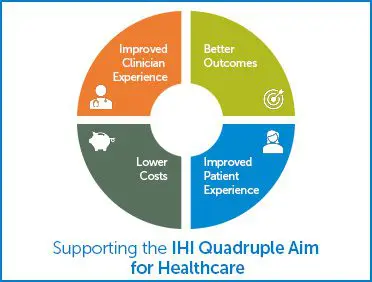
Measuring success in healthcare is not new. Years ago, there were six widely accepted healthcare quality factors viewed as most important. The factors, based on Institute of Medicine report Crossing the Quality Chasm, provided a framework for measuring care based on it being safe, effective, patient centered, timely, efficient, and equitable.

In 2006, a breakthrough idea from two faculty members from the Institute for Healthcare Improvement (IHI) suggested that, although the six quality measurements were essential, the goal of healthcare was much larger than just at the point of care. John Whittington, MD and Tom Nolan, PhD developed the Triple Aim approach which focuses on enhancing the patient experience, improving population health and reducing costs. Their 3-prong approach became an industry standard of excellence.

What became apparent as the years went on is that physician burnout threatened the symbiosis to patient care Triple Aim was geared towards providing. This led to the addition of a fourth aspect to the compass that continues to guide the healthcare system forward – thus creating Quadruple Aim.

There are a number of people, process and technology strategies that healthcare delivery organizations can employ to accomplish Quadruple Aim. One area is data lifecycle management, which affects the ways legacy data is handled when clinical, financial and administrative systems in the healthcare ecosystem get replaced.

Health Data Archiver

Consolidating legacy data stores and deploying a HIPAA-compliant, long-term record storage solution like HealthData Archiver® helps both acute and ambulatory facilities achieve Quadruple Aim optimization in the following ways:

Lower Costs

In general, implementing an active archive platform like HealthData Archiver® can provide a return on investment within 12-18 months. The savings can be measured against maintenance cost of the legacy systems, IT labor to administer those systems, training of users over time on antiquated and out-of-production systems, hardware infrastructure, etc. It will also allow for legal and compliance teams to more efficiently prepare for litigation or legal inquiry with faster eDiscovery versus waiting on HIM to search multiple systems and consolidate records. Easier access to records and the ability to quickly search across consolidated legacy data sources also increases efficiencies when the revenue cycle management team may be preparing for a payer audit. In addition, this legacy data archiving solution also provides the ability to decommission a revenue cycle system early and wind-down A/R by posting transactions in an active archive.

Improved Patient Experience

Consolidated historical records provide a health information management (HIM) team the ability to comprehensively fulfill a release of information request quickly and accurately. That means that patients wait less time, increasing their satisfaction with a process that can take days or weeks if records are stored in multiple legacy systems across the network and must be queried and consolidated. Another area where patients see an improved experience from data archiving is at time of care. With HealthData Archiver® in place and connected via an API to an active EHR (i.e., Epic), clinicians can instantaneously gain access to the patient’s full clinical narrative at the time of treatment through Single Sign-On. This promotes better patient care through more informed decision-making for treatment because the patient’s history is readily accessible for consideration.

Better Outcomes

A discrete data archive allows clinicians to filter and sort on historical records for quicker results, and also allows researchers to mine legacy records in support of population health initiatives and management. Further, analyzing legacy data can help with predictive analytics for initiatives like the All of Us Research Program, which gathers health information used to investigate diseases, predict disease risk, and find improved diagnosis and treatment strategies.

If we expand our definition of outcomes outside of the clinical realm and into security, legacy data archiving brings additional benefits. Defenses against cybersecurity and data breach can be fortified when data is consolidated with tighter security controls in an active archive.

Improved Clinician Experience

The Single Sign-On feature in HealthData Archiver® provides in-context access to historical patient records from the active EHR. That means that clinicians no longer need to request and wait for information from HIM, nor do they need to spend time logging in to legacy systems separately. Benefits also extend to the consolidation of historical records out of data traps/silos and into ONE archive that offers a Consolidated Clinical View to clinicians as an option.

And, with patient care always being the forefront of any clinician’s work, extensive security measures and features deliver increased protection from cybersecurity attacks and provide peace of mind that PHI is being stored safely so the focus can be where it’s most important – the patient.

At Harmony Healthcare IT, we believe in doing our part to ensure our clients are on target with Quadruple Aim.

We believe in stepping up with innovative solutions that help manage the life cycle of data and provide secure access to it.

We believe in measuring success.

Ranked #1 in 2020 Best in KLAS Report for Data Archiving, and Rated #1 by Black Book for Data Extraction and Migration we’re committed to quality, routinely tracking our own customer satisfaction and Net Promoter Scores throughout the project lifecycle to feed a continuous loop of product enhancement and process improvement.

Ready to hit the bullseye in Quadruple Aim?

Let’s connect.

Healthcare IT tips, guides, news & more delivered to your inbox

Learn More

Summary

Harmony Healthcare IT is pleased to announce that it has joined the Active Archive Alliance, a vendor-neutral source that provides expertise and guidance for the design and implementation of intelligent data management solutions. With its participation, Harmony Healthcare IT will gain access to nearly 12,000 data storage professionals from other industries. Data, especially in healthcare,...

Join Fellow Healthcare IT Pros

Tips, Guides, News & More

Sign Me Up
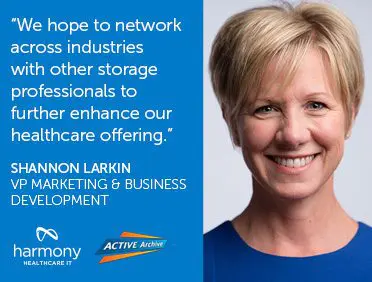
Shannon Larkin Testimonial Active Archive

Harmony Healthcare IT is pleased to announce that it has joined the Active Archive Alliance, a vendor-neutral source that provides expertise and guidance for the design and implementation of intelligent data management solutions. With its participation, Harmony Healthcare IT will gain access to nearly 12,000 data storage professionals from other industries.

Data, especially in healthcare, is growing at exponential rates. Across industries, there are similar challenges and opportunities for extracting, transforming and loading big data sets to secure, active archive platforms. By joining the Active Archive Alliance, Harmony Healthcare IT hopes to network to further enhance its healthcare offering, HealthData Archiver®. Archiving solution HealthData Archiver® currently makes records accessible and usable for clinical decision-making, records release, eDiscovery, financial transaction posting, research, and analytics.

“As the amount of protected health information skyrockets, healthcare leaders rightfully demand preservation and protection of data that will meet retention requirements and mitigate risk of breach,” said Shannon Larkin, VP of Marketing and Business Development at Harmony Healthcare IT. “The Active Archive Alliance can help us advance our health data lifecycle management solutions in newly-informed ways.”

Leading the way as first-to-market innovators of legacy data management solutions for medical facilities, Harmony Healthcare IT archives patient, employee and business records for healthcare organizations nationwide. The company’s mission is to strengthen care delivery and improve lives by preserving vital information in a way that keeps it secure, compliant, accessible and usable. Since 2006, Harmony Healthcare IT has extracted, migrated and retained records from over 350 different clinical, financial and administrative software brands. The information is secured on its cloud-based storage platform, HealthData Archiver®.

Want to stay informed on how Harmony Healthcare IT will further advance its legacy health data management strategies now that forces have been joined with the Active Archive Alliance?  Subscribe here for future communications.

Healthcare IT tips, guides, news & more delivered to your inbox

Learn More

Summary

Yesterday, millions of viewers tuned in to the CBS News Sunday Morning story on Epic, a company many have never heard of despite the fact that its software handles the medical records of about 60% of patients in our country. But for those of us working in health IT, Epic is a household name. The...

Join Fellow Healthcare IT Pros

Tips, Guides, News & More

Sign Me Up
Street sign saying Archive pointing in a direction

Yesterday, millions of viewers tuned in to the CBS News Sunday Morning story on Epic, a company many have never heard of despite the fact that its software handles the medical records of about 60% of patients in our country.

But for those of us working in health IT, Epic is a household name. The company, its theme park-like campus, its well-known CEO, and its 10,000 employees are anything but “behind the scenes” in our day-to-day work. As CBS Sunday Morning put it, Epic is a “system that is now integral to patient care in nearly every major U.S. health system.”

In fact, according to Fiercehealthcare.com, among hospitals with 500 or more beds, Epic has a 58% market share and among all 5,400 acute care hospitals nationwide, 28% market share.

As the Epic software hold grows, so too does the need for data archiving.

Because 100% of the legacy data from a system that Epic replaces doesn’t get converted to Epic, there is a need to address it. Access to a complete historical medical record – including legacy health data – is imperative to a physician’s ability to deliver an accurate diagnosis and treatment. Archiving the data and making it available via single sign-on from Epic is a good solution because, as Mayo Clinic physician Dr. Steve Peters noted in the broadcast, having all of a patient’s medical information come from one source makes providing good patient care a lot easier and “without good access to data, you really are flying blind.” To achieve this, there needs to be a data management plan when switching to the Epic EMR system.

Harmony Healthcare IT (HHIT) is a legacy data management firm that archives patient, employee and business records for healthcare organizations nationwide. Since 2006, we’ve extracted, migrated and retained records from over 350 different clinical, financial and administrative software brands that market-leading systems like Epic have replaced. We secure that information on our cloud-based storage platform, HealthData Archiver®, which is live in production on Epic’s App Orchard

To support the “one source” concept Dr. Peters advocates for, our Single Sign-On with Epic connects clinicians from the active EHR to the active archive, HealthData Archiver®. That creates an opportunity for wholistic access to the patient’s stored medical history.

While our Harmony Healthcare IT brand may not be recognized by the millions of Americans who caught the CBS Sunday Morning Epic story yesterday, it is becoming much more well-known in the health IT space. Harmony Healthcare IT was recently ranked #1 in the 2020 Best in KLAS Software & Services Report as a Category Leader in Data Archiving. We were also ranked as the top data extraction and migration healthcare IT company by Black Book Rankings.

Our deep experience in extracting and migrating legacy data into a secure and searchable active archive provides our clients with the peace of mind that their life cycle of data is handled. Our legacy data management solution consolidates data stores, reduces out-of-production system maintenance costs, mitigates technical risk, complies with record retention mandates and offers both interoperability and data analytics capabilities.

Are you an Epic user looking for a trusted solution to help manage historical patient, employee, and business records? Would patient context sharing with integrated clinical views, release of information workflows, revenue cycle features, and eDiscovery capabilities make work life easier?

We’re here to help.

Healthcare IT tips, guides, news & more delivered to your inbox

Learn More

Summary

Built on its legacy of first-to-market innovation, Harmony Healthcare IT has been exploring the potential impact of blockchain in healthcare by participating in the Blockchain in Healthcare Task Force, a part of the Interoperability and Health Information Exchange Committee at HIMSS (Healthcare Information and Management Systems Society, Inc.). Volunteers on this HIMSS Task Force explore...

Join Fellow Healthcare IT Pros

Tips, Guides, News & More

Sign Me Up
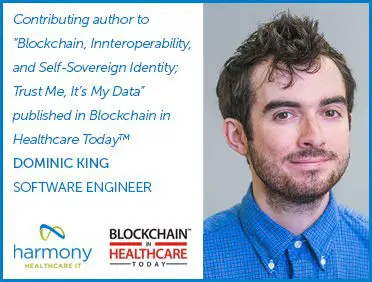
Dominic King Blockchain Testimonial

Built on its legacy of first-to-market innovation, Harmony Healthcare IT has been exploring the potential impact of blockchain in healthcare by participating in the Blockchain in Healthcare Task Force, a part of the Interoperability and Health Information Exchange Committee at HIMSS (Healthcare Information and Management Systems Society, Inc.).

Volunteers on this HIMSS Task Force explore and educate the healthcare community on the practical applications of blockchain and distributed ledger technologies. Members are tasked with highlighting real-word examples of the technology’s use, creating resources to better understand the technology and considerations for implementation, and sharing subject matter expertise on the various use cases to which the technology can be applied.

“Being a member of the HIMSS Blockchain in Healthcare Task Force has been an awesome experience,” says Dominic King, Software Engineer at Harmony Healthcare IT.  “I have been able to work with a number of hugely talented people from organizations like Microsoft, The United States Department of Veteran’s Affairs and Optum – to name just a few.”

King volunteered to contribute to the group about a year and a half ago, excited about the impact that blockchain could have on healthcare – particularly in how it could give patients more control over their data, and how it could help improve the data sharing process among healthcare organizations.

“We organize into working groups within the task force in order to accomplish specific goals like writing articles or creating education material,” says King. “I recently contributed to an article published on Blockchain in Healthcare Today called Blockchain, Interoperability, and Self-Sovereign Identity: Trust Me, It’s My Data.  In the article, our group covers the high-level problem facing Healthcare and how blockchain might be applied to establish self-sovereign identity and a consent audit trail for the patient’s digital identity.”

In addition to this article, King was also a co-contributor of some foundational content on the HIMSS website that defines blockchain, dispels some myths associated with it, and covers specific use-cases for the industry like Digital Identity Management, Financials, Insurance & Records, Clinical Research & Data Access/Monetization and Health Supply Chain Management.

“Eventually, I hope to leverage my knowledge and experience from the task force to implement blockchain solutions that can improve how we use and manage healthcare data between industry stakeholders,” says King.

The team at Harmony Healthcare IT is proud of King’s active role in the industry and his commitment to be a part of this transformational distributed ledger technology.

Wanna chat with us about Blockchain in Healthcare?  Contact us.

The article in reference was originally published by Blockchain in Healthcare Today, Vol. 3., 2020. DOI: https://doi.org/10.30953/bhty.v3.122. For more information, contact the corresponding author listed.

Healthcare IT tips, guides, news & more delivered to your inbox

Learn More

Summary

Glencoe Regional Health partnered with Harmony Healthcare IT to decommission and archive its Healthland EMR data into HealthData Archiver®. Harmony’s user-friendly, cost-effective, and user-friendly system made archiving simple and cost-effective. The solution provided low-impact resources and minimal effort for internal staff, ensuring HIPAA compliance and patient access to medical records.

Join Fellow Healthcare IT Pros

Tips, Guides, News & More

Sign Me Up
Reliable System Decommissioning

Glencoe Regional Health (GRH) transitioned from its Healthland electronic medical record (EMR) to Epic in 2013. As some of the Healthland data was not able to convert to Epic, and in order to maintain HIPAA compliance, GRH needed to archive its Healthland data in perpetuity so patients could access their medical records.

GRH needed a partner that could decommission its legacy system reliably and efficiently, as well as deliver a solution that provided user-friendly access to archived medical records.

The GRH team interviewed and received demos from “many different vendors,” shared Ryan Lake, GRH’s Director of IT. “Most of them charged based on data volume or for hosting and access,” Lake continued. “Their payment models really didn’t work for us. We needed an easy-to-use system that we could maintain long term without a huge expense.”

Ryan Lake, Director of IT

“Harmony came in with a process and procedure that was more laid out and defined than most vendors that we work with. That process made archiving very simple for us. Harmony would let us know what they were doing, but even more importantly, they’d let us know when they needed something from us and exactly what they needed from us… It was very low-impact for the resources on our side.”
– Ryan Lake, Director of IT, GLENCOE REGIONAL HEALTH

Solution

Glencoe Regional Health partnered with Harmony Healthcare IT (Harmony) to decommission Healthland and archive its legacy data into HealthData Archiver®.

“Harmony was the one vendor that could promise a long-term solution without a huge expense,” said Lake. “HealthData Archiver® was user friendly and intuitive, so we didn’t have to put a lot of effort into learning a system being used for relatively few people.”

In addition to being cost effective and user friendly, Harmony implemented the project to spec with very little involvement from GRH resources.

“Harmony requires very little effort from internal staff and the project is kept on time, on budget. There are few vendors that can produce what I need without a lot of time and effort from me – Harmony can,” noted Lake.

Archive with an Audit Trail

“HealthData Archiver® tracks which medical records were released to which patients.”

R. Lake

Delivered Within Budget

“We had a few instances of scope creep, and each time Harmony said they could handle the change for zero cost.”

R. Lake

User Friendly

“I have only heard good comments in terms of how user friendly and easy the system is to work with.”

R. Lake

Access this Case Study in .pdf format

Healthcare IT tips, guides, news & more delivered to your inbox

Learn More