Summary

Most healthcare organizations know records must be retained for HIPAA purposes. Each state also determines the laws for its jurisdiction. Learn more...

Join Fellow Healthcare IT Pros

Tips, Guides, News & More

Sign Me Up
A Wooden Judge Gavel And Stethoscope On A Medical Chart. Medical
Need to meet EMR medical retention mandates?

Most healthcare organizations are aware that records must be retained for HIPAA purposes for six years from the date of its creation or the date it was last in effect. What may be less commonly known, however, is that each state determines the laws for its jurisdiction. The length of time states require records to be retained varies from as short as five years to as long as ten. For states requiring less than six years, health organizations must still retain HIPAA information for six years.

A variety of factors impact medical record retention regulations. They vary depending on the type of patient with different rules for adults and minors. For patients under 18, the records must be retained for a specified length of time after the age of majority. Some states, such as Oklahoma and New York, have requirements for records of deceased patients as well. Certain states also have differing laws for medical practices and hospitals. It is important to note that accrediting agencies also have separate regulations that health organizations should understand and follow.

To find the medical record retention regulations for your state, consult this government table provided by HealthIT.gov which details the conditions for record retention. Since the laws can be modified by the state legislature, check regularly to make sure that new legislation is not being considered on record retention. If you have questions, refer to the HealthIT.gov website for local representatives and common questions.

When determining how to comply with state regulations, be sure to carefully consider your strategy for retaining the data. Some retention options include:

  • maintaining the legacy system (which can be costly)
  • EHR data conversion – converting the data into your go-forward system (which can be costly and complex)
  • printing/scanning the records (which is labor intensive)
  • migrating and storing discrete data elements in an electronic data archive

Editor’s Note: This blog has been updated from a post in 2015.

Medical Record Retention Laws
This information is intended to serve as a starting point for investigating medical record retention laws in your state. It is important to note the laws govern in some states govern hospitals and doctors together and in some states separately. This differentiation was noted where this information was evident.
Disclaimer
The contents of this blog are intended to convey general information and not to provide legal services or opinions. Organizational Policies and Procedures should not be created relying on information provided in this blog. The information on this blog post may not reflect the most current statutes, regulations or legal developments. An attorney should be contacted for advice on specific legal issues.
This was last updated February 2020.
Visit Our Resource Center

Healthcare IT tips, guides, news & more delivered to your inbox

Learn More

Summary

Precision medicine – a model of healthcare treatment that takes into consideration the genes, environment and lifestyle of individuals – requires large data sets to accurately predict which prevention strategies might work for a particular disease in certain populations. For example, initiatives like the All of Us Research Program from the National Institutes of Health...

Join Fellow Healthcare IT Pros

Tips, Guides, News & More

Sign Me Up
DNA Genome 3D

Precision medicine – a model of healthcare treatment that takes into consideration the genes, environment and lifestyle of individuals – requires large data sets to accurately predict which prevention strategies might work for a particular disease in certain populations.

For example, initiatives like the All of Us Research Program from the National Institutes of Health (NIH), recruits volunteers  from around the U.S. to provide genetic data, biological samples and other health information that is used to investigate a large range of diseases with the goal of better predicting disease risk and finding improved diagnosis and treatment strategies.

As interest increases and results become more apparent, the California Precision Medicine Advisory Committee reports that precision medicine will require significant investments in data storage, infrastructure, and security systems in the coming years to achieve its full potential.

This data storage and infrastructure must keep pace with the demand to preserve, manage, and share patient data, which is expected to increase for each patient from several gigabytes to terabytes of generated data in the near future. And as the uses for the increasing amounts of data exponentially expand, healthcare delivery organizations and research firms must solidify a legacy data management strategy that will keep protected health information (PHI) both safe and accessible. To contribute to precision medicine, this isn’t an option, it’s a necessity.  To address this, Harmony Healthcare IT has developed EMR Data Archiving for Precision Medicine.

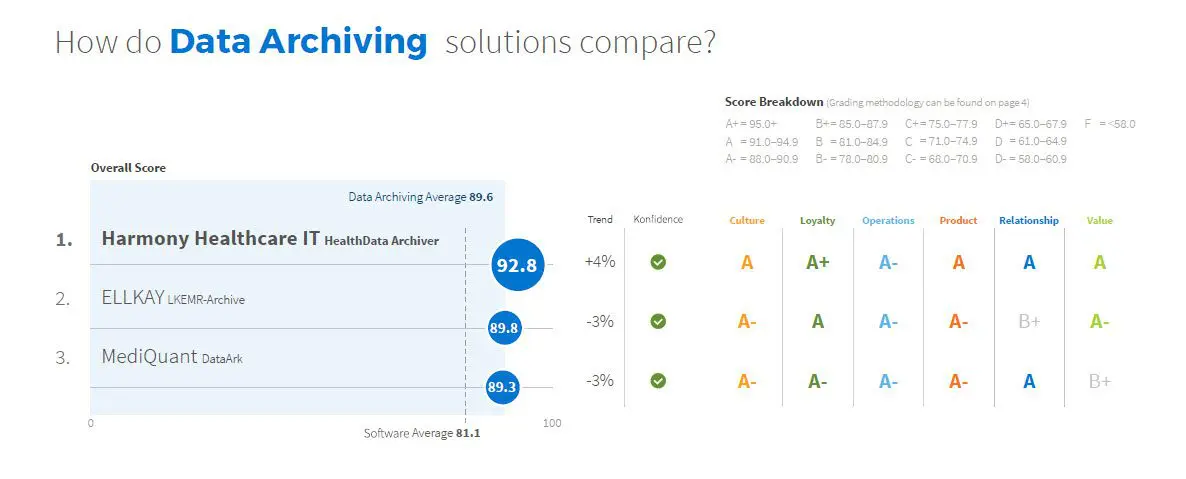
Harmony Healthcare IT, ranked #1 in the category of data archiving by KLAS Research, helps healthcare providers consolidate data stores by decommissioning legacy systems and securely retaining PHI across the healthcare enterprise.

HealthData Archiver®, its long-term EMR data storage solution, delivers a single point of access for clinicians and researchers to vast stores of vital historical patient records. These clinical care records may contain critical and contextual information that could impact the analytics, data science and outcomes of precision medicine.

The new frontier of personalized, precision medicine holds bright promise for improving many aspects of health and healthcare. This includes the design of new tools for building, analyzing and sharing large sets of medical data as the amount of patient health data exponentially increases. Harmony Healthcare IT, with its mission of preserving vital information to strengthen care delivery and improve lives, welcomes the opportunity to make strategic legacy data management a part of that promise – and its EMR data archiving solutions for precision medicine is helping lead the way.

If you are part of a provider or research organization ready to be proactive with its legacy EMR data management, let’s talk.

Healthcare IT tips, guides, news & more delivered to your inbox

Learn More

Summary

Practice Fusion, Inc., an Allscripts Company, will pay $145 million to resolve criminal and civil investigations relating to its electronic health records (EHR) software, the Department of Justice announced. The Allscripts Practice Fusion settlement includes two parts: A $26 million criminal resolution, where the company admits that it solicited and received kickbacks from a major...

Join Fellow Healthcare IT Pros

Tips, Guides, News & More

Sign Me Up
Piece of Paper that Says Settlement Resting On Money

Practice Fusion, Inc., an Allscripts Company, will pay $145 million to resolve criminal and civil investigations relating to its electronic health records (EHR) software, the Department of Justice announced. The Allscripts Practice Fusion settlement includes two parts:

  • A $26 million criminal resolution, where the company admits that it solicited and received kickbacks from a major opioid company in exchange for utilizing its EHR software to influence physician prescribing of opioid pain medications
  • A separate civil settlement for $118.6 million for accepting kickbacks from the opioid company and other pharmaceutical companies, as well as causing users to submit false claims for federal incentive payments by misrepresenting its EHR software

One of the major tenants of the civil settlement is based on Practice Fusion receiving kickbacks from pharmaceutical companies in exchange for implementing clinical decision support (CDS) alerts in its EHR software, designed to increase prescriptions for their drug products.

The Opioid Epidemic Calls for EHRs to Help, Not Hurt

With statistics still at epidemic levels in our nation’s battle to beat opioids, medical professionals and law enforcement are turning to technology for innovative ways to fight against the opioid crisis – specifically EHRS – with the expectation that these tools and the vendors behind them are in compliance with healthcare industry standards.

Technology like electronic health records can provide an efficient and literally life-saving role by providing timely data at the click of a button. There is value in instant access to both current patient records along with archived legacy records, providing easy insights into the deep history that reveals patterns and making EHRs a major contributor to the healthcare industry’s efforts against opioid abuse.

For the 30,000 medical practices across the U.S. that relied on Practice Fusion to deliver care to 5 million patients a month, the abuse of trust seeded by the Practice Fusion DOJ investigation may leave the ambulatory medical community wondering if Practice Fusion will be able to recover from this major settlement. And, if so, should the practice remain a customer.

Archiving Supports Potential Need for eDiscovery and a Secure Solution for Legacy EHRs

If your organization is affected by the Practice Fusion DOJ settlement or just looking for a secure storage solution for legacy data from an out-of-production EHR, HealthData Archiver® offers a secure repository for long-term storage of protected health information.

Talk to us about a legacy data management solution that offers a simpler option than the complexity and cost of data conversion to a new EHR – one that reduces risk and meets HIPAA, state and agency medical record retention requirements. We’re ready to help.

For more information, you can also download a free copy of our legal whitepaper on eDiscovery and Healthcare Record Retention today.

Healthcare IT tips, guides, news & more delivered to your inbox

Learn More

Summary

“Providers and payers demand better performance, usability, and interoperability from their vendor partners every year. Best in KLAS winners set the standard of excellence in their market segment. Earning a Best in KLAS award should both excite and humble the recipients. It serves as a signal to providers that they should expect only the best...

Join Fellow Healthcare IT Pros

Tips, Guides, News & More

Sign Me Up
KLAS Category Leader Harmony Healthcare IT

“Providers and payers demand better performance, usability, and interoperability from their vendor partners every year. Best in KLAS winners set the standard of excellence in their market segment. Earning a Best in KLAS award should both excite and humble the recipients. It serves as a signal to providers that they should expect only the best from the winning vendors.” – KLAS President Adam Gale

Harmony Healthcare IT, a first-to-market innovator in legacy data management solutions and the maker of HealthData Archiver®, a long-term record storage software application; announced it has been ranked #1 in the 2020 Best in KLAS Software & Services Report as a Category Leader in Data Archiving.

In addition to the #1 ranking, Harmony Healthcare IT received an A+ in the research category of loyalty as well as all A’s in each of the five remaining categories of culture, operations, product, relationship, and value.

“This #1 ranking reflects our commitment to quality in data extraction, migration and retention,” said Tom Liddell, CEO at Harmony Healthcare IT.  “We take pride in our position as the industry leader for legacy data management and will never stop improving and refining our client experience.”

Tom Liddell, CEO, Harmony Healthcare IT

Customer insights about Harmony Healthcare IT cited in the report include:

“I can’t say enough good things about Harmony Healthcare IT. I have done lots of projects, and I can’t think of a project that has gone more smoothly than the one we have done with Harmony Healthcare IT. That is largely due to the fact that the vendor has a well-defined process that they follow. Our implementation was really easy. The vendor was extremely experienced. Harmony Healthcare IT had a whole process that they walked us through. They actually followed the steps that they laid out. When we walk away from our meetings with the vendor, we marvel at how easy things are for us. It is always nice when we work with a vendor that makes a project easy.” – Director, November 2019

“Harmony Healthcare IT has been one of the better companies that we have ever worked with. They are always very proactive, very on top of things, and very responsive.” – Manager, November 2019

“When we chose HealthData Archiver®, we compared it to four different products. Based on the demos we saw, HealthData Archiver® had the best price and was the easiest to use. Overall, HealthData Archiver® has met all of our needs.” – Manager, November 2019

Looking for a company with experts in data extraction, migration, and retention dedicated to providing you a trusted archiving solution? We’re ready to talk.

Healthcare IT tips, guides, news & more delivered to your inbox

Learn More

Summary

Communication is the foundation of any great team – whether it’s a signal from a catcher to a pitcher on the baseball field, a cue from one improv actor to another on stage, or a hand-off from a systems analyst to an implementation specialist at a leading data management firm. That’s why we made it...

Join Fellow Healthcare IT Pros

Tips, Guides, News & More

Sign Me Up
Wrigley Field

Communication is the foundation of any great team – whether it’s a signal from a catcher to a pitcher on the baseball field, a cue from one improv actor to another on stage, or a hand-off from a systems analyst to an implementation specialist at a leading data management firm. That’s why we made it a part of our team’s 2020 Kick-Off agenda when we took the Windy City by storm earlier this week.

Our first stop was to historic Wrigley Field, home of the Chicago Cubs. At The Maker’s Mark Barrel Room, we celebrated 2019 achievements, shared 2020 objectives, and even took a few swings in the batting cage. It was an evening of networking, food and fun that allowed the team to relax and bond.

Next, we took our seats stage side at The Second City, a world renowned comedy club and school of improvisation. Here, we learned how the communication philosophy of “Yes, and…” can spark creativity, making us more compelling and collaborative. That’s a concept we intend to embrace since it aligns so well with our innovative spirit and commitment to quality.

Our 2020 Kick-Off and trip to Chi-Town – with a focus on communication, clarity and ownership of our objectives, and team building – has set us on course for another amazing year of extracting, migrating and retaining vital information for hospitals and health systems nationwide.

Want to be a part of our growing team? Let’s connect.

Healthcare IT tips, guides, news & more delivered to your inbox

Learn More

Summary

Industry reports suggest that almost half of large hospital systems and almost a third of outpatient/ambulatory providers have system replacement plans before the end of 2020. Across the industry, hospital system executives are seeking highly functional, customizable and integrated practice management, revenue cycle management, and electronic health records (EHR) systems. The reason for replacements is...

Join Fellow Healthcare IT Pros

Tips, Guides, News & More

Sign Me Up
Hospital

Industry reports suggest that almost half of large hospital systems and almost a third of outpatient/ambulatory providers have system replacement plans before the end of 2020.

Across the industry, hospital system executives are seeking highly functional, customizable and integrated practice management, revenue cycle management, and electronic health records (EHR) systems. The reason for replacements is consistent – to elevate their IDN practices and implement a new system with the hopes of consolidating technologies and better aligning with the organization’s evolving needs.

Enter Data Archiving

Data archiving is a solution for any ambulatory or enterprise health system faced with replacing a variety of information management systems. Once those systems are replaced, keeping them up and running solely to meet record retention requirements becomes a big risk.

  • Servers and infrastructure ages
  • Software must be patched to be protected from hackers
  • Staff members who know how to navigate the displaced system may leave the practice for a new job

For these and other reasons, legacy data management and EHR systems pose technical risk for the provider, not to mention cost and labor burden. And, should release of information be required to fulfill requests from patients, lawyers, employers, payers or auditors, the historical medical record must be accessible and easy to share in a HIPAA-compliant format.

Secure, compliant, long-term PHI storage in an electronic health data archive solution helps manage the legacy application portfolio, minimizing the volume of legacy EMR, ERP, GL, Accounting or HR/Payroll applications, saving on maintenance contracts, mitigating technical risk, and reducing labor burden.

Data archiving is also a key component to 57% of healthcare professionals reporting that, in the past five years, their experience has been positively impacted by having access to patients’ full medical history, which includes legacy data.

Learn More About Archiving

Our team is in the field daily with practices and enterprises that are refining and managing the mountains of information they are required to retain. We see, and are a part of, the critical decisions about how to ensure the information is accurate, available and secure for years to come.

At Harmony Healthcare IT, our mission is to preserve vital information to improve lives with our product, HealthData Archiver®, which delivers cost-savings, information access and transaction posting benefits. It also fortifies defenses against cyberattack by providing a single and secure storage place for disparate silos of legacy data.

If you’re looking to replace multiple existing medical practice systems, connect with us to talk about a lifecycle data management strategy.

We’re ready to help preserve the data in your care that is required and necessary to improve lives.

Healthcare IT tips, guides, news & more delivered to your inbox

Learn More

Summary

Medical record breaches, including those of well-known celebrities and politicians, is a serious issue. Here we discuss Break the Glass – a specific role-based product feature that targets the safety of highly confidential medical records.

Join Fellow Healthcare IT Pros

Tips, Guides, News & More

Sign Me Up
Break the Glass Security

What do Michael Jackson, George Clooney, U.S. Representative Gabrielle Giffords and Nadya “Octomom” Suleman have in common? Each of these celebrities had their medical records breached by non-authorized healthcare personnel.

Since the enforcement of HIPAA in 1996, there have been numerous medical record-breach violations that resulted in fines, firings, suspensions, and even prison sentences. While EHRs have varying degrees of record access and audit features, there is a need to continue to protect the privacy and security of all medical records, both current and legacy, including those of high-profile patients.

Role-based access controls (RBAC) allow health information managers to establish, control, and track record access so that – when needed – users can legitimately gain access to a restricted patient record. Some of the most important RBAC benefits to a healthcare organization include:

  • The simplification of access definitions, auditing, and administration of user security access rights.
  • The assignment of role versus user-based access. This means that the delegation of access rights doesn’t occur at the discretion of any user, including the security administrator. Instead, roles are clearly defined and imposed, without exception.
  • The minimization of intentional or inadvertent viewing, deletion, or modification of files.
  • The ability to push out updates by roles – which apply to multiple users – instead of updating privileges for every user on an individual basis.

We know that access to, and protection of, ePHI across the entire lifecycle of the medical record is a priority, especially concerning more classified patients. As such, our HealthData Archiver® solution has numerous features to manage, audit and protect legacy health records.

This includes a specific role-based feature targeting the safety of highly confidential medical records – Break the Glass.

With the ability to assign patient records as Classified (employees, patient requests, domestic abuse, behavioral health), or Highly Classified (celebrities, government officials, athletes), even legacy ePHI stored in an active archive has an added layer of security and tracking.

Break the Glass provides:

  • A Client Administrator option to add a Gatekeeper who is responsible for managing Care Team Member access for Highly Classified patients.
  • Extra security measures, including explicit auditing of user authentication, authorization, and data level access.
  • End user access to privileged patient information only when necessary or in the event of an emergency, requiring that a reason to access the patient record be indicated.

Cybersecurity today requires a comprehensive safety plan for ePHI that includes fortifying records from external as well as internal threats. Harmony Healthcare IT can help mitigate your risk.

HealthData Archiver® consolidates data stores, reduces out-of-production system maintenance costs, and complies with record retention mandates. But most of all, our archiving solution provides increased security from both external cyberattacks and internal threats, protecting your organization and your patients.

Looking for increased security in your legacy data management strategy? We’re leading the way and ready to help.

Healthcare IT tips, guides, news & more delivered to your inbox

Learn More

Summary

Six in ten adults in the U.S. currently battle a chronic illness that requires long-term and ongoing medical attention for ailments like cardiovascular disease, diabetes, stroke, Alzheimer’s, cancer, depression or anxiety. Care for patients in this segment, which makes up 90% of the nation’s $3.5 trillion dollar healthcare expenditures, can come with medical records management...

Join Fellow Healthcare IT Pros

Tips, Guides, News & More

Sign Me Up
Chronic Diseases Chalk

Six in ten adults in the U.S. currently battle a chronic illness that requires long-term and ongoing medical attention for ailments like cardiovascular disease, diabetes, stroke, Alzheimer’s, cancer, depression or anxiety. Care for patients in this segment, which makes up 90% of the nation’s $3.5 trillion dollar healthcare expenditures, can come with medical records management challenges.

Four out of those ten adults have two or more chronic conditions, and often seek care across multiple providers and clinics. This adds complexity to their care and drives providers to administer chronic disease management (CDM) programs aimed at preventing hospitalizations and adverse events. To support these programs, electronic health records (EHRs) with chronic care management tools are integrated into laboratory and pharmacy information systems. All of these patient care components create a large volume of health information from many authors.

Adding to that volume, there are now newer technologies and integrated devices – like blood glucose meters, digital dementia assessment tools and at-home COPD devices – that are gathering real-time health data from patients with chronic illnesses and reporting it to the EHR.

More data.

And because chronic illness, by its nature, lasts for one year or more, layer in the movement of the patient record. As patients move from one provider to another, and as provider organizations get acquired and merged, that comprehensive medical record needs to remain accessible. Clinical data needs to keep up with the patient and be readily available at the point of care, every time. As a result, access to both current and historical medical records to decrease medical errors and improve outcomes can become a challenge.

As EHR systems are upgraded and legacy systems are sidelined, it is imperative to have a legacy data management plan in place to maintain simplified access to the ever-growing volumes of health data that must be kept accessible for up to 25 years or more.

At Harmony Healthcare IT, we take pride in our contribution to advancing heath IT through the work we do to preserve access to historical chronic care medical records. HealthData Archiver®, our long-term data storage solution, can be key to ensuring access to the full clinical narrative.

If you’re looking for easy access to critical legacy data for patients with chronic illness so medical errors can be reduced and outcomes improved, let’s talk.

Healthcare IT tips, guides, news & more delivered to your inbox

Learn More