Summary

A recent industry survey on the digital health progress of healthcare organizations worldwide notes that there is an increasing priority toward governance for technology decision-making, education and deployment to ensure data and insights are effectively utilized. Making sure an organization’s data governance program is followed requires data stewardship actions to carry out the policies and plans. Learn about how information governance and data stewardship work together within healthcare organizations to ensure regulatory compliance, advance data insights, and improve patient outcomes.

Join Fellow Healthcare IT Pros

Tips, Guides, News & More

Sign Me Up

Information governance in healthcare is relatively new, with focused efforts beginning in 1997. What started as an effort for healthcare providers to comply with regulatory and information security requirements has grown into comprehensive programs that also aim to deliver high quality data insights to enhance healthcare outcomes.

Today, health care organizations are fine tuning their data management policies and procedures to better manage data quality, privacy, and security. The evolving regulatory requirements and massive data growth with volumes tripling every three years forces an urgently needed roadmap to keep the organization’s data secure, accessible, sharable and compliant.

With medical mistakes ranking as a leading cause of death in the United States, there are many efforts underway across all continuums to improve patient safety and outcomes. From a health data standpoint, there is a significant shift toward data governance as a top priority in healthcare organizations according to a recent survey.

The role of carrying out governance program policies is the job of data stewards who oversee the organization’s data governance policies.

Bottom line: To fully realize the benefits of health data requires a concerted effort with a commitment to data governance’s guidance and data stewardship’s actions.

What is health data stewardship and why is it important?

Quite simply, data stewardship involves the day-to-day management and oversight of healthcare’s data assets to ensure their quality, consistency, and accuracy. The role of data stewards is becoming more prominent as the demands for healthcare data continue to expand.

Data stewardship includes overseeing every aspect of the data lifecycle and follows the organization’s established data governance policies.

Benefits of a solid stewardship program can help the organization realize advantages that include:

  • Improved data quality
  • Enhanced data security and privacy
  • Better decision making
  • Regulatory compliance
  • Improved data accessibility
  • Efficient data integration
  • Cost savings

The Role of Health Data Governance and Stewardship in Healthcare

Both data governance and data stewardship hold key responsibilities in successful data management. Both disciplines are related and increasingly complex due to the skyrocketing growth of health data volumes and the increased interoperability requirements from the 21st Century Cures Act.

Data governance is the umbrella that covers the overall data management policies for an organization. AHIMA’s definition of Data Governance: The overall administration, through clearly defined procedures and plans, which assures the availability, integrity, security, and usability of the structured and unstructured data available to an organization.

Information Governance (IG) involves: “Minimizing information risks and costs while maximizing information value,” according to Information Governance expert Robert Smallwood, MBA, CIP, IGP.

The data governance market is on a rapid growth trajectory with a valuation of $3.27 billion in 2024 to $8.03 billion by 2029. This represents a CAGR of 19.72 percent.

This growth has fueled 90 percent of large companies including healthcare organizations to employ dedicated team members such as a Chief Data Officer to oversee governance, analytics and security which helps ensure regulatory compliance, operational efficiencies and supports data-driven decision making.

The main difference between data governance and data stewardship is that governance programs help ensure overall data integrity and security through policies, standards, and procedures. Data stewardship entails the implementation of the rules. Boiling it down, governance is the framework, and stewardship is the operational actions that follow the framework.

Health data stewardship is crucial in managing a data warehouse (i.e., all the data within an organization). This includes six key areas:

  1. Data Quality and Integrity. Includes conducting regular audits and quality checks to ensure high data standards are met.
  2. Security and Privacy. Champions ethical data practices for responsible data use, with a focus on privacy and security in all activities.
  3. Data Integration. Ensures data from various systems is consistent and compatible. This is increasingly important with AI and analytics initiatives.
  4. Data Accessibility/Interoperability. Ensures data is stored in an environment and in a source that can be accessed and shared. Facilitates seamless data exchange and enables collaboration.
  5. Compliance. Navigate the regulatory landscape to ensure that data handling practices meet legal standards and industry regulations.
  6. Lifecycle Management. Oversees data from creation through destruction to make sure it is accurate, consistent, and reliable.

Different individual roles in health data management

There are several professionals and organizations involved in health data management. Looking at the comprehensive stakeholder community, there are efforts to consider and respect their legitimate rights and interests to build and maintain an efficient, trusted, and fair ecosystem. Let’s look at the distinct roles for each group as they relate to data stewardship.

  • Researchers. The FAIR guiding principles for research data stewardship (findability, accessibility, interoperability, and reusability) are guideposts for research organizations. These principles provide direction that supports the systematic sharing of data along with related ethical, methodological, and organizational policies.
  • Data owners, stewards, and users. These roles are responsible to make sure data is managed effectively and supports the organization’s objectives. Data owners refer to c-suite and leaders who oversee specific data sets and have oversight for its use. Stewards can be subject matter experts (SMEs) who are the go-to for inquiries. Data users are a wider group of staff members or teams who use data for reporting, provide feedback to support continuous improvement.
  • Healthcare providers. Clinicians who collect and use patient data for decision making and care improvements. They need to facilitate data sharing and follow data governance policies in doing so.
  • Health information technology vendors. Organize and manage data within data governance guidelines for the organization.
  • Government agencies. Collect and monitor healthcare data. For example, the CDC’s public health data strategy (PHDS) aims to strengthen the core of public health data, accelerate access to analytics, provide visualization insights to inform action and advance interoperability between health care providers and public health.
  • Payers. Use data for reimbursement and benefit design for future programs.

What Is a Data Steward?

Data stewards are responsible for implementing data governance policies, handling data-related requests and maintaining data integrity. Specific responsibilities for data stewards include defining data quality metrics, managing metadata and reference data, tracing data lineage and classifying sensitive data.

Data stewards differ from data analysts who use data analytics to improve healthcare outcomes. Data analysts focus on gathering, sorting, and analyzing data from many sources to support better patient care with improved processes.

Bottom line: Data stewards safeguard the privacy and accessibility of data while a data analyst transforms the data into actionable insights by creating reports and visualizations.

The Data Steward’s Role in Healthcare

Data Stewards have a significant role in managing and safeguarding data. In some organizations there are teams of data stewards, while in smaller or those developing their programs, there may be one person in this position.

The key responsibilities of a data steward include oversight of the organization’s data governance policies on security, privacy, and data quality upkeep. This also includes making sure data access only includes the appropriate staff members.

To do their job well, the data steward needs the right tools. This includes the data warehouse that is the best fit for their organization and the right software to facilitate the operational aspects of data management.

Get Started with Health Data Stewardship

According to the World Economic Forum, the essential ingredient in digital healthcare is not a surprise, it is: data. In this context, the focus for many organizations is on how new digital tools can help physicians and their patients predict, prevent and treat disease with the benefit of personalized care. As the tools evolve, there needs to be a coordinated governance effort to guide the stewardship of the data.

The plan for a true learning health system in the future that advances knowledge based on trustworthy digital technology within the guidelines that meet the ethical and responsible compliance requirements is the ultimate goal. To get there, a robust data governance program and a commitment to stewardship is vital.

Harmony Healthcare IT commits to the stewardship of sensitive personal information and critical business information, in acknowledgement of the many threats to information security and the importance of protecting the privacy of the company’s constituents, safeguarding vital business information, and fulfilling legal obligations.

Harmony Healthcare IT’s information security policies and procedures represent the foundation for its information security program. Information security policies serve as overarching guidelines for the use, management, and implementation of information security throughout the organization.

Looking for a partner who values strong data governance and walks the talk of data stewardship every day?

Let’s connect.

Healthcare IT tips, guides, news & more delivered to your inbox

Learn More

Summary

Cyberattacks in healthcare continue to cause major turbulence. The U.S. Dept of Health and Human Services (HHS) Office of Civil Rights (OCR) reported a 264% increase in healthcare ransomware attacks over the past five years. Hospitals and health organization are facing a massive increase in ransomware worldwide, and especially in the United States with a 73 percent increase in attacks. These attacks of critical systems force the cancellation of surgeries, exams, and sometimes even halt the entire health system’s operations. The aftereffects of recovering from a breach include an average can cost more than , plus the challenges of reputation repair. To fight off cybercrimes before they happen, a healthcare organization should examine its weak links, starting with its legacy systems.


Join Fellow Healthcare IT Pros

Tips, Guides, News & More

Sign Me Up
six-ways-legacy-systems-expose-to-security-risks

Electronic health record systems (EHRs) have an important and expanding responsibility to enable interoperability (record sharing) between providers, payers, patients and other users. However, many EHRs developed years ago are not able to deliver on current and future needs and will be upgraded or replaced.

Upgrading or replacing an EHR is only part of the solution. Currently, 73 percent of healthcare providers still use legacy information systems and the average organization has almost 1,000 unique applications in use. Beyond the technical limitations, legacy systems are a leading bad practice for healthcare security, according to the Cybersecurity and Infrastructure Security Agency (CISA).

Healthcare as a leading target for cyber-attacks and legacy technology is reported as the third-biggest security challenge facing healthcare cybersecurity programs.

It is imperative to review the entire IT landscape for security risks and make necessary changes.

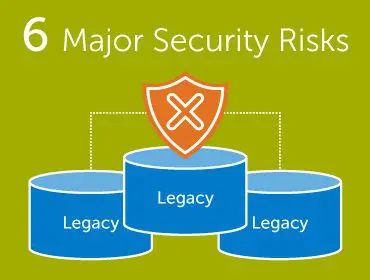
Six major security risks lurking in legacy systems.

  1. Easy Back-Door Entry – Unsupported or end-of-life systems with silos of data stored in outdated systems are the easiest entry points for hackers. Network servers are the target for more than 50 percent of all hacking-related breaches. Poor security protocols and weak infrastructure make it easy for a hacker to gain access to a legacy system and then move freely throughout the network. There can be upwards of 30-40 legacy systems running in maintenance mode at a health system that is the equivalent of having unlocked doors and windows unlocked and ripe for attack.
  2. Lack of Vendor Support – With outdated systems, there often is a lack of regular security updates which leaves them open to cyber-attacks. A lack of support from the manufacturer means a lack of available security patches.
  3. Technical Risk – Legacy software kept running in read-only mode is ripe for corruption, breakdown, cyberattack or even internal threats. There also may be a lack of internal system experts who are familiar with how to operate the legacy system which can further complicate workflows.
  4. Non-Compliance with HIPAA – Legacy systems may not be HIPAA compliant which increases the risk of potential breaches and leaves the organization vulnerable to penalties and sanctions. The HIPAA Security Rule requires covered entities and their business associates to implement safeguards that reasonably and appropriately secure electronic patient health information (ePHI) that these organizations create, receive, maintain or transmit. Legacy systems can make patient and other records vulnerable during a cyber or phishing attack.
  5. Absence of Monitoring Capabilities – Many legacy systems are not equipped to monitor and audit user activity, data access and use. Most older systems were designed for easy data access as security was not as big a factor when the systems were implemented.
  6. Internal Threats – Legacy systems often have limited security protocols which creates an opportunity for employee mistakes or insider threats. These two categories are responsible for most healthcare system breaches. The average healthcare organization has 31,000 sensitive files (which is about 20 percent of all files and include HIPAA-protected information, financial data and proprietary research) that are open to everyone in the organization.

How to improve cybersecurity preparedness for a healthcare organization.

The first step is to follow the HIPAA Security Toolkit. This will help the organization take stock and manage its ongoing risk. The next critical step is to become HITRUST CSF certified. This globally recognized standard provides a comprehensive, flexible, and efficient approach to regulatory standards compliance and risk.

With these two frameworks in place, it is recommended to centralize legacy data into an active archive like HealthData Archiver®. This helps ensure the organization meets regulatory requirements that can include record retention of six to 30 years or more while also allowing legacy systems to be decommissioned. A streamlined portfolio offers a host of security, cost and other benefits.

The Harmony Healthcare IT team of data extraction and migration experts have helped hundreds of healthcare delivery organizations decommission legacy systems and safely consolidate patient, employee and business records from more than 550 different clinical, financial and administrative software brands.

For more information about securing legacy healthcare data and deflecting cyberattacks, check out this white paper: Security Focus Creating a Legacy Data Management Plan and the 10 privacy and security questions to ask an archiving partner. With 87 percent of healthcare’s security issues in the last 12 months involving a third-party breach, it is critical to scrutinize every supporting organization and utilize best practices for third-party risk management.

Beyond the obvious reasons to take cybersecurity seriously, the Department of Health and Human Services (HHS) released 10 essential and 10 enhanced cybersecurity performance goals designed to better protect the healthcare sector from cyberattacks. The guidance is expected to include financial penalties in the form of reduced payments to certain hospitals that fail to meet cybersecurity standards beginning in fiscal year 2029.

If you are ready to move forward with a legacy data management strategy, we are ready to help.

Let’s connect.

Healthcare IT tips, guides, news & more delivered to your inbox

Learn More

Summary

Ireland lags far behind all other European Union (EU) countries for its current eHealth maturity for patient access to their digital health records and provider interoperability capabilities to share records. A new initiative outlines the country’s six-year plan toward a national electronic health record (EHR) solution that will help it meet the European Health Data Space (EHDS) requirements. As a result, Ireland’s current EHRs will be displaced over time, yet still have records that need to be retained to meet regulatory compliance rules. In this blog, we examine Ireland’s current state of health IT, challenges in moving forward and options for successful lifecycle data management.

Join Fellow Healthcare IT Pros

Tips, Guides, News & More

Sign Me Up
Health Data Management is Needed in Ireland

Ireland is playing catch up with other European Union (EU) countries in developing a national shared platform for electronic health records for its 5.26 million people. The bigger story is Ireland has room to grow across all health IT metrics. As of 2024, all EU Member States, except Ireland offer patients access to electronic health data through an online portal. Ireland currently has an overall eHealth maturity score of 11 percent, with 79 percent being the EU average.

A new initiative called Digital for Care: A Digital Health Framework for Ireland 2024-2030 has a near-term goal of launching a patient app that will empower Ireland’s residents with access to their medical history. Next up is a national shared care record, according to the country’s Secretary General of the Department of Health, Robert Wyatt. The shared record will contain basic patient information, as well as details about the patient’s care and visits with providers. These efforts are viewed as a building blocks for the longer-term goal of a national electronic health record (EHR) solution which is needed to comply with the European Health Data Space (EHDS) Regulation.

Ireland, which is about the same size as the state of Indiana, has 86 hospitals (77.9% are publicly administered) with just over 20,000 practicing physicians. There are EHRs in use across the country’s healthcare system, but not one streamlined record platform that is used and shared between primary care, hospitals, labs, patients, etc. The new digital health framework will serve as a roadmap to transform health services in Ireland and improve access for patients. This is in line with efforts already in place with other European countries.

The European Health Data Space (EHDS) aim is to improve the flow and access to health data for patients, providers and researchers across all European Union countries. This includes a single market for EHRs and an efficient system for using and reusing health data for research, innovation, policy-making and regulatory activities. These efforts come with data management obstacles.

What are the health data management obstacles in Ireland?

About 30 percent of Ireland’s healthcare budget is allocated to managing data, yet there are hurdles to ensure that data is accessible and sharable. Four primary challenges include:

  1. Patient access. Ireland’s health IT programs have not meaningfully addressed patient access. Currently, less than 19 percent of the population in Ireland has online access to their records. There is one large private hospital group that provides patients with access through a mobile app. While a national effort for records along with an ePharmacy program that will deliver prescriptions to patients is in the works, further investments and technology solutions will be needed to offer comprehensive patient access.
  2. Interoperability. Integrating and sharing health data across multiple providers is a global healthcare challenge. In Ireland, not having interoperability options in place can lead to missed information, repeated tests and other issues that affect patient care. This lack of information flow also can prevent data being available for medical research and other innovations.
  3. Data security. Confidentiality and security of patient data is vital. The major cyber-attack on the Health Service Executive (HSE) in 2021 caused widespread disruption and signaled the need for increased cybersecurity efforts. With health data breaches at an all time high and a 60 percent increase in recent phishing attacks in Ireland, security must remain a priority. The EU also has imposed stricter security measures and standards that require healthcare organizations to take appropriate security measures and report serious incidents to authorities.
  4. Standardization. There are a wide range of EHRs in use across Ireland. This includes outdated or custom systems that aren’t equipped to use modern data standards like FHIR and HL7. Challenges remain as there are so many variables and differences between systems that impede the goal of working together.

What are the record retention and destruction policies in Ireland?

Generally, record retention guidelines in Ireland span from a few years to the lifetime of the patient plus eight years after the last treatment of death for many types of records. The HSE National Records Retention Policy provides guidance about how to manage and how long to keep each type of record.

Record destruction in Ireland also is governed by the HSE with its Information Classification and Handling Policy. Clinical records may be transferred to the National Archives if they have archival value or disposed of according to specific guidelines. The National Archives primarily holds the records when a hospital closes or when a third party manages long-term access to the records.

Ireland’s Health Information Bill of 2024 calls for a priority for digital health records.

A new Health Information Bill supports digital health improvements in Ireland. The focus on creating a digital health record is a priority. The new bill outlines:

  • A duty to share health information for patient care and treatment.
  • Establishing a Digital Health Record for all patients in Ireland that will contain a patient summary, prescriptions (including which ones were dispensed), medical images (scans and X-rays), medical test results and discharge reports.
  • Greater patient access to their own health information.
  • Greater protections around health information for primary care use (care and treatment).
  • Better health information for the HSE for public-interest purposes.

Harmony Healthcare IT solutions provide options for Ireland’s digital transformation strategy.

As healthcare teams in Ireland move forward with efforts toward a comprehensive national EHR, there will be applications that will be retired with the data needed to meet retention requirements.

That is where we come in.

Our team at Harmony Healthcare IT helps healthcare organizations move and store patient, employee, and business records. We have broad and deep experience with more than 550 unique clinical, financial, and business software applications.

We extract the data from legacy systems, migrate and consolidate it in a relational archive database which keeps it accessible, usable, secure and interoperable for years to come.

Our team supports healthcare teams of all sizes securely manage legacy health records. Our ETL Environment, HealthData Platform, Data Center and Workstations have earned certified status from HITRUST, the global standard for security and data protection.

We help organizations:

We recently earned all A’s in the KLAS Data Archiving 2024 Report across the six customer experience pillars of culture, loyalty, operations, product, relationship and value. Further, we ranked as a standout for archiving some of the most complex and large clinical and financial software systems on the market.

We know that with properly maintained health data, healthcare provider organizations in Ireland can ensure data accessibility, compliance, interoperability, integration, patient safety and long-term data protection.

We look forward to an opportunity to support the digital health transformation in Ireland.

We are here and ready to connect.

Healthcare IT tips, guides, news & more delivered to your inbox

Learn More

Summary

Erik Johnson, Vice President of Marketing at Harmony Healthcare IT, and Tyson Blauer, Research Director for KLAS Research, discuss the recent KLAS Data Archiving 2024 Report in a HealthData Talks podcast.

Join Fellow Healthcare IT Pros

Tips, Guides, News & More

Sign Me Up

Health data archiving is a hot topic in healthcare. Provider organizations facing skyrocketing data volumes that triple every three years, and interoperability requirements of the 21st Century Cures Act, need solutions to support better data agility. A robust active archive can support the organization’s lifecycle data management strategy.

The overall state of health data archiving is the focus of a recent Harmony Healthcare IT podcast with special guest Tyson Blauer, Research Director for KLAS Research, and Erik Johnson, Vice President of Marketing at Harmony Healthcare.

KLAS Research has focused on health data archiving for the last six years.

Blauer explains that KLAS focuses on the topics that provider organizations are focused on and purchasing that are going to make an impact for them. Regarding the trend in electronic health record (EHR) system replacements, he shares:

“There is a lot of old historic data that they are saying, we need to hold on to this and keep it for compliance reasons, but it’s expensive to keep your old source systems up and going. And so instead of having to pay the maintenance cost to do that, let’s archive that.”

Then and Now: The primary drivers behind data archiving decisions.

Historically, one-off archiving projects were driven by what Blauer calls, “Big Pain.” This refers to legacy vendors charging high ongoing maintenance fees to keep legacy EHR systems up and running in a read-only mode.

More recently, there has been a shift toward a comprehensive archiving strategy with a long-term partner. Blauer shares that more organizations have a process and a plan to look for an archiving partner to help with their long-term goals.

The KLAS Data Archiving 2024 Report focuses on customer satisfaction.

Blauer adds that the recent Data Archiving 2024 Report is intended to provide deeper insights on customer satisfaction. This is different from previous research on archiving that looked at buying trends and the factors that went into making an archive purchase.

Blauer explains, “We were trying to parse out the field and say, okay, are there some vendors who work with larger, more complicated projects? Are there some who work with smaller, more basic projects? And so that is really what we wanted to be able to parse out and see. Is there a difference between those two? And there is. You can see in there that there are some vendors who do more of those larger projects and some who do more of those smaller projects.”

The Future of Archiving and the Next KLAS Research Reports

The next round of KLAS research in the data archiving space is expected to continue to gather performance data, watch the buying trends and measure customer satisfaction. Blauer shares a new report focusing on buying decisions is in the works. This report will add in mind-share, meaning that it will delve into current vendor relationships or if the organization is looking for a new vendor, who would be in their top three list.

Other trends that Blauer has noticed include:

  • Larger organizations replacing EHRs which will continue to increase the need for archive solutions.
  • More vendors entering the archiving business which could increase the competition and signal some consolidations.
  • Artificial Intelligence (AI) advances in data mapping that can help streamline and automate processes.

Harmony Healthcare IT Recognized for Success with Large and Complex Legacy Data Projects in KLAS Data Archiving 2024 Report.

For more information on KLAS Research, visit: klasresearch.com

Healthcare IT tips, guides, news & more delivered to your inbox

Learn More

Summary

With the ongoing skyrocketing volume of healthcare data and increasing regulatory requirements from the Cures Act, there are key considerations for large healthcare enterprises to take note of in their overall data governance programs. The ABCs of lifecycle data management is just the beginning.

Join Fellow Healthcare IT Pros

Tips, Guides, News & More

Sign Me Up

Healthcare data production recently reached 2,314 exabytes (EB) per year. An exabyte is 1,000 times larger than a petabyte. For example, a hard drive with 1 EB can store 341 billion three-minute MP3s.  With the healthcare industry generating roughly 30 percent of all the world’s data, at a growth rate of 36 percent annually, managing healthcare’s clinicalfinancial and business records is a big job that is getting bigger. This is especially true when you consider the record retention regulations for this data.

EHRs play a valuable role in healthcare delivery

With the exponential rate of data growth and increased data sharing regulations of the 21st Century Cures Act, it makes sense that the electronic health record (EHR) business is also booming. The EHR market in the United States is anticipated to increase at a CAGR of 12.5% from 2022 to 2030 and reach nearly $40 billion by that time.With more than 96 percent of all non-federal acute care hospitals onboard with EHRs today, compared to only 28 percent in 2011, much of the growth will come from EHR replacements and upgrades to better meet regulatory and consumer demands.

The ABCs of healthcare data lifecycle management

The 21st Century Cures Act mandates strict rules for sharing data, accessing patient records, and blocking information. As a result, healthcare providers nationwide are reviewing and adopting long-term data governance plans and determining how to meet current and future requirements for data management.

Three areas of consideration for best practices in lifecycle data management include:

Access to data. Making sure current and historical data is accessible and secure is a priority. This focus aims at improving workflows and supporting better patient care outcomes. With some health systems managing more than 10 EHRs and working with 18 disparate EMR vendors, there is room for consolidation and streamlining with fewer applications to save time and reduce costs.

Consumers are increasingly demanding simplified, centralized access to health information and an easier overall healthcare experience. A recent report noted that 75 percent found technology could minimize struggles during the patient journey, especially in getting test results, asking medical questions and paying medical bills.

Build out of interoperability tools. A recent report from The Office of the National Coordinator (ONC) notes that while there is progress toward improved digital solutions, challenges remain. Those challenges include creating a uniform nationwide network of interoperability across care continuums. While progress has been made with health information exchanges (HIE) at state and local levels, more work needs to be done to advance network-to-network exchange. The Trusted Exchange Framework and Common Agreement (TEFCA) seeks to create a policy and technical infrastructure that builds on the existing progress of the HIEs. Healthcare providers continue to pursue solutions to help improve their interoperability posture.

Compliance requirements. There is a lot to do to keep an organization compliant with data management regulations. A compliance program is a must to create and update the organization’s processes, policies, and procedures so they are in line with federal and state laws. A solid legacy data management program is an important part of an overall compliance effort.

Consolidating historical clinical, business, and financial records

One way to support the ABCs of legacy data management is to consolidate disparate silos of health data contained in legacy EHRs. This can be especially important when mergers and acquisitions (M&A) bring multiple EHR applications into the enterprise that are outside of the go-forward solutions.

In one case study, a healthcare system client absorbed 83 physician practices and four hospitals, each with their own clinical and financial systems. With a total of seven acute-care hospitals and nearly 500 locations overall, the decision was made to utilize Epic® across the entire enterprise and to archive the other legacy systems using the active HealthData Archiver®. The project included 182 TB of legacy data with a cost savings of $2 million (and counting), plus workflow efficiencies and improved cybersecurity.

Managing the lifecycle of health data involves an evolving portfolio of systems and applications. Over time, some systems and applications are kept up and running to meet access and retention requirements, but can cost an organization a 15 percent increase every year in maintenance alone. If this is happening, streamlining the IT portfolio is a necessary step.

Managing enterprise data for the long haul

Cost and security issues are driving reasons why CIOs report their healthcare enterprises are rationalizing IT portfolios and becoming better prepared for the future.

To hear more perspectives from healthcare IT experts, check out the webinar: Enterprise System Decommissioning and the Complexities of Managing Down the Portfolio.

Is your organization working on application portfolio management with a focus on reducing bloat, costs and improving lifecycle data management for the future?

Our team is ready to help with a broad range of application rationalization experience.

We have worked with more than 550 unique clinical, financial, and administrative brands and have been rated the number one data extraction, migration and archival healthcare IT company nationwide for four years running.

We work with the most complex, integrated health systems around.

We are ready to connect.

This blog has been updated from a previous version published on Aug  21, 2023

Healthcare IT tips, guides, news & more delivered to your inbox

Learn More

Summary

Health data volumes on all fronts are skyrocketing, with overall health data tripling every three years. Pharmacy data adds additional complexities like details of the prescribed medications, dosages, schedules, and pharmacist notes. These records must be accurate, timely and interoperable between providers, pharmacists, insurance providers and patients. In this blog, we examine the unique role of pharmacy data in the overall health record, the data management challenges specific to pharmacy records and what to do to keep legacy records secure, compliant and accessible.

Join Fellow Healthcare IT Pros

Tips, Guides, News & More

Sign Me Up
Legacy Data Management for Pharmacies - Six Challenges to Beat

The U.S. pharmacy market is growing. Net spending in the past five years increased $102 billion with a growth rate of 5.5% CAGR. Continued growth of 4-7 percent is expected through 2028. One significant growth factor is the 50-55 new medicines launched each year especially for oncology, diabetes and neurology.

For many patients, the new medicines can’t get here fast enough. New prescriptions in the United States ranked as the highest utilized area of the five areas of health services according to an IQVIA Institute Report.

Pharmacy data is also growing in volume and in velocity, as the data must be accessible and interoperable to meet ever-expanding regulations. Legacy data management for pharmacy records can be complex, especially because of the different standard data exchange standards that exist between pharmacy and medical providers and health plans.

Keeping track of pharmacy data is a big and important job.

The average American adult takes four prescription medications. The data generated by prescriptions quickly adds up and must be accurate, retained and accessible. Pharmacy information typically includes details of the prescribed medications, dosages, schedules and notes. The factors that impact the data generated in the pharmaceutical area include:

  • E-prescribing is becoming more popular, and the additional data that is stored electronically adds volume to the patient record.
  • Patient portals where patients now directly access their prescription data which must be up to date and accurate.
  • Insurance companies and pharmacies collect data on spending and frequently prescribed medications.

Data management for pharmacy records is vital for compliance, efficiency and accessibility.

There are efforts underway to support increased pharmacy interoperability and better integration with HL7 FHIR specifications and Application Programming Interfaces (APIs) that support data exchange. A PeCP (Pharmacist eCare Plan) content standard, jointly developed by NCPDP and HL7 allows pharmacists to document and share clinical care information with other healthcare providers and payers. This includes sharing patient goals, health concerns, active medication list, drug therapy problems, lab results, vitals and payer information.

Regulatory compliance for pharmacy records includes abiding by the 21st Century Cures Act which has several requirements regarding interoperability and patient access. Plus, federal regulations (HIPAA, etc.) mandate that electronic prescriptions and controlled substance records must be accessible for two years; Medicare requires providers to maintain prescription records for seven years, and states may have their own specific requirements.

Beyond record retention and accessibility, data security is governed by the HIPAA Security Rule. There are administrative, physical and technical requirements that ensure the data is kept secure, accurate and ready to share with authorized users.

Six challenges facing pharmacy records legacy data management:

  1. Data silos. Pharmacy data can be housed in isolated systems which can impact accurate and timely decision making and patient care.
  2. Data security. Data breaches and unauthorized access can create problems for patients and providers.
  3. Data quality. Inaccurate or incomplete patient data creates higher risks and can create significant issues if there are clerical errors and/or outdated information.
  4. Volume and variety of data. Pharmacies collect a lot of patient and transaction data in various formats from multiple sources (patient records, insurance claims, etc.) that must be integrated into a usable format.
  5. There are unique challenges for pharmacy records that need to communicate with different systems and databases. A resource guide from Pharmacy Health Information Technology Collaborative provides key information about this important topic.
  6. Timely access and analysis. It can be challenging to analyze pharmacy data quickly and accurately to help providers gather and assess all the relevant information needed for optimal patient care.

Pharmacy records need a long-term data management strategy.

Several EHRs have specialized modules to manage pharmacy records, including Epic, Oracle Cerner, Allscripts, McKesson and others. As these EHRs and other smaller specialty applications are upgraded or replaced, there is an immediate need for a legacy data management strategy.

To begin, create a legacy system inventory, develop or revise your legacy data management strategy and look for a vendor partner to support the legacy data management with an active archive.

Four benefits of a strong pharmacy legacy data management program:

There are four primary benefits of streamlining the legacy data systems and application footprint within the provider organization, including:

  1. Improved efficiency. Archiving medical records, including pharmacy records, consolidates data silos (sometimes hundreds of applications) into a vendor neutral archive that can be accessed via a Single Sign-On from the active EHR. Improved workflows and less clinician frustration is a plus.
  2. Cost reduction. Cost savings driving legacy data management decisions is a leading priority for 55 percent of the CIOs we surveyed. Cost savings by customers moving to an active archive for legacy data typically realize a return within 18-24 months. In contrast, maintenance alone on legacy applications can lead to a 15 percent annual budget increase.
  3. Better decision making. Archiving is a best practice that also delivers clinicians a supportive bedside tool linked to the comprehensive medical record. Further, Legacy Record Indicator is a new archive feature that empowers healthcare providers with immediate knowledge that a historical patient record is present.
  4. Data accessibility and security. Archived data within HealthData Archiver® is accessible and enabled with FHIR enabled Harmony Healthcare IT’s ETL Environment, HealthData Platform and Workstations have earned certified status from HITRUST for information security. This is the worldwide standard for cybersecurity preparedness.

Access to comprehensive patient records supports pharmacists, healthcare providers and patients.

Harmony Healthcare IT provides comprehensive data management services to migrate and archive records across the entire healthcare system of health systems, pharmacies, clinics, labs, blood banks, home health care, long-term care, etc.

Our HealthData Platform solution is a cloud-hosted enterprise-wide infrastructure designed for the secure management of protected health information. This scalable solution has customizable modules that help organizations preserve vital information, strengthen healthcare delivery and streamline application portfolios.

Do you have legacy data stuck in data silos across your organization?

We can help. Reach out.

Healthcare IT tips, guides, news & more delivered to your inbox

Learn More

Summary

There is talk about new go-forward systems in healthcare. These new systems and applications offer tremendous potential, but what about the current and legacy systems? With more than three quarters of hospitals and health systems running legacy systems, what are the issues and opportunities ahead for digital transformation?

Join Fellow Healthcare IT Pros

Tips, Guides, News & More

Sign Me Up
All about legacy systems in healthcare - what to know

Global spending on digital transformation in healthcare surpassed $1.3 trillion and is growing at a rate of over 10 percent year-over-year. Digital transformation refers to more than just the latest technology and systems, but is a holistic, organizational shift that includes health system agility that improves operations and patient experience while reducing costs. Healthcare providers of all sizes are looking at their stable of current and legacy systems to decide what stays and what needs to go.

What is a legacy system in healthcare?

Legacy systems refer to outdated software or technology still in operation. Currently, legacy systems are in use at 76 percent of hospitals and health systems, with legacy footprints comprising up to 20 percent of all technology assets. There are many reasons why these systems are still in use, from record retention rules to difficulties or high costs associated with integrating with newer systems.

Bottom line: Legacy systems may not be equipped to keep up with the current or future technology agility needed in healthcare organizations.

What are examples of legacy systems being used in healthcare?

Legacy systems are found in all departments across the entire healthcare continuum. They can include older electronic health record (EHR) systems, payment and administrative platforms, medical devices, and communication networks. As systems get upgraded or replaced, some older systems are left running, even if their best “racing days” are in the past.

Digital transformation is more than a buzzword… it is a shift to fundamentally change how things are done.

In a Deloitte study, 92 percent of healthcare professionals and institutes reported better consumer satisfaction and engagement as the top outcomes they want to achieve from digital transformation. Across all industries, creating a connected user experience is a priority that is causing organizational headaches with 55 percent of organizations reporting they find it difficult to integrate user experiences.

There are challenges and issues with legacy systems in healthcare.

New applications and systems have a different set of requirements than older systems that were built with other priorities in mind. We have identified four main challenges that healthcare teams face with legacy systems.

  • Interoperability is a top priority for the entire healthcare ecosystem with the seamless integration of information between all healthcare entities as the goal. Older systems were not designed with this in mind and can create problems. A report found that the average organization (from all industries) uses 976 unique applications, and that many of those are legacy applications.
  • Security issues. Healthcare is a leading target for cyber attacks and legacy technology is reported as the third-biggest security challenge (after ransomware and phishing) facing healthcare cybersecurity programs.
  • Maintenance costs. Cost containment is a top priority in healthcare. Maintenance alone on legacy applications can lead to a 15 percent annual budget increase.
  • Lack of compliance. Regulatory guidelines continue to increase, and sometimes legacy systems cannot meet the expanding requirements. Besides the health organization’s internal policies, there are federal, state, HIPAA and the 21st Century Cures Act rules that must be followed.

A checklist of the six reasons to know it is time to modernize your legacy systems.

If you can check any (or some) of these areas below, it may be time to prioritize modernizing your legacy IT systems and applications.

  1. __ Poor Performance. Workflow bottlenecks, slowdowns, system crashes, lack of functionality and inability to handle increased workloads. Not able to scale.
  2. __Short on Security/Compliance. Frequent breaches and non-compliance with security standards
  3. __Higher Costs. Higher maintenance costs, low return on investment compared to newer solutions as well as a high cost of total ownership.
  4. __Poor user experience. is regularly reported, and users find the system inefficient.
  5. __Lack of system Integration. Poor interoperability with other systems.
  6. __Scarcity of vendor support. end of life announcements and infrequent or end of updates.

Tips for managing legacy systems (how to prepare for modernization)

It may be an easy yes that there are legacy systems within an organization that could be better served with newer, more robust systems. In a study, 87 percent of IT decision-makers agreed that their organizations need to modernize critical applications for success. That said, it is not that easy to conduct an immediate overhaul. This is where strategy and planning play a critical role. There can be complicated infrastructure issues that require time and budget investments, as well as compliance and data migration issues to think through.

The first and most crucial step is to develop a strategic roadmap for system and application modernization. This involves upfront assessment and planning to evaluate the current systems and to create objectives for the modernization initiatives. This is the point where it is vital to gain stakeholder buy-in and executive support before moving forward with any modernization strategies. As the plan comes together for which systems to replace, make sure there is a path forward to migrate data to continue to meet compliance and security requirements.

Pros and cons of replacing legacy systems in healthcare.

Your plans to modernize your healthcare environment may be met with some resistance to change. Here are a few areas to think about as your create and implement your modernization plans.

Modernization Pros – There are reasons to get excited about modernizing the systems and applications with an organization including: improved efficiency, sophisticated security features, being prepared for emerging technologies and other growth.

Modernization Cons – Changing systems can sometimes lead to temporary challenges. There are cases where the current systems are cost-effective if they are functioning well. The current network of applications and systems may be compatible and currently not causing too many issues. With these scenarios, it likely is only a matter of time before action needs to be taken.

Harmony Healthcare IT can help your team prioritize which legacy systems and applications to keep or rationalize in the near and long-term.

Equally as important, we support the secure migration of legacy data from retired systems to ensure record retention guidelines are met.

When there are decisions to sideline applications and decommission data silos, HealthData Platform offers storage, workflows, transactions and interoperability to securely manage protected health information.

Our team offers our in-depth experience and record of success in archiving some of the healthcare industry’s largest and most complex clinical and software systems. Our achievements are noted in the KLAS Data Archiving 2024 Report where we received all A’s in the six customer experience pillars of culture, loyalty, operations, product, relationship and value.

We take each project as an opportunity to earn an A.

Ready to talk about modernization?

We are here.

Healthcare IT tips, guides, news & more delivered to your inbox

Learn More

Summary

Data management leaders unite to deliver unmatched value to healthcare customers through world-class enterprise solutions.  

Join Fellow Healthcare IT Pros

Tips, Guides, News & More

Sign Me Up
Harmony Healthcare IT Acquires Trinisys

Harmony Healthcare IT, a first-to-market innovator of health data management and platform solutions, today announces the acquisition of Trinisys, a leader in data management based in Nashville, Tennessee. The acquisition enables Harmony Healthcare IT to advance its delivery of enterprise solutions supporting comprehensive data lifecycle management for healthcare.  

Harmony Healthcare IT, founded in 2006, is known for its pioneering offering including HealthData Platform, an enterprise-wide, cloud-hosted infrastructure that moves and secures patient, employee and business records for healthcare delivery organizations. Steadfast in its commitment to enhancing the lives of patients and providers, Harmony Healthcare IT continues to innovate and empower the healthcare industry.  

“We are excited to unite the Harmony Healthcare IT and Trinisys organizations. This move accelerates our commitment to build the most efficient, high-quality lifecycle data management platform available,” shared Tom Liddell, CEO of Harmony Healthcare IT. “Both teams share a strong culture and commitment to exceptional customer experience. This cultural alignment will ensure a successful integration as we drive to expand our solutions portfolio and deliver increased value for our customers.” 

Founded in 2004, Trinisys is respected for its market-leading technology solutions that support data management and workflow automation for healthcare, insurance, financial services, and state agencies.  

“Joining forces with Harmony Healthcare IT creates a powerhouse team in the industry,” said William Bartholomew, CEO of Trinisys. “Coming together accelerates our ability to invest in innovative solutions that tackle, store and deliver data for customers. This is great news for our employees, as well as current and future customers.” 

Together Harmony Healthcare IT and Trinisys will leverage their combined expertise and resources to deliver significant benefits for their customers. Harmony Healthcare IT continues its commitment to improving care delivery by offering accessible, interoperable, cost-effective and secure enterprise health data management solutions.  

Healthcare IT tips, guides, news & more delivered to your inbox

Learn More

Summary

A newly proposed rule from the Department of Health and Human Services (HHS) through the Office of the National Coordinator for Health Information Technology (ONC) aims to further enhance patient engagement and streamline information sharing across the healthcare industry. What does the new Health Data, Technology, and Interoperability (HTI-2) proposed rule mean for patients, providers, payers, and others involved in health IT? Dave Navarro, Senior Director of Data Science at Harmony Healthcare IT, explains in a recent podcast.

Join Fellow Healthcare IT Pros

Tips, Guides, News & More

Sign Me Up
New ONC HTI-2 Rule

The Health Data, Technology and Interoperability: Patient Engagement, Information Sharing and Public Health (HTI-2) rule announced in July 2024 is the latest push to further deliver on the 21st Century Cures Act and advance interoperability (record sharing) among patients, providers, payers and public health agencies. The HTI-2 proposed rule is available to read and comment on until Oct 4, 2024.

Dave Navarro, Senior Director of Data Science at Harmony Healthcare IT, walks through what the newly proposed rule means, and how to prepare, in a recent podcast.

What is new in the proposed HTI-2 rule?

There are several new areas and updates that are included in the newly proposed HTI-2 rule, including:

  • Public health and payer certification. This is the first time health IT certification criteria includes a focus on enabling health IT data exchange certification for public healthcare providers/organizations and payers under the ONC’s Health IT Certification Program. Both efforts aim to improve public health response and advance value-based care.
  • Image sharing. There are several proposed technology and standards updates that range from the capability to exchange clinical images and the addition of multi-factor authentication.
  • Adoption of USCDI v4. The HTI-2 proposed rule also seeks to require the adoption of the United States Core Data for Interoperability (USCDI) version 4 by January 1, 2028.
  • Pharmacy focus. A new, real-time prescription benefit tool would empower providers and patients to make more informed decisions based on transparent information to compare the cost of drugs and alternatives.
  • Trusted Exchange Framework and Common Agreement (TEFCA). A plan to establish TEFCA governance rules.

What does the new proposed HTI-2 rule mean for healthcare IT?

Navarro shares that the ever-evolving ONC certified health IT program and updates like the proposed HTI-2 rule help ensure that health IT products meet industry standards and sets clear direction for the interoperability needed.

“It’s a guiding light for those building and implementing health IT products,” he commented.

Three takeaways from the recent ONC announcement.

There are several updates and changes to read through in the proposed rule. These three items top Navarro’s list of things you should know.

  1. Understand the regulation landscape. Use the ONC as a guide. Health IT is complex, and it can be tough to know what you should focus on. The resources at gov are helpful.
  2. Be an active participant in rule making. The commenting period for the proposed rule is open until Oct. 4, 2024. The ONC relies on those in the industry to review and comment on the proposed rules.
  3. Become a novice at interpreting the FHIR specifications. While you may not be a developer or programmer, knowing the basics about Fast Healthcare Interoperability Resources (FHIR) and how data is transported can be helpful. There is a lot to think about as data standards evolve, so understanding the basics of FHIR and HL7 supports being better prepared for future integrations and increased interoperability.

How is Harmony Healthcare IT gearing up to meet HTI-2?

Navarro maintains that since Harmony Healthcare IT specializes in historical patient data management, legacy data solutions ought to align their data categorization, organization, and accessibility methodologies with those of active EHRs. This includes a baseline data content standard to ensure customers have a common set of data elements and definitions across their entire enterprise. This common approach makes sure interoperability standards are met and focuses on the improved integration of active and legacy records.

“In today’s world, a clinician may be able to Single Sign-On within the active EHR to view historical data, but  the data may not be able to be consumed by the EHR,” said Navarro. “We need the information to be able to be viewed and available for consumption and sharing. This can only happen if all the players are using aligned content and format standards.”

Harmony Healthcare IT continues to innovate solutions to increase interoperability options for healthcare providers of all sizes. This includes addressing the key updates in the HTI-2 rule:

Clinical image exchange. Expanding the features of  HealthData Archiver® with DICOM Viewer, provides a complete medical image archive with a comprehensive cloud-based DICOM Viewer. This feature supports the HTI-2’s call for enhanced clinical image exchange capabilities for vital diagnostic images and X-rays.

Enhanced security with Multi-Factor Authentication. Harmony Healthcare IT’s ETL Environment, HealthData Platform, Data Center and Workstations are certified by HITRUST for information security. The HITRUST certification represents the highest and most comprehensive set of security controls and includes integrating robust multi-factor authenticated protocols to protect patient and other data.

Laying the groundwork to adopt USCDI v.4. The team is actively ahead of the curve in preparing for the USCDI v4 mandate of 2028.

Do you have questions about the newly proposed rule or about how to align your data management strategy to be prepared for the future?

Dave Navarro and our team of health data experts are ready to help you.

Reach out to set up a call.

Healthcare IT tips, guides, news & more delivered to your inbox

Learn More

Summary

Americans are opening up about their financial concerns and cost-saving plans when it comes to healthcare-related expenses in 2025 in a new report by Harmony Healthcare IT, a data management firm that works with health data. The survey finds people are planning on skipping non-elective procedures and doctor appointments to save money. 

Join Fellow Healthcare IT Pros

Tips, Guides, News & More

Sign Me Up
Health spending outlook survey for Americans

Health Spending Outlook 2025

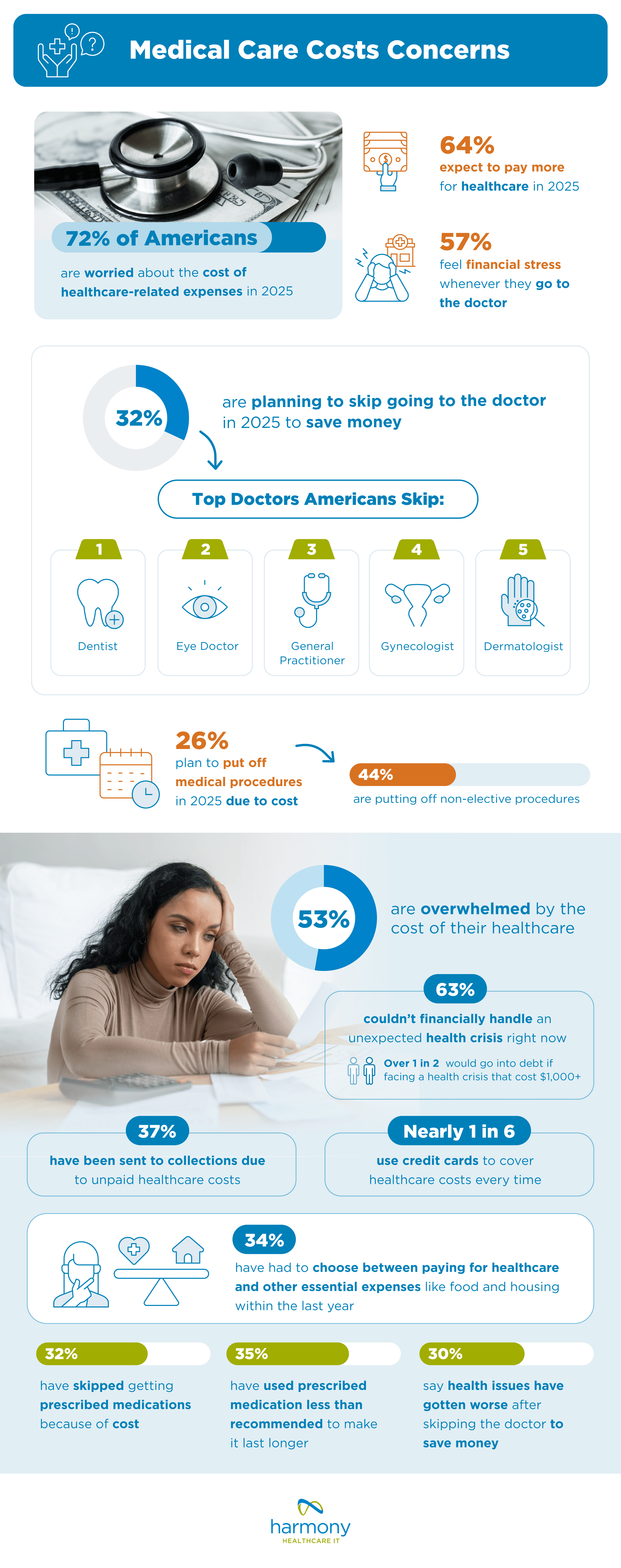
Finances are heavy on the minds of many Americans as we head into a new year. Nearly 3 in 4 (72%) Americans are worried about the cost of healthcare-related expenses in 2025, and 2 in 3 anticipate paying more for their healthcare compared to the year prior. Costs have become such a concern that over half (57%) feel financial stress whenever they go to the doctor.

These financial concerns are leading some Americans to take more drastic measures when it comes to their health: skipping important health procedures, cutting back on prescriptions, and avoiding certain doctors.

Nearly 1 in 3 Planning to Skip Going to the Doctor in 2025 to Save Money

Health Care Cost Concerns - www.harmonyhit.com report In 2025, nearly 1 in 3 (32%) are planning to skip going to the doctor to save money (young people aren’t the only ones doing it). The top doctors Americans plan to avoid are dentists followed by eye doctors and general practitioners. People are not only skipping regular appointments, but necessary health procedures too. Over 1 in 4 (26%) plan to put off medical procedures in 2025 to save money, and 44% of those are avoiding non-elective procedures.
When it comes to medications, 34% have skipped getting a prescribed medication because of how much it costs, and 35% have used their medication less than recommended so they could make it last longer and not spend as much money.

All of this comes at a health cost: 30% say their health issues have gotten worse after skipping the doctor to save money. 

Majority of Americans Do Not Have Enough Funds for a Health Emergency

If Americans had a health emergency today, 63% feel they couldn’t financially handle it. In fact, over 1 in 2 admitted they will go into debt if facing a health crisis that costs $1,000 or more.

Healthcare costs are increasingly anxiety-inducing for some Americans with over half (53%) feeling overwhelmed by the costs. Within the last year, 34% have had to choose between paying for healthcare or other essential expenses like food and housing. Nearly 1 in 6 use credit cards to cover every healthcare bill, and 37% said they’ve been sent to collections for unpaid medical bills.

Medical Care Cost Complexities and Confusion

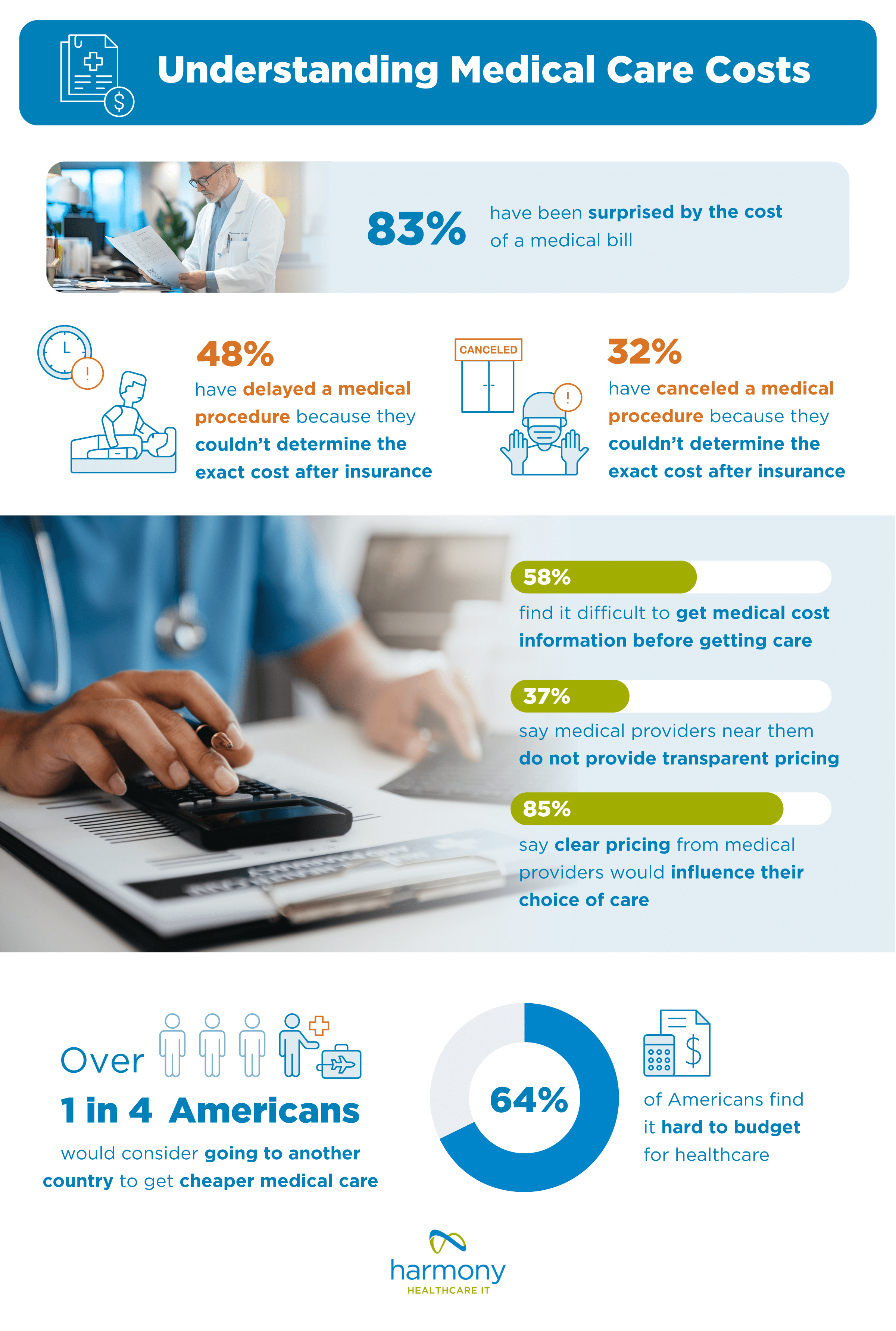
Complexity of medical care costs - www.harmonyhit.com report For many Americans, the way medical bills are determined leads to a lot of confusion. Over half (58%) find it difficult to get medical cost information before getting care, and 37% say medical providers do not provide transparent pricing. Transparent pricing in healthcare is when companies share how much appointments and procedures cost ahead of time.

Medical care cost concerns are leading some Americans to postpone or even cancel medical procedures. Survey statistics show nearly half (48%) have delayed a medical procedure because they struggled to figure out how much it cost after insurance, and 32% have gone so far as to cancel it entirely.

Others are considering getting their healthcare done out of the country. Over 1 in 4 (26%) would consider going someplace international for medical work. A very small percentage of survey respondents shared that they’ve actually done what is often referred to as medical tourism. While those Americans mainly went to Mexico, Turkey, and Thailand, one survey respondent shared they went to India for an ear procedure. They said that doctors in the U.S. quoted them $4,000 and insurance wouldn’t cover it, but in India, they were able to get the same procedure done at a reputable hospital for $100.

Healthcare costs aren’t the easiest to navigate, especially when trying to understand what a final bill will look like. Recent laws, such as hospital price transparency, have been passed to help pull back the curtain on medical care costs in the U.S. and help people have a better understanding of what they’ll be expected to pay, but for many, confusion and uncertainty still remains. If you have concerns about your healthcare costs, reach out to your insurance and your health provider.

Methodology

In September 2024 we surveyed 1,007 Americans about their healthcare. 41% were men, 57% were women, 1% were non-binary, and 1% would rather not say. Ages ranged from 18 to 79 with an average age of 41.

For media inquiries, please contact media@digitalthirdcoast.net.

Fair Use

When using this data and research, please attribute by linking to this study and citing https://www.harmonyhit.com.

Healthcare IT tips, guides, news & more delivered to your inbox

Learn More