Summary

Harmony Healthcare IT announced the appointment of Erik Johnson as its Vice President of Marketing. In this role, Johnson is responsible for leading the firm’s strategic marketing efforts to drive continued expansion in the United States and abroad. Johnson’s deep experience as a seasoned leader in healthcare technology will be instrumental to these efforts. “We...

Join Fellow Healthcare IT Pros

Tips, Guides, News & More

Sign Me Up
Erik Johnson joins Harmony Healthcare IT as VP of Marketing

Harmony Healthcare IT announced the appointment of Erik Johnson as its Vice President of Marketing. In this role, Johnson is responsible for leading the firm’s strategic marketing efforts to drive continued expansion in the United States and abroad. Johnson’s deep experience as a seasoned leader in healthcare technology will be instrumental to these efforts.

“We are thrilled to welcome Erik to our leadership team,” said Tom Liddell, CEO of Harmony Healthcare IT. “His impressive global marketing, sales and digital transformation experience will be invaluable as we continue to expand our reach and impact in the healthcare industry.”

Johnson brings more than 20 years of award-winning healthcare marketing and management experience to this role. He has held leadership roles at a Software-as-a-Service (SaaS) start-up, a healthcare technology company that provides clinical surveillance and analytics solutions that analyzes patient data in real-time and a global business development role for a healthcare software solutions firm.

“I am honored to join Harmony Healthcare IT and look forward to contributing to its mission of strengthening care delivery and improving lives,” said Johnson. “Together, we will drive forward innovative data management solutions that keep vital information accessible, releasable, usable interoperable, secure and compliant.”

Healthcare IT tips, guides, news & more delivered to your inbox

Learn More

Summary

The 21st Century Cures Act has adopted the United States Core Data for Interoperability (USCDI) standard to help further interoperability efforts and data sharing among providers and patients. In this blog, we unpack the details around USCDI and look at how it is constantly changing as more data points and data classes are reviewed and added.


Join Fellow Healthcare IT Pros

Tips, Guides, News & More

Sign Me Up
USCDI

Written by David Navarro, Senior Director of Data Science, Harmony Healthcare IT

What is the USCDI?

United States Core Data for Interoperability (USCDI) is a standardized set of health data classes (categories) and constituent data elements for interoperable health information exchange.  USCDI serves as a minimum guide for provider organizations on what data classes and elements will be stored and made interoperable, prescribing specific concepts like LOINC, SNOMED, CPT, and ICD10 that should be utilized to store patient observations.

The Office of the National Coordinator (ONC) adopted USCDI as the content standard for 21st Century Cures Act.  The latest version of USCDI (v5) was released in July 2024.  USCDI v5 is the latest iteration of the standardized set of health data classes and elements with a goal to facilitate nationwide, interoperable health information exchange. This version includes 16 new data elements and two data classes that seek to:

  • Improve patient care
  • Promote health equity
  • Reduce disparities
  • Support underserved communities
  • Enable public health data exchange

For more information on the final USCDI (v5) guidance, check out the most recent ONC Standards Bulletin.

How is the USCDI updated?

The USCDI is constantly under review. In fact, the ONC has a process for health IT stakeholders to follow to suggest updates. This can mean the addition of new data classes, like those listed above, or data elements that could be added to an existing class.

The process to suggest an update includes submitting new data elements and classes to the USCDI ONDEC (ONC New Data Element and Class) Submission System.

The submission for a proposed change should include:

  • Use case information
  • Applicable standards and technical specifications
  • Existing industry use and exchange
  • Potential challenges of incorporating proposed data elements

Then, the ONC evaluates the proposed data elements and assigns them one of the following levels:

  • Comment– Data may not have a well-defined use case or value to potential users
  • Level 1– Limited existing use in electronic systems, limited exchange between systems
  • Level 2– Extensive existing use in systems, and exchange between systems, would improve nationwide interoperability

Next, the ONC publishes data elements to the USCDI page for comments by health IT stakeholders. Updates and comments can be made for consideration of moving proposed data elements into the next version of the USCDI standard. Submissions achieving Level 2 will then be considered for incorporation into the new USCDI version of the standard.

While there may be a long list of suggested updates, the ONC is taking a judicious approach about how much to add to subsequent USCDI versions because of the USCDI’s broad applicability to certified healthcare technology, interoperability transactions, and its potential effect on user experience and workflow.

How are new versions of the USCDI incorporated into initiatives such as the 21st Century Cures Act?

To date, version 3 is required to meet the Cures Act requirements.  However, USCDI  Version 4 (v4) has been proposed as the new required version in the Health Data, Technology and Interoperability (HTI-2) proposed rule, with an effective date of  January 1, 2028 for adoption.

To address the emergence of new standard versions, the ONC has established a voluntary Standards Version Advancement Process (SVAP).  The SVAP enables health IT developers to incorporate newer versions of the standards and implementation specifications as part of the “Real World Testing” Condition and Maintenance of Certification requirement of the Cures Act. This means that using SVAP, certified health IT developers are permitted to use a more advanced version of the USCDI standards than currently in widespread use.

The impact of USCDI is not limited to just health IT products certified under the ONC Health IT Certification Program.

The USCDI also is used to align interoperability requirements and national priorities for health IT and health care broadly across industry initiatives. In fact, CMS and other federal, state, local, and tribal partners reference the USCDI for a range of health information exchange purposes.

Get organized and ready to move forward with Cures Act requirements and best practices.

It is important that organizations understand all the provisions detailed in the 21st Century Cures Act and apply the broad regulations to their specific interoperability use cases. All data, current and legacy, should be interoperable to ensure quality patient care and to support efficient clinical workflows.

Legacy data plays an important role in the safety and care of patients. Harmony Healthcare IT is committed to ensuring our legacy data solutions align with interoperability practices defined in the 21st Century Cures Act.

If you’re ready to get started on talking about your health data and the need for interoperability, contact me or my team.  As a data management firm that moves and stores patient, employee, and business records for healthcare organizations, Harmony Healthcare IT is up to date on interoperability strategies, and ready to help you develop your plans.

Contact us.

For other blogs related to interoperability and the 21st Century Cures Act, check out:

21st Century Cures Act – Information Blocking & Rule Summary

The 2022 ONC Annual Meeting Recap

Understanding TEFCA and its Role in National Interoperability

21st Century Cures Act and the Push for REST API Adoption

As Senior Director of Data Science at Harmony Healthcare IT, David Navarro drives interoperability initiatives and focuses on the curation and accessibility of data in the healthcare ecosystem.

Healthcare IT tips, guides, news & more delivered to your inbox

Learn More

Summary

Earning all A’s for all customer experience measurements, 100% of customers surveyed report they would purchase again from the innovative legacy data management company.

Join Fellow Healthcare IT Pros

Tips, Guides, News & More

Sign Me Up
Harmony Healthcare IT recognized as top in KLAS for 2024

Harmony Healthcare IT, a first-to-market innovator in legacy data management, ranks as a standout for archiving some of the healthcare industry’s largest and most complex clinical and financial software systems in the KLAS Data Archiving 2024 Report. The report on the state of healthcare archiving calls out Harmony Healthcare IT’s robust legacy data work with highly complex projects at some of the largest health systems in the country.

Further, Harmony Healthcare IT received all A’s in the six customer experience pillars of culture, loyalty, operations, product, relationship, and value. Customers commended the long-term record storage platform, HealthData Archiver®, for its strong uptime, efficient data access and improved cybersecurity. Customers reported a key differentiator for the Harmony Healthcare IT team is its strong project leadership that ensures integration is built correctly so that the data migration process is efficient. This extends to the vendor being respected as a reliable and trusted partner that provides a return on investment and the ability to scale as its customers’ data management needs evolve.

“We take great pride in this positive feedback from our valued customers,” said Tom Liddell, CEO at Harmony Healthcare IT. “Our team is well equipped to tackle the most challenging and complicated data management projects for the largest health systems in the country and beyond. We are committed to improving interoperability for our customers of all sizes with our thorough approach to decommissioning legacy servers and archiving vital data, so it remains secure and sharable between clinicians, patients, payers, and other end users.”

With health data tripling every three years and 94 percent of healthcare provider organizations still operating legacy applications, there can be workflow, security and data sharing challenges in keeping outdated applications running in a read-only mode. There is an urgent need for healthcare providers from the smallest clinics to largest health networks to have a solid lifecycle data management plan that includes archiving. With properly maintained health data, healthcare provider organizations can ensure data accessibility, compliance, interoperability, integration, patient safety and long-term data protection.

Healthcare IT tips, guides, news & more delivered to your inbox

Learn More

Summary

EMRs now account for nearly 10 percent of cyberattacks, with legacy software offering some of the easiest entry points. With the price tag for a healthcare data breach reaching an all-time high, decommissioning aging, out-of-production applications to secure patient, employee and business records is more important than ever before.

Join Fellow Healthcare IT Pros

Tips, Guides, News & More

Sign Me Up
Legacy Software Ranks No. 1 Cybersecurity Bad Practice

Fighting cybercriminal activity in healthcare is a nonstop battle with attackers constantly upping their tactics and varying their targets. Even more than before, cyber criminals are targeting EMR applications to siphon as much data as possible, cause operational damage, and push for ransom payments. Since 2018, there has been a 264 percent increase in large breaches that involve ransomware attacks.

Smaller hospitals, physician groups and specialty clinics are particularly vulnerable to  hacking or IT incident breaches as they may have less resources to protect themselves. Midsized hospitals also report being hit harder than their larger counterparts.

With the price tag for a healthcare data breach at an all-time high of $11 million, looking at your EMR environment for weak links is a smart move for organizations of every size.

Legacy Software and Hardware are the Weak Links in Healthcare Security

Cyberattacks are not only grabbing headlines, but causing major turbulence in healthcare, forcing the cancellation of surgeries, radiology exams and other services because systems, software and/or networks had been attacked and disabled due to cyber criminals. The cost to the breached organization is high in terms of economic loss and reputation repair. There are many steps needed to protect healthcare organizations, which starts with understanding not only everywhere the electronic protected health information (ePHI) resides, but in the security vulnerabilities associated with legacy systems across the enterprise.

Legacy/Unsupported Software Ranks No. 1 as a “Bad Practice”

According to the Cybersecurity and Infrastructure Security Agency (CISA), the use of unsupported (or end-of-life) software is a Bad Practice that increases risk to critical infrastructure including public health and safety.

Multiple silos of data stored in outdated systems offer the easiest entry points for hackers. Legacy software kept running in read-only mode can be vulnerable to corruption, breakdown, cyberattack or even internal threats. Minimizing open doors and windows in your organization by decommissioning legacy software to defend against cybercrime is a smart and necessary step in your organization’s long-range security plan.

Healthcare Providers Must Strengthen Their Cyber Posture

While there are best practices for health data management, many organizations are finding it necessary to allocate more resources toward security preparedness. According to a recent survey by Healthcare Information Management and Systems Society (HIMSS), 55 percent of healthcare cybersecurity professionals reported an increase in their cybersecurity budgets. While healthcare spending on cybersecurity may be difficult to increase, the recent HIMSS survey also notes that those “not investing in their cybersecurity programs will likely struggle to keep up with evolving threats.” The time is now to take the recommended action steps to better protect patient, employee, and business records.

The one, two punch: Costs can add up with cyberattacks and new penalties for failure to protect ePHI

If defending against cyberattacks wasn’t enough of a reason to take action, there also are regulatory penalties for not adhering to compliance standards. There are new fines for organizations found guilty of not protecting the ePHI in its care. As of July 2024, the HIPAA Privacy, Security and Breach Notification Rules now include penalties (called disincentives) for covered entities such as health plans, health care providers and health care clearinghouses as well as business associates who fail to protect the privacy and security of protected health information. HIPAA stipulates four tiers of violations that reflect increasing levels of culpability, with minimum and maximum penalty amounts within each tier. Having a thorough privacy and security plan is more than a necessity, it is a critical mission.

An Important To-Do: Decommission Aging, Out-of-Production Applications

When decommissioning legacy systems and determining how to address legacy data to reduce the risk factor to your ePHI, there are a few things to ask any future archiving partner.

The data extraction and migration experts at Harmony Healthcare IT have helped healthcare delivery organizations decommission legacy systems, and safely consolidate patient, employee and business records since 2006.  Extracting, migrating and retaining legacy records from over 550 different clinical, financial and administrative software brands, Harmony Healthcare IT secures discrete data and images for the long haul on its cloud-based platform, HealthData Archiver®.

Stepping Up Defensive Moves to Protect ePHI

Need help protecting legacy records in this hostile, hacker-centric environment? Harmony Healthcare IT has been consistently ranked as the #1 data extraction, migration, and archival healthcare IT company according to Black Book Market Research for four years (2019-2022) as well as ranked #1 in the 2020 Best in KLAS Software & Services Report as a Category Leader in Data Archiving.

For more information about securing legacy healthcare data, reach out to connect.

This blog has been updated from the previous version published on Oct 04 2022

Healthcare IT tips, guides, news & more delivered to your inbox

Learn More

Summary

There is an urgent need for a better-connected health system in Canada where person-centric care allows each patient’s records to follow them across all settings. Harmony Healthcare IT recently shared its ground-breaking health data products at e-Health 2024 in Vancouver. The company’s solutions integrate health data in real time which supports the Connected Care for...

Join Fellow Healthcare IT Pros

Tips, Guides, News & More

Sign Me Up
Harmony Healthcare IT Innovations Support Canadian Priority for Connected Health Services

There is an urgent need for a better-connected health system in Canada where person-centric care allows each patient’s records to follow them across all settings. Harmony Healthcare IT recently shared its ground-breaking health data products at e-Health 2024 in Vancouver. The company’s solutions integrate health data in real time which supports the Connected Care for Canadians Act and the Shared Pan-Canadian Interoperability Roadmap which aim for a connected, equitable and sustainable health system.  

Managing health data is complex. Health records represent 30% of the world’s data volume and it multiplies faster than any industry. Canadian health records are stored in electronic health record (EHR) platforms like MEDITECH, Epic and Oracle Health. Currently, only 35 percent of clinicians in Canada can share patient information outside their practice. Data management and record sharing challenges are compounded when there is an EHR upgrade or replacement, since record retention requirements span 5-16+ years.  

“Our team pioneered a suite of healthcare IT products to support the ongoing seamless flow of health data from more than 550 software systems between providers, specialists, patients and other users,” said Tom Liddell, CEO of Harmony Healthcare IT. “We are honored to share these advancements to help our Canadian healthcare colleagues meet their long-term goals.”  

Harmony Healthcare IT’s innovations include HealthData Platform, an enterprise-wide solution that addresses the full data lifecycle, designed specifically for data storage, workflows, transactions and interoperability. The platform includes several customizable solutions, including HealthData Archiver®, a vendor-neutral active archive that ensures critical health data is available when, where, and how it is needed. When EHRs are replaced, data that is not migrated to the new system can be securely stored in the archive and remain accessible. This supports decommissioning outdated applications and servers, which improves security and reduces costs. 

Healthcare IT tips, guides, news & more delivered to your inbox

Learn More

Summary

The dynamic merger and acquisition (M&A) landscape in healthcare is moving quickly with the pace expected to pick up more steam if the Federal Reserve cuts interest rates. As provider organizations of all sizes explore M&A activity, one key consideration is how to modernize the information systems and use the right infrastructure, applications and legacy data management solutions to deliver on the interoperability demands of today and tomorrow.

Join Fellow Healthcare IT Pros

Tips, Guides, News & More

Sign Me Up
Mergers & Acquisitions need to prioritize legacy data

The days of healthcare mega mergers and acquisitions (M&A), those with annual revenues north of $1 billion, have returned. There also is a trend toward integrated multi-state health system mergers and an uptick in community health systems merging with larger partners to combat ongoing financial pressures. Regardless of the size or scope of the merger or acquisition, one constant is the need to have a solid legacy data management strategy as the application portfolio expands.

Legacy data includes patient records, finance records, personnel records, company data, and more that are stored in an electronic health record (EHR), electronic medical record (EMR), enterprise resource planning (ERP) or practice management (PM) systems. The number of systems in use within an organization varies, but larger hospitals and health systems average 18 different EHR vendors. When there is a merger or acquisition, numerous redundant systems can create an unruly IT footprint that is difficult to manage.

When there is talk of M&A, there needs to be a thorough plan to inventory, review and determine an action plan for all the technology, applications, and legacy data involved.

What steps are necessary to effectively manage legacy data during a merger or acquisition?

The challenges of managing data during a merger multiply almost faster than the data itself. And, that is pretty fast considering health data triples every three years. Below are five important steps toward a solid legacy data plan when the organization is amid M&A activity.

  1. Create a legacy data strategy. It is important to take a big picture view of the entirety of the software and applications from each organization. Involve the Data Governance team to provide oversight and set direction. Consider including a vendor with application rationalization expertise to help guide the implementation of the organization’s strategy about what data will be retained, and when applications can be decommissioned with the data migrated to an archive.
  2. Document what you have. Take inventory of all the applications each acquired hospital or clinic uses. This is more than just a list, modern data management must follow the HIPAA Security Crosswalk to NIST that states: managing assets enables “the organization to achieve business purposes that are identified and managed consistent with their relative importance to business objectives and the organization’s risk strategy.”
  3. Plan for application rationalization. Make sure there is early consideration to rationalizing applications according to the organization’s overall plan. Use a consistent strategy, budget for this project, and include a cross-departmental governance team from the beginning.
  4. Review the options for legacy data. The primary options for legacy data that can support regulations include converting legacy data to the new EHR or migrating legacy data to an active archive. Consider the legacy data strategy with data governance to support the organization’s overall data management goals.
  5. Engage an active archive. As applications are determined to not “make the cut” to move forward, the legacy data will likely need to be retained to meet regulatory and clinical retention timelines. An active archive with discrete and non-discrete data and intuitive user workflows will also allow for efficient record access and release.

The benefits of a streamlined application portfolio achieved through legacy data archiving:

Achieve a faster return on investment (ROI). By migrating legacy data from disparate systems to active archive, like HealthData Archiver®, there is a reduction in hard costs such as application maintenance, support, server/hardware costs as well as soft costs for IT overhead/support, IT labor to maintain legacy systems and workflow time savings for clinical and HIM users. With cost reduction as a leading concern for CIOs surveyed about the factors driving legacy data management decisions, 55 percent reported cost as a significant or very significant pain point.

Support data compliance and reduce legal risk. Record retention requirements can span 25+ years, which makes an active archive like HealthData Archiver® a viable solution. Legal and compliance teams can retain records for the duration of the retention period with an efficient, secure and cost-effective way to store records in a HIPAA-compliant format. It also allows for accessibility to meet requirements around the release of information.

Improve interoperability to help with data sharing and accessibility. Consolidating legacy data to a central archive is a pivotal step to support interoperability of records between providers, specialists, payers, patients and other users. Beyond the archive’s primary role, advanced features such as Single-Sign On from the active EHR, break-the-glass functionality of role-based access, purge functionality, and Secure Record Delivery deliver innovative capabilities that supports a seamless flow of patient, business and financial data.

Our team helps organizations work through M&A legacy data plans.

At Harmony Healthcare IT, we perform data extraction from legacy systems, complete the clinical data migration and store it in a relational database and make it accessible in an easy-to-use, browser-based viewer for years to come. If your healthcare organization has or will go through a merger or acquisition, check out our HealthData Platform to learn about cloud-hosted long-term storage of PHI for both ambulatory and acute care systems as well as HR, GL and accounting data.

M&A Legacy Data Success Case Study: How an integrated healthcare system delivered $2+ million in data consolidation savings during a merger and acquisition.

Ready to connect?

We’re here.

Healthcare IT tips, guides, news & more delivered to your inbox

Learn More

Summary

Getting it right from the beginning is a vital step in most projects including health data archiving. At Harmony Healthcare IT, a well-defined discovery and scoping process led by a team of experienced solutions engineers helps get projects on the right path from Day One. Jake Carson walks through some tips for effective discovery and scoping in a podcast interview.

Join Fellow Healthcare IT Pros

Tips, Guides, News & More

Sign Me Up
Discovery Process and Scoping for an Archive Solution

Healthcare technology projects reportedly miss their mark up to 50 percent of the time and some require massive reworking after launch. Problems include things like unintended project delays, substantial cost overruns or not meeting intended goals. In some cases, projects are even completely stalled because of something that could have been discovered earlier in the project cycle.

But, this doesn’t have to be the standard.

Of all the variables that go into a well-orchestrated healthcare IT project, one of the most important steps is an early one: Project Discovery and Scoping.

Check out our HealthData Talks: Archive & Discovery Scoping podcast where IT Solutions Engineer, Jake Carson, explains how the discovery and scoping process at Harmony Healthcare IT involves a deep dive to gather and organize all of the information needed to define and map out the project before it starts.

Getting it right from the beginning starts with a thorough discovery and scoping effort.

Discovery and scoping help avoid project pitfalls and mitigate risks.

The team at Harmony Healthcare IT has developed a thorough Discovery and Scoping process that digs deep to help guide the pre-sale process to ensure all the information needed to inform the project plan is known, such as if the system has images, the size of the system, the types of records included, and so much more. It is important to get started on the correct path to realize the key goals such as being on budget, meeting the project timeline and delivering value to the organization.

Discovery. This is a defined process that starts with a discovery document, which is a valuable list of questions and an inventory template to help chart the complete details of the systems on deck for data migration and/or archiving. However, it goes beyond just a document with a discovery call that includes involving the subject matter experts from the client’s organization who are using the system every day. Our team digs in and uses their experience and knowledge to ask questions like: What are the key data points you want to be able to hold on to and release in the long-term? For systems that are sourced by a vendor, it is important to understand the exact deliverables from the vendor. Our team seeks to understand the export deliverables since exports sometimes could come back incomplete. For these reasons, investigating beforehand is better.

Scope. This, in a nutshell, is the overall extent of what needs to be migrated or archived. With most archives including custom built options, it is important to walk through the options and determine the scope of the archive needed for the specific system. Is it PAMI or assessment forms that need to be built? What product features are needed, etc.? Having an accurate discovery process informs the scope and pricing in an efficient manner.

The benefits of a solid discovery and scoping process means getting it right up front.

Unfortunately, there are some organizations that have endured other archive experiences that did not have a complete upfront experience and ended up with a stalled project (or many change orders)—so they turned to us. One example is at AltaMed, a community health network in Southern California.

Complex dental records halted an archiving project with another vendor that didn’t have a solid understanding of scope.  

Harmony Healthcare IT dug into handling the odontogram records that stumped the original archiving vendor.  As a result, Harmony Healthcare IT delivered a customized legacy data management solution with a seamless integration between the archived records and the go-forward production system, Epic. Read the story in Healthcare IT News.

We identify the potential gotchas before they happen.

Ready to learn more? Let’s talk.

Healthcare IT tips, guides, news & more delivered to your inbox

Learn More

Summary

Harmony Healthcare IT, a data management firm that works with health data, surveyed over 800 current college students in undergraduate universities and technical colleges about how they’re balancing school and their mental health. Learn about the impact it’s having on their college experience.  

Join Fellow Healthcare IT Pros

Tips, Guides, News & More

Sign Me Up
College students and mental health stuggles

College and Mental Health Report  

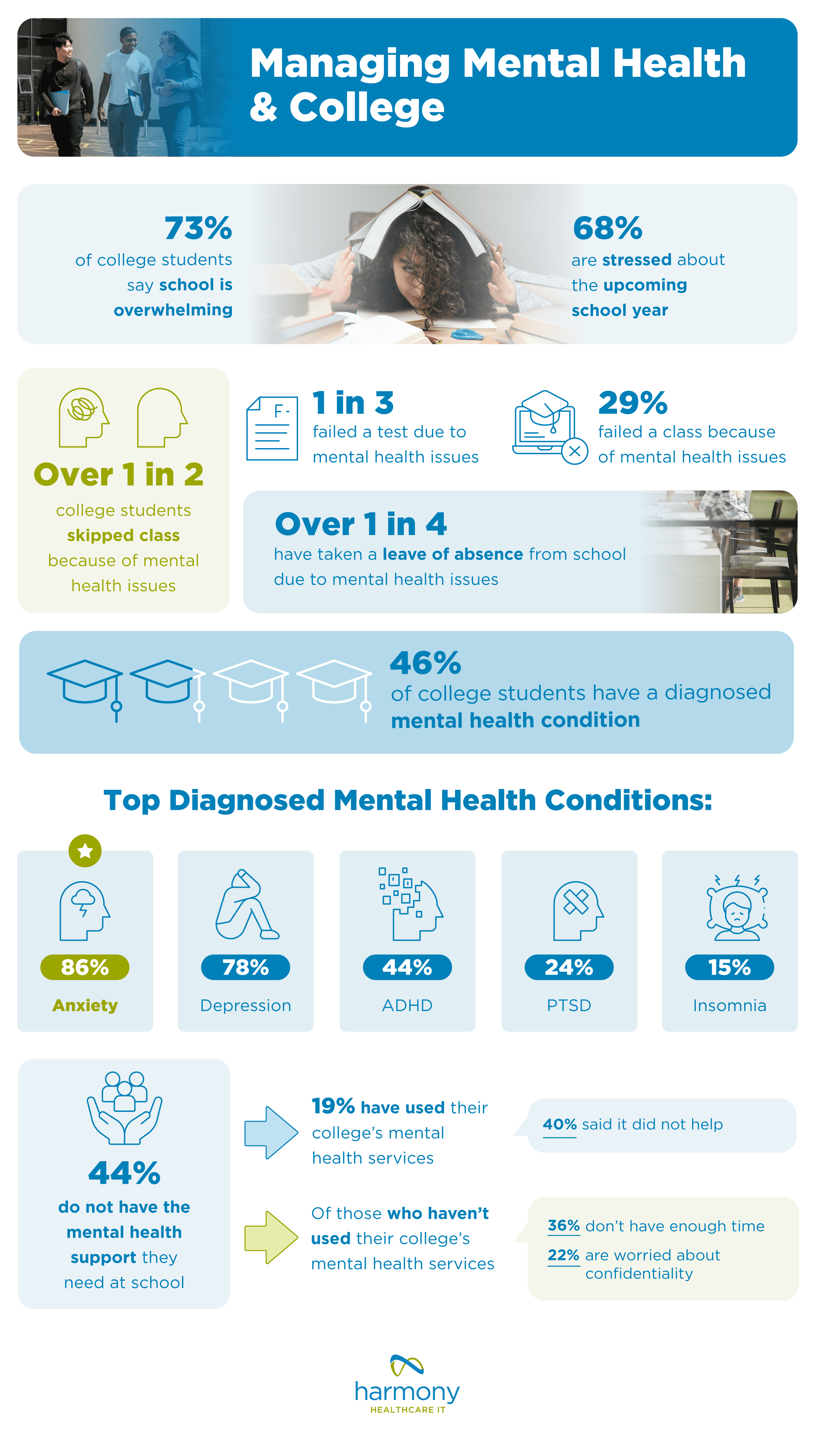
A day in the life of current college students is very different from how it was five years ago, let alone a decade ago. Our new survey of current college students finds nearly 3 in 4 (73%) find school overwhelming. Mental health plays a big part in the lives of college students, impacting everything from class attendance to grades. For some, it’s even led them to take a leave of absence from school.  

How Mental Health Impacts the College Experience

College and Mental Health - Graphic 1_Harmony Healthcare ITOver 2 in 3 (68%) college students are stressed about the upcoming school year, and mental health appears to have a considerable impact. Almost half (46%) of current college students have a diagnosed mental health condition, which is an even higher statistic than the previous study we did on the mental health of Gen Z. The top mental health conditions students struggle with are: 

  1. Anxiety
  2. Depression
  3. ADHD
  4. PTSD
  5. Insomnia    

Mental health is entering classrooms with many students. Due to mental health struggles, over half (51%) of today’s college students have skipped class, 1 in 3 failed a test, and nearly 1 in 3 (29%) failed a class. Mental health struggles have gotten so bad for some that over 1 in 4 (26%) students have been forced to take a leave of absence from school.   

44% of current college students say they do not have the mental health support they need at school.  

While nearly 1 in 5 (19%) have used their college mental health services, 40% said it did not help. Of those who haven’t used mental health services on campus, 35% said they don’t have enough time, 22% are concerned about confidentiality. In a similar vein, 11% don’t want their parents to know they’re struggling and are worried they’d find out if they try to get mental health help.  

Top 5 Stressors for Current College Students 

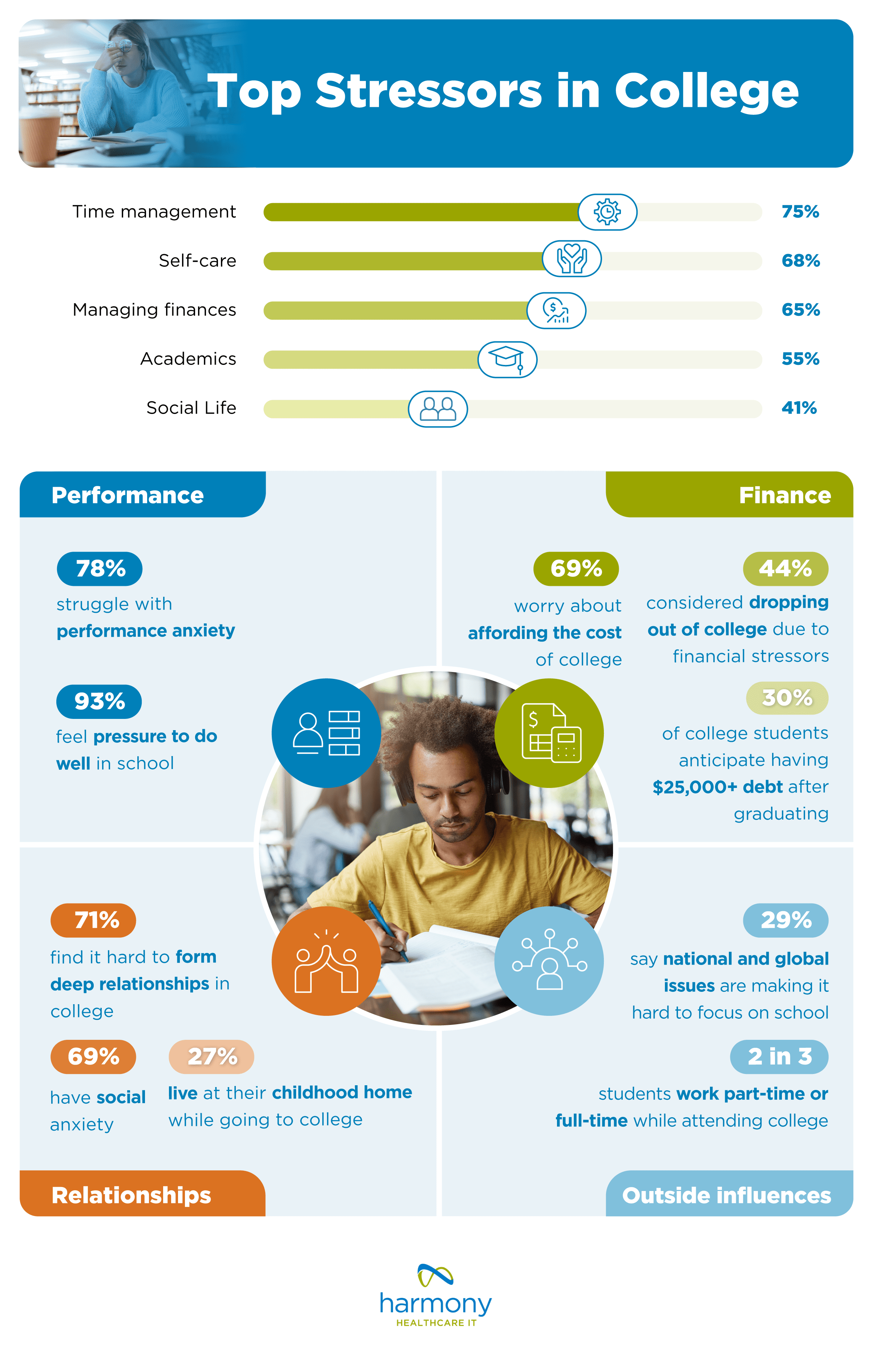
College and Mental Health - Graphic 2_Harmony Healthcare ITBeing a college student is not easy. On top of balancing academics, college students are often learning how to live life on their own. The top 5 stressors current college students face are:  

  1. Time management
  2. Self-care
  3. Managing finances
  4. Academics 
  5. Social life  

Part of what goes into time management is figuring out the best way to balance studies and social life. 93% of college students feel pressure to do well in school, and while 44% say that’s due to family pressure, 85% find that pressure comes from within themselves. Over 3 in 4 (78%) specifically struggle with performance anxiety, or the need to do well in their classes, sports, activities, etc.  

Another form of anxiety many students grapple with is social anxiety, or fear and stress in social situations. 71% say it’s hard to form deep relationships. To make the college experience even harder, some college students aren’t living amongst their classmates. Over 1 in 4 (27%) are attending school while living at their childhood home. Of those, 78% struggle to form deep relationships.  

How Finances are Impacting College Students   

Financially, 69% of college students are worried about affording the cost of college. This anxiety is so intense that 39% say financial stress has negatively impacted their academic performance, and 44% have gone so far as to consider dropping out of school due to their finances. Over 1 in 3 (34%) have a financial aid scholarship that is contingent on maintaining certain grades or GPA.    

According to survey data, 30% anticipate having $25,000 or more in student loan debts after graduating. That may be why 67% of college students work either part- or full-time while attending school.  

Impact of Global and National Issues for People in College  

While there are timeless issues all students face from generation to generation, each year, students find themselves dealing with unique geopolitical influences that impact their time in school. Nearly 1 in 3 (29%) say national and global issues make it hard to focus on school. The biggest issues that are top of mind for students are the 2024 presidential election (64%), the Israel-Palestinian conflict (63%), and the COVID-19 pandemic (62%).  

How College Students Cope with School 

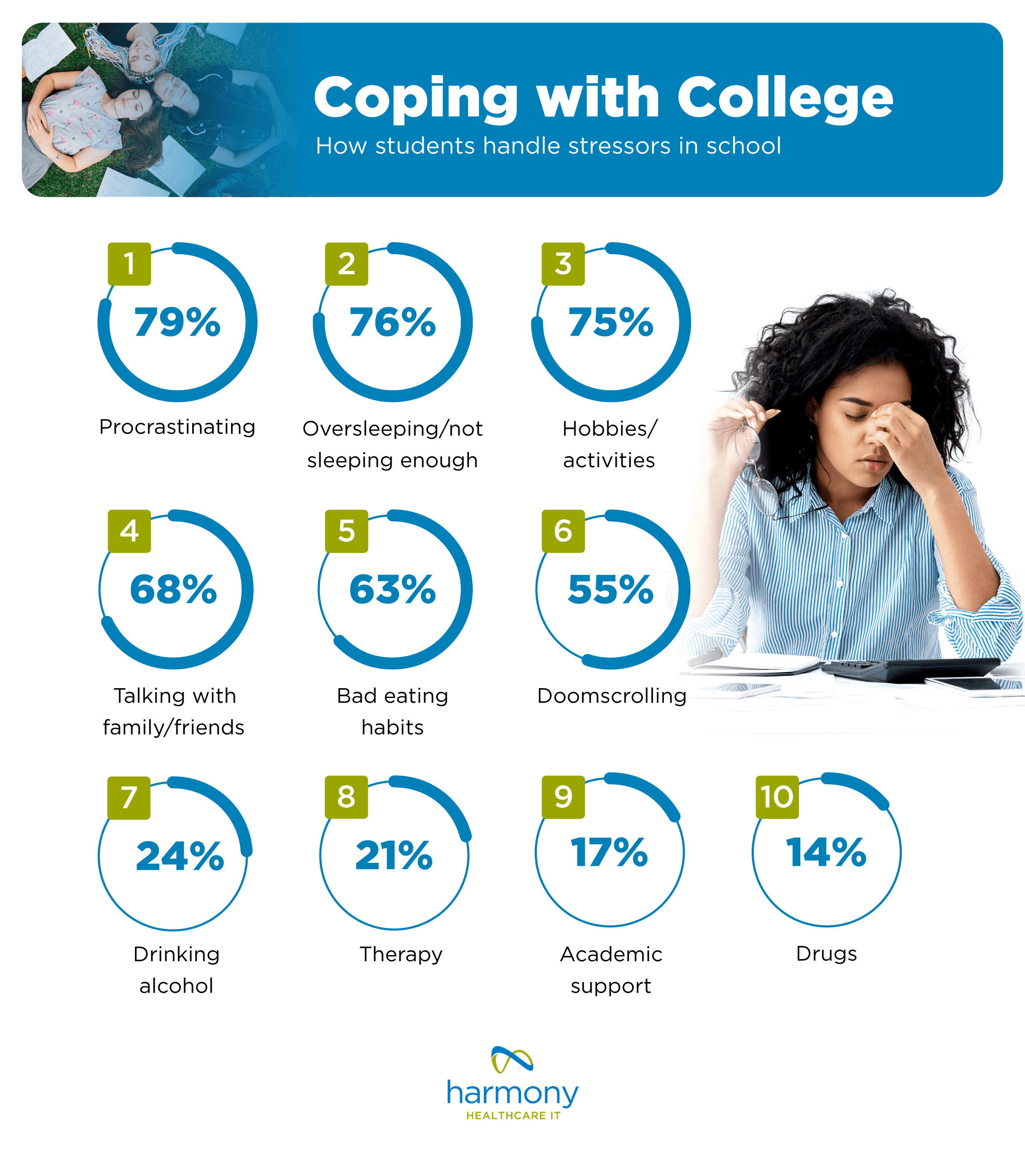
Top 10 ways college students handle college stress - report by www.harmonyhit.com   There are a range of ways students cope with stressors – some positive and some negative. The top way college students handle stress is by procrastinating. 79% of students admit to procrastination, while 76% share that they oversleep or, conversely, don’t get enough sleep (it’s no surprise since college students are often known for pulling ‘all-nighters’).  

Statistics show that 3 in 4 students turn to positive habits such as working on their hobbies or doing extracurricular activities, and 68% talk with family and friends. Others admit to having bad eating habits, doomscrolling on their phones, and drinking alcohol.  

College is not an easy transition. It’s a time when students learn to manage all aspects of their lives from academics to activities. While it’s an exciting period of growth, it can be difficult, especially for those struggling with mental health. The college experience doesn’t have to be impossible: focusing on healthy habits, and speaking with a therapist, trusted school advisor, friend, or family member can help so you’re not navigating this new stage of life alone.  

Methodology 

In June 2024 we surveyed 817 current undergraduate and technical college students. Survey respondents ranged in age from 18 to 63 with an average age of 27. 48% were women, 48% were men, 4% were nonbinary or would rather not say. 10% were first years, 23% were sophomores, 28% were juniors, 31% were seniors, and 8% were in a technical college or program that doesn’t use traditional year designations.  

For media inquiries, please contact media@digitalthirdcoast.net. 

Fair Use 

When using this data and research, please attribute by linking to this study and citing www.harmonyhit.com  

Healthcare IT tips, guides, news & more delivered to your inbox

Learn More

Summary

“Abandoned” legacy data left in old EMR/EHRs can create a lot of challenges. While the data is not officially abandoned, leaving it in read-only mode in disparate application silos is risky. In a survey of Chief Information Officers (CIOs) at healthcare provider organizations, 94 percent shared they still use legacy systems. It is important to...

Join Fellow Healthcare IT Pros

Tips, Guides, News & More

Sign Me Up
Risks of Ignoring Legacy Data Management

“Abandoned” legacy data left in old EMR/EHRs can create a lot of challenges. While the data is not officially abandoned, leaving it in read-only mode in disparate application silos is risky. In a survey of Chief Information Officers (CIOs) at healthcare provider organizations, 94 percent shared they still use legacy systems. It is important to be aware of the risks involved in leaving old systems up-and-running to house data that must be preserved.

Avoiding properly addressing legacy data comes with risks. Here are nine examples.

  1. Increased exposure to cyberattacks. Legacy applications are the most targeted for breaches as they are considered weak links. These applications are easier for attackers to gain entry because they can lack modern security tools. Plus, vendors often have stopped providing support and no longer offer security patches. Unpatched vulnerabilities are linked to 60 percent of data breaches.
  2. Data loss. Systems created long ago may not be equipped to manage large volumes of data which can lead to slow processing and even data loss. Data loss also can occur when data is accidentally deleted or overwritten and can’t be recovered.
  3. Technical failure. Outdated applications can be difficult to update and maintain. This can lead to errors, downtime, and an absence of the right technical staff with knowledge of the legacy system. Aside from complete failure, having multiple outdated applications can bog down every step of data retrieval and cause delays that impact business operations and ultimately the bottom line.
  4. Lack of access. Data stored in multiple disparate silos makes records complicated to access. This affects clinical, HIM, legal, HR, billing and other departments who rely on accessing clinical, financial and business records to fulfill their roles. Patients must try and remember all their medications, problems and historical information. Clinicians are burdened to try and access historical records by logging into multiple systems. HIM, legal and billing departments face workflow and technical issues. The list goes on.
  5. Unnecessary cost. In an era of cost consciousness, maintaining and licensing two or more HIPAA-compliant record sets (old and new) is not efficient or necessary. Contract costs add up quickly.
  6. Impaired interoperability. Many older systems were designed before digital interoperability (record sharing) was a priority. They may not be equipped to communicate with other systems, which results in gaps in data exchange and business setbacks.
  7. Compliance violations. Data privacy legislation such as HIPAA requires organizations to take appropriate measures to protect against security risks. This means that using outdated hardware and software could be considered non-compliant.
  8. Steep penalties. Healthcare records must be secure and produced within a given timeframe, or the organization could be fined for non-compliance with HIPAA as well as face reputational damage. There are four tiers of HIPAA penalties that range from a few thousand to more than $2 million dollars as the current maximum annual penalty limit.
  9. Future problems. Compounding the number of applications and complexity of an organization’s IT footprint is like kicking a problem down the road. Eventually, there is a reckoning, and it could be harder to fix when there are even more applications and data involved. Check out this case study which highlights the challenges involved in working with a plan for 3,000 legacy clinical, financial and business applications stored in 13 data centers.

Mitigate risks with a solid legacy data management strategy.

When an organization transitions to a new EHR or EMR, there are 10 things to consider to support a successful implementation.

One key step is to determine what to do with legacy data which involves an application rationalization strategy to make the historical records available, searchable, releasable, and interoperable. This helps coordinate the data for all stakeholders and helps ensure compliance with the 21st Century Cures Act.

A legacy data management strategy can help reduce the risks, labor burden and cost of maintaining out-of-production software applications post transition.

The Harmony Healthcare IT team helps healthcare delivery organizations manage data. Our suite of data management solutions supports current and future interoperability requirements. We have experience with more than 550 clinical, financial and administrative software brands used in healthcare delivery organizations of all sizes.

We can help reduce the risks and secure legacy data with our active archive solution, HealthData Archiver®.

Let’s connect.

Healthcare IT tips, guides, news & more delivered to your inbox

Learn More

Summary

Eight of ten Americans we recently surveyed report access to their medical records is important or very important to them. That said, 63 percent of that same group report they do not currently have their lifetime medical history and vaccinations records. As increasing interoperability (record sharing) continues to be a top priority across the entire healthcare system, the gap between patients’ wants and what they have likely will close. In this article, we examine how much of a priority patients place on access to their medical records over time and steps providers can take to ensure their data management plans are on point.

Join Fellow Healthcare IT Pros

Tips, Guides, News & More

Sign Me Up
Why medical record access is important

Our company recently conducted a survey of over 1,000 Americans about their moving habits and the impact it has on their healthcare and medical records. The results also show some gaps in what patients would like in terms of medical record access versus what they currently have.

More than 80% of Americans surveyed report that having access to their complete health record is important or very important.

While 648 (63%) of those surveyed report they do not have their medical history and vaccination records since birth, 670 (65%) are confident that they know where to find their records. This is interesting as 81% say that having access to their complete up-to-date health record is either important or very important to managing their overall health.

Perhaps this increased interest in having access to their records is partly due to the uptick in the electronic availability of medical records. In a national survey by the PEW Charitable Trusts, about half of all respondents had accessed their digital personal health record. Healthcare IT plays an important role in increasing interoperability (record sharing) between providers and patients. There are many initiatives underway for providers to meet the requirements of the 21st Century Cures Act. However, when patients move or have complicated medical histories, there can be extra challenges to keeping the information accurate, up to date and accessible.

Two challenges for patients in maintaining a lifelong medical record:

  • Chronic conditions add complexity to care coordination and support the priority for long-term record management. With six in ten adults in the country currently battling a chronic illness that requires long-term and ongoing medical attention for conditions like diabetes, stroke, cancer, depression, anxiety and cardiovascular disease, maintaining accurate records that are shared between all care providers and with the patient is critical. Chronic disease has a substantial effect on the U.S. health system with about 90% of the annual $4.5 trillion health care expenditure attributed to managing and treating chronic diseases and mental health conditions. Care coordination is vital with patients often needing care from multiple providers and clinics. As such, access to the comprehensive medical record for clinicians and patients can support chronic disease management.
  • Number of times the patient moves. According to the S. Census Bureau, the average American moves 11.7 times throughout their lifetime, with two or three of those times happening after age 45. With every move, the patient has a responsibility to communicate with their current and new healthcare providers to facilitate a smooth transfer of their medical records. Patients are advised to check with their new provider for their preferred record transfer process which may include getting a hard copy file in a CD or flash drive, or requesting the current provider digitally transfer the records. There are new HIPAA amendments in 2024 that restrict the right of individuals to transfer their ePHI to a third party, limiting this right only to ePHI maintained in an electronic health record (EHR) system. This is meant to provide a better balance between patient accessibility and data security.

Patient access to their long-term records and transferring records between providers is mostly a smooth process.

The healthcare industry continues to make strides toward better interoperability of medical records between providers, payers, and patients. Of those patients we surveyed, more than 70% reported they have not experienced any difficulties transferring records between healthcare providers or when switching doctors or specialists. Similarly, more than 70% reported they have not had any difficulty in accessing their records from a healthcare provider.

However, over time, electronic health record (EHR) systems are replaced, and legacy data interoperability is important as retention requirements can span decades.

What are the options for healthcare providers to maintain the complete medical record to meet patient needs and comply with regulatory requirements?

When there is a need to preserve and protect medical, business, and financial records, there is a one-stop solution to meet each organization’s individual needs.

Long-term access to records is enabled with Harmony Healthcare IT’s HealthData Platform, a secure infrastructure that provides cloud-hosted accessibility to patient, employee, and business records for healthcare delivery organizations. This is important because over time as EHRs are replaced, records must be retained to meet clinical, legal, and business requirements. This solution supports storage, workflows, transactions, and interoperability to help IT, HIM, legal and business teams continue to function. There are many options for record storage within the Platform that all work together to keep records secure and accessible long term.

As decisions are made to decommission a legacy system, structured and unstructured data is either extracted and converted to a go-forward system (i.e., Epic, Cerner, MEDITECH) or migrated and secured into an active archive solution such as HealthData Archiver®.

HealthData Archiver® is an application that stores records of any type and provides on-demand access via a user interface with intelligent workflows (i.e., release of information for HIM users or Single Sign-On for clinicians as integrated on Epic’s Showroom and marketplaces for other leading EHRs).

Does your organization have records still residing in legacy applications, and looking for the best options for retention and sharing?

If patients move more than 11 times during their lifetime, healthcare providers also need to get moving to ensure their lifecycle data management plans are set for the long haul.

Our team can help you meet your cost, security, and interoperability goals.

Reach out here.

Healthcare IT tips, guides, news & more delivered to your inbox

Learn More