Summary

As 2019 comes to an end and we ready for the fresh perspectives and opportunities that a new decade will offer, it’s a time to reflect and be grateful for what this last year has brought to Harmony Healthcare IT. Taking team building outside of the office early last year set our team up for...

Join Fellow Healthcare IT Pros

Tips, Guides, News & More

Sign Me Up
Ugly Sweater

As 2019 comes to an end and we ready for the fresh perspectives and opportunities that a new decade will offer, it’s a time to reflect and be grateful for what this last year has brought to Harmony Healthcare IT.

  • Taking team building outside of the office early last year set our team up for success in 2019. This kind of engagement was just one contributing factor that led to Harmony Healthcare IT being honored by Modern Healthcare as one of 2019 Best Places to Work in Healthcare.
  • Team dedication to consistent, quality work also drove another exciting recognition – being ranked as the top data extraction and migration healthcare IT company according to Black Book Rankings, a division of Black Book Market Research.
  • We were also pleased to announce the availability of our industry-leading legacy data management platform, HealthData Archiver®, in Epic’s App Orchard. This supports efficient management and accessibility of historical patient, employee, and business records for Epic users.

Here at Harmony Healthcare IT, one important piece of staying #InHarmony is also giving back. From launching our inaugural blood drive, to participating in the 2019 National Kidney Foundation walk, to caroling for the elderly and adopting families for the holidays through St. Vincent De Paul Society, one of our favorite things to do is pull together to give back to our community.

We put a bow on the decade in the same way we started 2019 – as a team. We gathered at a holiday party to celebrate the accomplishments reached, the successes to come, and to have a little friendly competition.

Thank you to our employees, friends, families, and clients for helping us usher out the decade with continued growth, success and gratitude. We wish you all happy holidays filled with your favorite things. We look forward to starting this next decade out with even more drive to inspire great things.

Healthcare IT tips, guides, news & more delivered to your inbox

Learn More

Summary

Vaping has become an increasingly popular trend, but a recent outbreak of lung injuries related to vaping, or e-cigarettes, has led medical professionals and policymakers to sound the alarm for concern. According to Centers for Disease Control and Prevention (CDC), more than 1,800 cases of lung injuries due to e-cigarette, or vaping, use have been...

Join Fellow Healthcare IT Pros

Tips, Guides, News & More

Sign Me Up
Survey Vaping

Vaping has become an increasingly popular trend, but a recent outbreak of lung injuries related to vaping, or e-cigarettes, has led medical professionals and policymakers to sound the alarm for concern.

According to Centers for Disease Control and Prevention (CDC), more than 1,800 cases of lung injuries due to e-cigarette, or vaping, use have been reported in 49 states as of October 29, 2019. Millennials and teens have been affected the most by these vaping-related illnesses. In fact, according to the CDC, the vast majority of these cases (nearly 80%) have been under the age of 35.

As a health data management firm, we were interested in discovering more about the habits, reasons and feelings toward vaping among millennials and young users. We recently surveyed 1,800 Americans between the ages of 18-38 who actively use vaping products to find out more about vaping and its popularity.

Majority of Young Users Feel Safe Vaping

Survey Vaping

Vaping Survey

Young Users Vaping

While some states are being proactive by putting policy measures in place with the hopes of curbing vaping use and accessibility among young adults, the CDC notes there is still uncertainty around the root causes of vaping illnesses and overall health risks of vaping.

Vaping: Nicotine vs. Cannabis

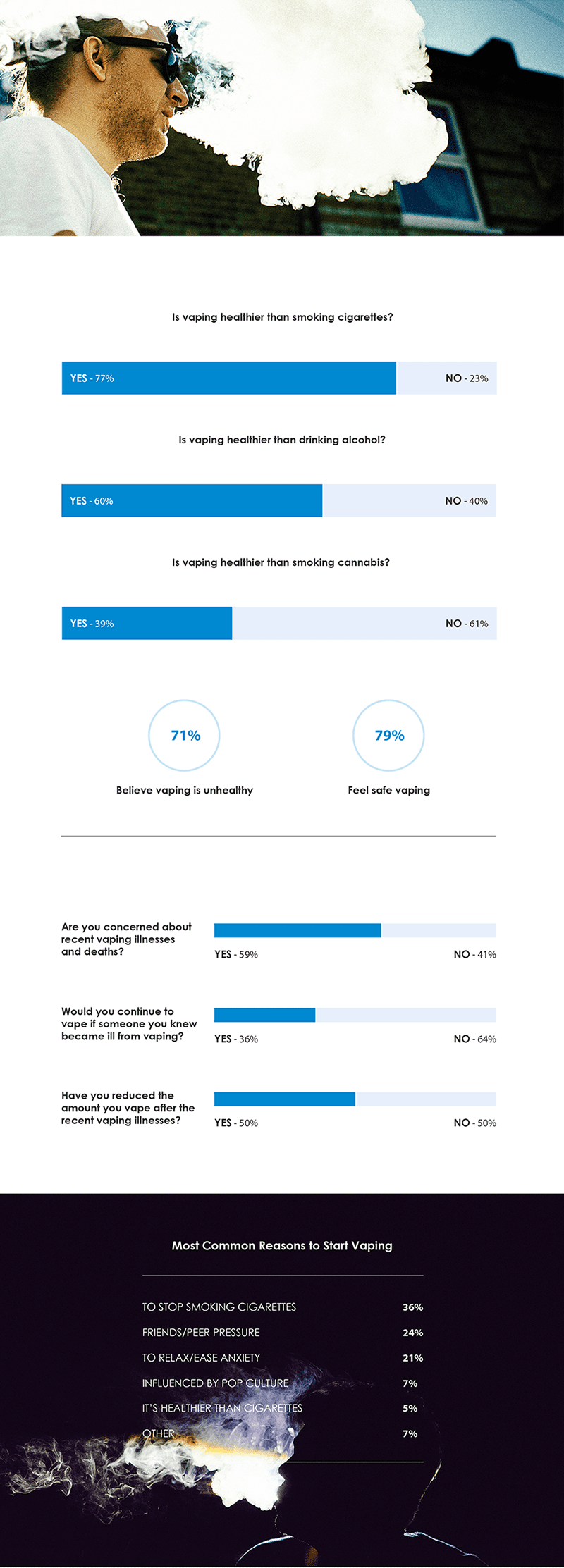
Although exact health risks may not be known, what is known is that young adults are vaping both nicotine and cannabis products. According to respondents, 41% use nicotine vaping products, 30% use cannabis vaping products and 27% said they use both. Vaping also seems to be a relatively new trend among users. Of the survey respondents, more than half (59%) of nicotine vaping users said they have been vaping for two years or less, while 53% of cannabis vaping users also said they’d been vaping for two years or less.

The majority of users might be new to vaping, but there also seem to be several that are heavy users. Among nicotine vapers, 31% said they finish an entire vaping pod or cartridge within two days or less. To put that into perspective, one pod or cartridge is equivalent to two or three packs of cigarettes. But perhaps where nicotine and cannabis vapers differ the most is how much they spend on each product. According to respondents, nicotine vapers spend an average of $55 per month on vaping products such as pods, cartridges and vaping pens while cannabis vapers spend nearly double that amount at $97 per month.

It’s also interesting to note the conceptions related to vaping and health. Nearly 80% of all vaping users said they felt safe while using vaping products, however when asked if vaping itself was healthy, only 29% said yes.

Lack of Concern?

According to the CDC, 1,888 cases of illnesses and 37 deaths related to vaping or e-cigarettes have been reported since October 29, 2019. Considering those risks, is there a lack of concern among vaping users? When asked if they were concerned about the illness outbreak, respondents were split right down the middle at 50%. They were also split 50/50 when asked if the amount they vape has decreased since becoming aware of said illnesses. Perhaps most surprising is that 1/3 said they would continue to vape even if someone they were close to became ill due to vaping.

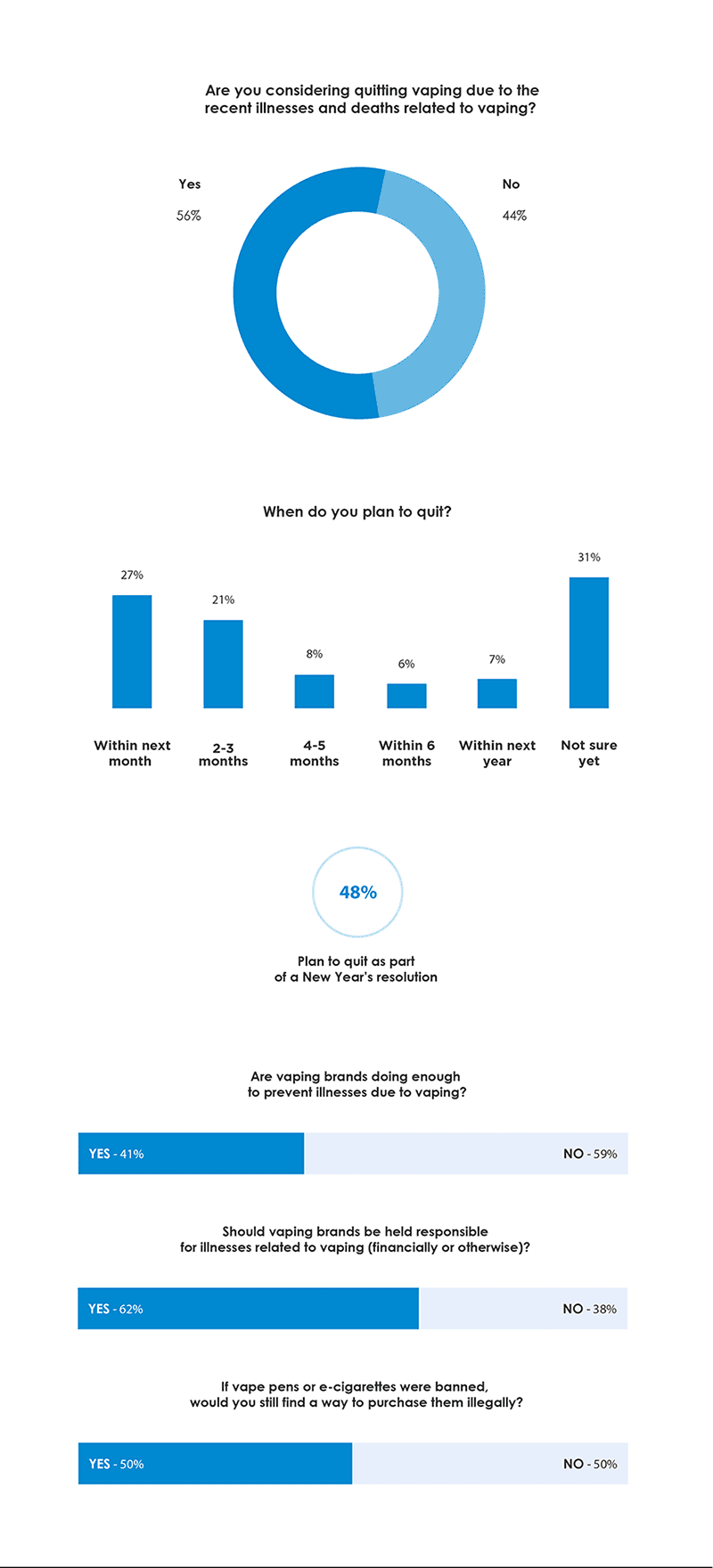
Respondents were also somewhat split when it came to the topic of quitting vaping. About 56% said they are considering quitting because of the illness outbreak. Of those, 26% said they plan to quit within the next month, while 48% said they plan to quit as part of a New Year’s resolution.

Prevention and Education

Are vaping brands doing enough to prevent vaping-related illnesses? Nearly 60% of respondents said no. In fact, 62% said that vaping brands should be held responsible for illnesses. Along with vaping brands, fingers have also been pointed at social media’s ability to influence young adults to start vaping. Overall, 23% of respondents said they actively follow vaping brands and influencers on social media, but 33% said social accounts that promote vaping should be banned.

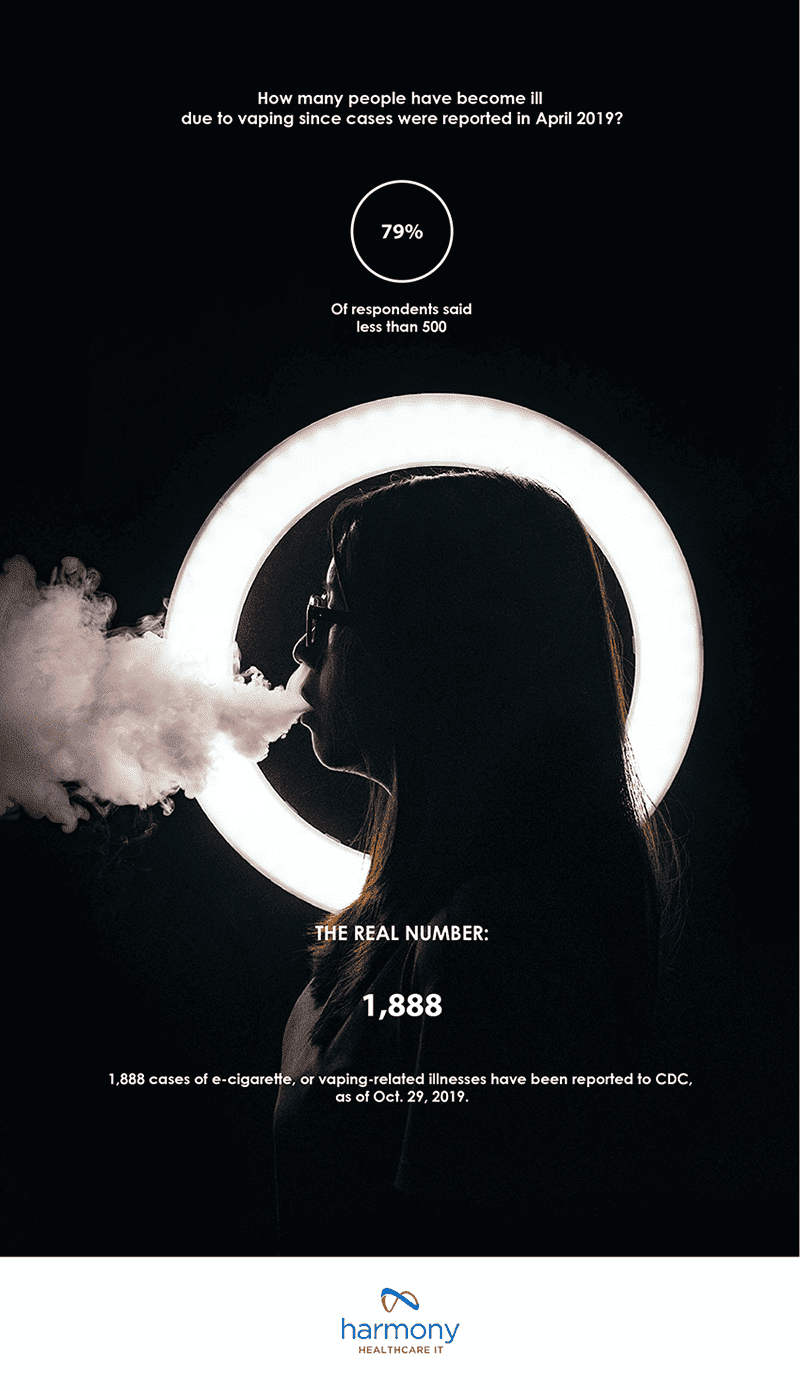
Despite the conversation and uncertainty around who’s to blame for the vaping illness outbreak, it’s clear that more research and education are needed, especially among young vaping users. Nearly 80% of survey respondents vastly underestimated the number of vaping illness and injury cases that have been reported, believing that less than 500 cases had been cited – a number in stark contrast to the actual number of 1,888.

Until more research is conducted around vaping and vaping-related illnesses, it seems that a combination of prevention and education are currently the best tools to help curb these illnesses and injuries.

Methodology

From November 22 to November 27, 2019, we surveyed 1,843 active vaping users between the ages of 18-38. Of those respondents, 51% were male and 49% were female. 40% were non-tobacco smokers; 30% used to smoke tobacco but quit when they started vaping; 26% were current tobacco smokers who smoked before they started vaping and 4% started smoking tobacco after they started vaping.

For media inquiries, contact media@digitalthirdcoast.net.

Healthcare IT tips, guides, news & more delivered to your inbox

Learn More

Summary

Every two seconds, someone in the U.S. needs blood. And, at 2,400 blood banks across the United States, the shelf life of platelets and red blood cells are 5 and 42 days, respectively. It makes sense, then, that maintaining accurate records of donors, patients and blood collection information is an essential component of a safe...

Join Fellow Healthcare IT Pros

Tips, Guides, News & More

Sign Me Up
Blood In Bloodbank

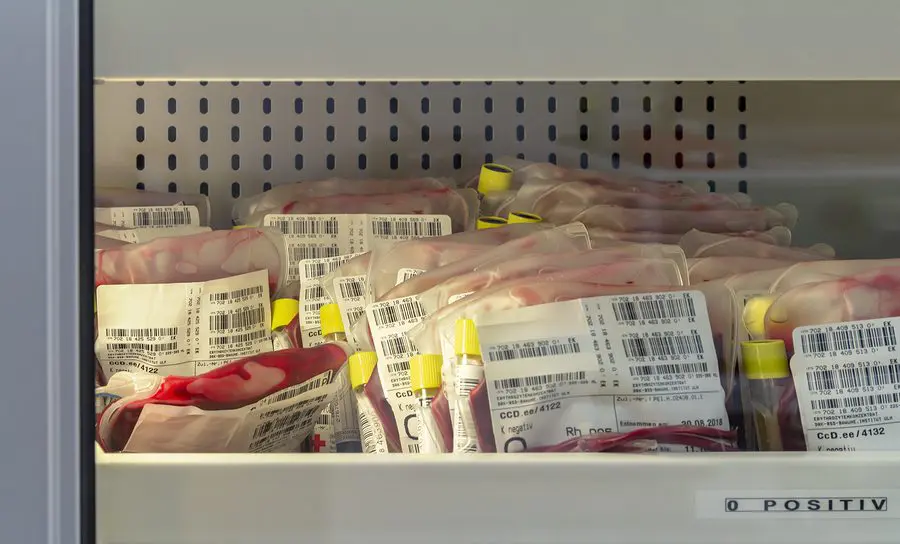
Every two seconds, someone in the U.S. needs blood. And, at 2,400 blood banks across the United States, the shelf life of platelets and red blood cells are 5 and 42 days, respectively. It makes sense, then, that maintaining accurate records of donors, patients and blood collection information is an essential component of a safe blood supply for our country.

FDA requirements for the collection of blood, blood products and recordkeeping are extremely detailed. According to the FDA, blood bank records must be retained beyond the expiration date for the blood or blood component to facilitate the reporting of any unfavorable clinical reactions. This means individual product records must be retained for no less than 10 years after the records of processing are completed or 6 months after the latest expiration date for the individual product – whichever is the later date. When there is no expiration date, records must be retained indefinitely.

There are also expanded requirements citing that documentation in the patient records must include the identification of individuals who performed each significant step in collection, processing, compatibility testing, and transportation; container qualification/process validations; the final inspection and verification of blood before issue; and blood supplier agreements.

Blood Bank

To comply with FDA requirements as well as state and federal record retention guidelines, blood banks need a blood bank records software with searchable history for both patient and blood product unit. When these data elements are stored discretely in a relational database, search, sort and filter capabilities are available. A clinical data platform like HealthData Archiver® offers this functionality in a secure framework that will preserve blood blank records long-term.

Are you decommissioning blood bank software such Soft Bank, SafeTrace Tx, MEDITECH, Sunquest or Mediware as you migrate to Cerner Millennium or Epic? Need to make sure all your blood bank record retention requirements, including the ability to search both patient history and unit history, can be met for the long haul?

We’re ready to help.

Ready to connect?

Contact us today to learn more about our healthcare data management solutions.

Healthcare IT tips, guides, news & more delivered to your inbox

Learn More

Summary

Currently, 90 million Americans over the age of 40 have vision and eye problems – more than 3 in 5 people. And by 2050, one study predicts that the population with cataracts will reach 45.6 million people, an 87% increase from 2010. Statistics like these prove that having regular eye exams is imperative to helping...

Join Fellow Healthcare IT Pros

Tips, Guides, News & More

Sign Me Up
Optometry and Ophthalmology Eye Exam Image

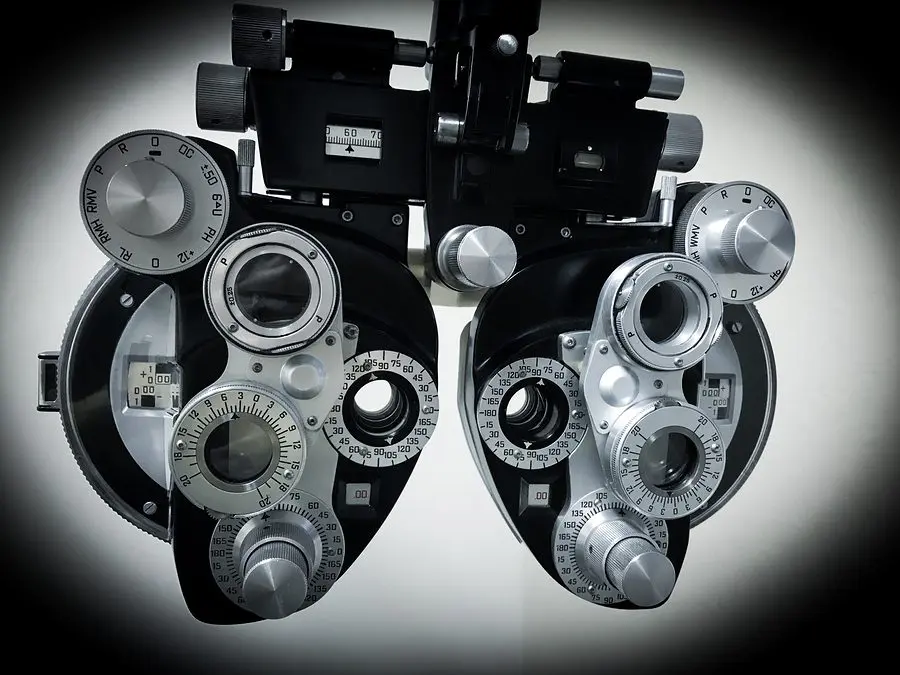
Currently, 90 million Americans over the age of 40 have vision and eye problems – more than 3 in 5 people. And by 2050, one study predicts that the population with cataracts will reach 45.6 million people, an 87% increase from 2010. Statistics like these prove that having regular eye exams is imperative to helping with early detection and treatment of vision issues.

But eye exams don’t just identify possible vision issues. They can also play a key role in detecting common chronic conditions such as thyroid disease, high blood pressure, and autoimmune disorders. This makes maintaining medical records from these eye exams a critical part of an overall health picture that can provide helpful information over the patient’s lifespan.

Beyond being a necessary component of a complete medical record, eye exam data is also subject to record retention requirements. These can vary, but often mandate that records be kept at least 10 years after date of last contact.

There’s also a need for long-term record keeping to help support population health initiatives like the Vision & Eye Health Surveillance System (V&EHSS), part of the Vision Health Initiative of the Centers for Disease Control. This system tracks vision statistics nationwide and offers a searchable database to assist with improving vision care outcomes.

Considering all of this, it’s logical that ophthalmologists, like other medical practitioners, have steadily increased their use of EMRs. In the past several years, the adoption of EHRs by ophthalmologists has more than doubled, and is similar to that of primary care physicians (79%), according to a survey of 2,000 ophthalmologists nationwide. To address the need for access to legacy eye exam records, Harmony Healthcare IT provides EMR & eye exam record archiving for ophthalmologists.

When EHR Systems Get Replaced
As needs shift and change, EMR systems within an ophthalmologist’s office are often replaced with one that better suits the organization. Some of the most popular reasons a new EMR is considered is to improve workflows with streamlined methods of viewing and interpreting diagnostic images, and to ease the amount of repetitive data that the clinician must type in manually for each patient.

When a new EMR is implemented, it’s necessary to consider a legacy data management strategy. Mapping and converting legacy data from one EMR database schema to another can be complex and costly. An alternative is to migrate and store legacy patient and operational records into a long-term, secure, searchable archive. An archive of ophthalmologist eye exam and EMR records allows for access to the historical records while taking the cost and technical burden of the legacy system off the books.

HealthData Archiver®, is a data storage solution that delivers a single point of access to historical patient, employee or business data for healthcare delivery organizations. The solution consolidates data stores, reduces out-of-production system maintenance costs, mitigates technical risk, complies with record retention mandates, and offers both interoperability and data analytics capabilities.

As ophthalmologists evaluate their EMR systems – from market-leading ambulatory brands like Allscripts, NextGen, and eClinicalWorks to specialty-specific EMRs such as EMA Ophthalmology, Medflow, EyeMD EMR, CureMD, Nextech Ophthalmology and others – we stand ready to offer an award-winning legacy ophthalmologist eye exam and EMR data management solution.

Not sure which records need to be or should be migrated to your go-forward system? Ranked as the top data extraction and migration healthcare IT company according to Black Book Rankings, a division of Black Book Market Research, we can help you navigate through this planning and implementation.

If you’re ready to talk through options for retaining legacy health and business records from your ophthalmology practice in a secure and searchable archive, let’s connect.

Ready to connect?

Contact us today to learn more about our healthcare data management solutions.

Healthcare IT tips, guides, news & more delivered to your inbox

Learn More

Summary

It’s no secret that #Windows Server 2008 and Windows Server 2008 R2 are rapidly approaching the end of their support lifecycle. As of Jan. 14, 2020, additional free on-premises security updates, non-security updates, free support options, and online technical content updates will no longer be available. While most IT teams of organizations utilizing Windows Server 2008...

Join Fellow Healthcare IT Pros

Tips, Guides, News & More

Sign Me Up
Microsoft Logo Photo

It’s no secret that #Windows Server 2008 and Windows Server 2008 R2 are rapidly approaching the end of their support lifecycle. As of Jan. 14, 2020, additional free on-premises security updates, non-security updates, free support options, and online technical content updates will no longer be available.

While most IT teams of organizations utilizing Windows Server 2008 and 2008 R2 know this date is looming, they may not have made this upgrade yet. Here are some compelling points that might assist in communicating the importance of addressing the Windows Server 2008/R2 end of support issue:

  • Cybersecurity is a big deal. Not upgrading to a supported server creates system vulnerabilities
    • Since 2015, healthcare has topped all other industries as the most cyberattacked vertical. That year hackers seemed to realize that there are far greater rewards from stealing medical records and Social Security numbers than credit cards. The payoff was (and continues to be) thousands of dollars per individual set of health records
    • Between 2009 and 2018, health records of almost 190 million people in the United States – roughly 59% of the population – were involved in a theft/exposure. From January, 2019 thru October, 2019, breaches surpassed the 38 million mark, which involves about 12% of the U.S. population in just a 10-month period
    • Healthcare breaches (of 500 or more records) are becoming so common that they now are reported at a rate of more than one per day
    • Remember WannaCry? This major cybersecurity attack in May 2017 infected more than 230,000 computer systems in 150 countries which resulted in about $4 billion in financial losses. There are groups who never recovered from that attack and others at risk who haven’t patched their systems against this ongoing vulnerability
  • Not upgrading from Microsoft 2008 could result in HIPAA fines and it would be difficult to make the case of being unaware of the risks
    • The civil penalty tier system for healthcare organizations is based on the extent to which the HIPAA covered entity was aware that HIPAA Rules were violated. The maximum civil penalty for knowingly violating HIPAA is $50,000 per violation up to a maximum of $1.5 million per violation category per year. While it is unlikely that failing to upgrade would result in individual fines, there are HIPAA fines that can be levied against individuals who knowingly violate HIPAA rules
    • The Office for Civil Rights (OCR) clarified 45 C.F.R. 164.308, encouraging Covered Entities “to review systems for unpatched vulnerabilities and unsupported software that can leave patient information susceptible to malware and other risks.” This guidance was a result of a breach investigation for a facility in Alaska which resulted in a $150,000 fine. OCR stated “the security incident was the direct result of the [Covered Entity] failing to identify and address basic risks, such as not regularly updating their IT resourced with available patches and running outdated, unsupported software”
  • The General Data Protection Regulations (GDPR) in Europe is already allocating fines for organizations who do not comply with data protection laws
    • According to Article 83 of the new data protection rules, regulators will adhere to a two-tiered structure for the administration of sanctions. The higher tier carries potential fines of up to $20 million, or 4% of global annual turnover (annual revenue), whichever is higher. The lower tier carries a maximum fine of $10 million, or 2% of annual turnover, whichever is higher

While the potential of HIPAA fines is a real possibility, the bigger threat remains that a major cybersecurity incident could cripple or put an end to a healthcare provider.

If your organization is still dependent on legacy EHR systems to meet retention requirements and provide legacy data access, Harmony Healthcare IT can help mitigate your risk. Our data archiving solution  consolidates data stores, reduces out-of-production system maintenance costs, and complies with record retention mandates. Most of all, it provides increased security from cyberattacks, protecting both your organization and your patients.

Our recommendation remains the same. We strongly advise that all affected systems should be updated as soon as possible. 

When you’re ready to get this item off your to-do list so you and your team can go into 2020 with an increased peace of mind, we’re here to help.

Healthcare IT tips, guides, news & more delivered to your inbox

Learn More

Summary

As college students return to campus post-pandemic, there are unique health issues for this nationwide group of 20 million young adults. Increased mental health services are needed as well as the possibility for updated student medical record management processes to ensure compliance with the 21st Century Cures Act. Read the CliffsNotes-style blog below for a synopsis of the health trends for college students and the record management considerations for the campus health centers that serve them.

Join Fellow Healthcare IT Pros

Tips, Guides, News & More

Sign Me Up
College Students Talking while walking

There are about 22 million college students in the U.S. eligible to use campus health centers. While over 80% of them  reported to the American College Health Association (ACHA) that their health is good, very good or excellent, there has been a noted increase in students seeking mental health care.

In fact, 41.2% of students sought care from a counselor/therapist or psychologist for mental health issues. And, according to the ACHA, more than 60% of college students said they had experienced overwhelming anxiety in the past year while over 40% said they felt so depressed they had difficulty functioning.

Statistics like these indicate a need for campus health centers to offer more mental health services. They also support that keeping secure and detailed records is paramount in creating a comprehensive medical record that provides a complete history of health now and well into the future.

Campus health centers – like other medical providers – are held to federal and state laws for protecting health information and retaining medical records. In fact, some institutions must store student records 10+ years after the last semester of attendance, making it necessary for universities to have a secure, long-term data management strategy. This includes student medical record archiving.

HealthData Archiver® is a record storage solution that delivers a single point of access to historical patient information. This HIPAA-compliant solution also allows for secure, user-restricted access to documented behavioral health information.

In addition to other risk and cost savings benefits, HealthData Archiver® offers both interoperability and data analytics capabilities for colleges tracking population health information as a part of the College Health Surveillance Network (CHSN), a national database of over 1 million enrolled students from student health centers at universities across the country.

Harmony Healthcare IT, the makers of HealthData Archiver®, is equipped to provide campus health centers with technical and business guidance that will allow them to develop and execute a secure legacy data management strategy. That’s why we offer campus health centers data management services like extraction, migration, retention and student medical record archiving.

Are you seeking data archiving solutions or a legacy system replacement strategy for your student health center? We’re experienced in decommissioning major EHR brands often used in campus health centers.

Need to make sure all your mental health documentation is secure and your data retention and population health requirements can be met long after the student has left campus?

Let’s talk.

Healthcare IT tips, guides, news & more delivered to your inbox

Learn More

Summary

7 out of 10 physicians report that electronic health records (EHRs) contribute to physician burnout. That’s not surprising considering that 70% of physicians spend more than 10 hours each week on paperwork, maintaining compliance with a multitude of standards and requirements. Further, a survey by the Physicians Foundation found that “when EHRs are poorly designed...

Join Fellow Healthcare IT Pros

Tips, Guides, News & More

Sign Me Up
Physician Burnout

7 out of 10 physicians report that electronic health records (EHRs) contribute to physician burnout. That’s not surprising considering that 70% of physicians spend more than 10 hours each week on paperwork, maintaining compliance with a multitude of standards and requirements. Further, a survey by the Physicians Foundation found that “when EHRs are poorly designed or are not user friendly, the frustrations inherent to paperwork duties are magnified.”

One way of battling physician burnout is by employing medical scribes – paraprofessionals who specialize in charting physician-patient encounters in real time. The role of the medical scribe is to:

  • help providers navigate the EHR
  • enter information into the EHR as directed by providers
  • respond to various messages as directed by providers
  • research information requested by providers
  • locate information for review (i.e., previous notes, reports, test results, and laboratory results)

One notable aspect of the medical scribe’s job is to locate historical medical record information for review at time of treatment. For example, there may be certain test results or former problems that, when considered with current symptoms, could inform a better treatment plan. Depending on which EHR is being utilized by the physician and medical scribe, how long it’s been in use and what historical clinical data elements got converted into that EHR, this task can be more daunting than one might think.

As a contributor to lifecycle data management software, Harmony Healthcare IT consistently considers the user, such as a clinician, medical scribe or health information management (HIM) staff, when designing and enhancing its long-term medical record retention solution, HealthData Archiver®. Current key features that support efficient clinical and HIM workflows, and equate to longer-term benefits such as less physician burnout include:

Single Sign On – A simple yet extremely helpful capability, Single Sign On eliminates the need for manual logons into archived, historical medical records by seamlessly connecting clinicians from an active EHR, in-context, to the patient’s historical medical record. This feature saves valuable time and is typically available for most major EMR brands, like Epic, via standards such as Oauth/OpenID, Advanced Encryption Standard (AES), Security Assertion Markup Language (SAML 2.0) and others.

Consolidated Clinical View – Further saving time, a Consolidated Clinical View in an archive aggregates a single patient’s encounter data across multiple legacy data sources to a single screen. This view provides added convenience and access to a comprehensive clinical narrative (i.e., lab results, flow sheets, growth charts or other clinical data) to better inform treatment decisions at the point of care.

Data Filtering/Sorting – When an archive stores data discretely, it opens up to the time-saving feature of filtering and sorting. Not only can data like medications or lab values be readily discovered and reviewed, but they can also be sorted in ascending, descending, alpha or numeric order.

Notes and Comments – Since archived medical records are stored separately from those in the active EHR, an ability to view the information and then add notes as necessary becomes valuable to other users. Notes and Comments allows a clinical, medical scribe, HIM staffer or any archive user to create and store unlimited documentation to help create more context to otherwise immutable stored records.

These are just a few features that an archive of medical records can offer physicians and medical scribes to save time and lessen EHR workflow frustrations. Fortunately, there is a continued industry focus on how to further advance EHR workflow efficiencies to help stifle physician burnout.

Stanford Medicine recently hosted a medical symposium where experts discussed strategies to help minimize the burden of documentation and learn more efficient ways to utilize technology. One of the innovations offered up was that of Steven Lin, MD, clinical assistant professor of medicine at Stanford, who’s developing a utilization for artificial intelligence to “create a patient record by transcribing conversations during doctor visits.” While AI could certainly have a revolutionary impact on clinical data intake and management, there remain challenges like the limitations of direct transcripts to be worked through before field testing can begin.

Until AI takes hold in a more significant way, Harmony Healthcare IT will continue to do its part, as a first-to-market innovator, to provide legacy data archive solutions that fit into an efficient clinical workflow for physicians and medical scribes.

Are you in need of more efficiencies? Let’s connect.

Healthcare IT tips, guides, news & more delivered to your inbox

Learn More

Summary

Baby boomers, those born between 1946 and 1964, are driving an unprecedented shift in America’s older population, with the 65+ age group expected to capture 23% of the total population within the next 40 years – an astounding 7% increase. Consistent with this trend in aging, in 2006 Medicaid paid $9.2 billion dollars for fewer...

Join Fellow Healthcare IT Pros

Tips, Guides, News & More

Sign Me Up
Nametag Baby Boomer

Baby boomers, those born between 1946 and 1964, are driving an unprecedented shift in America’s older population, with the 65+ age group expected to capture 23% of the total population within the next 40 years – an astounding 7% increase.

Consistent with this trend in aging, in 2006 Medicaid paid $9.2 billion dollars for fewer than 1 million hospice patient beneficiaries – in 2017, 1.49 million Medicare beneficiaries were enrolled in hospice care, a 4.5% increase from 2016.

Currently, there are over 4,300 Medicare-certified hospice care agencies in the United States providing medical care for patients with a life-limiting diagnosis or condition and given a prognosis of six months or less to live. Hospice care can include pain management as well as emotional and spiritual support for the patient and their family. More than 42% of hospice patients elect to receive services in their own homes, while approximately 40% receive inpatient care at a freestanding hospice facility, hospital, nursing home or other long-term care facility.

As mentioned above, the number of Americans 65 and older is expected to nearly double from 52 million in 2018 to 95 million by 2060, which means there’s an immediate need for providers to address this demographic changeover and ensure that medical record retention requirements are being met within the home healthcare and hospice settings.

There are medical record retention requirements at the federal and state levels mandating a clinical record of past and current findings must be maintained for each hospice patient. Numerous requirements for the information must be included in the record as well as the requirement that the record must be readily available by request of an appropriate authority.

Furthermore, Medicare requires providers to maintain clinical records for five years after it files the cost report when there isn’t a defined state record retention requirement, with a recommendation of maintaining copies of the cost report and related working papers permanently.

Beyond federal and state regulatory directives, clinical and billing records are subject to the federal False Claims Act (FCA), which allows a plaintiff to bring an action within six years of the alleged false claim. The FCA permits a longer time period, often ten years, in which the government can file if it was unaware of the possible misconduct. For this reason, providers should consider keeping clinical records and related claims records longer, as an action under the FCA could be filed under seal. This means that it could be months, or even years, after the ten-year statute of limitations expires before the provider is served.

As hospice providers evaluate their EHR systems – such as Careficient, HEALTHCARE first, Hummingbird, Netsmart, and McKesson Homecare – and whether their needs are better served by a different system, legacy data management considerations should also be made.

System replacement provides an ideal opportunity to archive legacy patient and operational records stored within the outgoing system to maintain compliance and access to the information without keeping the cost and technical burden on the books.

Our HealthData Archiver®, is a long-term data storage solution that delivers a single point of access to historical patient, employee or business data for healthcare delivery organizations. The solution consolidates data stores, reduces out-of-production system maintenance costs, mitigates technical risk, complies with record retention mandates, and offers both interoperability and data analytics capabilities.

Eager to ensure record retention of the ever-expanding baby boomer population? Let’s connect.

Healthcare IT tips, guides, news & more delivered to your inbox

Learn More

Summary

Fetal monitoring strips are often required to be retained 10 years past the age of majority (28 years). When electric perinatal systems get replaced or retired, these strips must continue to be made accessible. Here we provide a strategy for secure, accessible, long-term retention for fetal monitoring strips.

Join Fellow Healthcare IT Pros

Tips, Guides, News & More

Sign Me Up
Fetal Heart and Uterus Data

For over 50 years, electronic fetal monitoring (EFM) has played a critical role in assisting labor and delivery teams. In the early days, fetal monitoring strips – which indicate if, when and how long a fetus is in distress – were output to paper. But, with the emergence of perinatal data management systems years later (i.e., Phillips OB TraceVue, GE Centricity Perinatal system and PeriGen Watchchild®), the ability for hospital caregivers to see and store perinatal information in context with fetal monitoring strips in a digital format was born.

So, gone are the days of racking boxes of paper strips to meet medical record retention requirements. However, a best practice is now required for archiving digital fetal monitoring strips when an electronic perinatal system gets replaced, retired, or decommissioned. Because, if the data isn’t accessible when a legal release of information is requested, the penalties could be extensive.

Storing Fetal Monitoring Strips for Cases of Litigation

In cases of litigation surrounding traumatic delivery, fetal monitoring strips may be sought as evidence long after the initial date of birth. While retention requirements vary by state, fetal monitoring strips are often retained 10 years past the age of majority. 28 years is a long time, and the law leaves little leeway if fetal monitoring strips are not produced upon request.

As long as the plaintiff is able to show that relevant fetal monitoring strips existed, the hospital had control over them, and that the law was violated when the hospital failed to keep the strips, the court may either render a missing document charge or strike the defending hospital’s answer for spoliation of the evidence.

A missing document charge is most common of the two options and directs the jury to draw the strongest adverse conclusion from the missing strips when considering evidence against the defending hospital. The more severe consequence is if the court finds a spoliation of evidence, a default judgment is handed down against the hospital or provider. This determination is only available in limited circumstances and the plaintiff must prove that the loss of the EFM strips deprives him/her the ability to prove if the birth injury is the result of malpractice.

To avoid scrambling for data during litigation or for any request, it’s imperative for hospitals to put a strategy in place for fetal monitoring strip retention, storage, and accessibility, especially when there’s upcoming intent to replace a legacy system with a new EHR.

Monitoring Strips

EFM Strip Retention After Legacy Perinatal System Replacement

Often, when a perinatal system gets replaced, only discrete charting data like assessments and vitals is migrated into the hospital’s new EHR (i.e., Epic or Cerner). That leaves fetal monitoring strips to be archived elsewhere for future accessibility. Providing that access, however, can be challenging.

Fetal monitoring strips are frequently displayed by the legacy perinatal system in a graphical interface. That means that when the data is extracted from the system in which it resides and displays, it is often in an unusable format. This leaves providers with only a few compliant fetal monitoring strip retention options:

  1. Keep the legacy perinatal software in full production (or read-only mode). The main issue with this solution is the maintenance cost to keep a replaced system up and running with the sole purpose of storing fetal monitoring strips. It also poses technical and security risks as the system ages.
  2. Pay the legacy vendor to provide fetal monitoring strip output to PDF. The challenge with this option often starts with the cost. The legacy vendor is in a situation to charge what hospitals may consider to be an excessive amount to generate the needed output from the fetal monitoring software. And, once it is generated, the protected health information must be indexed and stored in a HIPAA-compliant manner, somehow linking the strips to the rest of the patient’s medical record data.
  3. Preserve the fetal monitoring strips in a secure archive that offers SSO to the EHR. Harmony Healthcare IT, the top data extraction and migration healthcare IT company according to Black Book Rankings and the makers of HealthData Archiver®, offer a proprietary solution that is built to provide a searchable fetal monitoring strip directory organized by patient. And, to connect the strips to the rest of the medical record, Single Sign On (SSO) functionality to leading EHRs like Epic, Cerner, Allscripts and athenahealth is offered. That makes for a secure, cost-effective, HIPAA-compliant and long-term legacy data management strategy for fetal monitoring strips.

At Harmony Healthcare IT, data availability for the full clinical narrative of the patient is a top priority. And that includes the critical fetal monitoring strips from the youngest patients in your care.

Are you seeking data archive solutions and a legacy system replacement strategy for perinatal systems like Phillips OB TraceVue, GE Centricity Perinatal, PeriGen Watchchild®, OBIX fetal monitoring or others? Need to make sure all your data retention requirements, including fetal monitoring strips, can be met for the long haul of 28 years or more?

We are the team to help you. Let’s talk.

Healthcare IT tips, guides, news & more delivered to your inbox

Learn More

Summary

Next year, Siri will be a decade old and Alexa will soon be six. These and other digital assistants like Google Home and Cortana use artificial intelligence (AI) to recognize and respond to voice commands. They serve millions of users daily by giving directions, setting alarms, answering trivia questions and even telling jokes (try asking...

Join Fellow Healthcare IT Pros

Tips, Guides, News & More

Sign Me Up
Artificial Intelligence Causing a Disruption

Next year, Siri will be a decade old and Alexa will soon be six. These and other digital assistants like Google Home and Cortana use artificial intelligence (AI) to recognize and respond to voice commands. They serve millions of users daily by giving directions, setting alarms, answering trivia questions and even telling jokes (try asking Siri what zero divided by zero is). In 2019, 111.8 million people in the U.S. – over 33% of the population – are expected to use an AI voice assistant at least monthly. That’s no surprise considering that Siri alone is active on 500 million devices, responding to 10 billion requests each month.

AI is clearly making an impact in consumer goods. And analysts project that it will become a nearly $200 billion industry by 2025, making major strides in the areas of manufacturing and customer service.

What we’re watching, however, is how AI is disrupting healthcare.

While we haven’t yet seen AI transform healthcare to the point where there are more robots than humans in hospital hallways delivering care, we are seeing costs getting cut as AI augments human activity to make our industry more efficient and knowledgeable.

One AI tool making its mark is Machine Learning (ML). The primary objective of ML is for computing technology to mimic human operations. In healthcare, ML adds exponential benefits to administration, acting as the router between systems and data by automating repetitive high traffic tasks.

Here are some examples:

  • Christus Health System, headquartered in Texas, automated 80% of pre-registration tasks and increased productivity by 60%
  • An AI system from Google-owned DeepMind can identify 50 sight-threatening eye diseases with up to 94.5% accuracy, and is a lower cost alternative than a traditional MRI
  • The development of smartphone apps allows for at-home monitoring of health conditions, communicating with doctors and scheduling appointments

There are numerous time and cost efficiencies to be gained through these and other AI-driven tools continually being researched and launched; however, advancement depends largely on one thing: data.

In a recent report, Microsoft’s European office suggests the following gaps need to be worked out to support the widespread use of AI within healthcare:

  • Organizational and technical barriers to data sharing and data use
  • Insufficient public trust and lack of a regulatory framework that promotes more access to and use of patient data for research purposes, while addressing privacy and security concerns
  • A lack of clear rules, or even a tentative discussion framework, governing the ethical and social implications of patient data, AI and its growing use in the field of healthcare

One of the biggest organizational challenges mentioned is that health data is often stored across numerous silos, making access to a complete view of an individual patient very cumbersome. This, along with security, is a driver in the decommissioning of legacy systems. Decommissioning applications allows data to get extracted, migrated and consolidated to a single archive in health systems nationwide. AI can be leveraged in this ETL process as well as in tools that can utilize that common historical data store for research or analytics.

The report goes on to make several technological recommendations, including the need to:

  • Advance a common framework for documenting and explaining key characteristics of datasets
  • Invest in technical solutions, including through research funding, to enable secure machine learning with multiple data sources/systems

At Harmony Healthcare IT, where we develop and deploy HealthData Archiver®, our data experts are utilizing machine learning and predictive analysis to help us ingest, index, and properly identify patient data. We are constantly exploring how AI can help to automate and standardize our ETL (extract, transform, load) process to increase the speed, quality, predictability and punctuality of our health data management work.

The future of AI in Healthcare – especially as data volumes skyrocket – is promising. We are all anxious to see how AI can help reduce the quarter of a million of American deaths each year due to preventable medical errors. But as those more complex care delivery algorithms get written, we will continue to see advancements on the administrative and data management side of healthcare.

Want to learn more?  Contact us.

Healthcare IT tips, guides, news & more delivered to your inbox

Learn More