Summary

When Advanced Vascular Surgery realized their on-premises PACS system would no longer be supported, they needed to find a solution to save medical images to adhere to record retention guidelines. Their solution consisted of centralizing legacy systems for continuity of care, enhancing workflow efficiencies, and cost savings with HealthData Archiver® + DICOM Viewer.

Join Fellow Healthcare IT Pros

Tips, Guides, News & More

Sign Me Up

The Organization

Advanced Vascular Surgery, an independently owned and operated division of Paragon Health, is a specialty medical practice servicing patients with vascular and venous conditions throughout Michigan. The organization has three surgeons and two nurse practitioners across six locations.

The Situation

In 2019, Advanced Vascular Surgery underwent a transition from SRS to AdvancedMD. This electronic health record (EHR) transition left the organization with an abundance of records that needed to be saved off a dying server. Then, in 2021 Advanced Vascular Surgery made the decision to move from AdvancedMD to Epic EHR through an Epic Community Connect partner. The vast majority of the organization’s patients were using Epic through their primary care providers, so this move would enhance the continuity of care for Advanced Vascular Surgery patients.

In addition to the EHR transitions, Advanced Vascular Surgery’s PACS system, Medstreaming, announced their system was moving to cloud-based services only and their on-premises solution would no longer be supported. The organization needed to find a solution to save these medical images to adhere to record retention guidelines.

Advanced Vascular Surgery had two options: either purchase a new server, transfer the images and pay additional ongoing service on the server, or, implement an archive solution to host the legacy records and images.

The Solution

Advanced Vascular Surgery viewed the server option as expensive and archaic. So, the organization partnered with Harmony Healthcare IT to archive the medical images they faced losing and to consolidate their legacy records from SRS and AdvancedMD into HealthData Archiver®. HealthData Archiver® provided a complete cloud based medical image archive that includes a comprehensive DICOM Viewer in the standard Digital Imaging and Communications in Medicine image format. This solution supports the modalities Advanced Vascular Surgery’s PACS system required—cardiology and radiology. For example, bilateral carotid, triple A’s (aortic aneurism), and vein mapping images are stored and viewable.

Streamlining our systems was one of the smartest decisions our practice has made. The consolidation has greatly enhanced continuity of care, simplified workflows for our staff, and provided significant cost savings.”
Jo Stannard – Administrator, Advanced Vascular Surgery

Benefits & Results

Centralization. The historical records and images from three systems are now accessible in one location, HealthData Archiver®.

Ease of use. The archive provides a seamless process for accessing legacy data and images and is userfriendly for staff and physicians alike.

Cost savings. The return on investment increased as each legacy system was decommissioned.

Knowledgeable staff. A dedicated project manager from Harmony Healthcare IT provided customer support throughout the archive project

Lesson Learned

Obtaining data from the legacy vendor for migration can be time-consuming and challenging, regardless of whether that data is hosted or on-premises. When Advanced Vascular Surgery realized they needed to move images from their on-premises instance of Medstreaming to a new solution, they had to work with Medstreaming’s support team to determine the best plan of action. If they disconnected the server, they would have lost everything. This process took a lot of back and forth. Since getting data from the legacy vendor can take some time, it’s critical to get ahead of the situation.

DICOM Use Case

A patient comes in with history of a triple A (aortic aneurism). The physician can pull up the current image in Medstreaming and compare it to historical images within HealthData Archiver® DICOM Viewer. With the measuring tool in DICOM Viewer, the physician can measure the image and document the comparison in the current PACS system, Medstreaming. The physicians and patients alike can be confident the images they need will be there.

Healthcare IT tips, guides, news & more delivered to your inbox

Learn More

Summary

Federally Qualified Health Centers (FQHC) provide complete medical and dental care for about 30 million people in the United States, regardless of their ability to pay for services. FQHCs receive enhanced reimbursement from Medicare and Medicaid which comes with very detailed requirements for medical and financial record keeping and reporting. As electronic health record (EHR) systems are replaced, an active archive supports compliance requirements for clinical, financial and operational records.

Join Fellow Healthcare IT Pros

Tips, Guides, News & More

Sign Me Up
Federally Qualified Health Center Featured Image

FQHCs grow to expand service coverage.

Since 2010, the number of Health Center organizations has more than doubled. Currently, there are more than 1400 Federally Qualified Health Centers with 15,838 service sites in the United States. If you add in FQHC look-alikes, which operate much in the same manner but do not receive enhanced Medicare/Medicaid reimbursements, there are an additional 649 sites. This brings the number of FQHCs (and look-alikes) to a total of 17,900.

FQHCs provide comprehensive primary and preventative care to patients of all ages in underserved or rural areas, accepting all patients, regardless of their ability to pay or their health insurance status. They provide an important service as Health Center patients suffer from chronic conditions at higher rates than the general population.

A few differentiators for FQHCs versus other health providers:

  • Qualify for funding under Section 330 of the Public Health Service Act (PHS).
  • Qualify for enhanced reimbursement from Medicare and Medicaid, as well as other benefits.
  • Serve an underserved area or population.
  • Offer services to all regardless of the person’s ability to pay. Also offer a sliding fee scale.
  • Provide comprehensive services (on-site or with another provider):
    • Preventative health services
    • Dental services
    • Mental health and substance abuse services
    • Transportation services necessary for adequate patient care
    • Hospital and specialty care
  • Have an ongoing quality assurance program.
  • Have a governing board of directors.

Compliance, interoperability, and continuity of care are priorities.

Compliance for an FQHC is very involved and regulated. FQHCs must meet specific requirements in 21 category areas to remain compliant. The areas include a broad scope of operational (board authority, staffing, hours of operation, coverage for emergencies over holidays, etc.), clinical (continuity of care/hospital admitting, quality improvement, etc.) and financial operations (billing, collections, financial management, etc.).

The technology solutions, specifically the electronic health record (EHR) platforms used by FQHCs, carry a very important responsibility as they must be equipped to document a full range of health and dental records and be able to coordinate care and share the information with other providers.

Record retention requirements for FQHCs include reporting rules.

Medical records generated in an FQHC must be maintained following federal and state regulations to ensure that the information, if accessed, is accurate and complete. In addition to other requirements, CMS requires providers submitting cost reports retain all patient records for at least five years after the closure of the report. Medicare managed care providers must retain patient records for 10 years. Records can be in their original form or in a legally reproduced form.

FQHCs replacing its EHR need a trusted archive solution to continue record retention and reporting requirements.

Over time, the EHR used at the FQHC may be replaced with a more robust system that better addresses the center’s needs. When that happens, there needs to be a strategy and plan to ensure compliance and reporting with the historical records. Utilizing health data archiving for FQHCs within an active archive like HealthData Archiver®, is a cost-effective and efficient way to seamlessly migrate legacy records to the archive. Health data migration for FQHCs ensure continued access for patient care, release of information and reporting.

AltaMed Case Study: Vendor replacement leads to successful archive.

As one of the largest nonprofit FQHCs in the country, AltaMed serves the comprehensive health and dental care needs of underserved communities in Los Angeles and Orange Counties in California. When 27 terabytes of complex dental records halted an archiving project with another vendor, AltaMed called on the team from Harmony Healthcare IT to step up and get the project back on track and completed within a very aggressive timeline. Advice from the client: There is complexity any time one is extracting or migrating data to and from EHRsMake sure any archiving vendor has the right experience to handle the data.

Read the full story from Healthcare IT News.

Watch a video with Ray Lowe, Senior Vice President & CIO at AltaMed.

Experience and an adaptable archive solution support seamless integration between archive and go-forward EHR.

Harmony Healthcare IT’s suite of data management solutions under its HealthData Platform – such as HealthData Archiver®HealthData AR Manager® and HealthData Locker – provide options to enable stored data for interoperability leveraging HealthData Integrator®.  These integrated solutions can support health data archiving for FQHCs and health data migration for FQHCs with their ongoing compliance efforts in a cost-effective, efficient, and user-friendly manner.

Ready to learn more? Let’s connect.

Healthcare IT tips, guides, news & more delivered to your inbox

Learn More

Summary

The amount of health data generated by one person in their lifetime is predicted to exceed one million gigabytes. Between increasing lifespans, new data types such as wearable devices, and long-term retention requirements of pediatric medical records, that volume will likely grow. That’s why healthcare providers should employ a legacy data management strategy.  It not only ensures compliance but could ultimately be a key to better health outcomes for the adults and seniors of tomorrow.

Join Fellow Healthcare IT Pros

Tips, Guides, News & More

Sign Me Up
Retaining Pediatric medical records for retention

Especially with the advent of new data types such as wearable devices, a child generates a large volume of medical record data over time.  This volume contributes to our nation’s overall health data explosion. With the average hospital producing roughly 50 petabytes of data every year, the amount of data generated in healthcare is increasing at a rate of 47 percent.

According to state and federal record retention requirements, a child’s medical record must be protected.  At a minimum, pediatric medical records must be retained for 10 years or until the age of majority plus the applicable state statute of limitations (time to file a lawsuit) — whichever is longer.  That means that provider organizations need a long-term data management strategy for pediatric and other records.

Case Study: An active archive puts children’s historical health records at clinicians’ fingertips.

Children’s Minnesota, one of the largest freestanding pediatric health systems in the nation, was on the path of a full electronic health record (EHR) conversion after acquiring a practice.  As a part of the data conversion, Children’s Minnesota was required to retain access to historical medical records. As it became too costly and complex to convert the high volumes of data to the new EHR, a decision to of legacy data was made.

“There’s really no benefit in trying to convert all the data to a new go forward EHR,” shared Dave Lundal, Senior Vice President and CIO.  Dave had joined the health system and helped steer away from a full data conversion.  Rather, migration of legacy data to an active archive,  HealthData Archiver®, began.

The archive project is part of Lundal’s overall effort to transform the Children’s Minnesota organization, reset the enterprise environment, advance digitally, and create a modern digital environment for associates that leverages data. Here are four key factors Lundal and the Children’s Minnesota team looked for in an archiving partner:

  1. Security. The vendor needed to prove their own due diligence and security posture.
  2. A thorough plan of how the vendor partner would work with and support the health system’s team was vital.
  3. Cost. The archive solution needed to be cost effective with special caution to not “nickel and dime” for changes.
  4. Functionality. Clinicians required integrated access to archived information directly from within their patient account in the go-forward EHR.  Billing personnel needed an ability to continue collecting on accounts receivable from the archive solution.

To hear more about Children’s Minnesota’s successful active archive project utilizing HealthData Platform, check out this short video interview with Dave Lundal.

Planning for the future of better leveraging digital information in healthcare.

Historically, health data collected focused on patients with disease. Today, more and more information is collected through wearable monitors, and youth today likely will have access to participate in more opportunities that will provide a broader picture of human wellness.

Looking at personal fitness trackers, connected medical devices, implants and other sensors that collect real-time information, the average person is likely to generate more than 1 million gigabytes of health-related data in their lifetime.

Further, there are numerous advancements in child-focused medical technology solutions, such as specialized pediatric EHRs (like this one designed for the NICU), digital child health journals, and pediatric telemedicine apps.

An active archive is part of the long-term solution of keeping relevant information accessible and interoperable to support patient care and population health initiatives. Having easy access to more usable data supports long-term better outcomes in healthcare for youth as lifespans increase and they frow past adulthood to become seniors.

Pediatric medical records are key to the future of improved healthcare outcomes.

To assist healthcare delivery organizations with long-term health data management, Harmony Healthcare IT has developed a suite of products and services that consolidates data stores, reduces out-of-production system maintenance costs, mitigates technical risk, complies with record retention mandates, and offers both interoperability and data analytics capabilities.

We have worked closely with more than 550 unique software brands, including those focused on pediatric records.

Our team is ready and equipped to help healthcare delivery providers with long-term secure access to historical pediatric and general records and the migration and conversion services that need to happen along the way.

Contact us.

Ready to connect?

Contact us today to learn more about our healthcare data management solutions.

Healthcare IT tips, guides, news & more delivered to your inbox

Learn More

Summary

The continued year-over-year rapid growth of health data and the increasing regulatory requirements for data management requires a team effort. Data Governance Teams play a vital role in setting big picture goals, policies, and procedures within healthcare organizations. In this blog, we examine the important role of healthcare data governance and review the important steps organizations should take to ensure they have a solid plan for their legacy data.

Join Fellow Healthcare IT Pros

Tips, Guides, News & More

Sign Me Up
Data Governance Featured image

Why is Data Governance Important in Healthcare?

Between the astronomical growth of health data volumes and the increased regulations for interoperability, that includes long-term required retention of many types of records, health information management has become a complex operation.

Looking at the numbers, about 30 percent of the global data volume is generated by the healthcare industry. In the next few years, health data is expected to reach a 36% compound annual growth rate (CAGR) which puts it ahead of manufacturing, media/entertainment and finances. With the average hospital producing about 50 petabytes of data every year, more than twice the amount of data housed in the Library of Congress, the business of healthcare data management requires serious attention.

Add in the regulatory requirements from the 21st Century Cures Act that mandate strict rules for data sharing, patient access and prohibit information blocking, a and there needs to be a carefully guided plan within each healthcare organization.

This is work for a cross-functional team focused on data governance.

What does data governance mean in healthcare?

Quite simply, data governance in healthcare centers around having processes and practices that ensure best practices for clinical records (patient records, test results, medical images, prescriptions, etc.)

AHIMA’s definition of data governance: The overall administration, through clearly defined procedures and plans, that assures the availability, integrity, security and usability of the structured and unstructured data available to an organization.

How a data governance team supports successful healthcare data management

Considering the large volume and critical nature of health data, its management must be a team effort. The responsibility to keep clinical, financial and business data secure, accessible, compliant, and interoperable requires staff members across the healthcare enterprise. Coordinating this effort is essential.

This is where a Data Governance Team can be a significant asset with a cross-functional group working together to develop solid strategy, policies and plans to best serve the organization. Governance teams represent functions across the organization including compliance, legal, business operations, and technical teams – with members of the organization’s senior leadership (C-suite and stakeholders from senior management) included as part of a Data Governance Council that helps set overall direction and policies.

The benefits of data governance in healthcare

The primary benefit of a robust data governance program is an efficient data organization that contributes to improved patient care. Clinical teams benefit from being able to quickly locate and use the information they need both in-the-moment and long term. Other benefits include improved compliance with regulatory requirements such as HIPAA and improved ability to manage insurance claims including those with Centers for Medicare and Medicaid Services (CMS).

The differences between data and information in healthcare

While data governance is set at a big picture view, there are many different formats and types of data that need to be included in the plans. Generally speaking, healthcare information is processed data, meaning that data is the raw facts stored as characters, words, symbols, measurements or statistics. Healthcare information uses the data to create contextual meaning from the individual data points.

There are two main types of data:

  • Structured data is that which is quantitative and easily formatted into a database and usable within analytics and other decision-making systems. Structured data in healthcare includes things like patient demographics (i.e., age, gender), height, weight, blood pressure, laboratory tests and medications.
  • Unstructured data includes narrative data like clinical notes, surgical records, discharge summaries, medical images, pathology reports, etc. There is a lot of valuable information stored in unstructured data sources, but it is more complicated to extract than from a structured data source.

Data governance needs to include plans and policies for structured and unstructured data. This includes images (i.e., X-rays, MRIs and digital pathology files) and information such as written narratives (i.e., notes, problem lists, discharge summaries), prescriptions, allergies, and more.

The lifecycle of health data management

There are many critical decisions that must be made throughout the five steps of the health data lifecycle, outlined by AHIMA as:

  1. Record data in health information systems.
  2. Process. Series of actions taken to create a product and/or service.
  3. Use. Access, share and analyze.
  4. Storage. Maintain and archive.
  5. Disposal. Destruction per retention schedule.

Any time there is a need to convert data from one system to another, either due to a system upgrade or system replacement, the biggest question is what to do with the data that is left behind that often must be kept for years to come to meet retention requirements.

The role of legacy data management in a data governance plan

The primary options for legacy data management that can support compliance with the 21st Century Cures Act include:

  • Convert legacy data to new EHR. While clinical and HIM teams would like to have access to all historical data available in the new EHR, it is costly, complex and time consuming to map and move all of it. Most provider organizations convert key clinicals (PAMI+P) from the past 12-24 months to the go-forward EHR.
  • Migrate legacy data to active archive. An active archive is an open database that allows for easily mapped, migrated, and consolidated discrete data elements that are readily accessible via Single Sign-On from the go-forward EHR for clinicians and by direct login by the HIM teams to perform release of information workflows.

It is important to have a legacy data strategy with data governance guidance to support the organization’s overall data management goals.

We’ve outlined some steps to get started.

Seven steps to implement strong data governance for legacy data:

  1. Create a culture that understands the value of lifecycle data management. Legacy data is a critical piece of the overall data within the healthcare system. It should be prioritized and valued just like other projects. There are many ways to share insights and information with the organization to showcase the positives of data enablement. This can be messaging from senior leadership and include demonstrated use cases of how access to longitudinal data supports better outcomes.
  2. Identify a business sponsor per legacy software application. While the overall Governance Team should include cross-functional representation from IT, HIM, Legal, Finance and others who play a role in overall data governance, it is important to also include a sponsor/project manager for each legacy application to ensure that if any barriers occur, there will be an accountable resource from a validation perspective.
  3. Establish project manager. Have a dedicated project manager who serves as a central point of contact for all archiving projects. This person will provide a structured approach to all archiving projects.
  4. Determine the pathway and ultimate resting place for the data. The content of each legacy data source should be analyzed to determine the best approach for archival. This is the time to pose questions about the future access frequency for the data. If the data requires frequent access for HIM teams, it should reside in an active archive like HealthData Archiver® with a user interface that includes rich workflows for release of information, purging, redaction, notes and Single Sign-On. If the data requires access once or less per year, it may be a candidate for a long-term storage solution like HealthData Locker that does not include a user interface but does offer user technical access options for file copy or ODBC connection. For accounts receivable information, HealthData AR Manager®, a comprehensive billing and collections option may be needed. Other items to consider include a DICOM viewer for diagnostic images, migrating/converting some data to the go-forward EHR system and data integration into other applications across the enterprise (i.e., population health, consumer access to a patient portal and research databases).
  5. Track progress. Develop a system and framework that utilizes systemized tools to support the strategic, operational, and tactical levels within the organization. Specialized solutions can be implemented on-premises or in the cloud and support business, IT and security efforts.
  6. Develop a repeatable application rationalization and data governance playbook. This living document will serve as a guide through future mergers and acquisitions with the organization’s plan for legacy systems, aging hardware, cost, and security considerations.
  7. Encourage communication. Change can be unsettling and pro-active communication about what is happening with the data and systems will help aid clinicians and others who access the data to become comfortable, and even appreciate, the new ways of doing things.

While there isn’t a one size fits all approach to data governance, there can be an organized approach within the healthcare organization to utilize best practices for data stewardship that begins with a Data Governance Team and evolves with the changing requirements for the complete lifecycle of health data.

Our team is equipped to support healthcare providers of all shapes and sizes throughout the entire data lifecycle. Our HealthData Platform of solutions offer secure management of protected health information through storage, workflows, transactions, and interoperability.

We can support providers who are establishing Governance Teams or those who are at a crossroads in terms of where to go next with their lifecycle data management efforts.

Thinking about data governance? We are too.

Let’s connect.
Healthcare IT tips, guides, news & more delivered to your inbox

Learn More

Summary

Harmony Healthcare IT, a data management firm that works with health data, surveyed women across generations about their relationship with their body image, asking specifically how the childhood toy Barbie has impacted them. Below are the results.

Join Fellow Healthcare IT Pros

Tips, Guides, News & More

Sign Me Up
Women-and-Body-Image-Stats

Survey: More than half of Gen Z Women think Barbie Represents the Ideal Body Type

Since its creation in 1959, the Barbie doll has exploded in popularity, going from a staple toy for girls to something brought to life in movies and TV shows. As it has become larger than life, it’s also faced increased scrutiny for the message it sends to girls and women about the way they look.

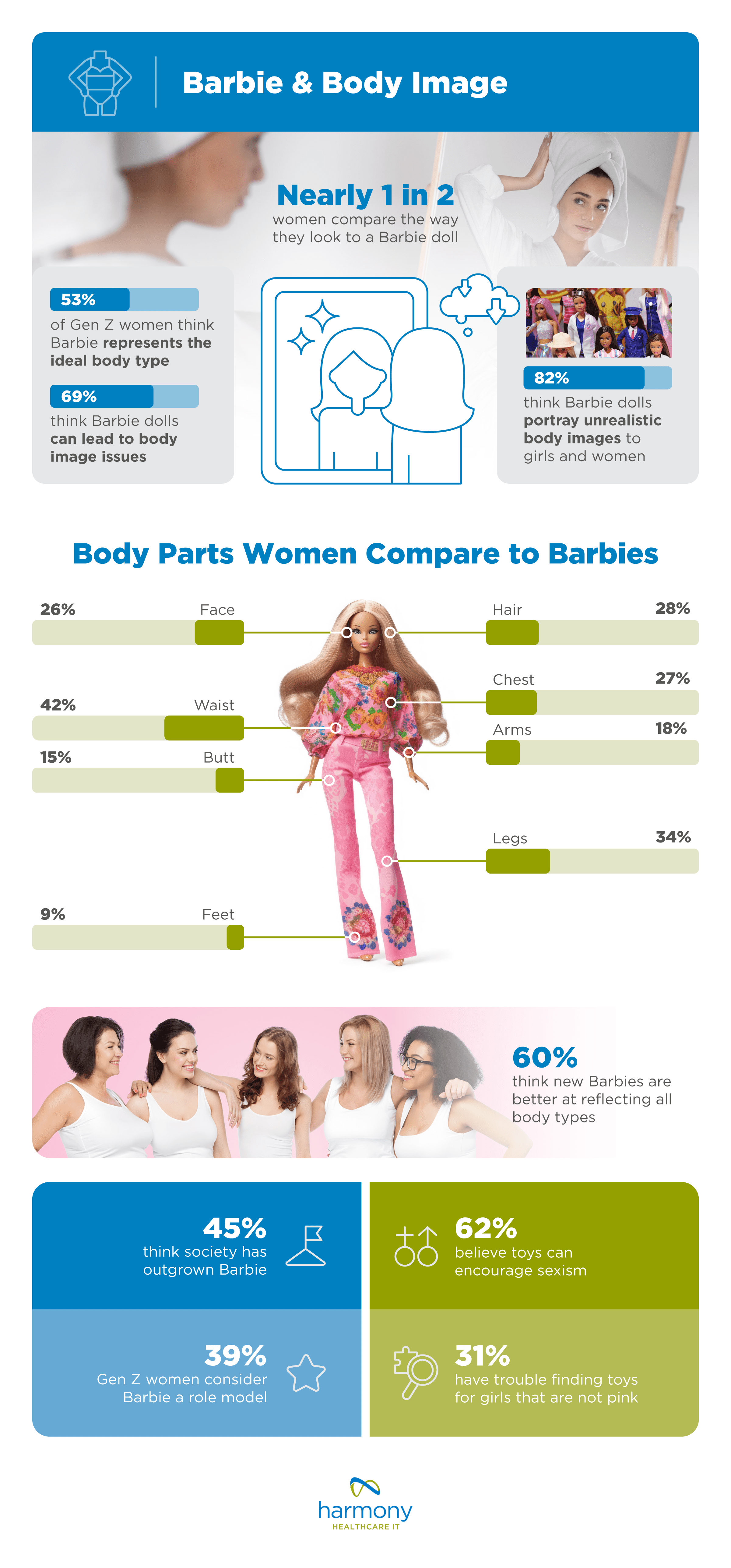
Nearly 1,000 women are now sharing their experiences growing up with the classic toy, and how it has impacted their own body image. While most women feel Barbie dolls portray unrealistic body images, a surprising 53% of Gen Z women think Barbie represents the ideal body type.

How Barbie Impacts Body Image

How Barbie impacts body image - report from harmonyhealthcareit.com

88% of women had a Barbie doll growing up, and it has significantly influenced how many feel about their bodies. Nearly 1 in 2 (45%) have compared the way they look to a Barbie doll. The most common body parts women compare are their waist followed by their legs, hair, and chest.

While 3 in 5 feel new Barbies are better at reflecting all body types than older versions, 69% still think Barbie dolls can lead to body image issues. The doll seems to have left a different impression on Gen Zers. More than half (53%) think Barbie represents the ideal body type, and 39% of Gen Z women consider the doll to be a role model.

No matter what people feel about Barbie, women feel toys can send a powerful message to kids at a young age. Survey statistics show more than 3 in 5 (62%) think toys can encourage sexism, and 31% have trouble finding toys for girls that are not pink. Some countries have adopted a gender neutrality law that encourages toymakers to create gender-neutral products that are not marketed specifically to boys or girls. More than 2 in 5 (41%) women think the U.S. should establish a law like that.

Body Image Issues in 2023

Body image issues in 2023 - report from harmonyhealthcareit.com  

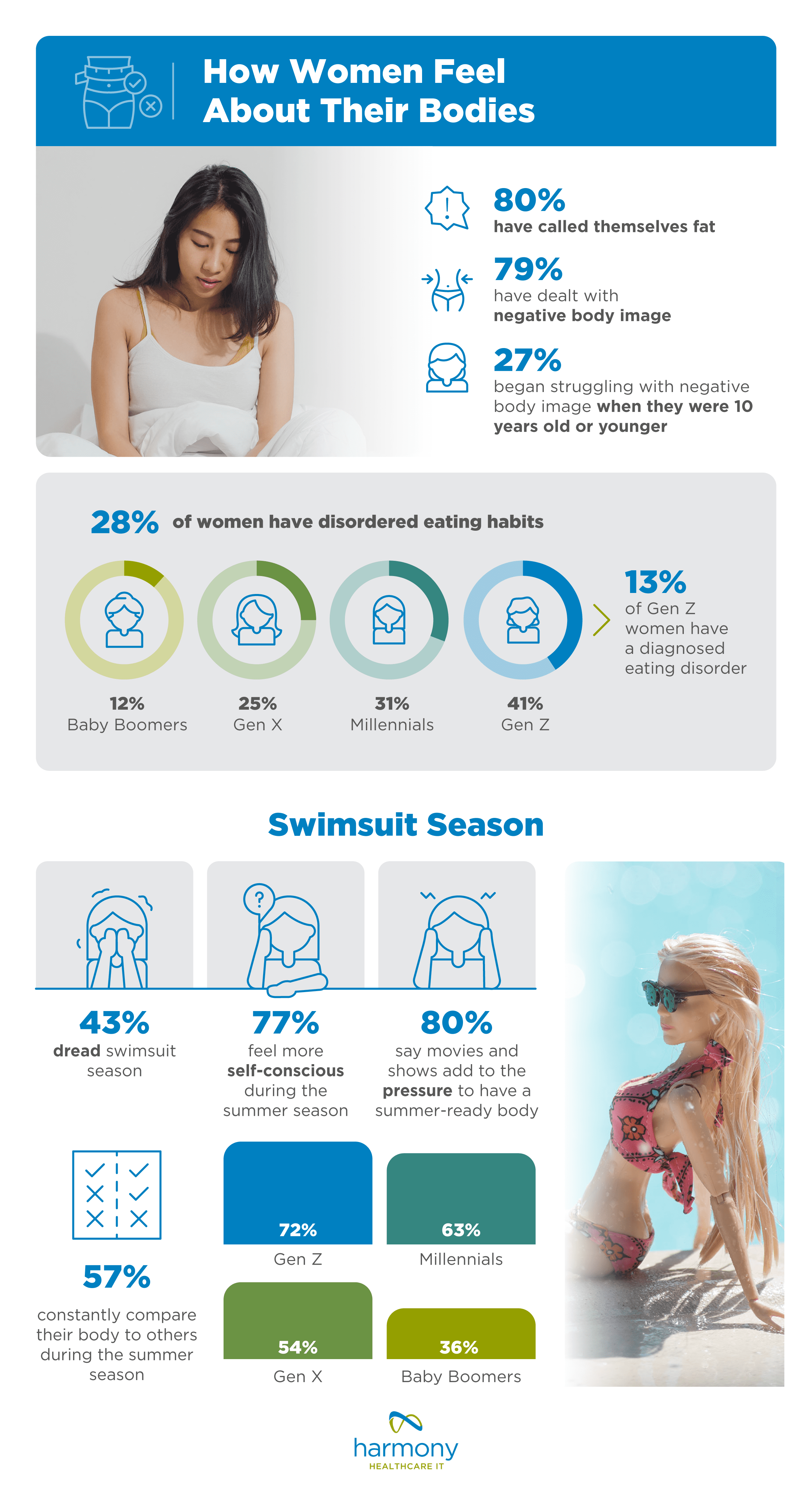
While it may be hard to determine what leads to bad body image, some women are dealing with it at a young age. More than 1 in 4 (27%) started struggling with negative body image issues when they were just 10 years old or younger. Overall, 79% have dealt with negative body image, and 80% of women have called themselves fat.

More than 1 in 4 (28%) women have dealt with disordered eating by doing things such as restricting their eating, eating compulsively, or eating irregularly. Gen Zers (41%) have self-admittedly struggled with this more than any other generation. More than 1 in 10 (13%) Gen Z women also shared they have a diagnosed eating disorder.

Summer is a particularly hard time when it comes to body image issues and women’s health. More than 2 in 5 (41%) dread swimsuit season, and 77% feel more self-conscious during this time when many focus on the so-called bikini body. One thing that contributes to the pressure: movies and TV shows. 80% of women said movies and shows add to the pressure to have a summer-ready body.

The Influence of Movies & Shows on Body Image

Movies and TV shows have a big influence on personal beauty standards as well as societal ones. Nearly 3 in 4 (72%) women feel shows and movies negatively impact societal beauty standards, and 56% shared that it has negatively impacted their own body image. One problem? A lack of realistic body types and diversity. 71% do not feel shows and movies promote body positivity and diversity.

Despite this, nearly 2 in 5 (38%) women plan to head to the theater to see the new Barbie movie. While only 1 in 6 think the movie will change their perspective about the somewhat-controversial doll, Gen Zers are going into it with more of an open mind. 35% of Gen Z women think the movie will give them a more positive perspective of Barbie.

Barbie dolls have been a go-to toy for decades. It continues to be a staple for many children and has withstood many opinions both positive and negative. While it may be hard to tell what leads to body image issues, remember you are beautiful, and feeling confident in your body often has to come from within. So next time you look in the mirror, don’t look at what you perceive as imperfections, but acknowledge you are stunning in your own way.

Methodology

In June 2023, we surveyed 999 women about their relationship with their body image. Respondents ranged in age from 18 to 77 with an average age of 43. 23% were Baby Boomers, 25% were Gen X, 26% were Millennials, and 26% were Gen Z.

For media inquiries, please contact media@digitalthirdcoast.net.

Fair Use

When using this data and research, please attribute by linking to this study and citing www.harmonyhit.com

Healthcare IT tips, guides, news & more delivered to your inbox

Learn More

Summary

Patient records must remain accessible – even if the patient moves, or the facility closes, or there is a merger and acquisition, as well as many other reasons. Compliance with the 21st Century Cures Act , state and HIPAA rules, requires a well-planned, long-term health data management strategy, action plan and an experienced team. There are at least 10 reasons legacy medical records will be needed in the future and many more reasons why now is the time to ensure your organization is equipped to manage its data responsibly. Read one to learn the importance of keeping health records.

Join Fellow Healthcare IT Pros

Tips, Guides, News & More

Sign Me Up
10 Reasons Medical Records are needed in the future

The 21st Century Cures Act requires health records be agile and shareable between providers and patients. This is not a simple task, since the average American adult moves 9.1 times after age 18, the volume healthcare information represents 30 percent of the world’s data, and most hospitals have simply added more and more EHR systems, with many running at least 10 EHRs in place with 16 disparate EMR vendors.

To ensure a seamless – few clicks to the information approach – a lot must happen behind the scenes. Bottom line: Healthcare providers, and specifically those in health IT, have their work cut out for them to manage all the data and systems within their care.

Replacing EHR Systems is a Necessity 

With the high volume of medical records and EHR systems in play at most healthcare organizations, streamlining the IT portfolio is a smart and necessary step. Over time, there are three main reasons healthcare providers replace their EHRs:

  1. The healthcare system is in merger and acquisition mode and determines one main go-forward system for the enterprise
  2. There are overlapping, redundant systems
  3. The EHR system(s) doesn’t meet the future needs of the organization

Regardless of the “why,” when the EHRs are being replaced, the patient, business and financial records contained in legacy systems must follow record retention laws to remain compliant, secure, and available in the future. According to AHIMA, there are ten reasons to keep legacy health records.

10 reasons patients and clinical care partners will need access to legacy medical records in the future:

  1. Preparing a personalized, comprehensive, longitudinal timeline for care coordination
  2. Preparing to participate in shared decision-making at appointments
  3. Appealing insurance denials
  4. Preparing advance directives and discussing end of life care
  5. Preventing dangerous delays in care
  6. Checking for medication errors to improve patient safety
  7. Avoiding redundancy in care, such as unnecessarily repeating tests or imaging
  8. Preventing billing errors and fraudulent claims
  9. Researching potential clinical trials for treatment planning
  10. Contributing data to scientific research

How We Can Help Maintain Legacy Records

An active archive is part of an overall solution to ensure the full historical patient narrative can be delivered wherever it needs to go… now and in the future. To assist healthcare delivery organizations with long-term health data management, Harmony Healthcare IT has developed a suite of products and services that consolidates data stores, reduces out-of-production system maintenance costs, mitigates technical risk, complies with record retention mandates, and offers both interoperability and data analytics capabilities.

To start, customers’ legacy systems get inventoried and prioritized in an online application rationalization tool called HealthData Planner. As decisions are made to decommission a legacy system, structured and unstructured data is either extracted and converted to a go-forward system (i.e., Epic, Cerner, MEDITECH) or migrated and secured onto one of the company’s active archive solutions, HealthData Archiver® or HealthData AR Manager®.

Records are then activated for interoperability with other systems, entities or consumers via HealthData Integrator®, which provides a set of tools or APIs based on common industry standards such as USCDI, FHIR, HL7, C-CDA, XML, or Direct. This also helps enable compliance with regulations of the 21st Century Cures Act.

Our Records Release Service

Our Records Release service supports healthcare facilities facing closure or M&A in meeting long-term regulatory requirements for protected health information. For healthcare providers facing closure or acquisition, our Records Release service allows healthcare providers (or their trustees) to confidently outsource release of information responsibilities. This service supports the future release of information that may be needed for any of the ten reasons above for patient care, litigation, insurance audits, validation of employment, etc.

Looking for an experienced partner to support your organization’s long-term data management goals?

Let’s connect.

Healthcare IT tips, guides, news & more delivered to your inbox

Learn More

Summary

For one academic medical center, transitioning to Epic and growing through merger and acquisition amassed a large portfolio of legacy
applications.

Join Fellow Healthcare IT Pros

Tips, Guides, News & More

Sign Me Up
Case study: Data Harmonization Achieved by Large Academic Medical Center featured image

The Situation

For one academic medical center, transitioning to Epic and growing through merger and acquisition amassed a large portfolio of legacy
applications.

Nine legacy EMRs were initially displaced: Cerner Millennium; Allscripts Sunrise Clinical Manager, TouchWorks, and Care Manager;
MEDITECH; eClinicalWorks; athenahealth; GE Centricity Perinatal; and Greenway Intergy. In total, 3,000 legacy clinical, financial and business software applications stored in 13 data centers needed a data management strategy and scalable action plan to consolidate the data silos and provide easy access to historical records from Epic.

To deliver on its data harmonization goal, the integrated delivery network needed an experienced data management partner offering a proven storage platform, including Epic integration and built-in workflows to support its user needs.

The Solution

After a thorough review of several vendors, Harmony Healthcare IT and its HealthData Archiver® solution was selected based on key
criteria, including:

  1. Superior Workflows. User-based workflows support the needs of clinical, HIM, and revenue cycle teams.
  2. Epic Integration. Through MPI patient matching, Single Sign-On from within Epic provides quick patient context access to
    historical records.
  3. Release of Information. Batch and template print and share features enable records release.
  4. Break the Glass. Audit logs and role-based access controls provide extra layers of security and tracking for classified patients.
  5. Security. A HITRUST CSF®-certified platform protects legacy records with hundreds of physical and process security controls.
  6. Expertise. Harmony Healthcare IT brings broad data extraction and archival experience across 550+ software brands.
  7. Implementation. Harmony Healthcare IT’s full-service approach reduces the burden on the healthcare organization’s team.

Data Volume

The multi-year legacy data management program is working. With 72 archives deployed and 30 more in-flight, current data volumes include:

Benefits & Results

22+ Billion

Rows of Archived Data

36+ Million

Patient Records Archived

1.7 Billion

Documents/Images Archived

140 TB

Total Archived Data

A key factor to the long-term success of this data archiving project is the standardized process that positions the organization for future legacy data archiving and decommissioning projects.

HealthData Archiver® is a cloud-based solution that supports the organization’s goal to access legacy clinical and financial data from within Epic.

Key Active Archive Benefits

The project supported the company’s goals and provided numerous benefits, including:

  • Care quality improved with Single Sign-On access to the archive from Epic
  • Time savings for HIM, Clinical and Revenue Cycle users to access legacy records
  • Cost savings totaling tens of millions of dollars
  • Decreased risk for technical vulnerabilities and compliance issues

Lessons Learned

  • Timing – Understand that high quality projects take time and collaboration
  • Extraction – Know the barriers to data that can arise from legacy vendors
  • Expertise – Consider the challenge of finding specialized expertise for  legacy systems
  • Scope – Create a scope, sequence & governance plan to manage archiving across the enterprise
  • Validation – Allocate time and resources for data verification and validation
  • Purging – Document and setup rules for soft and hard record destruction in the archive

Healthcare IT tips, guides, news & more delivered to your inbox

Learn More

Summary

With Oracle Cerner’s CommunityWorks℠, smaller healthcare organizations gain the benefits of using Cerner Millennium® without incurring the cost and resource burden of a full-scale implementation. When CommunityWorks℠ is utilized, there also is an opportunity to migrate legacy data into an active archive like HealthData Archiver® to ensure historical records that were not converted to the new system are accessible, secure and affordable to maintain.

Join Fellow Healthcare IT Pros

Tips, Guides, News & More

Sign Me Up
Oracle Cerner CommunityWorks featured blog image

With nearly one fifth of the US population living in rural areas, critical access hospitals and other small, medical facilities are vital in health care delivery nationwide. Over the years, as electronic medical record (EMR) systems have become a necessary standard, they have also become cost prohibitive for smaller facilities.

In 2020, Cerner, now Oracle Cerner, launched its tailored cloud-based Community Works℠ solution for  smaller and rural hospitals. With this effort, the larger health system extends its Oracle Cerner instance to nearby medical facilities that gain access to the Cerner Millennium® electronic health record (EHR) without the need to hire internal support teams or purchase infrastructure. The larger health systems leverage their own investment in a comprehensive EMR and support greater interoperability by connecting more providers who can be up and running within a few months.

Oracle Cerner reported in early 2023 that CommunityWorks℠ is in use at nearly 300 hospitals across 45 states and the number is growing.

The Benefits for Community Hospitals, Critical Access Hospitals and Ambulatory Clinics to Adopt CommunityWorks Include:

  • One electronic chart for a patient that is shared across all locations (nursing homes, med surg, primary care, pharmacies, etc.)
  • Time savings from workflow efficiencies
  • Increased safety and less opportunities for errors
  • Opportunity to utilize a leading EHR at a smaller facility
  • Predictable IT spending with an economical business model (avoids server maintenance all together and allows IT staff to concentrate on other areas.)
  • Increased collaboration between multiple providers

Overall, this defined partnership helps smaller providers achieve greater results without having to reinvent the wheel or be stuck with lower tier systems or paper records.

Establishing a Legacy Data Management Strategy with a CommunityWorks Implementation

With Cerner Millennium as the go-forward EHR, there is an opportunity to create a legacy data management strategy by decommissioning legacy servers, converting and/or archiving legacy data elements.

The benefits of streamlining the application portfolio include:

  • Opportunity to stop paying software maintenance costs to the legacy vendor
  • Removing the aging server from the technical infrastructure
  • Ensuring that historical records are consolidated and accessible in a viewer that is easily accessible over time as employees come and go
  • Complying with record retention regulations

When a Hospital or Clinic Decides to Opt in to CommunityWorks, There is a Need to Plan for the Applications it Will Replace

Harmony Healthcare IT can assist organizations moving to CommunityWorks℠

with data migration, and then archive the data from the legacy systems for staff to access historical patient, employee, and business records in a secure and cost-effective solution.

Is your community hospital on the fence about adopting Oracle Cerner’s CommunityWorks℠ solution? Do you have questions about the most efficient and cost-effective means for consolidating legacy systems while maintaining patient, financial and business records?

Check in with us.

We can help.

Healthcare IT tips, guides, news & more delivered to your inbox

Learn More

Summary

EHR system replacements and upgrades are common in healthcare as providers continue to evaluate and upgrade to more robust platforms. Most of the time, about two years of legacy data is migrated to the new system with the remaining data left behind. An active archive is an efficient, secure, and cost-effective solution for legacy data from a MEDITECH, or any other, EHR system replacement/upgrade.

Join Fellow Healthcare IT Pros

Tips, Guides, News & More

Sign Me Up
MEDITECH Expanse Blog featured image

MEDITECH is making healthcare headlines with the success of its Expanse EHR platform, and was one of only two EHR vendors to gain double digit growth in both hospital and acute care beds last year, according to the 2022 KLAS US Market Share Report…  More good news includes a 38% customer retention rate with 50 current customers migrating to Expanse rather than switching to another EMR vendor and an announcement about a collaboration with Google Health.

Magnolia Health Center Upgrades to MEDITECH Expanse – 20+ Years of Health Data Needs a Long-Term Home

Brian Davis, CHCIO at Magnolia Regional Health Center in Mississippi, and his team migrated to MEDITECH Expanse (formerly called MEDITECH 6.1) to better meet the organization’s needs. A MEDITECH customer since 1996, they decided to migrate two years of clinical data to the Expanse platform, which left more than 20 years of legacy clinical, financial (accounts receivable) and business data (payroll, GL) trapped in silos across each facility.

“We had legacy data sitting out there in unsupported, unpatched systems. We needed to get that data out primarily for regulatory purposes and then retire those applications,” explains Brian Davis, CHCIO, Chief Information Officer.

Magnolia Health Case Study Blog Call Out Magnolia Health Video resource graphic

Healthcare providers who upgrade to the Expanse EHR from a prior version of MEDITECH, or migrate from another EHR solution, need a strategy for legacy clinical, financial and HR records.

As healthcare providers work toward meeting 21st Century Cures Act requirements for broad regulations and specific interoperability use cases, all data – current and legacy – should be interoperable to ensure quality patient care and to support efficient clinical workflows.

Healthcare organizations can get so busy implementing and supporting complex enterprise systems that their legacy applications often remain active. That adds cost, labor, and risk to the IT portfolio. Harmony Healthcare IT specializes in clinical, patient financial, human resource/payroll and general accounting healthcare data management and EHR replacement. We can help when the strategy is to migrate as much clinical data into the go forward EHR system as the new vendor will allow. We also offer a cost-effective solution to migrate disparate legacy data sources into a single, secure health care archive.

There are numerous benefits of archiving legacy health data:

  • Exceptional usability in terms of Single Sign-On integration, navigation and the ability to easily find information
  • Detailed functionality including the ability to wind down A/R, release information within HIM workflows, and purge records once they’ve met the retention policy
  • Solid value with a focus on low reoccurring costs and a fair total cost of ownership
  • Scalability, as the archive is positioned to grow and accommodate evolving customer needs as additional EHRs are archived and decommissioned in the future

Health data management is what we do

Our team uses a variety of sources for information as well as what we know from our own experience of extracting, converting, migrating and retaining records from over 550 clinical, financial and administrative software brands commonly used in healthcare delivery organizations.  Our focus in managing data exclusively for the healthcare industry helps us to pioneer and deliver outstanding HITRUST CSF®-certified cloud-based storage solutions – HealthData Archiver®, HealthData AR Manager®, and HealthData Locker with options to enable stored data for interoperability with HealthData Integrator®.

Our team is ranked number one as the top Data Archiving, Data Extraction and Migration company according to Black Book Rankings, a division of Black Book Market Research. We’ve earned this ranking three years in a row. It underscores our commitment to keeping patient, employee, and business records accessible, usable, interoperable, secure, and compliant.

Are you a MEDITECH customer with a recent upgrade and need a plan for your legacy records?

We’re ready to connect and talk through your organization’s specific needs, challenges and next steps.

Healthcare IT tips, guides, news & more delivered to your inbox

Learn More

Summary

The Situation Merger and acquisition activity in recent years made it necessary for this northeastern integrated healthcare system to implement a legacy data management strategy. Since 2017, the organization absorbed 83 physician practices and four hospitals – each of which had its own clinical and financial systems. Having such a big volume of legacy data...

Join Fellow Healthcare IT Pros

Tips, Guides, News & More

Sign Me Up
Data Harmonization Achieved by Large Academic Medical Center social image

The Situation

Merger and acquisition activity in recent years made it necessary for this northeastern integrated healthcare system to implement a legacy data management strategy. Since 2017, the organization absorbed 83 physician practices and four hospitals – each of which had its own clinical and financial systems. Having such a big volume of legacy data sitting dormant on various vendor software applications was not a long-term solution, especially with financial, regulatory, and patient care repercussions. With seven acute-care hospitals and nearly 500 locations, a footprint of this magnitude presented the need for an experienced partner who could easily archive the disparate EHR systems without disrupting the level of care that patients had come to know and trust. Not only would an active archiving strategy provide efficient patient record access, but the financial savings would be a large benefit.

The Solution

The CIO of the organization recognized the need for a legacy data management partner to develop a modernized record retention strategy that would integrate with Epic® across the health system’s three flagship facilities, four acquired hospitals and 83 acquired practices. A key requirement for the team was to ensure that continuity of care was not disrupted. Maintaining day-to-day operations as efficiently as possible to provide high-quality patient care was important. Harmony Healthcare IT’s archive solution, HealthData Archiver®, enabled the goal of high-quality patient care with an easy-to-use interface and rich workflows, intended for daily use by clinicians, HIM teams, and more

Another objective for the team was to ensure record integrity in the archive by validating data migrated from the various legacy systems. With most archivals, this step can be lengthy and tedious, but the Harmony team expedited the process with a built-in customer validation tool. This streamlined the archival process, allowing 182 TB of data from 55+ legacy systems to be secured within 5 years.

Benefits & Results

Archives Deployed

55+

Total Data Archived

182 TB

Documents Archived

450M+

Cost
Savings

$2M+

Savings of $2M and Counting

With Harmony’s help, the health system has seen savings of $2M to date. By migrating legacy data from the disparate systems to HealthData Archiver®, a browser-based active archive, there has been a reduction in vendor management costs, IT support costs and more.

Continuity of Care

Going from three acute-care hospitals to seven in just five years meant there was no time to spare when it came to migration and patient care. In fact, consolidating legacy data into HealthData Archiver® has enhanced the patient experience. With Single Sign-On to the archive inside of Epic®, it is easier and more efficient for providers to access patient records

Data Consolidation and Bolstered Security

With the expertise and support of the Harmony team, the health system has archived: 55+ acute and ambulatory data sources, over 450,000 documents, and 182TB of legacy data. The process of merging data into one archive proved more efficient from a time and resources standpoint and bolstered cybersecurity for the organization.

Activation of Archive Steering Committee

With Harmony’s support, the health system created an Archive Steering Committee, an important internal team charged with keeping the archive project implementation moving smoothly and preventing headaches down the line. This group was composed of representatives from various entities within the organization including legal, finance, IT and clinical.

Access this Case Study in .pdf format

Healthcare IT tips, guides, news & more delivered to your inbox

Learn More