Summary

Since 2006, healthcare stakeholders have recognized the importance of information and technology in the transformation of healthcare. What started as U.S. National Health IT Week has evolved into Global Health Equity Week. Also, since 2006, our team of experts has pioneered data management solutions that move and store patient, employee, and business records. With experience with more than 550 unique software brands, we take our role seriously in keeping vital information accessible, secure, and interoperable.

Join Fellow Healthcare IT Pros

Tips, Guides, News & More

Sign Me Up
Global Health Equity Week 2023

Global Health Equity Week (#HealthEquity), Oct. 23-27, recognizes the power of information and technology to improve access to healthcare for all communities.

The 2023 focus includes five areas:

  1. Chronic disease management
  2. Digital health literacy, inclusion, and access
  3. Maternal health
  4. Substance use and behavioral health
  5. Workforce inclusion

As a health data solutions innovator, our team supports health equity through our commitment to developing and evolving solutions for digital health information integration.

The World Health Organization defines digital health literacy as:

The ability to seek, find, understand, and appraise health information from electronic sources and apply the knowledge gained to address or solve a health problem.

This definition is part of WHO’s Global Strategy on Digital Health 2020-2025 which emphasizes the importance of integrating financial, organizational, and clinical resources through digital health solutions.

A few examples of our work in the digital health space includes:

  • Long-term access to records with our HealthData Platform, a secure infrastructure that provides cloud-hosted accessibility to patient, employee, and business records for healthcare delivery organizations. This is important because over time as EHRs are replaced, records must be retained to meet clinical, legal, and business requirements. This solution supports storage, workflows, transactions, and interoperability to help IT, HIM, legal and business teams continue to function. There are many options for record storage within the Platform that all work together to keep records secure and accessible long term.
  • Single Sign-On. Is an essential tool that seamlessly connects users to a patient’s historical record stored in the active archive, HealthData Archiver®from within the patient’s current medical record in the active EHR. With one click, the user has immediate in-context access and improved workflows that save time and increase efficiencies.
  • Records Release Services. Provides release of information services for healthcare providers facing closures or M&A. Our team can provide a complete and secure option to ensure record retention regulations continue to be met. We can extract data from legacy systems, store the records in an active archive, provide a website for requestors, manage the records release and maintain an audit trail.
  • Secure Record Delivery. Directly supports the 21st Century Cures Act with the ability to transmit a patient’s historical record from within HealthData Archiver® to an EHR endpoint. This could include a patient portal which would allow patients to access their historical record.

We believe inclusive digital healthcare experiences are essential for ensuring equitable and accessible healthcare services for all individuals. Our team is committed to continue to develop solutions for lifecycle data management that help strengthen care delivery and improve lives.

Are you looking for a partner to help advance your lifecycle data management program?

We are ready.

Let’s connect.

Healthcare IT tips, guides, news & more delivered to your inbox

Learn More

Summary

Complex medical conditions often involve a large care team that relies on the patient record. Specialty pharmacies are a key part of the team as the specialty pharmacist is knowledgeable on key information on the individual medication, possible drug interactions, unique administration, best practices for patient monitoring and more. Specialty pharmacists need access to the complete patient record and integrated technology tools to help deliver the best patient outcome.

Join Fellow Healthcare IT Pros

Tips, Guides, News & More

Sign Me Up
Pharmacies need access to legacy medical data

The number of specialty medications to treat complex conditions like cancer, multiple sclerosis, respiratory conditions, rheumatoid arthritis and others account for 75 percent of the 7000 prescription drugs in development. Spending on specialty drugs accounts for 55 percent (up from 28 percent in 2011) of the nation’s drug spending. It makes sense, then, that specialty pharmacies – charged with managing the requirements, handling, storage, dosing and follow-up care of these high-cost, high-touch medications – have experienced 315 percent growth from 2015 – 2021.

The specialty drug pipeline also is projected to grow by another 8 percent each year through 2025. A challenge with this growth is that many specialty pharmacies do not currently have the right technology tools to support their patients.

EHRs need to integrate with specialty pharmacies to provide a complete patient picture.

With growth comes a need for software systems to manage specialized follow-up care. There are several systems designed for specialty pharmacies such as Wellsky’s CPR+ and CareTrend, as well as others that support the specific needs of specialty pharmacies. CVS Health implemented Epic’s EHR system in its specialty pharmacies to “enable immediate information sharing with other health care providers across the patient’s entire care team.” And, with about one-third of specialty pharmacies located within the hospital setting, large hospital networks continue to align their specialty pharmacy systems such that they allow easy access to the patient’s main medical record.

Cures Act interoperability includes specialty pharmacy to improve patient experience.

Pharmacy interoperability is included in the 21st Century Cures Act with a workgroup of private and public health members developing standards for prescribing and management of emerging therapies including specialty medications. Some key considerations the workgroup is focused on include:

  • Patient access to pricing and prescription status information.
  • How to improve inefficient workflows where medications are processed manually at transitions of care and can be lost with papers given to drivers, etc.
  • Medication information being conveyed and verified mostly through the patient.
  • Patient education about their medications that may exist in electronic form but isn’t always linked in patient portals.

Further discussion is also underway to improve the process for prescribing medications, including specialty medications, so that the provider has better access to confirming coverage. The goal here is to decrease the number of times a physician isn’t aware of the patient’s insurance coverage, prescribes a medication that isn’t covered and then the patient is stuck in the middle trying to coordinate the processes needed for further review. The goal is to clear the blockages with information available to the physician, pharmacist and patient.

Why is it important for a pharmacist to have access to the patient’s medical record?

From the moment a physician prescribes a specialty drug, the clinical pharmacist’s access to the patient medical record matters in terms of speed, accuracy, and responsiveness.

Specialty pharmacies are uniquely positioned to collect clinical and qualitative data needed to assess therapy effectiveness and recommend interventions. Specialty pharmacies can be especially helpful if they have the information needed with an integrated EHR pharmacy platform and a clear understanding of what metrics to track. Because it provides a full view of the medication list and lab results, the electronic medical record (EMR) plays a critical role in specialty pharmacy.

As pharmacy systems are upgraded and mergers and acquisitions continue, the need for a specialty pharmacy’s access to medical records remains. As specialty pharmacies continue to work through the technology integration that follows mergers and acquisitions and upgrade their systems, maintaining access to legacy pharmacy records as well as the complete and active patient narrative is vital.

Access to longitudinal patient records supports pharmacists, healthcare teams and patients.

HealthData Archiver® is a HIPAA-compliant record storage solution that can manage specialty pharmacy data. It promotes interoperability and offers built-in workflows for release of information managers, clinicians, pharmacists, legal and compliance officers, rev cycle collectors, researchers, and human resources.

At Harmony Healthcare IT, our mission is to preserve vital information to improve lives. Our active archive product, HealthData Archiver®, delivers cost-savings and information access. It also fortifies defenses against cyberattack by providing a single and secure storage place for disparate silos of legacy data. Harmony Healthcare IT has been consistently ranked as the #1 data extraction, migration, and archival healthcare IT company according to Black Book Market Research for four years (2019-2022) as well as ranked #1 in the 2020 Best in KLAS Software & Services Report as a Category Leader in Data Archiving.

We migrate and archive records across the care continuum – for hospitals, health systems, pharmacies, clinics, labs, blood banks, home health care, long-term care and more.

Have mergers and acquisitions impacted your specialty pharmacy system? Does your organization have disparate systems running, leaving legacy data at risk? We can help.

Note: This blog has been updated from an original post on July 15, 2020.

Ready to connect?

Contact us today to learn more about our healthcare data management solutions.

Healthcare IT tips, guides, news & more delivered to your inbox

Learn More

Summary

Social engineering is a new wave of cyberattacks that is hitting healthcare hard. Attackers use sophisticated fake emails called phishing to lure employees into clicking on malicious links to gain access to the organization’s systems. Unfortunately, these phishing efforts are working with a high percentage of healthcare workers opening these bad links. With the cost of healthcare breaches at an all time high of almost $11 million, there are steps providers can take to better equip their teams to fight off bad actors.

Join Fellow Healthcare IT Pros

Tips, Guides, News & More

Sign Me Up
Four tips to avoid phishing and improve cybersecurity

Vigilance is a necessity in fending off phishing attacks. Phishing refers to malicious emails that look innocent but can cause organizational mayhem when an unsuspecting employee clicks on the bad links.

A report found that 88 percent of healthcare workers have opened phishing emails and that phishing and other forms of cyber-attacks have seen a 75 percent increase since 2021.

Once a hacker gains access to one area of protected health information or business records, they can wreak havoc on the entire system and cause financial and reputational damage that is difficult and very costly to repair.

Phishing is part of a new wave of cyberattacks called social engineering.

Social engineering is listed as the number one threat to healthcare cybersecurity. Beyond standard phishing, other variations used to gain access to critical healthcare records include:

  • Smishing. Fake mobile text messages are used to trick people into downloading malware, sharing sensitive information, or sending money to cybercriminals. The term is a combination of “SMS” or “short message service” (the technology behind text messages) and “phishing.”
  • Smishing with phone calls. Some attacks use a simple text and/or phone call to impersonate people or organizations to gain access to systems. The recent MGM Casino cyberattack is reported to have targeted an IT help desk employee with a fake call for access that ended in a large data breach that may have compromised tens of millions of customers driver’s licenses and Social Security numbers at a minimum.
  • A cybercriminal may masquerade as a senior player “big fish” and directly target other senior players or other important individuals to try and steal money or sensitive information. Whaling is also known as CEO fraud as the attacker impersonates the top executive and directs others to transfer information or money.
  • Business email compromise. This is a subset of phishing campaigns where attackers try to compromise email accounts to send out even more realistic phishing scams. This scam can target an unauthorized transfer of funds or other personally identifiable information like W-2 forms, etc. Healthcare email frauds have seen recent exponential growth of 473 percent.

Sitting ducks attract phishing attacks.

A HIMSS survey notes that 36 percent of non-acute care representatives reported their organization did not conduct phishing tests. Another report revealed that 24 percent of health employees in the U.S. hadn’t received any cybersecurity awareness training to know how to identify phishing scams.

Healthcare remains a top target for cyberattacks due to the large amount of health, medications, and personal information it stores. Currently, 30 percent of all large data breaches happen in healthcare and the costs are staggering. The average cost of a healthcare breach is $10.93 million, compared to the average data breach cost for all other industries is $4.45 million.

Healthcare organizations are behind other industries in having robust cybersecurity defenses. This is a combination of a lack of personnel and funding while also having to protect massive amounts of patient data and financial information. Plus, healthcare organizations often work with hundreds of vendors which increases the risk for a breach.

Doing nothing or not much to protect the organization is no longer an option.

Tips for healthcare organizations to protect against phishing and other social engineering cyberattacks.

The best defense against cyberattacks is a strong offense. This means taking a proactive approach to have a strong security program. It also means conducting regular security training for employees. It is vital to have a security-focused culture throughout every area of the organization as it only takes one click to cause massive destruction.

Four areas to include in your cybersecurity plan:

  1. Analyze exposure. Look at the threat landscape. Perform a security and privacy review. Look closely at the Business Impact Analysis (BIA) with vendors. A crucial step here is to use a third-party management program and have a contract with each vendor.
  2. Evaluate risk. Create and use a Risk Registry to document and fully evaluate the risk along with a mitigation plan. This allows you to prioritize items and have a central location for all incidents. This reduces the stress on the organization and allows the team a more organized way to work together. Have a weekly risk review meeting.
  3. Develop organizational security policies. Outline what the organization is doing to protect information, but also identify any gaps. Make sure you are compliant with legislation and meeting or exceeding industry standards.
  4. Provide security awareness training. Make sure everyone in the organization understands the policies and procedures. Explain the risks, like why personal devices cannot be logged into the network, for example. Remember that cybercriminals are constantly shifting their tactics. Be on the lookout for new threats and adjust the training at least annually.
    • All employees should be required to take HIPAA Security/Privacy Training upon onboarding and annually thereafter.
    • Employees should take Security Awareness training on a quarterly basis. This could be third-party administered.
    • All users should be included in monthly phishing campaigns with remediation training for any failures.
    • Include role-based training (e.g., Privileged User Training, Secure Development Training, etc.). This is important for users who have higher levels of permissions so they can better understand their risks and how to avoid falling for phishing scams.
    • Provide clear Do and Do Not examples for everyone in the organization to help combat phishing and social engineering attacks. This includes things like:
      • Do verify the source who is requesting any sensitive information such as your birth date or payment information before sharing that information.
      • Do Not click on any website link before hovering over it to make sure it is secure and legitimate.

Resources are available to support better security preparedness.

Beyond phishing and social engineering, there is an urgency to have a solid and ever-evolving security plan. Here are resources that can help build or expand on your plan.

One important security move for any organization is to become HITRUST CSF®-certified.

HITRUST CSF is the most widely adopted security framework with a thorough certification program for healthcare organizations. This globally recognized approach supplies a comprehensive, flexible, and efficient approach to regulatory standards and risk.

Being HITRUST CSF-certified is woven into everything we do. Hear from Dan Kompare, VP of Information Systems at Harmony Healthcare IT, about why this certification is important. And, check out this brief podcast for more about keeping data secure.

Security is reported as the most important factor in vendor selection. In a survey of hospital CIOs, 100 percent of respondents listed security as important or very important. In that same survey, 81 percent of CIOs reported that security vulnerability is the leading pain point driving legacy data management decisions.

Here are 10 Security Questions to Ask Your Archive Vendor.

Looking ahead: Be prepared on all fronts.

Cyber attacks are not slowing down or going away.

Industry experts predict a 25.7 percent likelihood that another massive healthcare breach like the 2015 Anthem Blue Cross attack that affected 78.8 million people is likely within the next three years. That attack was caused when an Anthem employee opened a phishing email that infected the employee’s computer with malicious files and allowed the attacker to access 90 different systems, eventually reaching Anthem’s data warehouse.

Having a solid plan for risk mitigation across current and legacy data systems can help overcome the chronic security issues that have become too common in healthcare.

It’s time to get the right people and partners together to move forward with a strong plan and tools.

We maintain a security-minded culture and are transparent with our program and policies to help you understand how products and data within our HealthData Platform are managed.

Are you fortifying your security plan, increasing employee security training efforts, and consolidate legacy data silos?

Let’s Connect.

Healthcare IT tips, guides, news & more delivered to your inbox

Learn More

Summary

Harmony Healthcare IT, a health data management firm, surveyed 997 Gen Z (ages 18 to 26) who struggle with anxiety about how it impacts their lives. Below are the results.

Join Fellow Healthcare IT Pros

Tips, Guides, News & More

Sign Me Up
Blog - Gen Z Anxiety Statistics - New Data

Why Does Gen Z Have So Much Anxiety? 

In our Gen Z State of Mental Health Report, we discovered the top diagnosed mental health condition among Gen Z is anxiety. But why is that? In a follow-up to our initial research, we surveyed nearly 1,000 Gen Zers who struggle with anxiety to ask them about what and who causes them to have anxious thoughts.

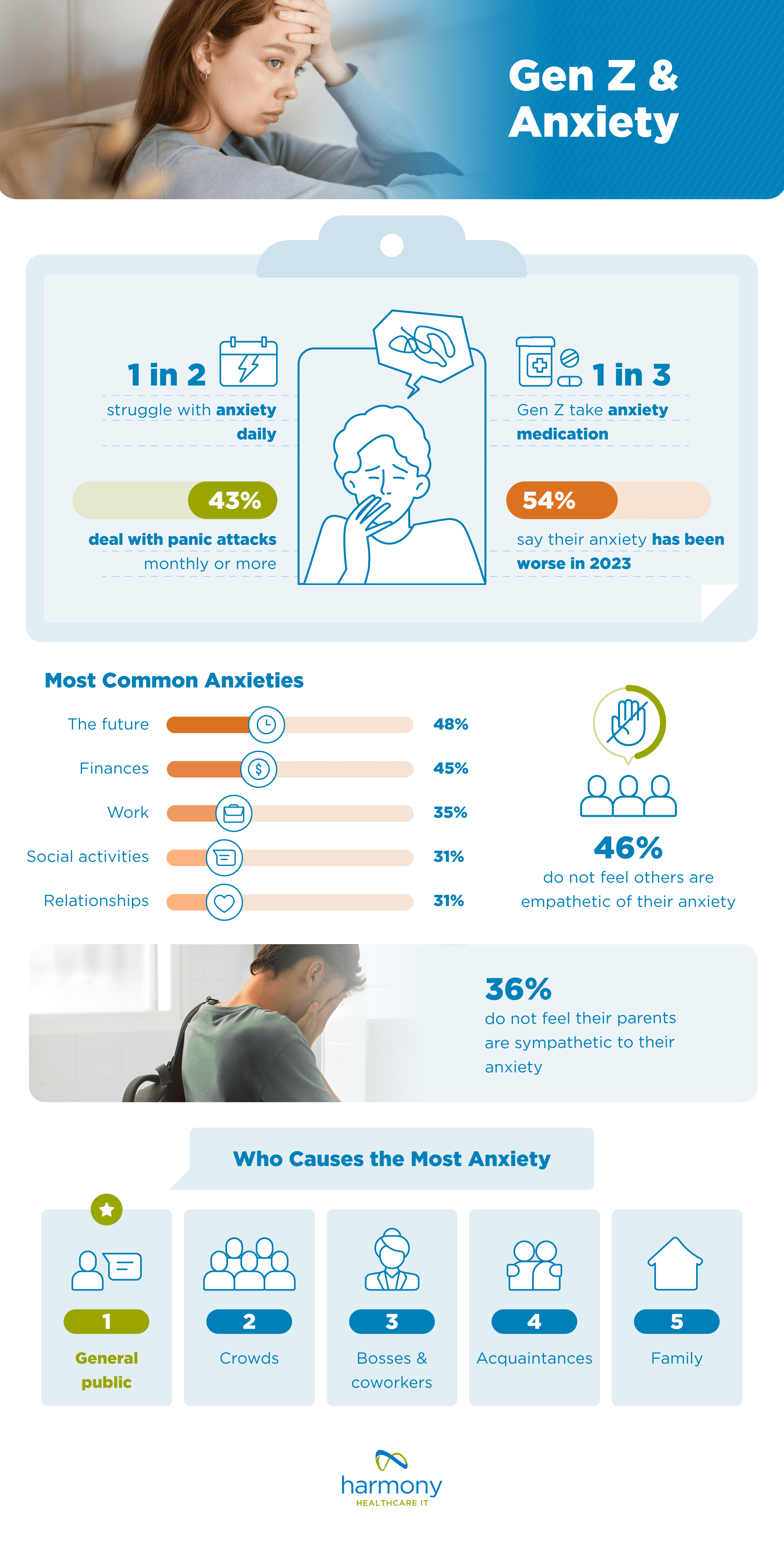
According to our research, more than 1 in 2 struggle with anxiety daily, and 1 in 3 are taking anxiety medication to try and find relief. But some are turning to other drugs or alcohol to cope.

Top 5 Causes of Anxiety for Gen Z

Top 5 causes of anxiety for Gen Z infographic - report by www.harmonyhit.com More than half (54%) of Gen Z say their anxiety has been worse in 2023. The most common cause of anxiety among them is the future. Nearly half of Gen Z said this was their biggest apprehension. Another major concern is cash, with 45% anxious about finances. Other top anxieties include work, social activities, and relationships. 

Even though so many deal with it, anxiety can be isolating. Nearly half of Gen Z do not feel like others are empathetic to their anxiety. There are certain people that the generation feels are especially uncaring when it comes to their mental health. More than 1 in 3 (36%) do not feel like their parents are sympathetic to their mental health struggles. But coworkers or bosses (34%) and extended family (30%) are not far behind.  

How Gen Z Copes With Anxiety 

How Gen Z Copes with Anxiety Infographic - report by www.harmonyhit.com

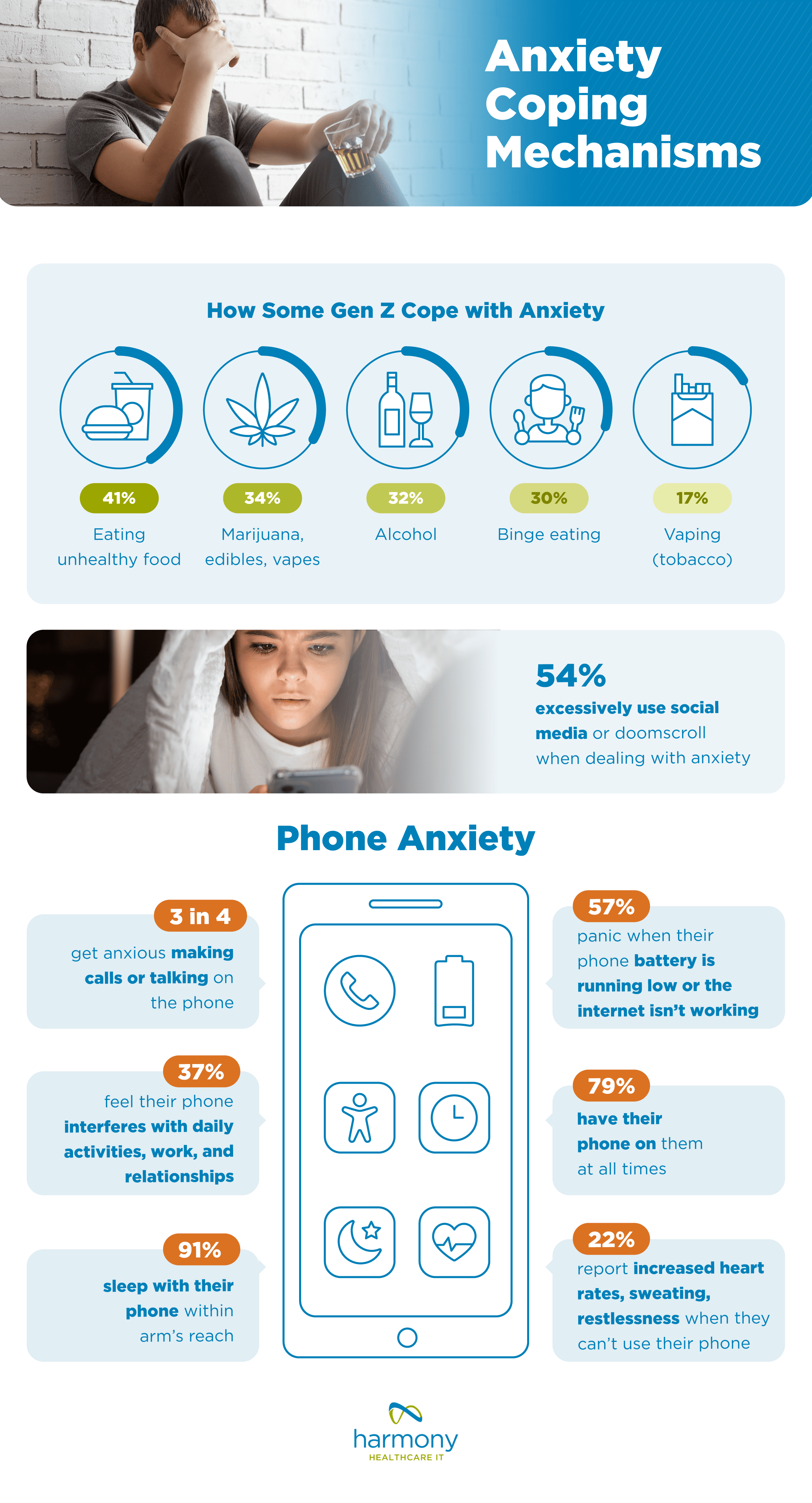
A lot of Gen Z turn to food to try to handle anxiety. More than 2 in 5 eat unhealthy food and 30% binge eat while trying to cope with their anxiousness. About 1 in 3 resort to substances such as marijuana, edibles, and vapes as well as alcohol. 

It’s also clear Gen Zers have a complicated relationship with their phones. Nearly 2 in 5 (37%) feel their phone interferes with daily activities, work, and relationships.  However, 54% admitted to excessively using social media or doomscrolling while trying to deal with anxiety. A whopping 96% of Gen Z use social media, mainly using sites like YouTube, Instagram, TikTok, Reddit, and Snapchat. 

Nearly 3 in 4 (74%) get anxious making calls or talking on the phone, and yet 91% of Gen Z sleep with their phone within arm’s reach. Nearly 3 in 5 (57%) feel panic when their phone battery is running low or the internet isn’t working, and 22% have reported feeling increased heart rates, sweating, and restlessness in situations when they can’t use their phone. 

Gen Z Anxiety Around the Holidays

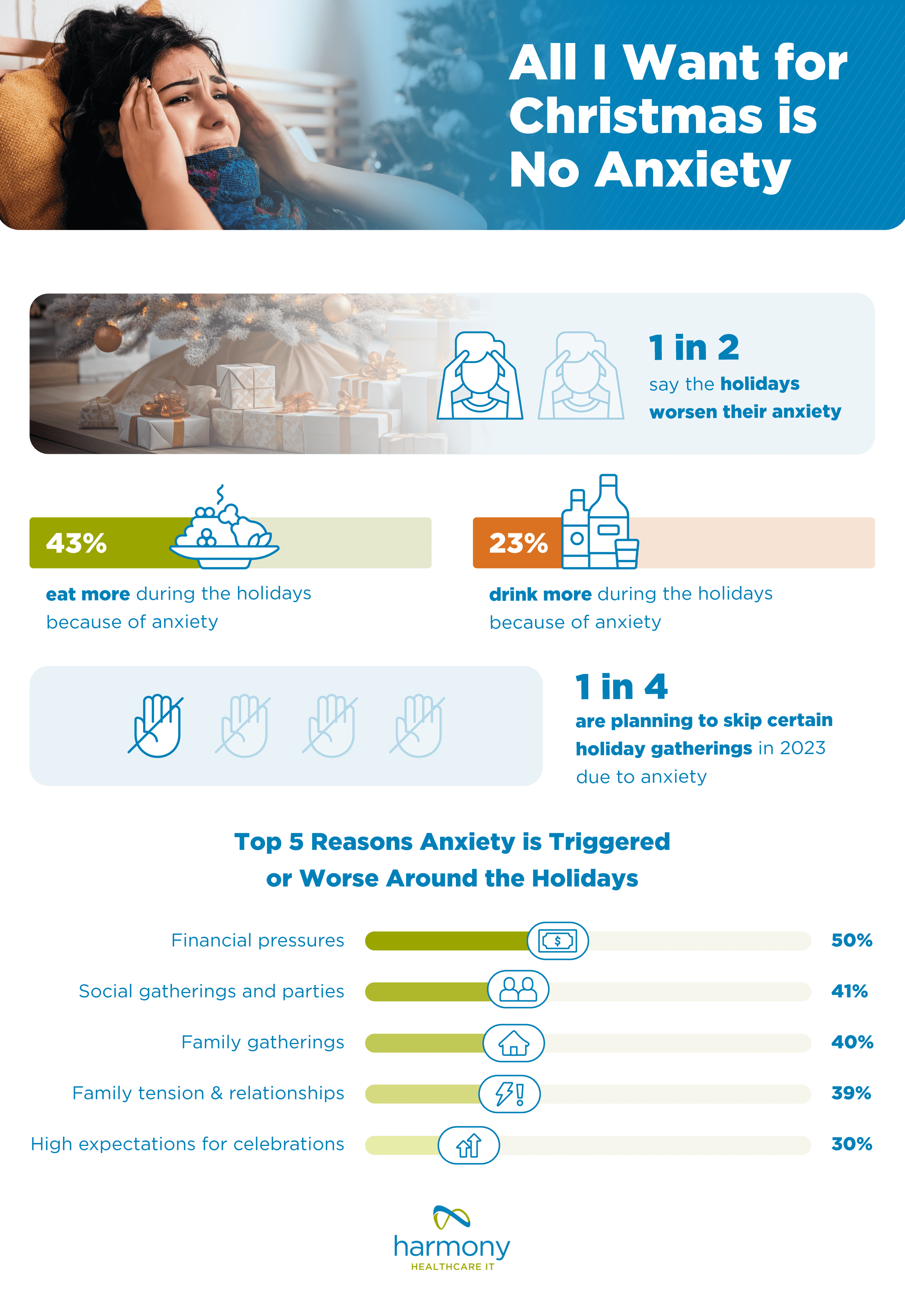
The holidays often make anxiety worse. More than half (53%) of Gen Z find this season worsens their anxiety. Some key reasons for holiday stress include: 

  1. Financial pressures
  2. Social gatherings and parties
  3. Family gatherings 

The increased pressure and anxiety around Thanksgiving, Christmas, and New Year’s are leading to some additional bad health habits. More than 2 in 5 (43%) Gen Z admitted they eat more during the holidays because of anxiety and 23% drink more. 

Positive Coping Mechanisms for Anxiety

Top 5 positive coping mechanisms for anxiety infographic - report www.harmonyhit.com.

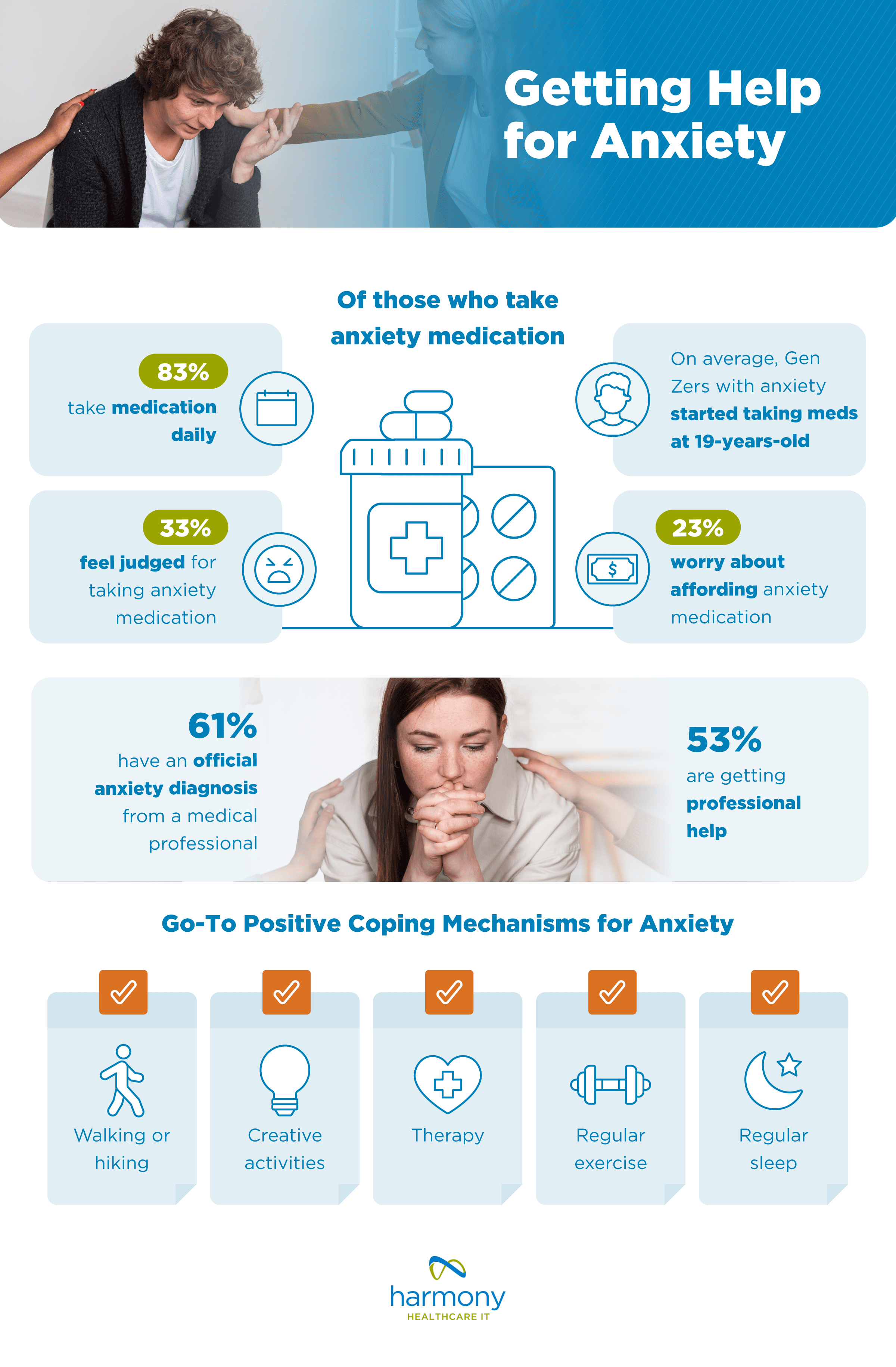
Nearly 1 in 3 Gen Z with anxiety are using medication to help them manage their mental health. On average, Gen Zers with anxiety started taking meds at 19 years old, and of those who take anxiety medication, 83% take it daily. 

Besides medication, many have go-to coping mechanisms to try and improve their anxious thoughts. Nearly half (48%) go on walks or hikes. Others try to stimulate their brain by turning to creative activities like painting, writing, or playing a musical instrument. 2 in 5 go to therapy. In fact, statistics show 53% have gotten professional help for their mental health, and 18% are considering it. 

If you struggle with anxiety, know that you don’t have to go through it alone. It’s one of the most common mental health struggles, and about 1 in 3 Americans experience anxiety at some time in their lives according to the National Institute of Mental Health. Don’t hesitate to reach out to a mental health professional. 

Methodology

In September 2023, we surveyed 997 Gen Z who deal with anxiety and asked them how it impacts their lives. Respondents ranged in age from 18 to 26 with an average age of 23. 47% were women, 47% men, and 6% non-binary. 

For media inquiries, please contact media@digitalthirdcoast.net.

Fair Use

When using this data and research, please attribute by linking to this study and citing Harmony Healthcare IT

Healthcare IT tips, guides, news & more delivered to your inbox

Learn More

Summary

Today, 96% of hospitals and 85% of ambulatory providers use electronic health record (EHR) systems. Many organizations are on their second, third or more upgrades in search of systems that better meet their current and future needs. Others are choosing to streamline the organization’s IT landscape to a single go-forward EHR after merger and acquisitions have added redundant systems to the mix. We review eight tips for choosing a new EHR – and what to do with the legacy data left behind.

Join Fellow Healthcare IT Pros

Tips, Guides, News & More

Sign Me Up

Healthcare data has a 24/7 job. This “job” often lasts for decades (or more) as record retention requirements can be lengthy.

The data priority for clinicians is immediate access to current and historical records for direct patient care. Meanwhile, billing, HIM, legal and other users, including patients, expect the data to be available and sharable to meet the 21st Century Cures Act requirements.

Finding the right EHR can be a job in itself.

A recent report found that many users want their EHRs to do more. While 30 percent were dissatisfied to neutral about their current system, the 70 percent who were satisfied reported their current EHR would not meet their future needs.

Today’s EHRs need to be equipped to do heavy lifting, sorting and data delivery to keep the organization running smoothly and complying with regulatory requirements. The term data agility is one to keep in mind. It represents the speed and flexibility needed to satisfy the data demands of the organization and is a core component of overall data health.

Choosing the right EHR for your organization’s unique needs is a process, but it doesn’t have to be a burden. Below are suggestions to help guide the decision of choosing or replacing an EHR with data agility as a priority.

Eight tips for choosing the right EHR.

An initial EHR shopping checklist should include a review of:

  1. Budget and features. There are many variables that will impact the overall cost of a new EHR. The software’s features and the size of the organization, hardware, network upgrades, data backups/storage, and cost per employee all affect the cost. It is recommended to review the features needed and also those that could be positive investments, such as improved communication tools (telehealth, messaging), online appointment scheduling, virtual registration, chatbots/social media to answer direct questions, etc.
  2. Licensing and maintenance. Compare apples to apples by creating a matrix to review the ongoing costs for a new EHR including licensing and maintenance.
  3. If you are implementing an onsite system, determine what hardware and security programs are required.
  4. Figure out what training and support is offered from the vendor.
  5. Determine which type of hosting makes sense for your organization. Most major EHR vendors offer a cloud-based option which means there is not a need to have servers or hardware onsite. Generally, cloud-hosted systems are lower cost and alleviate the cost of onsite IT maintenance and technical support.
  6. Additional fees. Read the fine print and know if there are other fees for certain add-on integrations, training, etc.
  7. Functionality/integration. Ensure the application meets your organization’s needs, especially with interoperability in mind. Health records are expected to be sharable between providers, patients, payers, and other users such as legal, HIM. System configuration is essential to ensure workflows will be enhanced with the new application.
  8. EHR certification. Look for an ONC certified product.

Smaller organizations can benefit from accessing an EHR from a larger organization.

Due to cost, community and critical access hospitals and ambulatory clinics may be limited in their ability to implement the most state-of-the-art EHRs. For those organizations, there are options to consider such as connecting through a larger healthcare enterprise with a smaller investment. Oracle Cerner’s Community WorksSM and Epic’s Community Connect are two of the largest and most comprehensive EHRs on the market that offer an extended instance of their applications to nearby medical facilities at a fraction of the cost of the smaller organization implementing the EHR on its own.

What are the benefits of a new EHR?

You can expect some of these benefits when a new EHR is a solid fit with the organization:

  • Optimized workflows.
  • Efficient, timely care for patients with up-to-date and complete information about patients available at the point of care.
  • Improved care coordination and interoperability with labs, hospitals, and specialists.
  • Regulatory compliance.
  • Administrative efficiencies for billing, human resources, and other business functions.
  • Reduced risk of medical errors.
  • Reduced costs through decreased paperwork, reduced duplication of testing, etc.
  • Potential to meet the Meaningful Use of certified electronic health technology (CEHRT), which qualifies for incentive payments through the Centers for Medicare & Medicaid Services EHR Incentive Programs and helps improve overall health care quality and patient outcomes.

What steps should I take to ensure data security when choosing an EHR?

Cybersecurity preparedness is top of mind for everyone in healthcare, especially those in data management. There is a strong priority to fully protect health data as well as integrate and share data within and outside the organization. This duality of protection and sharing creates challenges and a need for a security focus. Some key steps to consider to keep data secure when choosing a new EHR include:

  1. Look at the EHRs reviews and recommendations from other customers.
  2. Review the security-specific features in the new EHR. Look for systems that comply with the most up-to-date industry standards.
  3. Follow HITRUST CSF security framework across your entire health IT landscape.
  4. Ensure there is a plan so all data in transit is encrypted via NIST standards.
  5. Focus on HIPAA compliance.
  6. Look into the security features that will best serve your organization. This could include such things as partitioning of sensitive information through role-based security controls, audit logging/monitoring, data masking, third-party multi-factor authentication, strong password requirements and record access/amendment functionality.
  7. Choose a system that performs automated security and risk assessments.

What are the differences between practice management software and EHR?

Beyond clinical records, lab results and images housed in an EHR, there are other types of healthcare information stored. Medical practice management software bridges the gap between clinical documentation and everyday business records like insurance information, medical billing, and patient scheduling. Practice management software usually has some abilities to automate certain tasks like scheduling and billing and some additional features like processing claims and generating reports but does not contain much clinical information. It is important to have solutions that work together and provide integration benefits or utilize an all-in-one solution that provides both EHR and PM in one application.

What are the challenges of implementing or upgrading an EHR system?

Hurdles that may arise with a new EHR system can include the following:

Staff resistance. A lack of buy-in and support at the C-suite level can lead to a lack of funding and other resources needed. A lack of support from end users can affect morale and impact the implementation process and increase employee turnover. A survey found that 35 percent of healthcare employees are “likely to leave their organization if they are dissatisfied with EHR implementation or training.”

Data migration roadblocks. Having a well-planned data migration process  is 100% necessary based on the importance of maintaining access to patient, financial and business records. With cost being a top concern, often it is not feasible to migrate all records to the new system. Many organizations choose to migrate the most recent one to two years of clinical information and then utilize an active archive solution for the rest of the data. This ensures ongoing access to the data, often includes a Single Sign-On from the new EHR, and is a more cost-effective option.

Technical. It is important to stick to the features and functionality that the organization needs. Try to avoid a system that doesn’t offer enough compatibility or technical alignment for security, backups or scalability that the organization needs.

Financial missteps. Setting a realistic budget is key. The budget must include all the components necessary to implement the new system.

What kind of long-term data governance is required for EHR management?

Over time, healthcare organizations tend to collect a stable of EHRs, either through the purchase of specialty systems or through mergers and acquisitions (M&A). Regardless of how the EHRs joined the organization, there can be a complicated web of solutions that are in varying states of use.

Managing EHRs and the data contained within them takes a strategic approach. This is a job for a Data Governance team. One smart strategy is to standardize and virtualize the legacy data throughout the organization and keep it secure and accessible for patients and clinicians in an active archive.

With a goal of “One Patient, One Record,” New York-Presbyterian replaced nine EMRs with Epic® as its go-forward system. This move displaced 200+ legacy data silos of clinical, financial, employee and business records from its growth through mergers and acquisitions.

Case Study: Watch this webinar to learn more about how New York-Presbyterian moved forward to effectively manage their EHR system replacement and legacy data through archiving.

What are legacy data management options when an EHR gets replaced?

Part of a successful EHR implementation includes a plan for the legacy systems and data already in use within the organization. Our team at Harmony Healthcare IT can support your team at every step of the planning through implementation process of legacy data management. This includes an inventory of legacy systems, documented information about each source system, and support to prioritize decommissioning.

Our suite of data management solutions supports healthcare delivery organizations of all sizes secure patient, employee, and business records during an EHR replacement or rationalization.

We are ready to help your team realize its data agility goals.

The first step is to connect.

Healthcare IT tips, guides, news & more delivered to your inbox

Learn More

Summary

The Centers for Medicare and Medicaid Services (CMS) released new guidance for correctional facilities that allows states to use state and federal Medicaid matching funding to provide better prerelease health care services to incarcerated people.Part of the guidance supports IT investments to improve record sharing within and outside of correctional health care facilities.

Join Fellow Healthcare IT Pros

Tips, Guides, News & More

Sign Me Up
Correctional Facility Healthcare IT Upgrade

A new federal program aimed at helping prisons improve health outcomes for incarcerated individuals who are soon to be released is also providing funds for prison healthcare IT improvements. The CMS funding can be used for projects such as improving data integration to enable record sharing among correctional facilities, state Medicaid agencies, and community-based providers. Bettering the ability to share accurate health records for incarcerated patients is important as 95 percent of them are eventually released to rejoin society.

This effort is part of a broad program to provide improved prerelease healthcare such as case management, medication-assisted treatment (MAT) and a 30-day supply of prescription medications.

Stepping up the care for this population is important as the United States has the world’s highest incarceration rate with 1.7 million people in state or federal prisons and local jails. Generally, incarcerated people also have substantially higher physical and mental health needs than the general population. More than half have a mental health problem or a substance abuse disorder, or both.

Tracking individuals across the life cycle, including during stays in jail or prison, is facilitated by robust and harmonized electronic health records and public insurance,” said co-author and Harvard Kennedy School public policy professor, Marcella Alsan in a new paper.

Enhanced federal financing for information technology to help prisons improve their healthcare IT systems.

The new guidance details potential opportunities for leveraging enhanced federal matching funds on information technology (IT) system expenditures necessary to support reentry efforts.

For example, states can claim enhanced federal financing for activities that:

  • Establish new (or enhance existing) IT data systems that support eligibility and enrollment processes.
  • Facilitate communication between correctional staff and Medicaid providers and managed care plans.
  • Enable claims processing, and/or upgrade electronic health record (EHR) platforms to align with Medicaid regulatory requirements.

CMS funding also will provide time-limited waiver financing for capacity building (such as hiring and training staff or IT system updates) and implementation planning. Questions about specific IT system expenditures can be directed to the MES State Officers.

California is first to receive funding and test expanded services model.

California is the first state to receive federal authority to offer a targeted set of Medicaid services to incarcerated enrollees up to 90-days prior to their release. The recent $410 million from CMS is being used for capacity-building funds to support investments in personnel, capacity, and/or prison healthcare IT that are needed for collaborative planning and implementation of prerelease service processes.

Currently, 14 states have pending requests before CMS, with other states expected to follow.

There is a trend within correctional facility healthcare to increase their capabilities for health record sharing that supports long-term continuity of care.

In Oregon.

An effort to implement a new EHR at the Oregon Department of Corrections paused to consider the 88 different solutions across the continuum of care in the state and the importance of having a “truly interoperable health system.”

In Texas.

Harris Health in Houston recently began providing healthcare in the Harris County Jail, the third-largest jail in the country that regularly houses 10,000 individuals. They used Epic’s Community Connect to share the same patient records and give clinicians working in the jail access to the same tools in Harris Health’s other facilities.

In Georgia.

A new Wellpath alliance with the Morehouse School of Medicine and the HI-BRIDGE Health Information Exchange will share real-time correctional patient health information to improve inmate patient care delivery across 70 Georgia corrections facilities.

As new EHR systems are introduced, legacy systems and records may be displaced.

With available funding and the push toward improved interoperability, more correctional facilities may choose to upgrade and replace their current EHR. When this happens, legacy records will need to be securely retained to meet regulatory and patient care requirements. Migrating 24 months of key clinical data elements to the new go-forward EHR and archiving the rest of the records is typically a best practice. This ensures ongoing access to historical records while enabling the decommissioning of the out-of-production system.

This consolidation effort ensures compliance with record retention laws and provides easy access and release of information flows.

If your correctional facility is considering a new EHR, our team can help.

Our active archive product, HealthData Archiver®, can handle legacy health data at correctional facilities.  The solution helps to reduce maintenance costs, improve security, and reduce system vulnerabilities.

Our team has ranked as the number one company for data archiving, data extraction and migration for four years in a row, according to Black Book Rankings, a division of Black Book Market Research.

We have worked with over 550 unique clinical, financial, and administrative software brands.

HealthData Archiver® gives users Single Sign-On integration with major EHRs like Epic, Oracle Cerner and MEDITECH – enabling patient context sharing, release of information workflows and revenue cycle features to offer a significant value for organizations decommissioning legacy systems.

Is your correctional facility ready to move forward?

We can help.

Healthcare IT tips, guides, news & more delivered to your inbox

Learn More

Summary

The Indian Health Service (IHS) is replacing its decades-old RPMS electronic health record system to better meet the needs of its more than 2 million members. The goal of the new system (yet to be announced) is to provide upgraded features and better record sharing capabilities between providers and patients. EHR system replacements need a comprehensive legacy data plan and could benefit from an active archive solution.

Join Fellow Healthcare IT Pros

Tips, Guides, News & More

Sign Me Up
Indian health service replacing RPMS EHR

For the first time in more than 40 years, Indian Health Service (IHS), a federal agency within the Department of Health and Human Services (HHS), is getting a new electronic health record (EHR) system. The multi-year health IT modernization initiative will replace the organization’s homegrown Resource and Patient Management System (RPMS) with a more robust commercial solution.

The plan is for a new enterprise EHR system to deploy in 2024. Tribes recognized as Compacted Shares will choose to implement their own commercial EHR or to adopt the enterprise system chosen by the IHS.

The IHS serves 2.6 million members from 574 federally-recognized tribes of American Indians and Alaska Natives.  These members span twelve physical service areas across the county.

There are plans underway to ensure the transition to the new EHR goes well. There also needs to be a thorough plan to ensure the legacy health records currently in RPMS are accessible to meet patient care and retention requirements.

RPMS, like other older EHRs, has technical limitations.

Data silos and a lack of interoperabilityRPMS lives onsite in databases at local facilities across the country. This makes record sharing a challenge and creates additional problems for patients who need to share information with new providers when they are referred to a new facility, seek emergency room care or move to a new location.

A study of 2000 RPMS users from IHS, Tribal, and Urban sites concluded that it needs to upgrade with new technology or completely replace it (with another EHR). In addition, 40 percent of respondents rated the electronic sharing of information with patients through a portal as “very poor” or “somewhat poor.”

Shared technology with the VA would eventually require a costly IT programming investment. Even though RPMS is certified to the most recent 2015 Edition criteria published by the Office of the National Coordinator for Health Information Technology (ONC), future criteria could require significant investments.

“A unique challenge for RPMS is that it was developed with a Graphical User Interface (GUI) provided through a collaboration with the Department of Veterans Affairs (VA). The GUI code base over time will need support that would require additional investment by the IHS as the VA is moving forward with Oracle Cerner,” shared Mitchell Thornbrugh, CIO, IHS in an interview.  He also says the agency’s next EHR needs to include a more patient-centered design.

Specialized rules for IHS records management dictate new EHR functionality needed.

As a recognized federal agency, the IHS must follow Federal agency rules to preserve records that contain health and organizational information. Record retention requirements for the IHS follow the General Records Management Program issued by the National Archives and additional requirements detailed in the Disposition Schedule. A few points to note:

  • Ownership. All records are property of the Federal government and must be managed according to applicable laws and regulations.
  • Annual inventory. All records held by an IHS Office must be inventoried on an annual basis using a specific Records Management Inventory Worksheet.
  • Active record retention. Medical records are required to be retained in IHS health care facilities from three to seven years after the last episode of care. There are specific instances that vary from this rule, including dental records and lab reports, emergency room files, and others. Records may be retired to the Federal Records Centers (FRC) after three or more years of inactivity (depending on the facility’s available filing space and research activities).
  • Inactive record retention. After three years of inactivity, a record is considered inactive and sent to the Records are required to be batched and electronically transferred on an annual basis and maintained for 75 years.

RPMS replacement calls for a legacy data management plan.

With the upcoming replacement of RPMS and its ancillary systems VistA Imaging (VI), ICare, Laboratory Services, Clinical Reporting System (CRS) and Electronic Dental Record (EDR); a decision must also be made about what to do with legacy data.

In a recent presentation, three priorities for the Modernization Data Management Needs were outlined:

  1. Continuity of care. Only a small subset of data will be moved to the (new) enterprise EHR – basic demographics and recent core clinical data (Problems, Allergies, Medications, Procedures, Immunizations, and some clinical notes). Providers will need to reference older records on occasion, and they should not have to access old RPMS boxes to do that.
  2. Interoperability. Accessing data on shared patients, both within the IHS, Tribes and Urban (I/T/U) designations and with private/public sector.
  3. Medical record retention. . This may change, but it is unrealistic for RPMS or any EHR to hold that much data. Therefore, facilities will need

An active archive supports IHS legacy data priorities.

An active archive, such as HealthData Archiver®, is a go-to companion solution for any EHR system replacement. Archiving is a common industry practice in healthcare. More than 70 percent of CIOs from mainstream healthcare delivery organizations surveyed reported they have an archive in place and have more archiving on their to-do lists.

Generally, there are two paths forward for data housed in a current EHR system:

  1. Migrate and convert data to the new go-forward system. Usually about 24 months of key clinical data will move forward to the new system.
  2. Archive the legacy data. Due to cost and complexity of data conversion, it makes sense to archive historical data in HealthData Archiver® and include a Single Sign-On from the go-forward EHR for ongoing and immediate accessibility of the records.

There are many cost, security, and workflow efficiencies that come with including an active archive solution in a legacy data management plan.  Another benefit is that archived records are activated for interoperability with other systems, entities or patients via HealthData Integrator®, which provides a set of tools or APIs based on common industry standards such as USCDI, FHIR, HL7, C-CDA, XML, or Direct.

Are you an RPMS user that is part of the IHS, Tribes, or Urban Indian Organization (UIO)?

Our team delivers strategic planning, tactical execution, and day-to-day support for healthcare organizations of all sizes. Since 2006, our US-based team of experts has worked with over 550 unique clinical, financial, and administrative brands.

Our core values are simple and meaningful. We seek to do the right thing, be easy to work with, exceed expectations, serve humbly and never stop improving.

These values have helped guide us to be named the number one data extraction, migration, and archival healthcare IT company in the nation for the past four years.

We are ready to help the IHS facilities move forward.

Please reach out to schedule an introductory call.

Healthcare IT tips, guides, news & more delivered to your inbox

Learn More

Summary

Smaller medical groups that may not be budgeted to implement the sophisticated software and infrastructure to enable better health record sharing are caught up in a “digital divide.” To help, Epic is extending its software to medical practices through its Garden Plot offering. For medical groups who join Garden Plot, utilizing an active archive like HealthData Archiver® is important to ensure uninterrupted access to historical records. This integration is easy as the archive is available through Epic Connection Hub and already in use at many Epic sites.

Join Fellow Healthcare IT Pros

Tips, Guides, News & More

Sign Me Up
Epic Garden Plot

Epic Garden Plot may be the answer for independent physician groups grappling with how to adapt to the increasing demands for sharing health data with other providers and patients. The Software as a Service (SaaS) offering from the industry giant provides streamlined access to Epic software for primary and specialty care groups with more than 40 providers at a fraction of the cost of implementing the software on their own.

This could be a lifeline for the 46.7 percent of the nation’s private practices that are still independently owned. The high cost for physician offices to upgrade or replace their current EMR to meet the new interoperability standards of the 21st Century Cures Act has left some offices in a bind about what to do next.

With over 600 EMR systems on the global market and 90 percent adoption of EMR systems by medical facilities in the United States, the ability to share EMR patient data between hospitals and physician offices that use other EMR platforms continues to be a major challenge. Many facilities need a guide to legacy health data management.

Add link in the anchor text “guide to legacy health data management

Bridging the digital divide to help health data flow

Healthcare experts at the HIMS23 global conference reported that there is a “digital divide” within the industry as some providers are not able to fully participate and deliver to the current interoperability standards. Further concerns include that data transfers with incompatible systems can result in incomplete or corrupt data, both of which are a health risk.

The evolving record sharing standards released in 2023 requires that patients now can see task and clinical notes and that electronic record systems are able to safely exchange personal health information (PHI) with third-party applications such as Apple Health, patient-facing systems, and enterprise systems. What should be included in a data set also is expanding and is defined by the United States Core Data for Interoperability (USCDI). Future standards are expected to continue to push for more connectivity.

Epic’s effort to connect every part of the healthcare ecosystem

The Garden Plot is in addition to Epic’s Community Connect offering which extends the EHR to smaller medical facilities that connect through a nearby larger health system.

Both Garden Plot and Community Connect aim to increase interoperability and offer lower overhead costs to the smaller organizations that may not otherwise be able to manage the full cost of implementation.

Legacy data planning with Garden Plot implementation

When physician offices decide to move forward with Epic Garden Plot as their go-forward EHR, there is an opportunity to decommission current servers and archive legacy data into an active archive that integrates with Epic.

With HealthData Archiver®, historical records remain easily accessible through Single Sign-on from within the Epic log in. There are numerous cost savings and security benefits for Epic Garden Plot users who consolidate costly and sometimes vulnerable legacy systems into an archive and then decommission unneeded servers and end maintenance contracts.

An active archive is a forward-thinking solution for legacy data management.

HealthData Archiver® is a cloud-based legacy data management solution. It is available on Epic Connection Hub and is live and in use at many Epic customer sites.

There are many benefits of including HealthData Archiver® as part of your forward-thinking data management strategy. A few include:

Health delivery organizations of all sizes that transition to Epic need a trusted companion archive solution to secure legacy data, so it remains accessible, interoperable, and available for analytics.

Is your physician office researching your options with Epic Garden Plot?

Our team has helped many teams successfully work through this process.

We are ready to walk (or run) with you.

Let’s connect.

Healthcare IT tips, guides, news & more delivered to your inbox

Learn More

Summary

As healthcare technology evolves, some systems get retired and replaced. Konica Minolta reports their OPAL-RAD PACS and OPAL RIS systems will no longer be serviced by the end of 2024. As customers migrate to other systems, images will need to be migrated and retained to meet regulatory requirements. HealthData Archiver®, with its DICOM Viewer, provides complete cloud-based medical image archival with ongoing access to images with Single Sign-On from the go-forward EHR. It also eliminates the need to migrate and convert legacy images to a new PACS system.

Join Fellow Healthcare IT Pros

Tips, Guides, News & More

Sign Me Up
OPAL DICOM

A recent announcement from Konica Minolta explains that their OPAL-RAD PACS and OPAL RIS product support will end effective in December 2024. It states: As technology evolves, occasionally our products reach the end of their ability to be serviced or End of Support (EOS) stage of their product lifecycle.

Healthcare providers with the Konica Minolta OPAL-RAD PACS and OPAL RIS image systems, or others that reach EOS, need a plan to move forward. This may include a new Picture Archiving and Communication System (PACS) or Radiology Information System (RIS), but also must consider a plan for retaining medical images and reports to maintain regulatory compliance and organizational best practices. It is important to remember that images are considered medical records and must be retained for at least five years or as required by the state.

Solution offers cloud-based legacy data management solution for images.

A PACS or RIS application reaching EOS status calls for a long-term solution for the images that need to be retained. The DICOM Viewer from Harmony Healthcare IT is an advanced archive solution that stores images in full resolution, with built-in tools to offer an enhanced user experience over other PDF-based image archive solutions on the market.

The DICOM Viewer allows clinicians immediate access to review legacy image files through Single Sign-On access from the go-forward electronic health record (EHR) system. Benefits include improved workflows, multiple image display options, links to DICOM studies and cost benefits over other vendor neutral archives. For more information, check out this article.

Access to legacy images and scans supports deeper investigative care.

Medical adviser and emergency room physician, Dr. Mark Kricheff, MD, MPH explains how access to legacy DICOM images supports current patient care: “We see patients who have abnormal findings on a CT scan and we don’t know if those are new or old. That is a big deal. Having access to DICOM images from years ago can be valuable.”

Check out the HealthData Talks podcast: DICOM Viewer for an Active Archive.

DICOM Viewer for HealthData Archiver® renders images in their native state which allows the clinician to view the original study instead of viewing a PDF. This is a significant differentiator over other vendor neutral archives.

With interoperability of all health information as an expected standard, HealthData Archiver® DICOM Viewer supports regulatory and best practices for lifecycle data management.

Reach out to learn more or schedule a demo.

Healthcare IT tips, guides, news & more delivered to your inbox

Learn More

Summary

EHR replacements often drive the need to move data from a source system to the new system. In many cases, the systems have different data mapping requirements, with complexity and cost prohibiting the conversion of all the data into the new system. This is where having a solid understanding of data migration vs data conversion, and how to utilize both options, supports an overall data management plan.

Join Fellow Healthcare IT Pros

Tips, Guides, News & More

Sign Me Up
The difference between data migration and data conversion in healthcare

Some healthcare terms seem similar at first glance but mean very different things.

For example:

Electronic medical records (EMR) are a digital version of a patient’s paper chart that is used within one provider’s office. EMRs track data over time, identify the need for screenings/checkups and monitor the patient’s vitals (blood pressure, vaccinations, etc.)

By contrast:

Electronic health records (EHR) are digital files focused on the total health of the patient with a broader view of the patient’s health.  EHRs have all of the information from an EMR and more. Importantly, EHRs are built to share info between multiple providers, labs, specialists, etc.

Two other terms that are often used interchangeably, but mean different things are data migration and data conversion.

What is data migration? Data migration is the act of moving information from one system to another. Data migrations include steps to map the data to validate and ensure that the transfer was accurate.

What is data conversion? Data conversions involve moving information from one system to another AND add an additional step to transform the information from one format to another.

What’s the difference between data migration and data conversion?

The primary difference between data migration and data conversion is that in a migration project, you do not have to transform/reformat data as you would in a data conversion. Data migration refers to the movement of data from point A to point B, while data conversion also includes a transformation step to ensure the data will be mapped properly for the new system.

A common point in both migrations and conversions is that they both move data from a source system to a new destination system with a need for validation to ensure that all data has been moved properly and is accurate.

Many projects involve a combination of both data migrations and data conversions.

How to know if a project calls for data migration vs conversion or both: 

  1. Define the project. With a new EHR in place, it is important to clarify what and how much data from current applications will be loaded into the new system. Due to complexities and costs, often about 18-24 months of PAMI+P data (problems, allergies, medications, immunizations, and procedures) is moved to the go-forward system. In addition, a full snapshot of the data is moved to storage in an active archive like HealthData Archiver®. Because this archive solution is an open relational database, it is easier to map data to it versus transforming data from the format of the source EHR into the format of the destination EHR.
  2. Analyze existing data sources and inventory legacy systems. When a new EHR or ERP is chosen as the go-forward system, often 30-40 (and sometimes even hundreds) of legacy systems need to be reviewed and prioritized for conversion to the new EHR or migration to archive. This can include EMR, billing, lab, home health, pathology, blood bank, practice management, payroll, accounting, human resources and more. A best practice is to inventory the legacy systems to have a complete understanding of all the systems at play within the organization.
  3. Design a technical plan. With an understanding of the overall project goals and plans for legacy data to either be extracted and converted to the new system or migrated to an archive, a detailed plan for extracting, transforming and loading the data to the destination can be developed. This step includes important considerations in terms of what data could be archived, which would allow decommissioning of the legacy applications to reduce overall maintenance costs and technical burden while keeping the data accessible via Single Sign-On from the new EHR. Part of the technical plan should include an overall project timeline that includes steps for data extraction, testing, validation, etc. and lays out a decommissioning schedule for legacy applications.

In many cases, implementing a new EHR, such as Epic, Oracle Cerner or MEDITECH, will call for a combination approach of converting recent data into the new system and migrating legacy data into an archive to ensure compliance with record retention requirements. It’s not so much a data conversion vs migration approach, but a blending of the two options.

The Harmony Healthcare IT team has broad and deep experience that can assist your team in developing a thorough data management plan when a system replacement calls for strategizing on a data migration vs. data conversion, or both. This can help reduce the costs and complexity of your overall healthcare IT expenses.

Harmony Healthcare IT is ranked as the top data extraction and migration healthcare IT company according to BlackBook Rankings, a division of Black Book. Well versed in working with more than 550 software brands, Harmony’s U.S. based team of EMR conversion specialists have extracted and converted clinical, financial, and business data from healthcare organizations from small ambulatory clinics to the nation’s largest healthcare enterprises.

We tackle complex data management projects, offer detailed consulting, and have a systematic process with superior customer service.

Is a new EHR in your future? Looking at the best options for moving and storing your data?

We’re ready to help your team make a smooth transition.

Healthcare IT tips, guides, news & more delivered to your inbox

Learn More