Summary

Despite organizational and financial challenges from the pandemic, merger and acquisition (M&A) activity for skilled nursing facilities (SNF) remains active with 400 deals expected to close within the year. These business decisions impact health data management as medical records for nursing home patients are very lengthy and highly regulated with even the shortest stay generating a 100+ page record that must be retained for years to come. With M&A activity and EHR system replacements continuing at a steady pace, there are best practices to ensure regulatory compliance for SNF patient, business, and employee records.

Join Fellow Healthcare IT Pros

Tips, Guides, News & More

Sign Me Up
Mergers and Acquisition Deals

With more than 2 million patients admitted each year to over 15,000 skilled nursing facilities (SNFs) in the United States, this market represents about $28 billion in spend annually. The types of care at a SNFs range from short-term post-acute care (including intensive physical, occupational, respiratory, and speech therapy) to intensive nursing care after an injury or illness (e.g., hip fracture, myocardial infarction, stroke). These services are typically for people over the age of 65, and for younger disabled patients.

The merger and acquisition (M&A) activity in the skilled nursing market remains active despite the regulatory uncertainty with likely federal budget cuts of 4.6% or $1.7 billion. There are more than 400 acquisitions expected to close by the end of the year, according to the American Health Care Association (AHCA). This is driven by a new phase of healthcare partnerships for those organizations that can offer consumers access to new services or enhance the delivery of services that require specialized skillsets. For example, some active buyers have their own pharmacy, or their own therapy company and a skilled nursing facility could be a complementary business to add to their portfolio.

A high-performing SNF is an important ally for health systems, particularly those that are focused on performance in value-based care arrangements or looking to enable earlier discharge from inpatient care to the lower-cost skilled nursing setting to help to reduce hospital readmissions.

SNF medical record management is a major consideration during (and after) M&A

Medical records within a skilled nursing facility are highly regulated. There are 175 Federal Regulations that must be followed as well as state rules that may be more or less stringent. For many patients,  records are very lengthy as they have lived at a facility for many years.  Other patients have shorter stays as the skilled nursing facility is a steppingstone before going back home. Even for a short stay in a SNF, a medical record can be several hundred pages long and include several sections, such as:

  • Administrative information – admission fact sheet, hospital transfer forms, any advance directives
  • Prior hospital and emergency room records
  • Physician orders and progress notes
  • Consultations with other medical specialties (podiatry, dental, ophthalmology, optometry, surgical, psychiatry and others)
  • Minimum Data Sets (MDS) and Care Area Assessments (CAA)
  • Nursing assessments and notes
  • Medication and treatment administration
  • Skin integrity status (Federal regulation) with strict protocols for weekly and monthly checks for skin concerns and pressure ulcer reporting
  • Risk assessments for other neurological testing
  • Vital signs
  • Therapy (physical, occupational, speech and respiratory)
  • Dietary
  • Activities and recreational therapy
  • Social services
  • Laboratory and X-rays
  • Nursing assistant documentation
  • Other miscellaneous notes

The federally mandated medical record retention requirements for long-term care health information are focused on ensuring the safety, security and accuracy of health records. If state law requires a different retention period, the more stringent between the federal and state must be followed.

Best practices for successful SNF legacy data management during a time of M&A and/or system replacement

As most mergers and acquisitions cause the displacement of one or more systems, it is imperative to have a data management strategy — especially if additional M&A activity is planned. The first three steps include:

  1. Develop an overall legacy data management strategy to avoid leaving legacy systems up in read-only mode to meet long-term medical record requirements. This is especially important if more M&A is on the horizon, which would also require a solution that securely consolidates protected health information from multiple EMR data sources.
  2. Evaluate technologies from both healthcare entities to determine which go-forward data systems to use. That includes clinical, revenue cycle, ambulatory, enterprise resource planning (ERP), general ledger (GL), accounting and other ancillary systems. In the SNF M&A transition, one way to reduce cost, labor and risk on the IT side is to decommission data systems that get replaced.

It is important to compile software licenses and service agreements of both entities, including information on the usage scope of licenses, prices for additional or reduced usage and termination provisions. This will assist in making informed decisions about which license agreements to combine, which ones to terminate and which ones to expand. All of these efforts will lead to cost savings.

  1. Evaluate the organization’s needs for backup, archiving and active archiving as a smart step in managing historical patient and operational data well into the future. It is important to understand the specific differences between data backup, archive, and an active archive:
    • Backup creates a copy of data and restores it in case of data loss or corruption.
    • Archiving frees up expensive capacity by moving less frequently used data to more cost-effective storage locations.
    • Active Archiving is highly scalable storage with intelligent software equipped with workflows for release of information and clinical access. The software uses rich metadata, indexes, directories, tags and more to enable high-performance search and information retrieval.

At Harmony Healthcare IT, we perform EMR data extraction from legacy systems, complete the clinical data migration, and normalize historical data in a relational database and make it accessible in an easy-to-use, browser-based viewer for years to come. If your skilled nursing facility has or will go through a merger or acquisition, visit HealthData Archiver® to learn about long-term storage of protected health informaiton  as well as HR, GL and accounting data.

Since 2006, our US-based team of experts has worked with more than 550 unique clinical, financial, and administrative software brands used in U.S. and Canadian healthcare delivery organizations. Harmony Healthcare IT has been consistently ranked as the #1 data extraction, migration, and archival healthcare IT company according to Black Book Market Research for four years (2019-2022) as well as ranked #1 in the 2020 Best in KLAS Software & Services Report as a Category Leader in Data Archiving.

Are you facing M&A and sorting through your best options for data management at your skilled nursing facility?


We can help.

Healthcare IT tips, guides, news & more delivered to your inbox

Learn More

Summary

In his 20+ years as an Emergency Physician, Dr. Mark Kricheff, MD, MPH, FAAEM has encountered countless scenarios where he needed accurate patient information, fast. In a recent podcast, “Use Cases for Historical Records in the ER,” Dr. Kricheff shares insights and practical guidance for legacy data management based on his experience in emergency medicine and 15+ years as a Clinical Informaticist, most recently leading a transition from Cerner to Epic.

Join Fellow Healthcare IT Pros

Tips, Guides, News & More

Sign Me Up
Use Cases for Historical Records in the ER

Every patient who enters an emergency room has a story. As an Emergency Physician for the past 20+ years, Dr. Mark Kricheff, MD, MPH, FAAEM needs to know that story, stat.

“Some ER patients aren’t able to provide their own medical history, so access to their records is critical,” explains Dr. Kricheff, who also serves as Chief Clinical Advisor for Harmony Healthcare IT. “Let’s say the patient presents with shortness of breath. We do an X-ray, and see abnormalities, but they might not be conclusive. One X-ray does not tell the whole story; however, add in a prior echocardiogram and that one piece of historical data can make a huge difference to help us differentiate between chronic heart failure vs. covid or pneumonia.”

Bottom Line: One piece of legacy data can dramatically impact current patient care.

In a recent HealthData Talks Podcast, Dr. Kricheff shares several examples of how historical records play an important role in the ER. For example:

  1. Unresponsive patient – When the patient is unable to communicate their medical history which could stem from being unresponsive, suffering from dementia or with poor healthcare literacy, etc.
  2. Comparing Imaging/Scans – Longitudinal access to prior CT scans or other DICOM imaging can help the onsite emergency medical team compare current imaging/scans with prior versions to make better informed treatment decisions.
  3. Provider History – Non-clinical legacy data can be helpful to inform the emergency team of other specialists and medical groups who have provided the patient with care in the past so that referrals for further care are in line with the patient’s medical needs and care providers.

These are just a few examples of how legacy data can be an important asset in the ER. However, there also are scenarios where access to historical information is limited or hard to obtain. This can happen when a health provider changes their EHR to a new system, and the legacy data is left in a data silo which is cumbersome and inefficient to retrieve.

For providers, especially ER departments, who are considering an EHR system replacement, Dr. Kricheff offers some practical advice:

  1. Do not neglect legacy data access.
  2. Think about how providers will access historical data.
  3. Utilize an active archive solution like HealthData Archiver® with Single Sign-on capabilities from the new EHR to avoid logging in to multiple legacy applications (e.g., Health Information Exchange, legacy EHR, fax server to retrieve notes from another provider)..

Our team is equipped to assist healthcare providers in emergency rooms and across the enterprise to ensure legacy data does not create an emergency on its own.

Harmony Healthcare IT has been ranked as the top Data Archiving, Data Extraction and Migration company by Black Book Rankings, a division of Black Book Market Research, for four years in a row. This recognition underscores our commitment to keep patient, employee, and business records accessible, usable, interoperable, secure, and compliant.

For more information on managing legacy patient data in the emergency room or other hospital departments, contact us.

Healthcare IT tips, guides, news & more delivered to your inbox

Learn More

Summary

Harmony Healthcare IT, a data management firm that works with health data, surveyed more than 1,000 parents of kids 18 or younger to learn how they try to keep their children healthy, including diet, exercise, and tech habits. Here are the results.

Join Fellow Healthcare IT Pros

Tips, Guides, News & More

Sign Me Up
Family Illustration

Parents Weigh in on Childhood Obesity in New Survey

The American Academy of Pediatrics wants parents to take action if their child is obese. A person is considered obese if they have a body mass index (BMI) of over 30. The association’s new guidelines recommend that parents with obese children as young as two-years-old go through intensive health behavior and lifestyle treatment. It also recommends weight loss drugs for kids as young as 12 and surgery for kids 13 or older.

How do parents feel about this? In our survey, parents revealed some of their biggest struggles while trying to keep both their children and themselves healthy. New statistics show many are open to considering weight loss medication or even surgery for their kids.

Biggest Challenges with Keeping Kids Healthy 

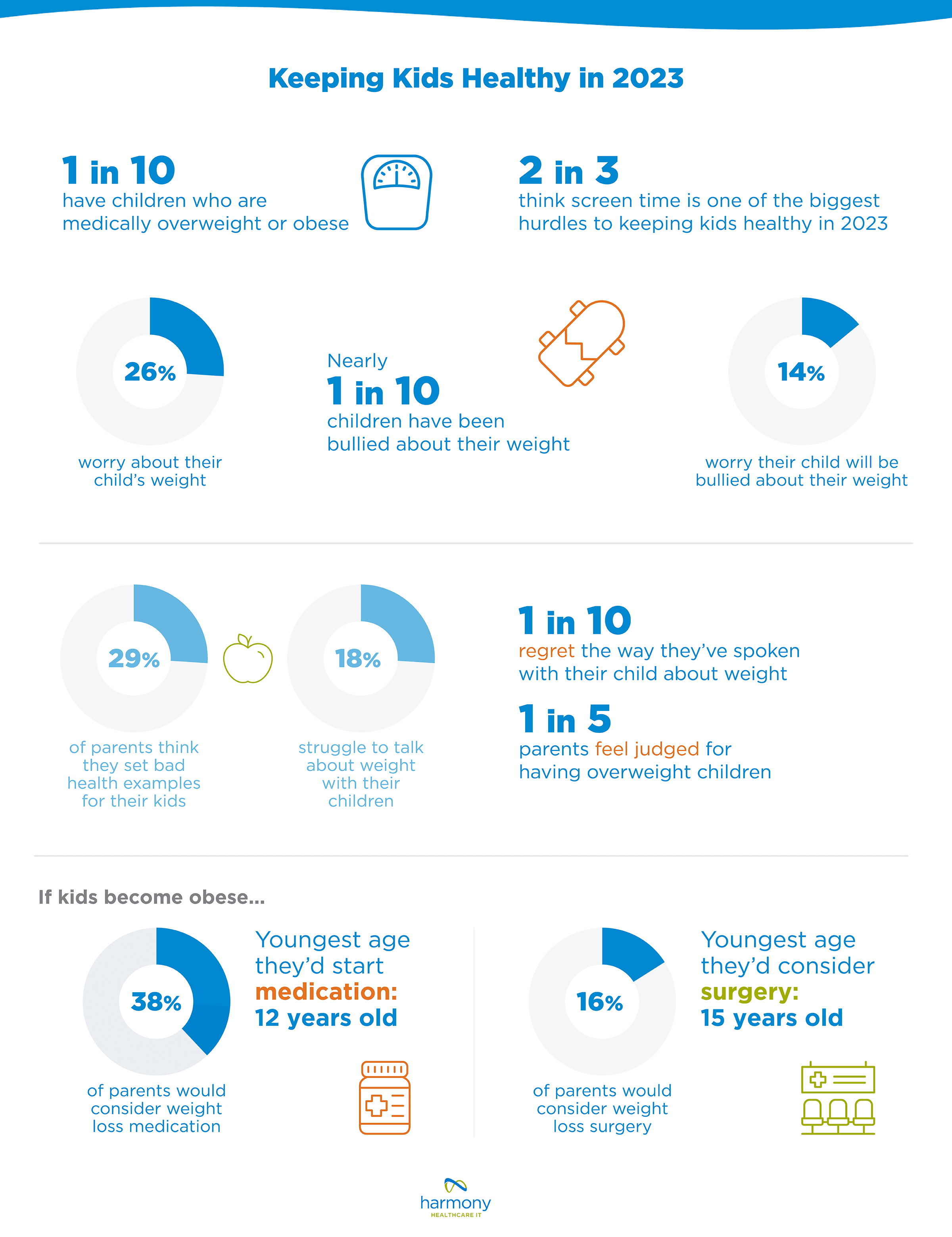
Nearly 2 in 5 (38%) parents would consider weight loss medication for their child if they became obese. Parents agreed with the recommendation from the American Academy of Pediatrics, noting the youngest age they’d start medication would be 12.
Meanwhile, about 1 in 6 (16%) parents would contemplate weight loss surgery for an obese child. However, parents would not consider this surgery until their child was an average age of 15, rather than the association’s recommended age of 13.

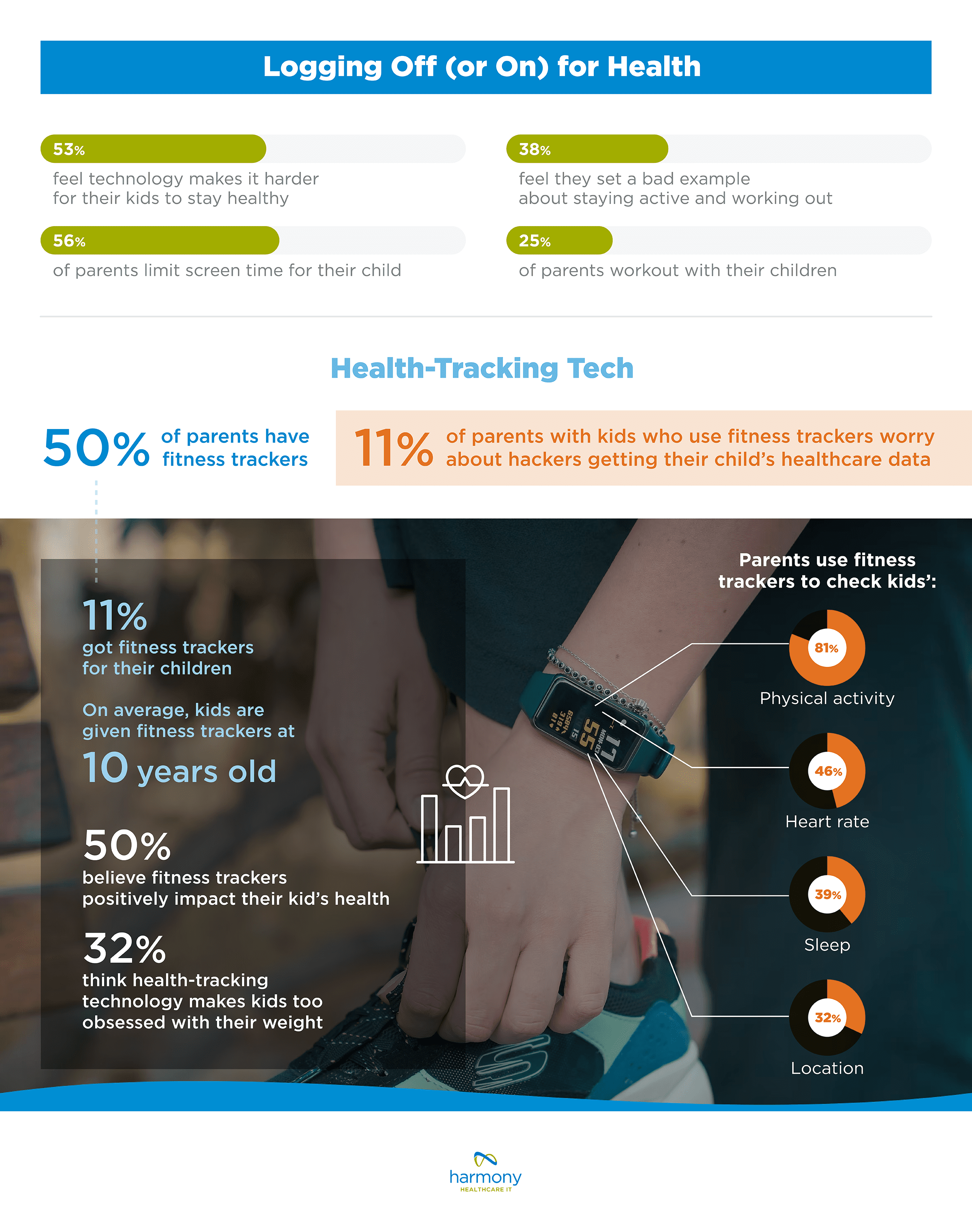
There are a lot of challenges to being healthy, but most (63%) parents agreed the biggest hurdle in 2023 is screen time. In fact, 53% feel technology makes it hard for their kids to stay healthy. Others noted getting kids to eat healthy foods or get a good night’s sleep is also a struggle.

Talking to Kids About Healthy Eating

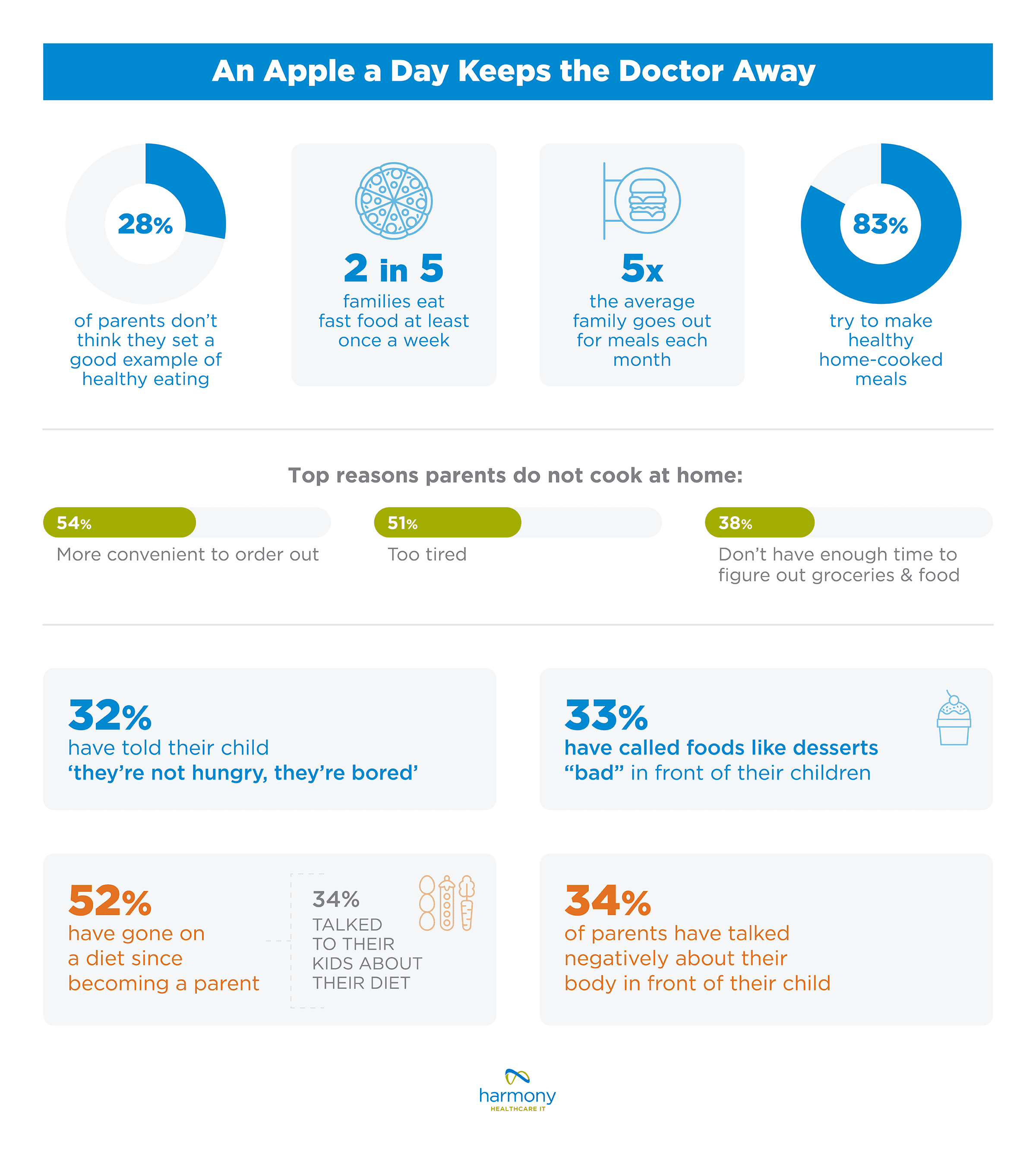
Talking to Kids About Healthy Eating and Fast Food report from www.harmonyhit.comNearly 1 in 3 (28%) parents don’t feel like they’re setting a good example when it comes to healthy eating. While 83% try to make healthy home-cooked meals, about 2 in 5 (39%) families eat fast food at least once a week. On average, families go out to eat for about 5 meals a month.
One of the top reasons parents don’t cook at home is because more than half (51%) are just plain tired. For 54% it’s more convenient to eat out, and 38% don’t have enough time in the day to figure out groceries and food.

While parents struggle to talk about weight with their children, many also struggle to talk about food too. 1 in 3 have called food like desserts ‘bad’ in front of their children, and 34% have talked negatively about their bodies while their kids were around.

How Tech Helps (or Hurts) Kid’s Health

Ways tech negatively affects children and how parents use fitness trackers report from www.harmonyhit.comWhile 1 in 4 exercise with their children, many parents feel like they’re dropping the ball when it comes to staying active. Nearly 2 in 5 (38%) believe they set a bad example about working out.

When it comes to technology, more than half (56%) limit screen time for their children, but some are trying to use tech for good! More than 1 in 10 (11%) have gotten fitness trackers for their children. On average, parents have gotten fitness trackers for their kids when they turned 10.

Most (81%) parents use trackers to monitor their child’s physical activity, but 46% check their child’s heart rate, 39% look at sleep patterns, and 32% track location.

While 50% believe fitness trackers positively impact their kid’s health, 32% of parents feel health-tracking technology is making kids too obsessed with their weight. Some also worry about cybersecurity. Of the parents who have gotten fitness trackers, 11% are worried about hackers getting their child’s healthcare data.

Either way, parents are trying their best to find interesting ways to promote an active lifestyle. It’s a difficult job encouraging kids to keep moving and eat healthy in a world where so much is online. Our advice to parents? Just take it one day at a time. Don’t beat yourself up if you have a day filled with more screen time or fast food than you’d have liked. Tomorrow is a new day! Here’s to a healthier 2023.

Methodology

In January 2023, we surveyed 1,063 parents of kids ranging in age from newborns to 18 years old. 47% identified as men, 52% as women, and 1% as non-binary. Respondents ranged in age from 20 to 63 with an average age of 37. 34% were stay-at-home parents and 66% were not. Parents had an average of two children. 29% of kids range in age from newborns to 3 years old, 32% ages 4-8, 20% ages 9-12, and 19% ages 13-18.

For media inquiries, please contact media@digitalthirdcoast.net.

Fair Use

When using this data and research, please attribute by linking to this study and citing Harmony Healthcare IT

Healthcare IT tips, guides, news & more delivered to your inbox

Learn More

Summary

What are the most vital considerations about legacy applications for hospital Chief Information Officers (CIOs) in 2023? See how College of Healthcare Information Management Executives (CHIME) members responded in a recent online survey.

Join Fellow Healthcare IT Pros

Tips, Guides, News & More

Sign Me Up
CIO Survey Results

The two main factors driving legacy data management decisions at healthcare organizations:

Security is the primary pain point driving archiving vendor evaluation and selection so that vulnerable systems and infrastructure may be retired.

Cost savings in maintenance from decommissioning legacy applications is reported as an expectation of more than half of respondents.

Survey results show CIOs believe that having an archive solution in place is a key ingredient in long-term clinical, financial, and business records management. With 71 percent reporting they already utilize an archive, the same percentage reports their organization has data archiving projects on tap in 2023.

The results

For a summary, download the 2023 CIO CHIME Legacy Applications Survey Results

CHIME CIO Survey Infographic

Question 1: To what extent do the following pain points impact a healthcare organization as it relates to use of legacy applications?

Results: Security vulnerability is the top concern with 81 percent of respondents reporting it has a significant or very significant impact. Other concerns reported in rank order of importance: technology, compliance with regulations, cost, IT labor burden and continuity of care.

Question 2: Does your organization have legacy applications up and running?

Results: Almost all respondents (94 percent) answered yes to having legacy applications still in operation.

Question 3: Does decommissioning legacy applications represent a significant cost savings opportunity for your organization?

Results: 58 percent of respondents reported  that decommissioning legacy applications provides significant cost savings.

Question 4: How would you rate application rationalization as a priority for your organization’s information technology (IT) department?

Results: More than three quarters (77 percent) responded that decommissioning legacy applications is a medium to high priority.

Question 5: Does your organization have a data archive in place?

Results: 71 percent have an archive already in operation.

Question 6: Does your organization have data archiving projects in its 2023 plans?

Results: 71 percent answered yes to having archiving projects on their to-do lists this year.

Question 7: Please rank the following drivers for importance in choosing a data archiving vendor.

Results: Security topped the list as the most important factor for vendor selection with 100 percent of respondents listing it as important or very important. Other factors listed in order of priority: cost, system experience, ratings by 3rd party analysts (e.g., KLAS Research, Black Book Research), project management philosophy and sales team knowledge.

Considerations and next steps

To assist healthcare delivery organizations with legacy health data management, Harmony Healthcare IT has developed a suite of products and services that consolidates data stores, reduces out-of-production system maintenance costs, mitigates technical risk, complies with record retention mandates, and offers both interoperability and data analytics capabilities.

Once legacy systems get inventoried and prioritized in an online application rationalization tool called HealthData Planner, decisions are made to decommission a legacy system.  Structured and unstructured data is either extracted and converted to a go-forward system (i.e., Epic, Cerner, MEDITECH) or migrated and secured into one of the company’s active archive solutions, HealthData Archiver® or HealthData AR Manager®.

Records are then activated for interoperability with other systems, entities or consumers via HealthData Integrator®, which provides a set of tools or APIs based on common industry standards such as USCDI, FHIR, HL7, C-CDA, XML, or Direct. This helps enable compliance with regulations of the 21st Century Cures Act.

Resources related to security:

Resources related to cost savings:

Is your organization looking for a strong partner to successfully manage legacy data? We’re ready to help.

Note: Survey data is based on responses from 31 CIOs in January 2023.

Healthcare IT tips, guides, news & more delivered to your inbox

Learn More

Summary

Health IT innovations are delivering important contributions to patient care and operational excellence. Simultaneously, there are increased pressures to contain costs, seamlessly deliver data to patients and between providers, and to keep that data safe and secure throughout its lifecycle. Harmony Healthcare IT shares three trends that will drive health IT success in the coming year.

Join Fellow Healthcare IT Pros

Tips, Guides, News & More

Sign Me Up
2023 Hit Trends

We are dedicated to assisting healthcare delivery organizations with health data management. This includes big picture product planning down to tactical project execution on data extractions, conversions, and migrations. Looking at 2023, our team is watching three trends that each require providers to have a strategy and a plan.

1. Containing Costs Will Have Every Department on the Front Line

Our Take: Financial pressures in healthcare are being driven by increased labor costs, staffing shortages, supply chain issues and inflation. According to industry research, hospital and health system expenses are expected to increase $135 billion in 2023. Rural hospitals continue to struggle with 30% at risk of shutting down.

These cost pressures are being met with unprecedented health data volumes. In fact, 30% of the world’s data volume currently is generated by the healthcare industry, and by 2025 the compound annual growth rate for health data is expected to hit 36%. This is faster than other industries such as manufacturing, financial services, media and entertainment.

Managing the lifecycle of health data involves an evolving portfolio of systems and applications. Over time, some systems/applications are kept up and running to meet record retention requirements but can actually cost an organization up to a 15% budget increase every year in maintenance alone. For many reasons, streamlining the IT portfolio may be a better alternative.

Our Recommendation: Reduce the cost burden by streamlining your application portfolio. This includes taking steps to prioritize and decommission data stores to reduce costs and comply with record retention regulations. An active archive like HealthData Archiver® can consolidate the legacy data and keep it secure and accessible to meet Cures Act and other requirements.

Our Resources: Check out these resources for more information about cost containment.

2. The Patient is Center Stage as IT Providers Step up to Deliver

Our Take: Every healthcare delivery organization in the country is working through compliance with the 21st Century Cures Act and ONC Final Rule. The goal of the Act/Rule is seamless and secure access, exchange, and use of electronic health information for patients and between providers. While we have all witnessed the evolution of the regulations coming to light, the time is now for providers to avoid information blocking and meet interoperability requirements or face fines for noncompliance.

Expanded rules expected to gain traction in 2023 include even more transparency in information for patients including the availability for patients to view clinical notes and notes from staff members.

Innovative IT solutions are needed more than ever to support compliance with the Cures Act and to offer best practices for sharing data with consumers.

Our Recommendation: Ensure the full historical patient narrative can be delivered to the patient upon request to increase care and satisfaction. When considering how to include historical records as a part of the release of information, consider a

Our Resources: We have several resources that provide an in-depth analysis of the health IT challenges and suggestions relating to the Cures Act.

3. Security Focus Requires Vigilance – Legacy Software Ranks as No. 1 “Bad Practice”

Our Take: Healthcare continues to be the number one target for cybersecurity attacks. Over time, EMRs have become more of a target and now represent 10 percent of all cyberattacks. Another record setting figure is the average cost of a breach is at an all-time high of $10.1 million. While there are many initiatives underway to tighten security and provide more training to employees, keeping legacy and unsupported software in use is the leading “bad practice” according to the Cybersecurity and Infrastructure Security Agency (CISA).

Our Recommendation: It is imperative to consolidate legacy data and decommission out of production applications. This action is a major step forward toward keeping the patient, business, and employee data in your care secure.

Our Resources:

Our team is onboard and ready to assist healthcare delivery organizations with health data management with customizable solutions to meet our clients’ unique requirements.

We offer a suite of products and services that consolidates data stores, reduces out-of-production system maintenance costs, mitigates technical risk, complies with record retention mandates, and offers interoperability capabilities.

Is your organization looking for a strong partner to successfully manage legacy data? We’re ready to help.

Healthcare IT tips, guides, news & more delivered to your inbox

Learn More

Summary

Approximately 46 million people – or 15 percent of Americans – live in rural areas. Rural Americans face a larger number of health issues (heart disease, cancer, unintentional injury, stroke, and others) than their urban counterparts. Caring for rural patients presents unique challenges for healthcare providers who may need to rally some creative thinking, smart planning and utilize innovative information technology solutions to deliver high-quality care and experiences that are generally found in major metro regions.

Join Fellow Healthcare IT Pros

Tips, Guides, News & More

Sign Me Up
Rural Hospital CIO Savings

Funding is Tight

The big picture for rural hospitals is that most were cash strapped prior to the COVID-19 pandemic, which further amplified the challenges of a dwindling population, increased reliance on outpatient care, excessive travel distances for patients and health professional shortages. While special financial assistance helped prevent most rural hospital closures in 2021 (only two rural hospitals closed during that year), the expiration of that aid requires swift and smart action.

Technology is key for rural healthcare success at Singing River Health System in Mississippi  

Enhancing patient care by driving technology improvements and implementations is how one rural health system is making a positive impact on its patients, clinicians, and communities it serves.

“When you lead information systems for a healthcare provider, you are more than an IT professional,” explains Kory Hudson, Director of Information Systems & Health Information Management at Singing River Health System in Mississippi. Hudson refers to hospital patients as “guests” and the role his 120-person IT team plays as “providing the best technology and the best services with no interruptions.”

This approach helped with the large Epic® electronic health record (EHR) installation which reduced paper records by 90 percent and brought more than $2 million in savings, primarily from consolidating and archiving protected health information and previous business records that were spread across multiple legacy systems.

Read the American Healthcare Leader article: Kory Hudson Uses Data as a Differentiator.

Prepare for the future with out-of-the-box thinking and smart planning

While rural hospitals and small acute care facilities do face challenges, there are opportunities to survive and even thrive by adapting to a market-based, patient-centered approach that provides real value to patients and other stakeholders. By embracing transparency, increased accountability and a consumer-centered model for health care, rural hospitals can provide higher-quality care at a lower cost.

Collaboration and Cost Sharing are Key

Perhaps one of the most important roles rural hospitals can play is with managing population health. It is becoming more and more important for the EHR to become the CHR – Comprehensive Health Record – which combines data points on a patient’s emotional state, sleep patterns, family dynamics and other key factors that contribute to overall health. This information and care delivery that often is a part of the rural healthcare experience is gaining popularity for contributing to overall improvements in patient outcomes.

Many remote hospitals are finding new and innovative ways to survive. Rural hospitals are forming accountable care organizations, creating patient-centered medical homes, and launching initiatives to improve the health of their communities. As those who live miles from their closest neighbor know, working together can mean survival, and few know it better than rural hospital CEOs.

Accessible Archive Provides Complete Patient Narrative and Cost Savings  

One of the easiest steps forward in cost savings and technology leadership for a rural hospital CIO is to create a solid long-term plan for legacy EHR and/or ERP systems. Often, legacy systems are left operating in read-only format, creating technical vulnerability, and running up unnecessary charges.

It is important to comply with record retention regulations. That requires a HIPAA-compliant medical data storage solution that can secure records for the long-term — typically anywhere from seven to 25+ years based on state mandates.  That’s a long time to keep a replaced billing, human resources or EMR system up and running in tandem with new system – especially if there happens to be more than one legacy system.

Servers age. Software applications must be maintained with the latest upgrades. Users who know how to navigate the old system may leave for a new job. For these and other reasons, the legacy system poses risk, not to mention cost and labor burden. Should release of information be required to fulfill a request from a patient, lawyer, employer, payer, or auditor; the patient clinical and financial history must be secure, accessible, discoverable, and easy to share in a HIPAA-compliant format.

To avoid risk and to be compliant with record retention mandates, legacy system decommissioning and data archival are important components of any system replacement. Affordable yet secure solutions exist for rural hospitals to extract data from a retired application and migrate it into an electronic archive. This transition of PHI from a full production system into a more static yet HIPAA-compliant, browser-based relational database allows the hospital to:

  • stop paying software maintenance to the legacy vendor
  • remove the aging server from its technical infrastructure
  • ensure that historical records are consolidated and accessible in a viewer that is easily accessible over time as employees come and go
  • comply with record retention regulations

We can help your rural hospital or acute center create a systemized plan to archive the legacy EHR or ERP that exists in numerous data silos across your organization.

A solid legacy data archive can be a smart step forward in managing historical patient and operational data well into the future. It offers compliance with the numerous local, state, and national regulations and a single, easy to use solution for historical information. As healthcare systems streamline their go-forward systems, so too should they streamline their archiving systems to support easy and efficient record retrieval.

We use a variety of sources for information as well as what we know from our own experience of extracting, converting, migrating, and retaining records from over 550 clinical, financial, and administrative software brands commonly used in healthcare delivery organizations.  Our focus in managing data exclusively for the healthcare industry helps us to pioneer and deliver outstanding HITRUST CSF®-certified cloud-based storage solutions – HealthData Archiver®HealthData AR Manager®, and HealthData Locker with options to enable stored data for interoperability with HealthData Integrator®.

If your rural facility has questions about the most effective and economical means for healthcare information archiving, contact Harmony Healthcare IT.

Healthcare IT tips, guides, news & more delivered to your inbox

Learn More