Summary

The electronic dental record, or EDR, is the EHR of dentistry and a contributor to the overall health picture of the patient. Interestingly, adoption of EDR in dental offices in the United States was higher in 2012 than electronic health record adoption rates in medical offices and was not driven by the HITECH program. Guidelines...

Join Fellow Healthcare IT Pros

Tips, Guides, News & More

Sign Me Up
Dental Laptop EHR

The electronic dental record, or EDR, is the EHR of dentistry and a contributor to the overall health picture of the patient. Interestingly, adoption of EDR in dental offices in the United States was higher in 2012 than electronic health record adoption rates in medical offices and was not driven by the HITECH program.

Guidelines for the Health Information Technology for Economic and Clinical Health (HITECH) Act authorized $30 billion in incentives to increase the adoption of certified electronic health records (EHRs) for meaningful use, but this didn’t necessarily apply to dental practices that didn’t meet the HITECH requirement of serving a patient population inclusive of a 30% rate of Medicaid beneficiaries.

So as the EDR had a strong organic start, the EHR gained momentum from incentives, leaving the EDR to play catchup.

As of 2017, nearly 9 in 10 office-based physicians had adopted an EHR, and nearly 4 in 5 had adopted a certified EHR. 96% of all non-federal acute care hospitals possessed certified health IT.

Comparatively, the last several years has seen the overall EDR adoption rate for clinical support to be around 52%. Adoption rates were higher among: (1) younger dentists; (2) dentists ≤ 15 years in practice; (3) females; and (4) group practices, and are once again making swift strides in the marketplace.

All signs point to the dental IT industry being ripe for growth.

In fact, the global Dental Practice Management Software Market is expected to surpass $2.7 billion by 2025, according to a new research report by Global Market Insights, Inc.

This growth, along with the need for efficient record keeping, is driven by two factors:

  • Severe periodontal diseases in approximately 25% of people aged 65-74 years old, as reported by the U.S. Surgeon General
  • Increased awareness regarding the importance of maintaining oral health, especially among the older population

As the drive for the comprehensive patient health record has become a focus in the medical field, EDR adoption and integration into the dental office continues to increase. Full integration of medical and dental records is an important next step. This linkage already exists in some larger health systems and institutions such as the Marshfield Clinic, and the Veterans Administration system.

Similar to medical records, long term access to dental records is important to patient care and does include retention requirements specific to the industry.

Our team at Harmony Healthcare IT develops and supports HealthData Archiver®, a data management platform providing a single point of access to historical patient, employee or business data for dental and healthcare practices.
EDR

The web-based solution, with its release of information workflows, Single Sign-On integrated clinical views, revenue cycle features and eDiscovery capabilities, provides a significant return on investment for dental practices that are switching to a new system and decommissioning legacy systems. The solution consolidates data stores, reduces out-of-production system maintenance costs, mitigates technical risk, and complies with record retention mandates.

An archiving solution such as HealthData Archiver® provides numerous benefits, including:

  • Easy, long-term access to dental records that meets retention requirements
  • Lower software support costs
  • Lower hardware costs
  • Decreased cybersecurity risk

Harmony Healthcare IT, an industry leader in data management and archival solutions, recently ranked as the top data extraction and migration health IT company according to Black Book Rankings, a division of Black Book Market Research.

Looking for guidance on archiving dental records that will keep you smiling? We’re working with dental practices that are making technology work seamlessly for their business.

Let’s talk.

Ready to connect?

Contact us today to learn more about our healthcare data management solutions.

Healthcare IT tips, guides, news & more delivered to your inbox

Learn More

Summary

  Harmony Healthcare IT is pleased to help spread awareness of National Health Center Week (August 4-10, 2019), the annual celebration of the importance of community health centers. First opening in 1965, these valuable community-based healthcare centers now serve 28 million patients nationwide. Community health centers serve on the front lines of national public health...

Join Fellow Healthcare IT Pros

Tips, Guides, News & More

Sign Me Up
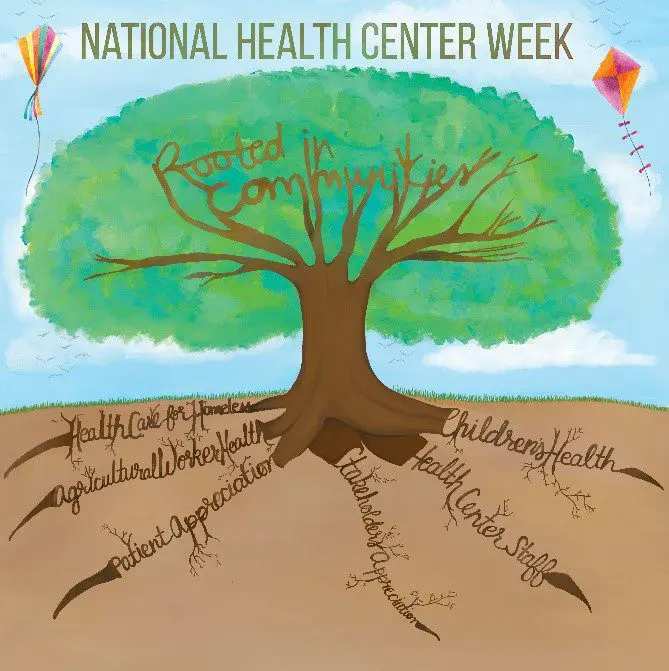
National Health Center Week Tree

Harmony Healthcare IT is pleased to help spread awareness of National Health Center Week (August 4-10, 2019), the annual celebration of the importance of community health centers. First opening in 1965, these valuable community-based healthcare centers now serve 28 million patients nationwide.

Community health centers serve on the front lines of national public health challenges – whether caring for veterans, providing opioid treatment, or responding to natural disasters. With nearly half of health centers located in rural communities, they are also a lifeline in remote and underserved communities where the nearest doctor or hospital can be as far as 50 miles or more away.

These health centers help increase access to crucial primary care by reducing barriers such as cost, lack of insurance, distance, and language for their patients. In doing so, health centers provide substantial benefits to the country and its health care system including:

  • Delivering a broad array of primary and preventive care services, including screening, diagnosis and management of chronic illnesses such as diabetes, asthma, heart and lung disease, depression, cancer and HIV/AIDS
  • Reducing unnecessary hospitalizations and unnecessary visits to the emergency room
  • Treating patients for a fraction of the average cost of one emergency room visit
  • Serving more than one in six Medicaid beneficiaries for less than 2% of the national Medicaid budget
  • Lowering the cost of children’s primary care by approximately 35%
  • Serving over 355,000 veterans throughout the country
  • Saving American taxpayers $24 billion a year in health care costs by preventing and managing chronic diseases

Accessible Archive Provides Complete Patient Narrative and Cost Savings  

Are you part of a community health center team that is focused on record retention requirements and lifecycle data management?

One of the easiest steps forward in cost savings and technology leadership for a community health center is to create a solid long-term plan for legacy EHR and/or ERP systems. Often, legacy systems are left operating in read-only format, creating technical vulnerability and running up unnecessary charges.

It is important to comply with record retention regulations. Doing so requires a HIPAA-compliant medical data storage solution that can secure records for the long-term — typically anywhere from seven to 25+ years based on state mandate. That’s a long time to keep a legacy billing, human resources or EMR system up and running in tandem with a new system – especially if there happens to be more than one.

To avoid risk and to be compliant with record retention mandates, legacy system decommissioning and data archival are important components of any system replacement. Affordable, secure solutions exist for community health centers to extract data from a retired application and migrate it into an electronic archive. This transition of PHI from a full production system into a more static, HIPAA-compliant, browser-based database allows the center to:

  • Stop paying software maintenance to the legacy vendor
  • Remove the aging server from its technical infrastructure
  • Ensure that historical records are consolidated and quickly accessible
  • Comply with record retention regulations

We can help your community health center create a systemized plan to archive the legacy EHR or ERP that exists in numerous data silos across your organization.

Let’s connect. 

About National Health Center Week

This year’s NHCW 2019 will highlight how health centers are at the forefront of a nationwide shift in addressing environmental and social factors as an integral part of primary care, reaching beyond the walls of conventional medicine to address the factors that may cause sickness, such as lack of nutrition, mental illness, homelessness and substance use disorders. Each day of NHCW 2019 is dedicated to a particular focus area.  To learn more and view a listing of events please visit: www.healthcenterweek.org.

Healthcare IT tips, guides, news & more delivered to your inbox

Learn More

Summary

From hot yoga to juicing, it’s no secret that millennials love wellness. In fact, the generation has often been referred to as the “wellness generation.” And while staying in shape is a crucial component to overall health, there are still many other key factors to maintaining health such as annual physicals and getting medical advice...

Join Fellow Healthcare IT Pros

Tips, Guides, News & More

Sign Me Up
Yoga

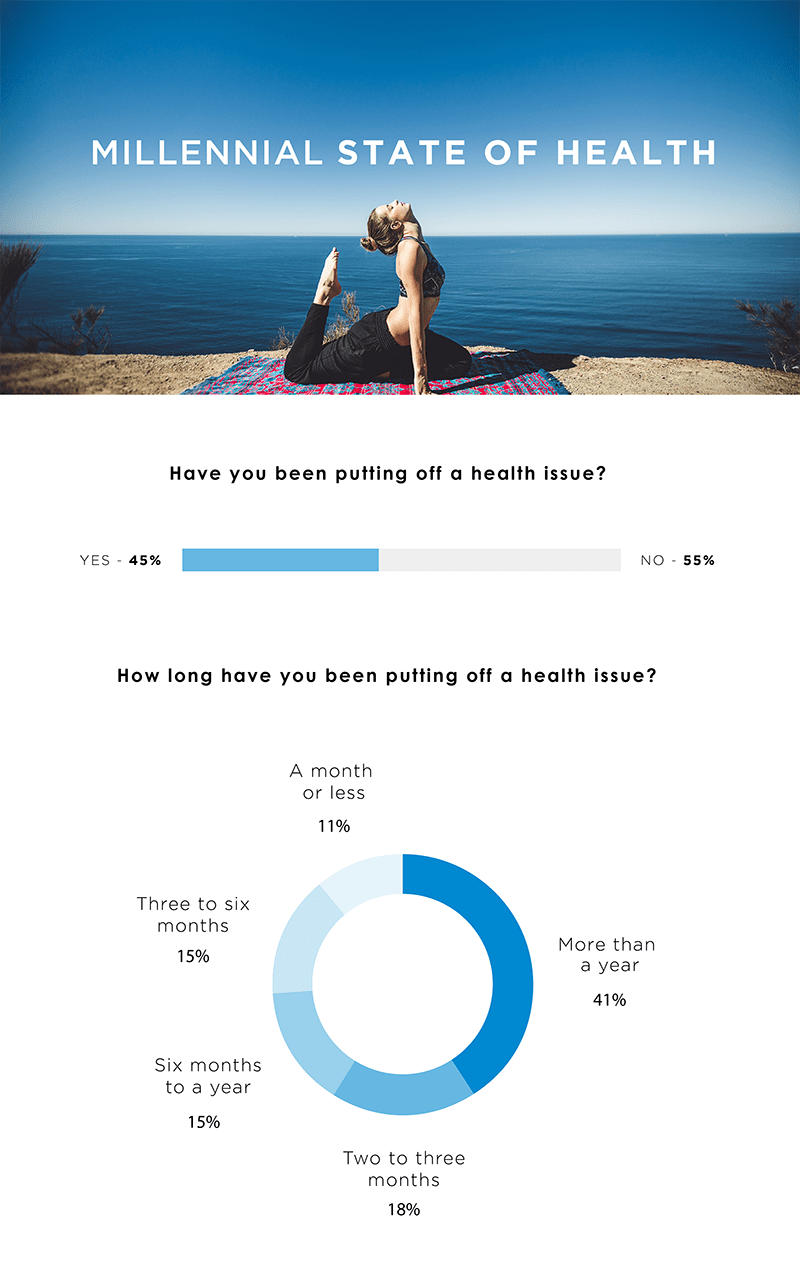
From hot yoga to juicing, it’s no secret that millennials love wellness. In fact, the generation has often been referred to as the “wellness generation.” And while staying in shape is a crucial component to overall health, there are still many other key factors to maintaining health such as annual physicals and getting medical advice from a professional.

But how often are millennials getting a check-up and how many actually have a primary care physician? As a health data management firm interested in the state of millennial health, we surveyed more than 2,000 millennials between the ages of 23 and 38. Here’s what we found.

Putting Off Health Issues

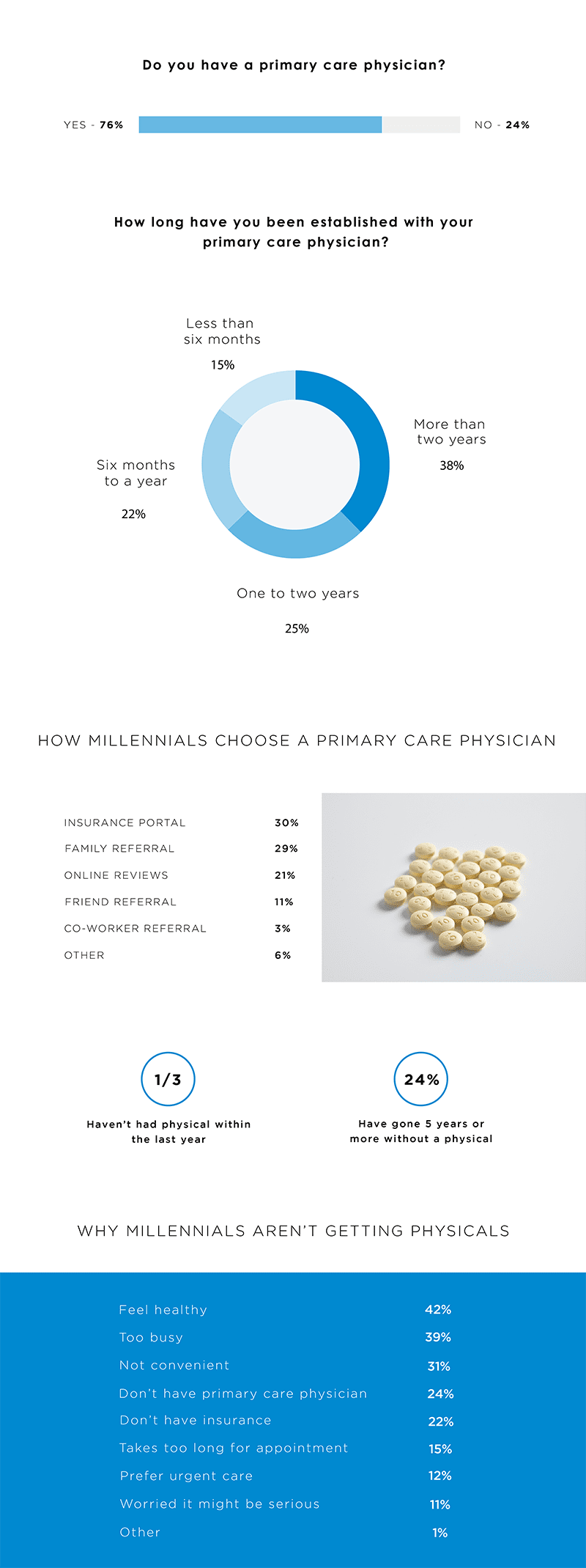
One of the worst things you can do when a health issue arises is ignore it, or delay getting answers. According to respondents, 45% have been putting off a health issue or issues. Of those, 41% have been putting a health issue on the back burner for more than a year. Chances are procrastination will only compound the issue. Seeking recommendations and answers from a professional, such as a primary care physician can prevent matters from getting worse. Thankfully, a majority of millennials said they are established with a primary care professional. According to respondents, 76% have a primary care physician and 38% have been established with one for more than two years.

However, 24% said they have gone five years or more without getting an annual physical examination and one-third have not had a physical within the last year. One of the biggest reasons millennials aren’t getting a physical exam is because they already “feel healthy,” they’re “too busy” and that going to see their physician is “not convenient,” according to respondents.

Online Medical Advice

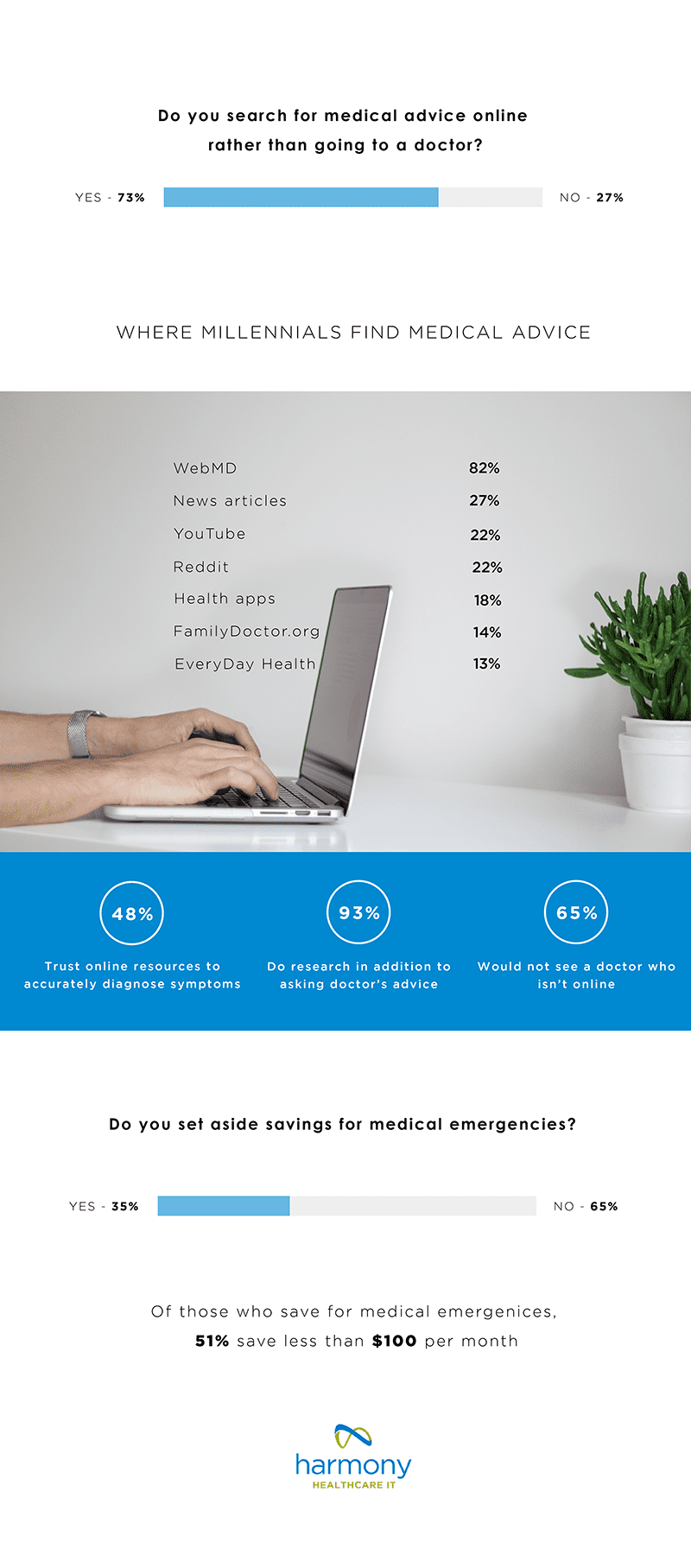
With the advancement of technology and Google at our fingertips, it seems that more and more millennials are turning to the internet to seek medical advice. In fact, 48% of respondents said they trust online resources to accurately diagnose symptoms and a staggering 78% said they seek medical advice online rather than going to a doctor. The most popular resources millennials said they use to find medical advice include WebMD (82%), news articles (27%) and YouTube (22%).

Respondents are also comfortable seeking professional medical advice from physicians via technology. Nearly half (48%) said they would prefer to see a doctor virtually rather than in-person.

Medical Savings

Along with convenience, keeping health care costs low was also important to millennials in our survey. Fifty-seven percent said they prefer a high-deductible insurance plan with a lower premium to keep down monthly costs. And when it comes to saving, 65% are not saving for medical emergencies, according to respondents. Of those who are saving for medical emergencies, half save less than $100 per month.

With an emphasis on convenience, low cost and technology, it will be interesting to see how this generation helps shape the future of health and how both patients and providers will adapt to those changes along the way.

Methodology

In June 2019, we surveyed 2,103 millennials between the ages of 23-38. Fifty-seven percent of respondents were female and 43% were male. Of those respondents, 82% were employed or self-employed. Thirty-five percent of respondents identified as having a pre-existing medical condition.

For media inquiries, contact media@digitalthirdcoast.net.

Healthcare IT tips, guides, news & more delivered to your inbox

Learn More

Summary

Cybersecurity continues to present as one of the biggest financial risks in healthcare, with the average healthcare organization reportedly spending $1.4 million to recover from a cyberattack. According to a 2018 radware report, “Quantifiable monetary losses can be directly tied to the aftermath of cyberattacks in lost revenue, unexpected budget expenditures and drops in stock...

Join Fellow Healthcare IT Pros

Tips, Guides, News & More

Sign Me Up
Chief Financial Officer Puzzle Illustrative

Cybersecurity continues to present as one of the biggest financial risks in healthcare, with the average healthcare organization reportedly spending $1.4 million to recover from a cyberattack. According to a 2018 radware report, “Quantifiable monetary losses can be directly tied to the aftermath of cyberattacks in lost revenue, unexpected budget expenditures and drops in stock values.”

Given the potential for such a tremendous financial impact, it makes sense that CFOs are now taking a more active operations role in this area. This is clearly demonstrated in a recent survey in which 85% of CFO respondents stated they seek greater compliance to proactively audit access to protected health information.

Cybersecurity as a Team Sport 

Organizations of all shapes and sizes, in all industries, are challenged with fortifying their cybersecurity defense. In their “2019 Future of Cyber” survey, Deloitte reports that the organizations best equipped to handle evolving cyber risks are those that spread accountability across the organization.

It is not surprising that this shift in CFO responsibilities spans many industries, not just healthcare. A recent Forbes article explains: “Today’s CFO knows how to budget, allocate resources, and prioritize cyber defense for the whole organization, so he/she can sleep at night.”

The increased CFO responsibilities seem to be beneficial. It’s been found that combining CFO and COO roles have led to improved financial reporting quality, with accruals being relatively more predictive of future cash flows. The broad-based training among those in the top financial role also suggests that CFOs who are given operational control can effectively perform both roles.

Archiving Legacy Data Adds to Cybersecurity Defense

As CFOs and the entire IT team continue to refine and update the health system’s long-range plan for cybersecurity, it makes sense to include a review of the landscape the team is protecting. Bottom line, a health team’s best defense is to limit the number of systems it needs to safeguard. There are many business reasons to consolidate legacy systems into a single and secure archive, but perhaps the most important is the added security of having less systems at risk for attack.

When considering decommissioning legacy systems and determining how to handle legacy data management to shore up the risk factor to your PHI, there are a few things you’ll want to ask any future archiving partner.

As the number one firm in data extraction and migration as ranked by Black Book, we’re also here to answer any questions you have on securing your legacy data.

Are you a CFO or part of a team charged with shoring up security and mitigating risks?
Let’s talk.

Healthcare IT tips, guides, news & more delivered to your inbox

Learn More

Summary

HIPAA, or the Health Insurance Portability and Accountability Act, is a well-known acronym in the healthcare industry. It’s a law protecting patient medical records including a privacy right identifying who has access to protected health information (PHI). Healthcare workers are legally bound to meet HIPAA regulations, and patients routinely see paperwork educating them on HIPAA...

Join Fellow Healthcare IT Pros

Tips, Guides, News & More

Sign Me Up
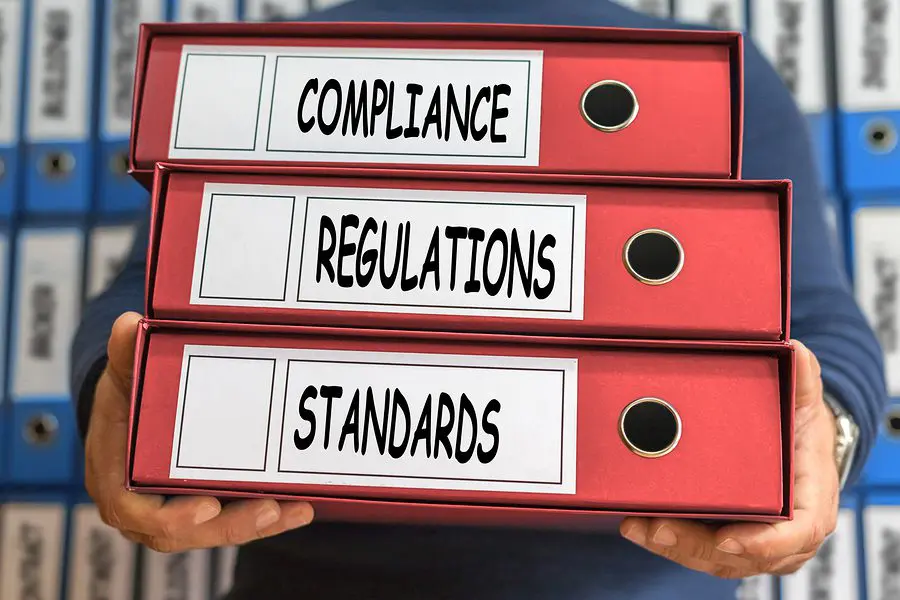
Compliance Regulations and Standards

HIPAA, or the Health Insurance Portability and Accountability Act, is a well-known acronym in the healthcare industry. It’s a law protecting patient medical records including a privacy right identifying who has access to protected health information (PHI). Healthcare workers are legally bound to meet HIPAA regulations, and patients routinely see paperwork educating them on HIPAA compliance and their rights when it comes to the protection of their personal information. In short, HIPAA is everywhere.

HITRUST, on the other hand, isn’t the well-known healthcare acronym that HIPAA is. The Health Information Trust Alliance (HITRUST) is also not a law. While HIPAA is a federal act that sets compliance standards, HITRUST is an organization that has established a common security framework (CSF) to help companies reach HIPAA standards and beyond. The HITRUST CSF is certifiable and brings together several compliance frameworks like HIPAA, NIST, PSI, and ISO. This certifiability is the difference between HITRUST and being HIPAA compliant.

HIPAA includes physical, technical, and administrative safeguards which outline the policies, procedures, and requirements that healthcare entities must adhere to. HIPAA compliance, although punishable by law if not followed, can be difficult to track and enforce. In fact, in the past, healthcare organizations were  simply expected to sign a form stating they’d taken the right measures to put data security controls into place to protect PHI. Although HIPAA enforcement laws have since improved, it’s still arguably a risk assessment process in which a standard is subjectively deemed as met or not.

HITRUST certification demands more objectivity. In fact, the CSF framework and HITRUST assessment and certification have 19 different domains that are necessary to address:

  1. Healthcare Data Protection & Privacy
  2. Information Protection
  3. Wireless Protection
  4. Transmission Protection
  5. Network Protection
  6. Endpoint Protection
  7. Portable Media Security
  8. Mobile Device Security
  9. Third Party Security
  10. Physical & Environmental Security
  11. Configuration Management
  12. Vulnerability Management
  13. Password Management
  14. Incident Management
  15. Risk Management
  16. Access Control
  17. Audit Logging & Monitoring
  18. Education, Training & Awareness
  19. Business Continuity Management & Disaster Recovery

The HITRUST CSF provides a comprehensive risk management framework optimized specifically for the healthcare industry, including mapping of the required implementation specifications from the HIPAA Security Rule. For organizations with specific risk factors, the HITRUST CSF provides a solution that addresses the additional required controls to meet compliance.

By integrating controls from several applicable frameworks and best practice standards, along with tailoring the requirements specifically to the needs of healthcare organizations, HITRUST speaks to most of an organization’s risk analysis, one of the tenet requirements of HIPAA, and one of the most often cited issues in audits conducted by the Office for Civil Rights (OCR).

As noted by HITRUST Alliance, healthcare professionals can use HITRUST for direction on relevant industry security and privacy issues, as well as for specific information about how to integrate an organizational information protection program.

Feel like you need more clarity on the difference between HIPAA and HITRUST? We can help.  As a leading medical data management firm offering HealthData Archiver®, a long-term PHI storage solution, Harmony Healthcare IT knows how to navigate risk analysis.

Healthcare IT tips, guides, news & more delivered to your inbox

Learn More

Summary

Location, location, location. It matters in real estate.  Does it matter in healthcare IT as well? From small practices to large enterprises, every healthcare organization has a decision to make regarding where its data is stored – on-site or in the cloud. This decision, which needs to be made for both active EHR and ERP...

Join Fellow Healthcare IT Pros

Tips, Guides, News & More

Sign Me Up
Celebrating at a grassy workstation

Location, location, location. It matters in real estate.  Does it matter in healthcare IT as well?

From small practices to large enterprises, every healthcare organization has a decision to make regarding where its data is stored – on-site or in the cloud. This decision, which needs to be made for both active EHR and ERP applications as well as archived patient and business data from legacy systems — impacts finances, resources, security and project timelines.

Traditionally, healthcare organizations have purchased, housed and maintained their own infrastructure for data archiving. It felt secure and controlled, and it likely aligned with the deployment strategies for EHR and ERP.  However, on-premise archive deployment also came with a need for up-front investment, air-conditioned and monitored server space and dedicated IT resources.

Cue the Cloud.

In a recent survey, 70% of healthcare executives surveyed reported that health IT is trending toward the cloud. This is indicative of the notion that most healthcare organizations evaluating their storage strategy and infrastructure are likely moving to a cloud solution.

Beyond fulfilling the basic need for advanced and secure storage technology, archiving health and business data to the cloud versus on-site:

  • offers a predictable monthly investment versus up-front
  • eliminates the need for platform management and maintenance
  • makes deployment and the upgrade process quicker and easier
  • reduces the chances of data loss in the case of disaster

These advantages play a large part in why the global healthcare cloud market is forecasted to grow by $16.4 billion between 2017-2022, a compound annual growth rate of 22%.

Harmony Healthcare IT recognizes the desire in the industry for a secure, cloud-based data management tool to meet the demand for quick access to critical legacy data.

That’s why we offer HealthData Archiver®, a long-term data storage solution that delivers a single point of access to historical patient, employee or business data for healthcare delivery organizations.  The solution consolidates data stores, reduces out-of-production system maintenance costs, mitigates technical risk, complies with record retention mandates, and offers both interoperability and data analytics capabilities.

We may work in the cloud, but we’re down to earth with technical and business guidance to help your organization meet data management needs. If you’re searching for a new archiving solution built to accommodate healthcare clinical and release of information workflows, we’re ready to talk.

Healthcare IT tips, guides, news & more delivered to your inbox

Learn More

Summary

Cybercriminals are targeting small healthcare businesses with increased vigor. In 2018, across all industries, about 70% of ransomware attacks targeted small businesses, with an average ransom demand of $116,000. The stats are equally as formidable for Q1 of 2019, with ransomware attacks on business targets increasing by 195 percent. What does this mean for ambulatory...

Join Fellow Healthcare IT Pros

Tips, Guides, News & More

Sign Me Up
Ransomware Attack

Cybercriminals are targeting small healthcare businesses with increased vigor.

In 2018, across all industries, about 70% of ransomware attacks targeted small businesses, with an average ransom demand of $116,000. The stats are equally as formidable for Q1 of 2019, with ransomware attacks on business targets increasing by 195 percent.

What does this mean for ambulatory practices?
Smaller healthcare practices are ripe targets for cybercriminals. The hackers look for vulnerabilities that are easy to infiltrate and then lock up the network, virtually shutting down the operation until the ransom is paid or restorative measures can get the practice up and running again.

And, that’s a best-case outcome.

In fact, within a span of just seven days in the month of June five US healthcare practices reported ransomware attacks, driving some to return to the days of paper and pencils while they worked toward restoring their systems. Others paid ransom to be reunited with their data, with one organization being forced to pay ransom twice after finding additional locked files when decrypting its systems.

At a minimum, the practices were disrupted for several days, but sometimes there are much more dire consequences.

In the case of Brookside ENT and Hearing Center, the owners chose not to pay the ransom. As a result, the hackers wiped the entire system clean, including the deletion of payment data and patient information. This led to the decision to close the practice while the unintended violation of HIPAA compliance regulations could bring additional fees.

Healthcare continues to be a cybersecurity target due to the richness of the data and its critical importance to the business. Cybercriminals aren’t discriminating – with each successful attack, the dark strategy may be refined to further zero-in on small and mid-size practices.

“Unfortunately, it’s often smaller businesses that are most vulnerable to attack by cybercriminals as they frequently lack the resources and protocols of larger firms,” says Beazley Breach Response Services Head Katherine Keefe.

One of the most important steps in protecting your organization’s PHI is to identify risk factors, especially in the case of legacy systems which can be an open door for attacks.

A health practice’s best defense is to limit the number of systems it needs to protect. There are many business reasons to consolidate legacy systems into a single and secure archive, but perhaps the most important is the added security of having less systems at risk for attack.

When considering decommissioning legacy systems and determining how to handle legacy data management to shore up the risk factor to your PHI, there are a few things you’ll want to ask any future archiving partner.

As the number one firm in data extraction and migration as ranked by Black Book, we’re also here to answer any questions you have on securing your legacy data.

Ready to decrease your ambulatory practice system vulnerabilities and increase your security? We’re ready to help.

Healthcare IT tips, guides, news & more delivered to your inbox

Learn More

Summary

To purge or not to purge, that is the question. Making sense of legacy health data retention takes equal parts patience and planning. Although HIPAA privacy rules don’t address medical record retention requirements, there are retention mandates that vary by state. For example, hospitals in MA are required to retain health records for 30 years...

Join Fellow Healthcare IT Pros

Tips, Guides, News & More

Sign Me Up
Purge Files

To purge or not to purge, that is the question.

Making sense of legacy health data retention takes equal parts patience and planning.

Although HIPAA privacy rules don’t address medical record retention requirements, there are retention mandates that vary by state. For example, hospitals in MA are required to retain health records for 30 years after the discharge date of final date of service. On the flip side, nine states require hospitals to keep those same records for only 5 years, while others provide no specific retention requirements for hospitals.

The fluctuation in requirements has led many organizations to individualize their purging practices. Some providers prefer to keep every patient record in perpetuity, while others follow a detailed record destruction strategy based on specific criteria.

AHIMA offers this guidance on retention and destruction of health information:

Destruction of patient health information by an organization or provider must be carried out in accordance with federal and state law pursuant to a proper written retention schedule and destruction policy approved by appropriate organizational parties.

As with record retention, there is no single standard destruction requirement. Some states require organizations to create an abstract of the destroyed patient information, notify patients when destroying patient information, or specify the method of destruction used to render the information unreadable. Organizations should reassess the method of destruction annually based on current technology, accepted practices, and availability of timely and cost-effective destruction services.

As the need to provide patients and providers accessibility to old medical records becomes more and more apparent, the line between which records should be kept and which should be discarded becomes increasingly grey. However, it’s possible to streamline your lifecycle data management by retaining legacy records in a secure and searchable way that also supports your purging strategy.

When considering your medical retention policy plan, take into account the cost and efficiency benefits archiving legacy data can provide. Maintaining old medical records and additional PHI doesn’t have to take up massive amounts of server space, file room, time and money – an archiving solution such as HealthData Archiver® can turn that blurred line into a more clear path by providing:

  • Easy, long-term access to data that meets retention requirements
  • Lower software support costs
  • Lower hardware costs
  • Decreased cybersecurity risk
  • Flexible purging capabilities

If it’s time to come up with a legacy data management plan and you’re unsure about which records to keep, which to purge, or how to maintain your old data without sinking substantial resources into it connect with us – we’re here to help.

Healthcare IT tips, guides, news & more delivered to your inbox

Learn More

Summary

When Priya Prakash was a child, she had poor health habits, was overweight and had a lot of struggles in school. Today, she’s on a mission to change that type of story for millions of children in India. Founding HealthSetGo, Priya is the CEO of the systematic healthcare platform that, to date, monitors and electronically...

Join Fellow Healthcare IT Pros

Tips, Guides, News & More

Sign Me Up
Thinking Illustration

When Priya Prakash was a child, she had poor health habits, was overweight and had a lot of struggles in school. Today, she’s on a mission to change that type of story for millions of children in India.

Founding HealthSetGo, Priya is the CEO of the systematic healthcare platform that, to date, monitors and electronically tracks the growth and development of more than 2 million students within 250 schools throughout 77 cities.

Intervening early in school and including health education in the curriculum, the program also uses doctors, teachers, and parents as advocates. Teachers are provided program training, while parents are equipped with their child’s continually updated, detailed online health record. This allows parents to have real-time insight into the progress of their children.

How It Works

Every year, children are assessed in the following areas:

  • Overall Physical Health
  • ENT
  • Dental
  • Vision
  • Anthropometric (height, weight and other body measurements)

Each child is given a comprehensive health report, and a health expert provides a teleconsultation to address any of the parents’ queries. Since everything is automated, parents can access and track their child’s health and wellness journey from day one, giving them visibility to any medical, social, or emotional needs that should be addressed with the pediatrician.

This data also helps direct government funding into the specific actions that are most needed. Creating this kind of awareness has already seen the program uncover medical, skin and heart conditions that may otherwise not have been detected. It’s also allowed for intervention on common health concerns such as iron deficiency.

What can the rest of the world learn from Priya and her HealthSetGo team?

That kind of ongoing patient data accessibility and proactiveness is something regularly talked about in the healthcare industry today.

Programs such as HealthSetGo make it apparent that providing health information to patients so they can track it and consult with their physicians makes a difference in their overall health status. It’s important to build a robust health record for each person and it is equally as important for that record to remain viable and accessible to provide the most value.

With EHR systems continuously being transitioned in and out, maintaining that robust record can become more cumbersome. Personal health information (PHI) can get bogged down in hospital/vendor disputes, legacy data can be difficult to quickly access, and legacy EHR systems can be left vulnerable to cyberattacks and breaches.

As the healthcare industry takes a cue from innovators like Priya and continues to strive towards increased interoperability, taking steps to ensure the accessibility of not only current but also legacy health data is paramount.

To help keep complete medical record histories intact, consider including legacy data archiving in your comprehensive data management plan. Consolidating legacy electronic medical records (EMR) into a secure and searchable archive with a single sign-on delivers safe and easy accessibility to ensure patient information is where it is needed now, and later.

Ready to take the next step towards ensuring patients always have access to crucial PHI, no matter how old it is? Get in touch with us, we’re ready to help.

Healthcare IT tips, guides, news & more delivered to your inbox

Learn More

Summary

The nationwide award from Black Book Rankings measures 18 performance areas for operational excellence along with extensive client feedback from numerous organizations served by the data management and archival solutions firm. Harmony Healthcare IT, an industry leader in data management and archival solutions, ranked as the top data extraction and migration healthcare IT company according...

Join Fellow Healthcare IT Pros

Tips, Guides, News & More

Sign Me Up
Silver Black Book 2019 Logo

The nationwide award from Black Book Rankings measures 18 performance areas for operational excellence along with extensive client feedback from numerous organizations served by the data management and archival solutions firm.

Harmony Healthcare IT, an industry leader in data management and archival solutions, ranked as the top data extraction and migration healthcare IT company according to Black Book Rankings, a division of Black Book Market Research.

“Our team appreciates this recognition,” said Laurie Seall, Senior Director of ETL & Data Management at Harmony Healthcare IT. “What makes this award meaningful is that it is based on thorough client feedback from numerous organizations we’ve served, and then audited by an independent panel of executives from Black Book and external sources.”

Black Book collects ballot results on 18 performance areas of operational excellence to rank vendors by software, systems, products, equipment and outsourced service lines. Client users submit ballots per vendor per function, which are juxtaposed with client size, functions outsourced, software installed, systems employed, services rendered, industry/vertical(s) affected, country of service origin and overall service and/or product line domain.

“This industry rating reflects our dedication to excellence and broad expertise,” says Seall. “We have well over a decade of experience in extracting, migrating and transforming data from the widest variety of clinical, financial and business systems used in healthcare delivery organizations nationwide.”

Harmony Healthcare IT develops and supports HealthData Archiver®, a data management platform providing a single point of access to historical patient, employee or business data for healthcare enterprises. The web-based solution, with its release of information workflows, Single Sign-On integrated clinical views, revenue cycle features and eDiscovery capabilities, provides a significant return on investment for healthcare delivery organizations decommissioning legacy systems. The solution consolidates data stores, reduces out-of-production system maintenance costs, mitigates technical risk, complies with record retention mandates and offers both interoperability and data analytics capabilities.

Looking for a reliable partner to help you securely and successfully extract and migrate your legacy data? We’re ready to get started.

Healthcare IT tips, guides, news & more delivered to your inbox

Learn More