Summary

Once again we will join hundreds of other technology companies and healthcare providers this October 2-6 to celebrate National Health IT Week. We are a partner in the advancement of health information technology, to help improve healthcare. “The Harmony Healthcare IT mission – ‘to preserve vital information that improves lives’ is at the heart of everything we do,” shared Tom Liddell, CEO and Managing Partner of Harmony Healthcare IT. “Our team will participate in several company-wide initiatives and events to showcase our support of this nationwide focus on continuing to advance healthcare IT.”

Join Fellow Healthcare IT Pros

Tips, Guides, News & More

Sign Me Up
National Health IT Week

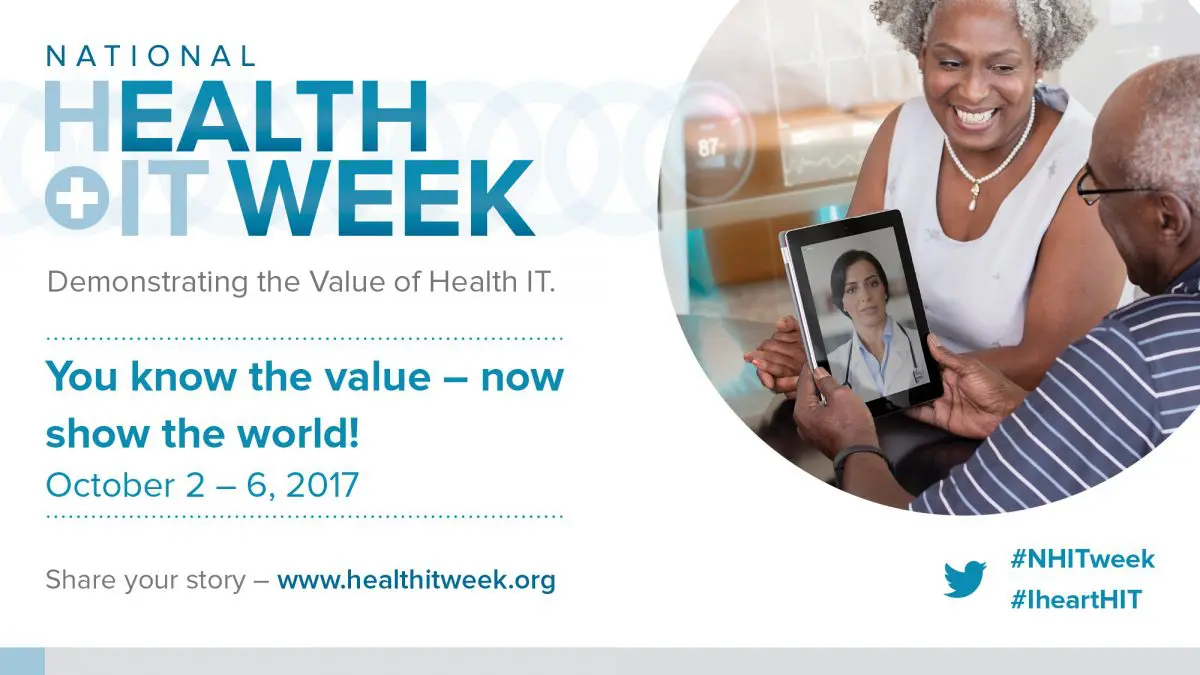
This October 2-6, Harmony Healthcare IT — as a partner in the advancement of health information technology to help improve healthcare —once again will join hundreds of other technology companies and healthcare providers in recognizing National Health IT Week.

National Health IT Week is the premier event offering all healthcare stakeholders an opportunity to unite under one banner, expressing the benefits that health information technology (IT) brings to U.S. healthcare. “The Value of Health IT.”

“The Harmony Healthcare IT mission – ‘to preserve vital information that improves lives’ is at the heart of everything we do,” shared Tom Liddell, CEO and Managing Partner of Harmony Healthcare IT. “Our team will participate in several company-wide initiatives and events to showcase our support of this nationwide focus on continuing to advance healthcare IT.”

As EHR systems continue to be replaced and eventually retired, there is a need for smooth and accurate data migrations, expertly decommissioned legacy systems and secure archives that provide access to historical records from multiple former data sources. Harmony Healthcare IT’s flagship product, Health Data Archiver, is one reason to celebrate. The innovations around HIM workflow management and legal eDiscovery built into this light-weight, browser-based application offers its user base security, performance and compliance with record retention requirements.

National Health IT Week was initiated in 2006 by the Healthcare Information and Management Systems Society (HIMSS), and has emerged as a landmark occasion for using health IT as part of the overall solution to improve America’s healthcare as a bipartisan, federally led, market driven initiative.

Comprehensive health care reform will only be possible with the system-wide adoption of health information technology, which improves the quality of healthcare delivery, increases patient safety, decreases medical errors, and strengthens the interaction between patients and healthcare providers.

National Health IT Week consists of events across the country, including —vendors, provider organizations, payers, pharmaceutical/biotech companies, government agencies, industry/professional associations, research foundations, and consumer protection groups— all working together to elevate national attention to the advantages of advancing health IT.

For more information and to join the National Health IT Week effort, visit the website here.  For more information about Harmony Healthcare IT, it’s team of data experts and its product and service offerings, visit Harmony Healthcare IT or Health Data Archiver.

#IHeartHIT

Healthcare IT tips, guides, news & more delivered to your inbox

Learn More

Summary

Tom Liddell, CEO of Harmony Healthcare IT, attended 20th Annual Rural Health Conference, discussing rural health initiatives, policy challenges, and revenue cycle management.

Join Fellow Healthcare IT Pros

Tips, Guides, News & More

Sign Me Up
IRHA

Tom Liddell, CEO of Harmony Healthcare IT and Board President of the Indiana Rural Health Association (IRHA), participated this week in the 20th Annual Rural Health Conference and Annual General Membership Meeting.

IRHA’s Annual Conference brings together physicians, nurses, pharmacists, public health professionals, and other rural health practitioners and advocates with residents of rural communities. Practitioners from the field and national experts discuss current topics, as well as share the experiences of others in public health and rural health care delivery, along with the latest information regarding the start-up and on-going management of rural health care delivery models.

“This is important work,” says Liddell.  “From our keynote and plenary sessions to our mobile simulation lab to our networking events, we aim to explore and advance public and rural health Initiatives.”

With a theme “Rural Health:  Economy, Impact, Care,” the goals of the conference were to:

  • Recognize the national efforts to support population health and healthcare reform in rural communities
  • Examine unique rural health policy challenges related to finance and quality measurement and resource allocation
  • Recognize how to effectively engage rural populations and leverage community partnerships
  • Recognize the need to integrate primary care and behavioral health
  • Recognize the role of public health and its importance in rural medicine
  • Recognize the current state of opioid abuse in Indiana and how collective efforts can steadily influence the pain population markets
  • Recognize the need for school-based outreach in a rural community and how it can advance the mission of organizations
  • Recognize the benefits of integration of mental health services into primary care in rural settings
  • Recognize the different types of telepharmacy and how it is improving patient care
  • Learn how regulatory changes impact revenue cycle management.

About Harmony Healthcare IT
Since 2006, health IT analysts at Harmony Healthcare IT have extracted demographic, financial, clinical and administrative data from hundreds of healthcare providers – both ambulatory and acute. Headquartered in South Bend, Indiana, the company’s mission is to preserve vital information that will improve lives. Harmony Healthcare IT employs experts in data extraction, migration, retention, integration and analytics to provide its clients with trusted solutions. Working with hundreds of systems, billions of records and terabytes of data, Harmony Healthcare IT — with its product, Health Data Archiver — provides clients with access to historical records. Simply.

About IRHA
The Indiana Rural Health Association (IRHA) is a not-for-profit organization representing a diverse statewide membership consisting of individuals and organizations committed to the improvement of health and resources for rural Hoosiers. IRHA seeks to provide a meaningful forum for assessing the strengths and weaknesses of the health and safety of rural communities in Indiana. IRHA seeks to provide educational programs that focus on the unique needs of the residents of rural Indiana and the providers who serve them. IRHA also works to educate the public on relevant issues and focus unified efforts to bring about the necessary changes in public and private policies to ensure that all rural Hoosiers have access to quality health care in their own communities. More information about the IRHA can be accessed through www.indianaruralhealth.org.

Healthcare IT tips, guides, news & more delivered to your inbox

Learn More

Summary

Recent news of a federal lawsuit against eClinicalWorks (eCW) alleges the company falsified its EHR capabilities pertaining to ‘meaningful use’ program requirements. If you’re a user, now might be an opportune time to replace eCW. The settlement includes provisions that require eCW to assist its customers in making the switch to the products of other competitors, at no charge.

Join Fellow Healthcare IT Pros

Tips, Guides, News & More

Sign Me Up
Stethoscope and Gavel Law

Recent news of a federal lawsuit against eClinicalWorks (eCW) alleges the company falsified its EHR capabilities pertaining to ‘meaningful use’ program requirements.  The suit, brought forward by the Department of Justice, claims the company “falsely obtained that certification for its EHR software when it concealed from its certifying entity that its software did not comply with the requirements for certification.”  The suit details that the company apparently “hard coded” drug information used for certifying the software to ensure it would pass. Further, the case alleges the software failed to provide data portability requirements that allow healthcare providers to transfer patient data housed in the eCW system to other vendors.

eCW settled the case without admitting to any wrongdoing and now must pay $155 million and agree to obtain an independent Software Quality Oversight Organization for the next five years to assess the quality of their systems and provide semi-annual reports that document the reviews and recommendations.

Source:  https://oig.hhs.gov/fraud/cia/agreements/eclinicalworks_05302017.pdf

Replacing eClinicalWorks EHR

If your organization uses eCW software, it might be an opportune time to consider replacing eClinicalWorks EHR.  Among other provisions, the eCW settlement with the federal Department of Justice includes provisions that require the company to assist its customers in making the switch to the products of other competitors, at no charge. Now, customers can get updated versions of their software free of charge, and upon request, eCW must transfer customers’ data to another EHR vendor without penalties or service charges.

Source: https://www.healthdatamanagement.com/news/settlement-may-affect-rate-at-which-clients-leave-eclinicalworks

Why did this happen?

Electronic medical records (EHR) are big business. A $28-billion dollar business to be exact.  Currently, about 1,000 vendors are vying for their piece of the market. This creates intense competition to evolve the platform capabilities within the systems to provide an even more seamless integration of information at the point of patient care. The result is a concentrated pressure cooker that pits innovation against time-to-market.

And, as a relatively new industry, the safeguards and oversight measures are still being developed. Keep in mind, it was just 2009 when the Health Information Technology for Economic and Clinical Health Act (HITECH Act) was created and the Department of Health and Human Services (HHS) established the Medicare and Medicaid EHR Incentive Programs (also known as the “Meaningful Use program”), to provide payments to healthcare providers who demonstrate “meaningful use” of certified EHR technology.

Over the past several years, adoption of EHRs among non-federal acute care hospitals is nearly universal. In 2015, nearly all reported hospitals (96%) possessed certified EHR technology according to the Office of the National Coordinator for Health Information Technology.

Looking for a Solution for Legacy EHRs?

If your organization is affected by the eCW suit or just looking for a secure storage solution for legacy data from out-of-production EHRs, an archive could provide an opportunity to efficiently consolidate numerous disparate systems into one streamlined, vendor neutral repository.

A well-planned legacy data management strategy alleviates future IT costs, risks and burdens as platforms come and go. Long-term medical data archive vendors that know the EMR market inside and out offer secure solutions that ensure data integrity and meet HIPAA, state and agency medical record retention requirements.

Harmony Healthcare IT as an EMR archiving partner 

The team of data management experts at Harmony Healthcare IT can help when the strategy is to migrate from eCW and disparate legacy patient or employee data sources into a single, secure archive. Complete return on investment usually is realized in 18-24 months. Should you need to decommission eClinicalWorks or any of your legacy systems, contact us.

Healthcare IT tips, guides, news & more delivered to your inbox

Learn More

Summary

With more than 1,000 vendors offering solutions, the $28 billion electronic medical record (EMR) industry is competitive. Recent industry articles with titles like “Is a takeover of athenahealth inevitable?” support the notion that mergers and acquisitions are consolidating the number of EMR vendors in the space — and, subsequently, the number of EMRs.  According to...

Join Fellow Healthcare IT Pros

Tips, Guides, News & More

Sign Me Up
Making a business deal in a room with three people

With more than 1,000 vendors offering solutions, the $28 billion electronic medical record (EMR) industry is competitive. Recent industry articles with titles like “Is a takeover of athenahealth inevitable?” support the notion that mergers and acquisitions are consolidating the number of EMR vendors in the space — and, subsequently, the number of EMRs.  According to a 2017 report by Kalorama Information, we are likely to continue to see consolidation as certain EMRs emerge and dominate as front runners in the integration space since there is not a single EMR system with a true interoperability solution.

CIO’s and IT teams at healthcare providers worldwide are keeping an eye on EMR vendors like athenahealth, which are potentially ripe for acquisition by the larger and better heeled competitors such as Epic, UnitedHealth Group, Cerner and IBM, according to the Healthcare IT News article referenced above.  We’ve seen similar EMR acquisitions in the past when CPSI completed its acquisition of Healthland.

As the EMR industry continues to consolidate, a series of questions permeate the minds of hospital CIOs:  what are my options if my EMR vendor joins the list of acquired companies?  Will the EMR brand stay on the market?  Will it eventually get retired?   If so, what then?

Archiving is a steady solution in a turbulent EMR market

Should any combination of your EMR products be acquired or sunset over time, data archiving is always an alternative to the more costly and complex EMR data conversion.   A well- planned legacy data management strategy alleviates future IT costs, risks and burdens as platforms come and go. Long-term medical data storage vendors who know the EMR market inside and out offer secure solutions that ensure data integrity and meets HIPAA and state medical record retention requirements.

When you look at the real cost of maintaining multiple legacy systems, including licensing, maintenance and support as well as the associated internal IT labor burden, the ongoing management of outdated systems becomes difficult to justify. Plus, the risk exists that the old systems may become obsolete and non-supported. Keeping the organization’s long term vision in mind, there is business value and strategic benefits to adopting an EMR archive to keep legacy data intact in a searchable, manageable and HIPAA-compliant format.

Harmony Healthcare IT as an EMR archiving partner 

The team of data management experts at Harmony Healthcare IT can help when the strategy is to migrate disparate legacy patient or employee data sources into a single, secure archive. Complete return on investment usually is realized in 18-24 months. Should you need to decommission any of your legacy systems, contact us.

Healthcare IT tips, guides, news & more delivered to your inbox

Learn More

Summary

A medical practice may risk compliance with record retention requirements when replacing its billing system or electronic medical record (EMR).  In a guest blog for PracticeSuite, a cloud based medical office platform that offers patient-to-pay ambulatory-care workflow automation software and revenue cycle management services, Harmony Healthcare IT’s VP of Marketing and Business Development,  Shannon Larkin, explains...

Join Fellow Healthcare IT Pros

Tips, Guides, News & More

Sign Me Up
Legacy Data Management for Medical Practices

A medical practice may risk compliance with record retention requirements when replacing its billing system or electronic medical record (EMR).  In a guest blog for PracticeSuite, a cloud based medical office platform that offers patient-to-pay ambulatory-care workflow automation software and revenue cycle management services, Harmony Healthcare IT’s VP of Marketing and Business Development,  Shannon Larkin, explains why the risk is in how legacy patient data is handled.

The article provides a brief overview of

  • the broad definition of protected health information (PHI)
  • state medical record retention mandates
  • the risks associated with leaving legacy systems running in read-only format
  • the benefits of a HIPAA-compliant medical data storage solution like Health Data Archiver

Read the full article at PracticeSuite.

Healthcare IT tips, guides, news & more delivered to your inbox

Learn More

Summary

While the focus of many healthcare systems is likely on the features and benefits that manage data in the go-forward EHR or ERP systems, it is equally as important to focus on the archive that manages legacy patient or employee data that did not get converted. An archive allows providers to decommission the EHR or ERP that got replaced. It provides a long-term, secure repository for all types of information that is required by law to be stored for years to come. Here are five things to expect when archiving...

Join Fellow Healthcare IT Pros

Tips, Guides, News & More

Sign Me Up
Computer Chalkboard Man

So you’ve made the decision to implement a new EHR or ERP system at your healthcare organization. While your focus is likely on the features and benefits that manage data in the go-forward system, it is equally as important to focus on the archive that manages legacy health data or employee data that did not get converted. A legacy EHR archive allows you to decommission the EHR or ERP that got replaced. It provides a long-term, secure repository for all types of information that is required by law to be stored for years to come.

What can you expect when archiving legacy systems?

  1. To Save Money – starting here makes sense, because who doesn’t want to trim the fat out of their IT budget? A legacy EHR archive is a cost-effective solution to migrate legacy data sources into a single, secure repository that typically results in a return on investment within 18-24 months. Efforts to “keep the lights on” for an out-of-production system can get expensive. Think about the operational expenses that can be reduced – from software maintenance to hardware upgrades to IT labor costs. And, the data in go-forward systems – which is soon to become historical data for archival – likely is multiplying 100% every 18-months or so. So, isn’t it time to take the bull by the horns and utilize a HIPAA-compliant archive to house legacy data?
  2. To Form a Data Governance Team – formalizing a data governance team is something many healthcare organizations know is a must, but, they just don’t get around to formalizing it. The implementation of a legacy EHR archive requires that a cross-functional team comes together to make important decisions about how historical records are managed long-term to meet legacy health data storage, retention and destruction policies — and there is a slew of benefits that come from that, including (a) Strategy Development — determining a plan for legacy data management and prioritizing the archival of a variety of legacy data sources is a necessary evil. The sooner it gets addressed, the less work it will be in the long run. The team will identify the necessary people, processes and platforms to support data policies; (b) Accountability – deciding which job title is ultimately accountable to the secure storage of legacy health data to meet state record retention requirements is critical. Understanding how other job titles influence the governance of protected health data is equally as important; (c) Efficiency – managing data systematically in a cross-functional team environment brings built in efficiencies. This is most evident when a health system is in merger and acquisition mode. The onboarding of new hospitals or physician practices from a technology standpoint runs much more smoothly when strategies for migrating data from one platform to another is fully defined in a proven and repeatable process. Learn more about forming a Data Governance Team.
  3. To Eliminate Data Silos and Reduce the Likelihood of Breach – storing legacy data in multiple places causes more problems than it solves. As many healthcare organizations strive for one common go-forward EHR or ERP system, they should also strive for one common archive. Preserving medical or employee records in a single location makes for simplified search, access, request for information fulfillment and reporting. It is not uncommon for healthcare organizations to have upwards of 30 disparate legacy systems up and running at one time. It’s a good idea to consult with trusted industry experts to help you properly and safely prioritize and project manage the decommissioning of legacy systems. Minimizing the number of locations that data exists can also potentially help minimize the risk of security breaches. Security breaches hit an all-time high in 2016 with 328 incidents, or almost one per day. A Healthcare Breach Report found that human error from unintentional disclosure accounted for 40 percent of the breaches in 2016; however, the five largest breaches were all due to hacking. In total, 16.6 million Americans’ records leaked in 2016.
  4. To Meet Record Retention Requirements – securing records for the next 7 to 25 years (or even into perpetuity) can be a challenge as the platforms housing the data age. Data security is at risk as servers degrade and operating systems corrupt. State and federal retention requirements are in place that could lead to fines if your organization is non-compliant. As legacy EHR archives are primarily read-only data stores, the infrastructure required to run them is minimal and easy to manage over time, especially when hosting is involved.
  5. To Get More Sleep – worrying about antiquated, unreliable or unsupported systems that are likely to crash when you need them most certainly has the potential to keep a conscientious IT Director or CIO up at night. A HIPAA-compliant archive safeguards historical patient records and simplifies user access. Less software. Less hardware. Less worry. More sleep.

Archiving may not be the most exciting item on your IT, HIM or legal “to do” list, but, it most certainly is a pressing one where the benefits far outweigh the risks. A solid legacy data archive can be a smart step forward in managing historical patient and operational data well into the future. It offers compliance with the numerous local, state and national regulations and a single, easy to use solution for historical information. As healthcare systems streamline their go-forward systems, so too should they streamline their archiving systems to support easy and efficient record retrieval.

If you have more questions about healthcare information archiving, contact Harmony Healthcare IT, the makers of HealthData Archiver.

Editor’s Note: Some of this information is from an earlier blog post from 2016.

Healthcare IT tips, guides, news & more delivered to your inbox

Learn More

Summary

Does your hospital or health system have out-of-production systems still running in read-only format? Are there disparate systems on various platforms, or, have you consolidated legacy data stores to a single, secure archive? Work with Harmony Healthcare IT to secure your legacy EMR and ERP data in a HIPAA-compliant archive to help protect your organization from additional cyber security threats.

Join Fellow Healthcare IT Pros

Tips, Guides, News & More

Sign Me Up
Businessman holds Ipad Cybersecurity

Healthcare ranks in the top four industries for cyber security risks according to a report by the University of San Diego. Connected cars, Smart Medical Devices/EHRs, Third Party Vendors and Cyber Espionage are named as the highest areas posing significant cyber security risks along with their high technology benefits.

A poll by Health IT News and HIMSS states that 75% of all hospitals surveyed have been hit by a ransomware attack in the past year. Attacks are expected to increase while the industry adapts to managing the massive amounts of patient and other data under its control.

Further in the healthcare arena, emerging smart medical devices have little or no security settings leaving them vulnerable if a hacker should find a way to manipulate the device, dosage or electrical signals.

While healthcare organizations are a big target for phishing attacks, ransomware attacks and unauthorized third-party hacking, there are recommended steps to protect your organization. Rick Adams, Vice President of IT and HIPAA Privacy and Compliance Officer at Harmony Healthcare IT regularly works with Harmony Healthcare IT clients on EHR security issues. He recently outlined the following protective measures that still ring true today.

Where are you at with the security of your legacy application portfolio?  Do you have out-of-production systems still running in read-only format?  Are there disparate systems on various platforms, or, have you consolidated legacy data stores to a single, secure archive?  Work with Harmony Healthcare IT to secure your legacy EHR and ERP data in a HIPAA-compliant archive to help protect your organization from additional cyber security threats.

Healthcare IT tips, guides, news & more delivered to your inbox

Learn More

Summary

As patients move, their clinical data needs to keep up with them and be readily available at the point of care, every time. While the go-forward EHR can be used for managing current clinical data, a solution must also be considered for legacy health data. We make historical clinical data available to clinical, HIM, legal, compliance, revenue cycle and IT users when it’s needed, where it’s needed and how it’s needed.

Join Fellow Healthcare IT Pros

Tips, Guides, News & More

Sign Me Up
Doctor checking on child in hospital

Patients are on the move. Over one patient’s lifetime, they may visit numerous specialists, have a few inpatient stays and maybe even move to a new state. As patients move, their clinical data needs to keep up with them and be readily available at the point of care, every time.

A group of outpatient clinics in New York really understands this concept.  To increase the connected services for its patients and better monitor their records over time, this group has implemented a system to track and monitor transitional care between four major patient evolutions:

  1. Emergency room or inpatient settings to outpatient providers
  2. Pediatric to adult
  3. Referrals between disciplines
  4. The addition of new patients

Managing Current and Historical Clinical Data

While the go-forward EHR can be used for managing current clinical data, a solution must also be considered for the entire patient data lifecycle.  Oftentimes, due to system replacement, merger and acquisition or the cost and complexity of data conversion; historical patient data is not always readily available in the go-forward EHR. So, what about these older patient records?  Shouldn’t that data be just as accessible as the current data for patient transitions to ensure the best outcomes over a lifetime?  We say yes.

At Harmony Healthcare IT, Data Availability for the full clinical narrative of the patient is a top priority.  To us, that means that historical clinical data will be available to clinical, HIM, legal, compliance, revenue cycle and IT users when it’s needed, where it’s needed and how it’s needed.  There are a variety of ways this can be accomplished.  There are also a variety of ways that the current data and historical clinical data can marry up even though they may be stored separately.

Our team of clinical data experts is focused on delivering both ambulatory and hospital-based client solutions that deliver data to the point of care and provide a secure, vendor neutral archive to help meet objectives for comprehensive clinical data availability.

We’re ready to help you put your patient data in its place — to make it available. Contact us today to get started with data extraction, migration and retention solutions.  Let’s discuss how Data Availability can benefit your patient population.

Healthcare IT tips, guides, news & more delivered to your inbox

Learn More

Summary

Got some old human resource and payroll systems to decommission? Looking for an ERP storage solution? We can help. We know about ERP data extraction, migration and application retirement. Leaving legacy ERP systems up and running in read-only format is costly, and, the IT labor burden and technical risk only continue to add up over the long...

Join Fellow Healthcare IT Pros

Tips, Guides, News & More

Sign Me Up

Download RFP Template for ERP StorageGot some old human resource and payroll systems to decommission? Looking for an ERP storage solution? We can help.

We know about ERP data extraction, migration and application retirement. Leaving legacy ERP systems up and running in read-only format is costly, and, the IT labor burden and technical risk only continue to add up over the long haul.  Choosing a reliable and experienced vendor for your ERP storage is a critical first-step in meeting employee record retention requirements.

Many healthcare organizations, especially those with an extensive inventory of legacy systems in their IT portfolio, release a request for information (RFI) or request for proposal (RFP) as a means of systematically gathering information about data extraction, migration and retention vendors.  It’s a great way to compare apples to apples when it’s decision-making time for ERP storage.

Are you trying to formulate a system retirement plan for your health system?  Are you charged with gathering proposals from numerous vendors? Do your archiving needs extend beyond patient data into human resource/payroll, general ledger or accounting data?  Again, we can help.

With years of patient and employee data storage experience, Harmony Healthcare IT, the maker of Health Data Archiver, has created a sample RFP template that healthcare IT teams can utilize as a starting point to help ensure the right ERP data storage solution is chosen.

Ask the right questions. Get the right answers.

Download the HR/Payroll Legacy System RFP Template so you can move forward.  Simply.

Healthcare IT tips, guides, news & more delivered to your inbox

Learn More

Summary

Replacing your hospital or practice EHR system? Our data extraction, migration and retention team is here to help with our four-step Data Availability Plan for legacy systems.

Join Fellow Healthcare IT Pros

Tips, Guides, News & More

Sign Me Up
Consultant Installing Server

More than 90 percent of office-based physicians now have electronic medical records (EMR) according to the Office of the National Coordinator for Health Information Technology. Plus, four out of five non-federal acute-care hospitals had adopted a basic electronic health record (EHR) with clinician notes by 2015, the ONC reported.

While EHR’s have solidified their spot in mainstream medicine, the new conversation is “EHR system replacement.”

There are a few reasons why your organization may replace an EHR system:

  • Your healthcare system is in merger or acquisition mode and streamlining legacy EHR systems
  • The EHR system doesn’t meet the current/future needs of the organization
  • The EHR system may be getting sunset by its vendor

Regardless of the reason for system replacement, the information housed in your EHR system(s), according to state and federal regulations, is to be retained for a certain number of years based on data type, medical specialty and/or healthcare facility type.

While switching to a new EHR holds the promise of a robust go-forward system, it is also begs the question of what to do with the legacy data from the EHR system to be replaced.  There is an impact on legacy data when an EHR system is replaced.  Our team at Harmony Healthcare IT has created an industry-leading archive, Health Data Archiver – that makes your data readily and easily available where it’s needed, when it’s needed and how it’s needed.

Scott Kidder
Scott Kidder
VP, Business Development

“Health Data Archiver plays an important role in the future of Data Availability,” says Scott Kidder, VP of Business Development at Harmony Healthcare IT.  “An archive supports the industry’s goal of a single patient record. Health Data Archiver gathers data from multiple legacy database systems in a variety of formats and maps it into usable patient information in a vendor-neutral flexible archive that can integrates via single sign-on technology with the go-forward EHR.”

Learn more about Data Availability by watching Scott Kidder’s recent presentation at HIMSS17.

We are ready to walk your team through a simple four-step Data Availability plan that will help your healthcare organization shore up legacy data and have it equally as available as current data while reducing costs, eliminating legacy data silos and providing a secure archive for as long as the data is needed.

Our team is ready to help.

Healthcare IT tips, guides, news & more delivered to your inbox

Learn More