Harmony Healthcare IT (HHIT) Business Development leaders Shannon Larkin and Scott Kidder spoke last month at the Michigan Association of Community Mental Health Boards’ “Improving Outcomes, Finance & Quality through Integrated Information” Conference. Their session, entitled “Records Retention,” focused on requirements and options for preserving mental health patient records, which is one of the most stringent record retention areas due to the personal nature of the protected information for a patient.
The conference and topic is timely as healthcare providers work to provide better care for the nearly 43.6 million adults in the United States with a mental health condition. These conditions include depression, anxiety, bipolar disorder, schizophrenia, and post-traumatic stress. This number represents 18.1% of all U.S. adults, according to the National Institute of Mental Health (NIMH).
The Many Layers of Record Retention Laws At a Federal level, electronic health records (EHRs) are governed by HIPAA and Medicare rules which require six years of preservation. Additionally, each state has its own set of retention mandates spanning from 7 to 10 or even 25 years depending on facility type. By the time you drop to an agency or, in this case, a medical specialty level, the record may need to be stored into perpetuity.
Some healthcare delivery organizations are deciding to simply keep patient data forever. Storage costs continue to go down and the value of the historical data continues to go up. This could be particularly true for mental health patient records as the comprehensive narrative record and integrity of a mental health record is of utmost importance.
Archiving Today Offers Many Benefits
Healthcare organizations that need to preserve legacy PHI and other medical records are relying on software-neutral archives, like Health Data Archiver from Harmony Healthcare IT. Mental health providers will appreciate specific benefits of an archive, including:
- HIPAA-Compliant (Security, Encryption, Audit Logs, etc.)
- Role-based User Security
- Simple eDiscovery and Release of Information for HIM
- Ability to Note/Addend
- Multi-Data Source (Scalable)
- Light-weight Deployment (Browser, No client software to load)
Big Picture Benefits
In general, archives deliver many enterprise-wide benefits, including:
Cost Reduction – Streamlining the long-term storage of historical PHI now will save money in the long-run. Not only will it reduce costs paid for the support and technical maintenance of an antiquated system, but, it will save on training new staff on how to access information over the next 7-25 years.
Eliminating Risk – Preserving historical patient data is the responsibility of every provider. As servers and operating systems age they become more prone to data corruption or loss. The archival of patient data to a simplified and more stable storage solution ensures long-term access to the right information when it’s needed for an audit or legal inquiry. Incorporating a data archive also avoids the costly and cumbersome task of a full data conversion.
Compliance – Providers are required to have data for nearly a decade or more past the date of service. Check with your legal counsel, HIM Director, medical society or AHIMA on medical record retention requirements that affect the facility type or practice specialty in your state.
Simplified Access To Data – We all want data at the touch of a button. Gone are the days of storing historical patient printouts in a binder or inactive medical charts in a basement or storage unit. By scanning and archiving medical documents, data and images, the information becomes immediately accessible to those who need it.
Merging Data Silos – Decades worth of data from disparate legacy software applications is archived for immediate access via any browser-based workstation or device. Also, medical document scanning and archiving provides access to patient paper charts.
Bottom line, a well-built mental health patient records archive will securely store legacy mental health data for long-term, easy access. Only one application is needed to access data from legacy systems that now can be decommissioned to further reduce software support and hardware costs. In most cases, complete ROI is within 18-24 months. While the cost and operational efficiencies make a lot of business sense, the true value of having access to a comprehensive and complete mental health record is priceless.
Contact Harmony Healthcare IT, makers of Health Data Archiver for more information.




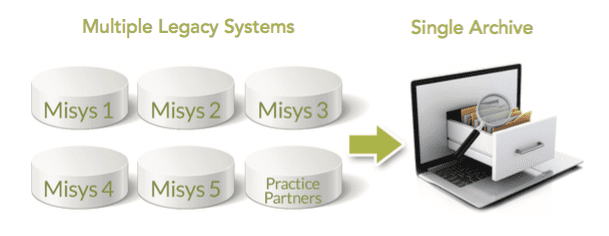
 “The real win is our physicians and their office staff are pleased with the archive. The entire archiving process was convenient and easy. We provided the Harmony Healthcare IT team with access to our legacy systems and they did all the heavy lifting. Testing and validation went smoothly and any minor issues identified were quickly resolved. This solution positions us well for future growth as more practices join the network and we standardize on a go forward EHR system.” – Barry Sheppard, Sr. Dir. IS at Torrance Health Association




 “We are already seeing HIM professionals leading the industry in achieving data integrity through information governance and ensuring patients and consumers have access to timely information they can trust,” said American Health Information Management Association (AHIMA) CEO, Lynne Thomas Gordon in a recent press release. “This year’s HIP Week theme reflects our commitment to our vision of a world where the right information is available to the right person at the right time—for better care.”