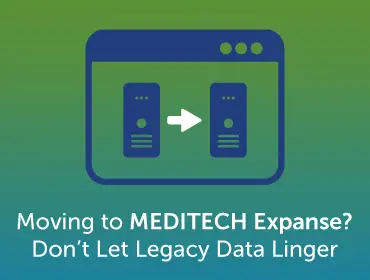
Transitioning to MEDITECH Expanse is a major milestone for healthcare organizations. It represents continued progress toward an optimized EHR environment, but it also raises an important question: what happens to the data in legacy MEDITECH systems once Expanse goes live?
Too often, that question is answered by simply leaving the old system running in the background. While this approach may seem convenient at first, it introduces unnecessary cost, operational complexity, and long‑term risk.
Why Keeping Legacy EHRs Alive Is More Costly Than It Appears
Running a legacy MEDITECH platform, whether Magic, Client/Server, or M‑AT/6.x, alongside MEDITECH Expanse essentially means supporting two EHR environments indefinitely. Even when a system is no longer actively used for care delivery, the expenses don’t stop. Software licensing, servers, hardware upkeep, and dedicated IT resources all remain part of the budget.
Over time, usage declines while costs remain. Staff access historical records through outdated interfaces and separate logins. Training becomes increasingly difficult as fewer team members are familiar with the system. Critical institutional knowledge fades, and the organization becomes dependent on a shrinking pool of expertise.
Legacy systems also pose a significant security and compliance concern. Older systems may lack compatibility with modern security frameworks, fail to meet evolving regulatory requirements, or no longer receive updates and patches. These gaps can expose organizations to unnecessary risk, including data breaches and compliance penalties.
Managing Legacy Data Without Legacy Systems
A dedicated archive provides a more sustainable and strategic alternative to keeping legacy MEDITECH systems up and running. With a strong archiving approach, organizations can:
- Retire legacy MEDITECH systems and eliminate ongoing licensing and infrastructure costs.
- Simplify access to historical data through modern interfaces and Single Sign‑On (SSO).
- Strengthen compliance and audit readiness with role‑based access and detailed logging
- Reduce risk by removing outdated systems from the operational environment
In many cases, the financial benefits alone justify the transition, often leading to ROI within months, and 2-3X ROI over time.
Why the Expanse Transition is the Ideal Time to Archive
Organizations that are moving to MEDITECH Expanse are uniquely positioned to address legacy data in a thoughtful, planned way. The transition creates a natural inflection point: workflows are changing, infrastructure is being reassessed, and long‑term technology strategies are already under discussion. Addressing archiving at this stage avoids rushed decisions later, especially those driven by unexpected system failures, compliance pressures, or security events.
Harmony Healthcare IT’s Approach to Archiving Legacy MEDITECH Data
Harmony Healthcare IT enables healthcare organizations to decommission legacy EHRs while preserving secure, long-term access to historical patient data. HealthData Archiver® supports enterprise-scale security, compliance, and usability.
As part of the MEDITECH archiving process, Blue Elm, a Harmony Healthcare IT company, provides deep MEDITECH data extraction expertise. With a team comprised entirely of former MEDITECH professionals, Blue Elm understands the proprietary structures of legacy MEDITECH platforms at a level no vendors can match. That insight drives more efficient extractions.
Contact us to learn more about how Harmony Healthcare IT can support your MEDITECH archiving needs.