Healthcare organizations invest significant time and resources into EHR migrations and system modernization initiatives. Yet even the most carefully planned project can encounter serious challenges if data is not properly validated before, during, and after conversion. That’s why health data conversion validation is one of the most important components of a successful EHR migration.
When a data conversion takes place (defined as an initiative in which data is moved from one system to another and transformed from one format to another), healthcare organizations need confidence that the information is mapped properly for the new system.
A thorough data conversion validation process helps ensure users can trust the converted data on day one, reducing risk and supporting a successful go-live. Just as importantly, effective validation relies on a structured, repeatable methodology that identifies issues early, accelerates resolution, and helps organizations maintain confidence throughout the implementation process.
What’s at Stake When Health Data Conversion Validation Goes Wrong?
Data conversion issues can create significant operational, clinical, and financial disruptions. Missing patient demographics, incorrectly mapped allergies, incomplete medication histories, and inaccessible historical records can negatively impact workflows and user confidence. Even seemingly small conversion errors can lead to reporting inaccuracies, billing issues, compliance concerns, and increased support requirements after go-live.
In many cases, conversion problems are not caused by the migration itself. Instead, organizations encounter challenges because issues were not identified through effective data conversion validation testing before deployment.
Without clearly defined validation workflows, issue tracking processes, and stakeholder review cycles, organizations often discover data quality concerns after go-live, when remediation becomes far more complex and costly.
What Is Health Data Conversion Validation?
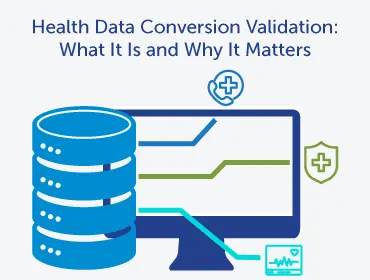
Health data conversion validation is the process of verifying that data converted from one system has been accurately transferred, transformed, and populated within a new application. This could include EHRs, ERPs, document management systems, and archiving solutions.
A successful conversion does more than transfer information. It ensures clinicians, HIM professionals, revenue cycle teams, and other stakeholders can trust the converted data and use it effectively within their day-to-day workflows.
Achieving that level of confidence typically requires a combination of automated validation, structured review processes, and collaboration between technical teams and business stakeholders.
Best Practices for Health Data Conversion Validation
Organizations that consistently achieve successful conversion outcomes typically follow a repeatable validation methodology. While every project is different, several best practices can significantly improve accuracy and reduce implementation risk. These include:
- Automated quality assurance (AQA testing)
- Side-by-side validation
- Data-rich test plans
- Integrated validation workflows
- A structured issue management and resolution process
Who Needs to Be Involved?
The best data conversion validation best practices involve a multidisciplinary team made up of clinical leaders, HIM professionals, revenue cycle teams, IT teams, and project leaders. Organizations often achieve the best results when these stakeholders follow a shared validation framework that clearly defines responsibilities, review timelines, escalation procedures, and approval requirements.
An experienced, trusted conversion partner can provide proven methodologies, validation tools, and industry expertise that help accelerate review cycles and improve accuracy. Partners with dedicated healthcare data conversion teams, platform-specific expertise, and established validation processes can often help organizations reduce risk while maintaining project timelines.
How Harmony Healthcare IT Can Help
As a leading healthcare data management partner, Harmony Healthcare IT helps organizations manage the full data conversion process, from extraction and transformation to migration, validation, and archiving. Our proven methodologies, healthcare-specific expertise, and technology-enabled workflows help reduce risk, improve data quality, and support successful transitions between EHRs, enterprise applications, and other healthcare systems.
With experience supporting hundreds of healthcare data projects across a wide 715+ applications, we help organizations navigate complex conversions with greater confidence, predictability, and transparency. Contact us to learn more.