To explore the realities behind electronic medical record access and its impact, we surveyed 1,001 Americans and 61 healthcare IT professionals about their experiences. The statistics reveal a disconnect while both groups agree that effective data management is essential to quality care, IT teams are far more confident in clinicians’ ability to access records than patients report experiencing at the point of care.
Key insights include:
- 97% of patients think it’s important that providers have access to their full medical history during treatment, and 90% of healthcare IT workers agree that data management impacts quality of care delivered to patients
- 1 in 5 patients reported experiencing long wait times due to record access, while 85% of IT professionals say historical data access only occasionally or rarely delays clinical decisions
- Only 37% of patients are very confident clinicians can access their records from the past 3 years, yet 66% of IT professionals rate clinical staff’s access to historic data as “good” or “very good”
- 46% of patients have had to fill out the same medical history forms multiple times, and 38% of IT workers cite fragmentation across platforms as their biggest frustration
97% of Patients Value Provider Access to Complete Medical History
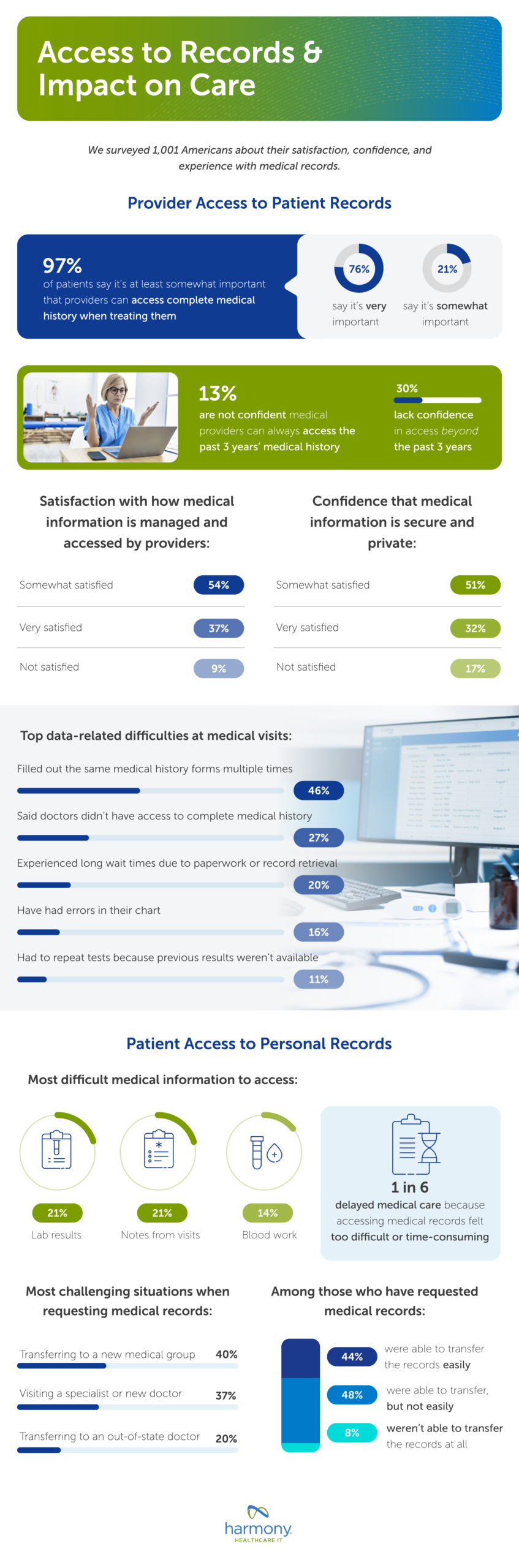
Our consumer survey points to a clear connection between access to complete medical records and perceived quality of care. An overwhelming 97% of patients consider it important that providers can access their full medical history during treatment, with 76% calling it “very important” and an additional 21% describing it as “somewhat important.”
Most Patients Are Only Somewhat Satisfied with How Medical Data Is Managed
When it comes to satisfaction with how medical information is managed and accessed by their providers, over a third (37%) claim to be very satisfied, 54% are somewhat satisfied, and 9% report dissatisfaction. Two underlying factors can explain why full satisfaction is out of reach for many patients.
Confidence in Electronic Medical Record Accessibility
First is patients’ confidence in their providers’ ability to access information. Over 1 in 10 (13%) are not confident medical providers can always access their medical history in the past 3 years. However, their confidence drops for even older records: 30% are not confident in access to medical records beyond 3 years.
Trust in Data Privacy and Security
Data privacy and security can also impact patients’ medical record satisfaction. Nearly one-third of patients (32%) feel very confident their medical information is secure, while just over half (51%) are only somewhat confident. The remaining 17% report little to no confidence in the privacy and security of their data.
Over 1 in 10 Patients Had to Repeat Tests Due to Missing Results
Gaps in record accessibility have consequences, with issues ranging from repeating tests to filling out repeated forms and experiencing long wait times.
The top data-related difficulties at medical visits include:
- Filling out the same medical history forms multiple times – 46%
- Doctors not having access to complete medical history – 27%
- Experiencing long wait times due to paperwork or record retrieval – 20%
- Having errors in medical charts – 16%
- Having to repeat tests because previous results were not available – 11%
1 in 6 Delayed Medical Care Due to Difficulty Accessing Medical Records
Patients need access to their medical records for a variety of reasons, such as checking on results, transferring to new offices, and fulfilling insurance requirements. However, it can be extremely difficult to access this data. Roughly 1 in 6 (17%) even delayed medical care because accessing medical records felt too difficult or time-consuming. According to the survey, the most difficult medical information to access includes lab results (21%), notes from visits (21%), and blood work (14%).
Of those who have requested medical records, 40% experienced challenges when transferring to a new medical group, 37% had difficulties when visiting a specialist or new doctor, and 20% had issues when transferring to an out-of-state doctor. Less than half (44%) were able to transfer their records easily, while 48% were able to transfer with difficulty, and 8% weren’t able to transfer the records at all.
The consumer findings underscore the need for hospitals and health systems to implement strong health data management practices, particularly for legacy data archiving and historical records access. Modern archiving solutions – such as those offered by Harmony Healthcare IT — should offer advanced capabilities including Single Sign-On (SSO) from the electronic medical record (EMR), Legacy Record Indicator in the electronic medical record, and Secure Record Delivery.
SSO enables clinicians to access archived patient records directly from the EMR without additional logins. Legacy Record Indicator allows clinicians to immediately determine whether a patient has historical records stored in the archive. Secure Record Delivery ensures the seamless and secure transmission of an archived patient chart to a designated EMR endpoint—supporting continuity of care while maintaining compliance and security.
90% of Healthcare IT Workers Believe Data Management Impacts Quality of Care
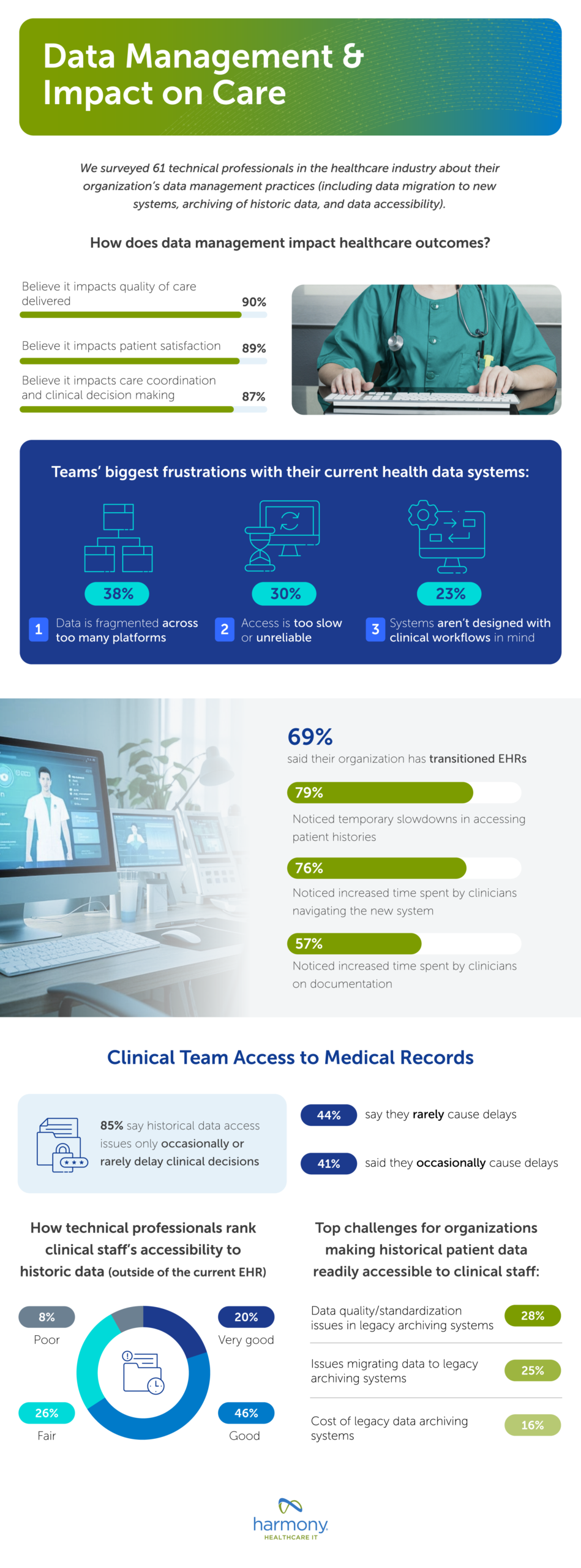
Our parallel survey of 61 healthcare IT employees found that most feel strongly about the impact of their work, matching patient sentiment. Almost all (90%) believe data management impacts quality of care delivered to patients, 89% believe it impacts patient satisfaction, and 87% believe it impacts care coordination and clinical decision making.
Perceived Impact of Data Accessibility, Migration, and Archiving Challenges
When asked specifically about negative impacts on patient care, patient satisfaction, and clinical decisions, data migration emerges as the area of greatest concern; it was listed as having the strongest potential to negatively impact patient care (75%) and care coordination (71%). These findings emphasize why, during an EHR migration, selecting a seasoned partner is critical. Organizations should select a provider with proven best practices to prioritize security and compliance while minimizing risk of outages and loss of patient data.
Data accessibility challenges:
- 64% believe it could negatively impact patient care
- 69% believe it could negatively impact patient satisfaction
- 62% believe it could negatively impact care coordination
Data migration challenges:
- 75% believe it could negatively impact patient care
- 66% believe it could negatively impact patient satisfaction
- 71% believe it could negatively impact care coordination
Data archiving challenges:
- 62% believe it could negatively impact patient care
- 56% believe it could negatively impact patient satisfaction
- 54% believe it could negatively impact care coordination
While migrations carry inherent risks, legacy EHR systems can present their own set of challenges. The biggest frustrations IT teams face with their current health data systems include fragmentation across platforms (38%), slow and unreliable access (30%), and systems that aren’t designed with clinical workflows in mind (23%).
Among respondents, 69% said their organization has transitioned to a new EHR. Nearly 4 in 5 (79%) noticed temporary slowdowns in accessing patient histories. An additional 76% noticed increased time spent by clinicians navigating the new EHR system, and 57% noticed they spent longer than usual on documentation.
Clinical Team Access to Medical Records
One area where our patient and healthcare IT survey results contrast is the clinical team’s access to medical records. While 85% of healthcare IT employees said historical data access only occasionally or rarely delays clinical decisions, 1 in 5 consumers reported experiencing long wait times due to record access.
Additionally, while only 37% of patients were “very confident” in clinicians’ access to their medical records in the past 3 years, 66% of healthcare IT professionals ranked clinical staff’s accessibility to historic data as “good” (46%) to “very good” (20%), with only 26% ranking it as fair and 8% as poor.
The top challenges in making historical patient data readily accessible to clinical staff include:
- Data quality/standardization issues in legacy archiving systems – 28%
- Issues migrating data to legacy archiving systems – 25%
- Cost of legacy data archiving systems – 16%
Bridging Expectations and Reality in Healthcare Data Access
While nearly all patients value complete access to their medical history, issues like fragmented systems, limited confidence in data accessibility, and migration-related disruptions can create friction across the care journey. These challenges don’t just affect satisfaction — they have tangible consequences, from delayed care to redundant testing and inefficiencies that burden both patients and providers.
As healthcare organizations work to modernize their data infrastructure, experienced partners can help reduce the complexity and risk often associated with EHR migrations and legacy data management. With deep expertise across hundreds of platforms and large-scale transitions, Harmony Healthcare IT supports organizations in maintaining access to critical patient information while minimizing disruption.
Methodology
In February 2026, we surveyed 1,001 Americans about their satisfaction, confidence, and experience with medical records. Ages ranged from 18 to 79 with an average age of 41.
In February 2026, we also surveyed 61 healthcare IT workers about data management. Ages ranged from 20 to 63 with an average age of 35.
For media inquiries, please contact media@digitalthirdcoast.net.
Fair Use
When using this data and research, please attribute by linking to this study and citing harmonyhit.com.