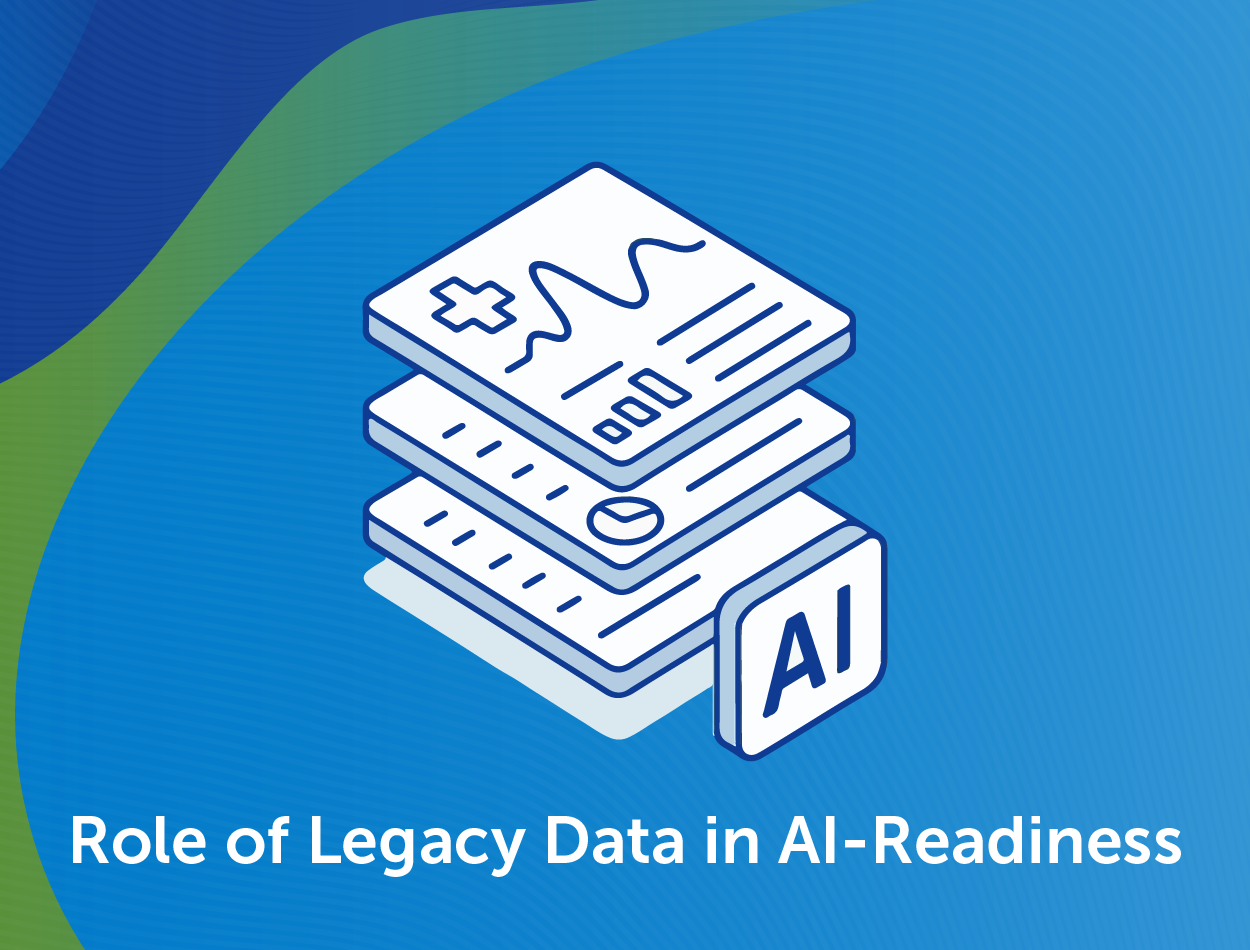
When healthcare organizations discuss AI readiness, the conversation often revolves around new technologies, such as modern EHRs, cloud platforms, and advanced analytics solutions. Yet one of the most valuable resources for fueling successful AI initiatives may already exist within your organization: legacy data.
During a recent webinar hosted by Harmony Healthcare IT, Benjamin Cassity, Director of Research & Strategy at KLAS Research; Bill Russell, Founder and CEO of This Week Health and The 229 Project; and Jim Hammer, PMP, FACHDM, Chief Operating Officer of Harmony Healthcare IT, discussed why legacy data has a bigger role in AI strategy than many organizations initially realize.
The Value of the Longitudinal Record
Legacy data represents institutional knowledge accumulated over years of operations, care delivery, financial management, and workflow execution. As AI initiatives mature, every panelist agreed that this historical information becomes increasingly valuable.
“For heavy-duty use cases around AI, you want the longitudinal record,” said Hammer. “Legacy data should absolutely be at the table when exploring AI.”
Cassity agreed, noting that legacy data is often where the most complete patient story resides. “My advice is stop treating archiving as a compliance checkbox and start treating it as a strategic lever with technology partners in the space.”
Beyond Clinical Use Cases
Although longitudinal clinical data is a significant asset for AI initiatives, Russell, who previously served as CIO of St. Joseph Health, noted that some of the most immediate opportunities may exist outside direct patient care.
Legacy records contain years of operational knowledge, including information about scheduling, claims processing, revenue cycle management, and countless other workflows. Those records provide a unique opportunity to understand not only what happened, but also how work was performed and what outcomes resulted. According to Russell, that historical context can be extremely valuable when developing, evaluating, and optimizing AI-driven processes.
Legacy data can also play an important role in training, testing, and validating AI solutions before broader deployment. Organizations can use historical records to evaluate how AI models would have performed against real-world scenarios, identify potential gaps, and refine workflows before putting them into production, he said.
Top Considerations for Legacy Data and AI
As organizations evaluate their own AI readiness strategies, the panelists emphasized that simply possessing legacy data is not enough. The data must be accessible, governed, and organized in ways that allow it to support current and future AI initiatives. Here are three ways to position your organization for success:
1. Make Legacy Data Part of AI Planning Discussions
Both Cassity and Russell encouraged organizations to think differently about archived information. Rather than viewing legacy data as historical baggage or a compliance requirement, healthcare leaders should recognize its strategic value in AI planning.
This can help organizations make more informed decisions about how they develop and deploy AI capabilities moving forward.
2. Understand and Enhance Your Legacy Data Landscape
Many healthcare organizations have valuable information dispersed across retired EHRs, departmental applications, and other legacy systems, said Hammer. Begin by inventorying those data sources and understanding how they fit into the broader data strategy.
As part of that effort, organizations should consider consolidating legacy information into a secure, centralized archive. Doing so can help improve accessibility, reduce fragmentation, support governance efforts, and ensure valuable historical data remains available for future analytics and AI use cases.
3. Use Archiving and Migration Projects to Improve Data Quality
Retiring a legacy application is more than a technical exercise. It can also serve as a valuable opportunity to validate records, address inconsistencies, strengthen governance practices, and improve overall data quality, said Hammer.
He recommended viewing migration and archiving initiatives as opportunities to improve the reliability and usability of the information that may eventually support AI applications (and partnering with a health data management partner that can help support those goals).
The ‘Bowl of Vegetables’ Analogy
While these recommendations may seem straightforward, obtaining the organizational attention and resources needed to execute them can be surprisingly difficult. AI pilots and emerging technologies often generate excitement, while the foundational work required to prepare data for those initiatives receives far less attention, said Cassity.
“The blind spot I see for a lot of organizations is treating archiving like a bowl of vegetables,” he said. “I have two children, and nothing brings more frustration into our home than setting down a nice bowl of freshly steamed broccoli at the dinner table. I can tell them a thousand times how good it is for them, and we still have to fight them to eat those vegetables because, at the end of the day, all they want is dessert.”
In other words, AI may be the dessert, but data archiving is often the vegetables.
The challenge for healthcare leaders is recognizing that archiving and AI strategy are not separate conversations. Organizations that can successfully access, govern, and leverage their historical information may be better positioned to realize the full value of AI. Those that overlook legacy data, meanwhile, risk building sophisticated AI capabilities on an incomplete foundation.
This is the second article in a series drawn from a recent Harmony Healthcare IT webinar on AI-data readiness. Read the other articles here:
Industry Perspective: AI Prioritization in 2027
The industry’s focus on AI continues to accelerate. The 229 Project’s “Signal Index Spring 2026 Report,” based on a survey of 146 healthcare IT leaders, found that AI emerged as the most-cited strategic bet among survey respondents. Nearly 30% identified it as their organization’s biggest bet over the next 12 months. No other category came close, with vendor consolidation ranking second at 16% and EHR optimization third at 11%.