Summary

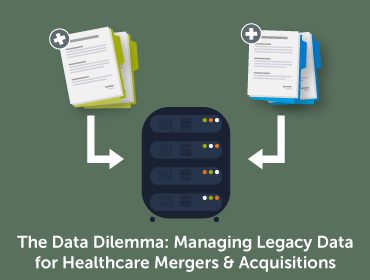
The dynamic merger and acquisition (M&A) landscape in healthcare is moving quickly with the pace expected to pick up more steam if the Federal Reserve cuts interest rates. As provider organizations of all sizes explore M&A activity, one key consideration is how to modernize the information systems and use the right infrastructure, applications and legacy data management solutions to deliver on the interoperability demands of today and tomorrow.

Join Fellow Healthcare IT Pros

Tips, Guides, News & More

Sign Me Up
Mergers & Acquisitions need to prioritize legacy data

The days of healthcare mega mergers and acquisitions (M&A), those with annual revenues north of $1 billion, have returned. There also is a trend toward integrated multi-state health system mergers and an uptick in community health systems merging with larger partners to combat ongoing financial pressures. Regardless of the size or scope of the merger or acquisition, one constant is the need to have a solid legacy data management strategy as the application portfolio expands.

Legacy data includes patient records, finance records, personnel records, company data, and more that are stored in an electronic health record (EHR), electronic medical record (EMR), enterprise resource planning (ERP) or practice management (PM) systems. The number of systems in use within an organization varies, but larger hospitals and health systems average 18 different EHR vendors. When there is a merger or acquisition, numerous redundant systems can create an unruly IT footprint that is difficult to manage.

When there is talk of M&A, there needs to be a thorough plan to inventory, review and determine an action plan for all the technology, applications, and legacy data involved.

What steps are necessary to effectively manage legacy data during a merger or acquisition?

The challenges of managing data during a merger multiply almost faster than the data itself. And, that is pretty fast considering health data triples every three years. Below are five important steps toward a solid legacy data plan when the organization is amid M&A activity.

  1. Create a legacy data strategy. It is important to take a big picture view of the entirety of the software and applications from each organization. Involve the Data Governance team to provide oversight and set direction. Consider including a vendor with application rationalization expertise to help guide the implementation of the organization’s strategy about what data will be retained, and when applications can be decommissioned with the data migrated to an archive.
  2. Document what you have. Take inventory of all the applications each acquired hospital or clinic uses. This is more than just a list, modern data management must follow the HIPAA Security Crosswalk to NIST that states: managing assets enables “the organization to achieve business purposes that are identified and managed consistent with their relative importance to business objectives and the organization’s risk strategy.”
  3. Plan for application rationalization. Make sure there is early consideration to rationalizing applications according to the organization’s overall plan. Use a consistent strategy, budget for this project, and include a cross-departmental governance team from the beginning.
  4. Review the options for legacy data. The primary options for legacy data that can support regulations include converting legacy data to the new EHR or migrating legacy data to an active archive. Consider the legacy data strategy with data governance to support the organization’s overall data management goals.
  5. Engage an active archive. As applications are determined to not “make the cut” to move forward, the legacy data will likely need to be retained to meet regulatory and clinical retention timelines. An active archive with discrete and non-discrete data and intuitive user workflows will also allow for efficient record access and release.

The benefits of a streamlined application portfolio achieved through legacy data archiving:

Achieve a faster return on investment (ROI). By migrating legacy data from disparate systems to active archive, like HealthData Archiver®, there is a reduction in hard costs such as application maintenance, support, server/hardware costs as well as soft costs for IT overhead/support, IT labor to maintain legacy systems and workflow time savings for clinical and HIM users. With cost reduction as a leading concern for CIOs surveyed about the factors driving legacy data management decisions, 55 percent reported cost as a significant or very significant pain point.

Support data compliance and reduce legal risk. Record retention requirements can span 25+ years, which makes an active archive like HealthData Archiver® a viable solution. Legal and compliance teams can retain records for the duration of the retention period with an efficient, secure and cost-effective way to store records in a HIPAA-compliant format. It also allows for accessibility to meet requirements around the release of information.

Improve interoperability to help with data sharing and accessibility. Consolidating legacy data to a central archive is a pivotal step to support interoperability of records between providers, specialists, payers, patients and other users. Beyond the archive’s primary role, advanced features such as Single-Sign On from the active EHR, break-the-glass functionality of role-based access, purge functionality, and Secure Record Delivery deliver innovative capabilities that supports a seamless flow of patient, business and financial data.

Our team helps organizations work through M&A legacy data plans.

At Harmony Healthcare IT, we perform data extraction from legacy systems, complete the clinical data migration and store it in a relational database and make it accessible in an easy-to-use, browser-based viewer for years to come. If your healthcare organization has or will go through a merger or acquisition, check out our HealthData Platform to learn about cloud-hosted long-term storage of PHI for both ambulatory and acute care systems as well as HR, GL and accounting data.

M&A Legacy Data Success Case Study: How an integrated healthcare system delivered $2+ million in data consolidation savings during a merger and acquisition.

Ready to connect?

We’re here.

Healthcare IT tips, guides, news & more delivered to your inbox

Learn More

Summary

When an EHR platform like Healthland Classic is sunset, healthcare organizations select and move forward with a new EHR. Ideally, that new EHR will be integrated with an active archive solution – like HealthData Archiver® – to provide seamless access to legacy data that didn’t get converted to the new EHR yet must be accessible to comply with regulatory requirements.

Join Fellow Healthcare IT Pros

Tips, Guides, News & More

Sign Me Up
EHR sunset

After acquiring fellow EHR vendor Healthland Holdings in 2016, Computer Programs and Systems, Inc. (CPSI) later announced, in 2017, its intent to sunset the Healthland Classic EHR in 2019.  In the years following, provider organizations transitioned to new EHRs, however, not all of them took immediate action to archive the legacy data stored in Healthland Classic. Harmony Healthcare IT, a data management firm specializing in legacy record storage, has migrated and archived data from Healthland Classic for providers nationwide to ensure access to patient, employee, and business records for decades to come.

Just like an EHR automates workflows, supports better outcomes and can improve patient and provider satisfaction, so too can an active archive like HealthData Archiver® offered by Harmony Healthcare IT.  HealthData Archiver® securely delivers these same results.

The case study below describes how one regional health center replaced Healthland Classic with Epic, and archived the legacy records with HealthData Archiver®.

Case Study: Glencoe

As you strategize around your data management plan and determine how to most efficiently decommission Healthland Classic or another sunsetting EHR, keep in mind that the legacy data management must be addressed. Leaving an old system up and running as read-only can be a security risk that leaves your protected health information (PHI) vulnerable and open to data breach. With healthcare leading the world as the number one most attacked industry, it is critical to safely and securely manage legacy data with an archive. Add in the Cures Act requirements for consumer access to historical records, and an archive is a must-have for any healthcare organization.

Our team is ranked number one as the top Data Archiving, Data Extraction and Migration company according to Black Book Rankings, a division of Black Book Market Research. We’ve earned this ranking three years in a row. It underscores our commitment to keeping patient, employee, and business records accessible, usable, interoperable, secure, and compliant.

We’re ready to connect and talk through your organization’s specific needs, challenges and next steps.

Healthcare IT tips, guides, news & more delivered to your inbox

Learn More

Summary

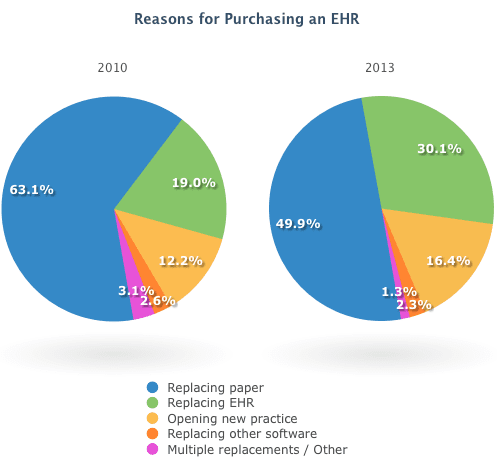
The study reveals that physicians are increasingly adopting or using EHRs, with five main reasons being replacing existing EHR software, opening a new practice, replacing paper records, replacing other software, or combining the above. The percentage of physicians transitioning from paper records dropped significantly from 2010 to 2013, while the share of practices replacing existing EHR systems grew by nearly 50%. Vendor dissatisfaction increases, and cost and customer service concerns also rise. The study highlights the importance of a rigorous process for software selection and implementation, as doctors are increasingly adopting or using EHRs.

Join Fellow Healthcare IT Pros

Tips, Guides, News & More

Sign Me Up

Software Advice, a trusted resource for medical software buyers, recently published results of a long-term study following demand drivers among prospective buyers of electronic health records (EHR) software. (more…)

Healthcare IT tips, guides, news & more delivered to your inbox

Learn More

Summary

KLAS rated Medical Informatics Engineering as top SaaS-based EMR provider with 83.8 points for advanced solutions.

Join Fellow Healthcare IT Pros

Tips, Guides, News & More

Sign Me Up

Medical Informatics Engineering (MIE), a business partner of Harmony Healthcare IT’s, was recently rated by KLAS as one of the nation’s top SaaS-based EMR providers in the healthcare IT industry. (more…)

Healthcare IT tips, guides, news & more delivered to your inbox

Learn More

Summary

Harmony Healthcare IT hosts monthly webinars on EHR for Medical Managers, focusing on incentives and web-based solutions.

Join Fellow Healthcare IT Pros

Tips, Guides, News & More

Sign Me Up

Each month, Harmony Healthcare IT, a provider of technology support to medical practices, offers a variety of content-rich webinars.  On Tues., 4/10/12 at 11am EST, be sure to attend the “EHR for The Medical Manager(r)” webinar to be held for 30-minutes plus Q&A. (more…)

Healthcare IT tips, guides, news & more delivered to your inbox

Learn More

Summary

Join Harmony Healthcare IT for a webinar on implementing an electronic health record solution for Medical Manager practice management software. The session covers Centers for Medicare & Medicaid EHR Incentive Programs and a web-based EHR solution.

Join Fellow Healthcare IT Pros

Tips, Guides, News & More

Sign Me Up

Looking for an electronic health record solution that will allow you to KEEP your Medical Manager practice management software?  Look no further.  Join Harmony Healthcare IT for a webinar on Thur., 2/16/12 at 11am EST for a 30-min. overview on how to achieve EHR meaningful use using The Medical Manager software. (more…)

Healthcare IT tips, guides, news & more delivered to your inbox

Learn More

Summary

MIE utilizes WebChart EHR for remote medical data collection and synchronization in Middle East field physicals, enhancing patient care.

Join Fellow Healthcare IT Pros

Tips, Guides, News & More

Sign Me Up

Harmony Healthcare IT corporate partner Medical Informatics Engineering (MIE), based in Fort Wayne, IN, recently announced that The George Washington University Medical Faculty Associates (GW-MFA) is utilizing its WebChart EHR to collect, track and manage medical information gathered from field physicals in the Middle East. (more…)

Healthcare IT tips, guides, news & more delivered to your inbox

Learn More

Summary

Medical practices face deadlines to convert to ICD-10, Sage Medical Manager upgrade or replacement options discussed.

Join Fellow Healthcare IT Pros

Tips, Guides, News & More

Sign Me Up

Achieving meaningful use of an electronic health record (EHR) is not the only deadline facing medical practices.  By federal mandate, in January of 2012, practices must process claims in the new 5010 format, (more…)

Healthcare IT tips, guides, news & more delivered to your inbox

Learn More

Summary

The Centers for Medicare and Medicaid Services has released new frequently asked questions about the electronic health records meaningful use incentive program.  The questions cover providing patients with an electronic copy of health information and counting patients not seen by the eligible provider.

Join Fellow Healthcare IT Pros

Tips, Guides, News & More

Sign Me Up

The Centers for Medicare and Medicaid Services has released new frequently asked questions about the electronic health records meaningful use incentive program.  The questions cover providing patients with an electronic copy of health information and counting patients not seen by the eligible provider. (more…)

Healthcare IT tips, guides, news & more delivered to your inbox

Learn More

Summary

MIE, a leading electronic health record vendor, has successfully deployed EHRs and patient engagement technology for 15 years. With 55% of Indiana physicians using MIE systems, WebChartNow offers cost-effective, easy-to-implement, and meaningful incentives.

Join Fellow Healthcare IT Pros

Tips, Guides, News & More

Sign Me Up

Hundreds of electronic health record vendors are marketing their products to physicians. How do you sort through the noise surrounding meaningful use incentives, conversion costs and the benefits for the practice to determine the solutions best for your environment? (more…)

Healthcare IT tips, guides, news & more delivered to your inbox

Learn More